Per WhichMailer, Starter runs $15 to $79 a month, Plus $49 to $145, and Pro $79 to $205, all billed annually and measured from 1,000 to 5,000 contacts. A growing business will see its monthly bill rise substantially without tier changes. Across that span, the chart shows how far each plan climbs. The point to take from it is that **growing the list fivefold costs more** than stepping up a tier. viz type=range title="What each ActiveCampaign plan costs as the list grows" unit="$ per month" source="Real Cost Labs - https://realcostlabs.com/activecampaign-pricing/"5 to $79 a month, Plus from $49 to ### Solo newsletter sender at 1,000 contacts At 1,000 contacts on Starter, a solo sender pays $15 a month, which is $180 a year, an amount most freelancers can expense without a second thought. That's the figure the headline price points to, and it's honest for this reader: one list, regular broadcasts, little else. Moving the same list to Plus costs $49, so the automation upgrade is $34 a month more, or $408 a year. If the sends are newsletters, that $34 buys features you won't use. At this size the sensible reading is that ActiveCampaign is a pricey newsletter tool. The premium only pays back once contacts trigger automations instead of just receiving broadcasts. ### Five-person team at 5,000 contacts On Plus at 5,000 contacts, a five-person team running automations pays $145 a month, or $1,740 a year. Starter at that list size is $79, so the team pays $66 a month more, about $792 a year, for the tier that carries the automation work. Step up to Pro at 5,000 contacts and the price is $205, which is $60 a month above Plus, or $720 a year. The team should buy Pro only if it can name the specific Pro feature it will use in the first quarter. That $720 is a standing charge whether or not anyone opens the feature. ### Where the plan you need is not the plan you priced When someone quotes you the Starter price, remember it's the plan a team doing automation is least likely to be on. Starter's growth is steep on its own: from $15 to $79 is a 5.3-fold rise for a 5-fold list, so cost tracks contacts almost one for one. Over the same span, Plus and Pro rise more slowly, about 3-fold, because the entry fee already covers part of the work. In dollars, the premium over Starter rises. It goes from $34 at 1,000 contacts to $66 at 5,000, and it falls in proportion, from 227% to 84%. As you accumulate contacts, the case for staying on Starter grows weaker. Price the plan for the automation you'll run, then let the contact count scale it. ## Hidden costs and limits raising the bill You will not find three things in the list price. They are how your contacts are counted, which features sit behind higher tiers, and the add-ons and seats that cost extra on top of the plan. ### How contacts are counted and billed **ActiveCampaign meters stored contacts, not emails sent.** A list you rarely mail still costs as much as one you mail daily. If duplicates, old leads or people who unsubscribed are sitting in the account, the vendor's documentation is where you confirm which of them count toward your band. Until you delete or merge them, you may be paying for contacts who will never receive an automation. When you cross a contact band, the whole plan reprices, not just the extra contacts. The bill therefore moves in jumps, and a list that grows slowly can still produce a surprise on one renewal. ### ActiveCampaign features locked to higher plans Expect the automation-action cap to bite first. The entry tier is built for newsletters with light automation, and it limits how many actions you can run. Once your workflows branch, score leads, or hand off to sales, you're shopping on the higher tiers. Those tiers carry the features that justify the product, such as deeper automation, a fuller CRM, and more reporting. Downgrading reverses this. If you drop a tier, anything built on a gated feature may stop working or become read-only. So if you build workflows on a higher plan to test them, price the move back down before you commit. ### ActiveCampaign add-ons, extra users and seat limits On top of the plan, ActiveCampaign bills several things separately: - Extra users beyond the seats your tier includes - SMS credits - The CRM pipeline add-on - Custom reporting Each is small beside the plan, and each has its own unit: per seat, per message credit, or flat monthly. A team of several people running SMS, a sales pipeline, and custom dashboards pays for four lines, not one. Before you buy, list the people who need logins, the channels you'll use, and the reports you'll ask for. Add those lines to the plan price at your current contact count, and you'll have the bill you can expect. ## The strongest case that ActiveCampaign is overpriced For any team whose real workload is newsletters and a few simple triggered emails, ActiveCampaign is overpriced. Rivals sell that for less once you count the contacts you're billed on. ### Why a cheaper ActiveCampaign alternative looks better It all turns on the unit being metered. Most email platforms bill by contacts stored, and ActiveCampaign does too, so the plan price you see climbs as your list grows whether or not you send more. Say a rival charges the same way but starts lower. If it also bundles a welcome series, a basic abandoned-cart flow and a signup form, it has covered most of what a small list needs. If you send one broadcast a week, you're paying for branching logic you never open. That's the best version of the argument, and it holds for a real group of buyers: publishers, creators and shops whose revenue comes from the broadcast, not the sequence. ### Price side by side at the same list size I have no confirmed figures from each vendor's pricing page for this integration, so the table below compares the dimensions without prices. Check the 5,000-contact line on each live page before you commit, because that's the row where plans diverge. | Platform | Entry price | Monthly price at 5,000 contacts | Automation depth | Built-in CRM | |---|---|---|---|---| | ActiveCampaign Plus | Check live page | Check live page | Deep: branching, scoring, multi-step goals | Yes | | Kit | Check live page | Check live page | Visual sequences, simpler branching | No | | A general email rival | Check live page | Check live page | Basic triggers and flows | Varies by plan | As the table shows, the gap is not one price against another. It's a gap in what each plan lets an automation do, and whether customer records live inside the tool. Sticker prices alone don't tell you which tool is cheaper for your job. ### Why ActiveCampaign pricing suits automation-led teams On one condition the objection wins: your automations are linear, with a trigger, a delay and an email. Then the extra tier buys nothing. It fails once a sale depends on behavior. If a contact's score, a page visit or a deal stage should decide the next message, a cheaper rival forces you to bolt on a separate CRM and a connector. You pay for that second tool plus the time to keep the two in sync. Real and recurring: the second tool costs money every month. Count it against the rival's lower plan price and the cheaper option often stops being cheaper. ## Connecting ActiveCampaign to other apps with Activepieces When the reason for an upgrade is only moving data between ActiveCampaign and your form, CRM or billing tools, Activepieces, whose core is MIT-licensed and which lists **744 integrations in its open source** monorepo, can sometimes remove it. It doesn't send email for you. Its unit is the flow: a trigger in one app, then steps that act in another. Say the tier you were about to buy was chosen to get a form submission or a paid invoice into ActiveCampaign as a contact with the right tag. That's the job a flow does. ### When a workflow tool replaces an upgrade Price the upgrade against the job it's meant to do. Say the gap between your current plan and the next one is there because you need contacts created from a form. Or you need a deal stage copied from a CRM (the system where your sales team tracks leads), or a "paid" tag applied after a billing tool records a payment. A flow can do that on the plan you already have. You pay for the upgrade only if the thing you're buying is ActiveCampaign's own automation builder, not the plumbing around it. Keep the shape simple: the form, the CRM and the billing tool each trigger their own flow in Activepieces, three flows that fit inside the unlimited flows the $0 Free plan allows, and each flow hands ActiveCampaign one thing, a contact with a tag. 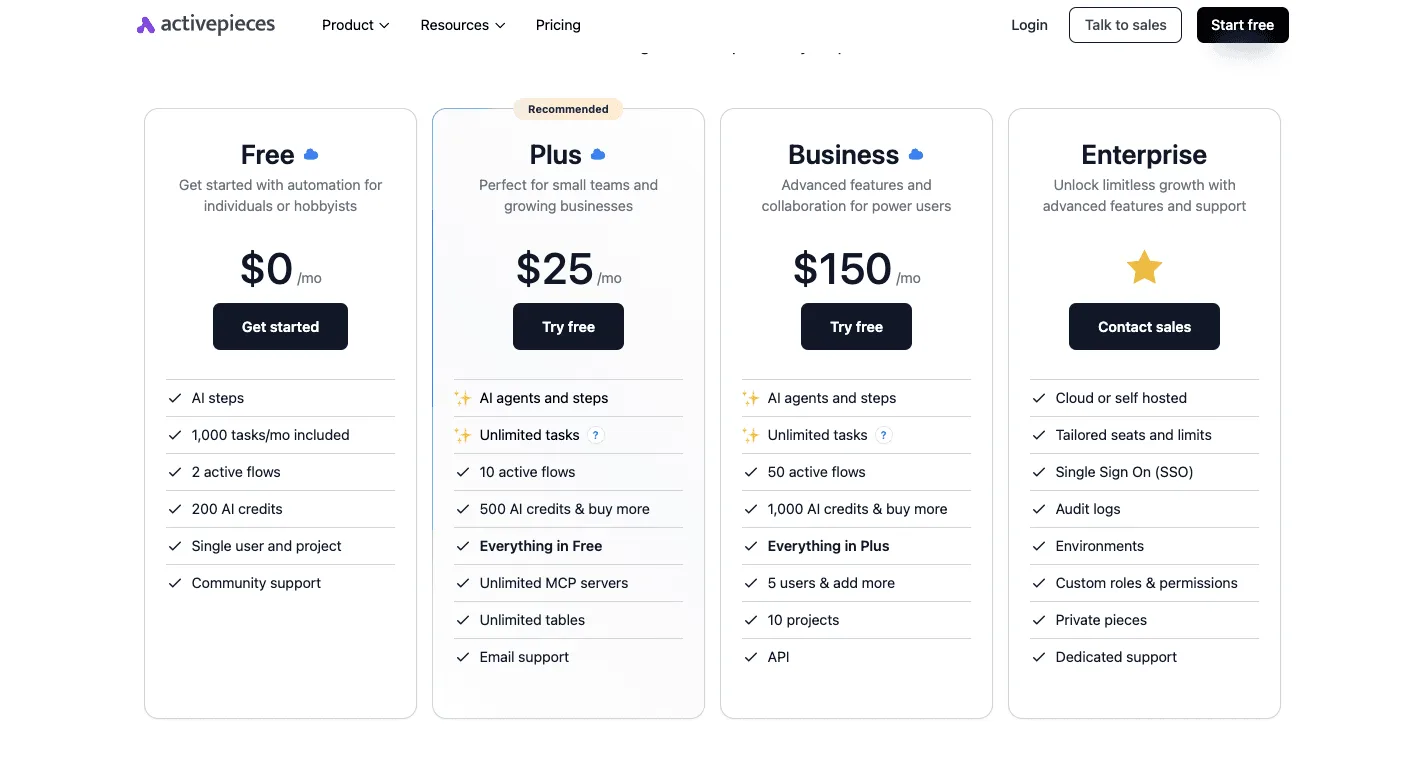 From there, the automations you have already built take over. Below, the illustration shows that path: form, CRM and billing tools each feed Activepieces, which passes a single "contact + tag" to ActiveCampaign, where its own email engine sits. The takeaway is that three different sources end in the same one-record hand-off, and the sending stays inside ActiveCampaign. Check one thing before you count the saving. Every run costs 1 credit on the Activepieces side, and the free plan includes 1,000 credits a month, so a high-volume form can move the cost from one invoice to another instead of removing it.  Run the arithmetic on your own submission volume before you commit. ### What it does not replace Don't expect Activepieces to replace ActiveCampaign's email engine; it moves records to where campaigns, segments and open tracking live. Because the meter is the run, at 1 credit each, the form-to-tag job can be split into validate, dedupe, tag and notify without the bill noticing. Zapier's pricing page counts tasks and Make's counts modules, so on both the careful version of that same flow costs more than the sloppy one. That sets a clear limit on the saving. If you're upgrading because you want behaviour-based automations that react to what a subscriber did inside your emails, a connector can't supply that, because the data lives in the engine it feeds. It also adds a second system to maintain. When a flow breaks, contacts stop arriving or tags go missing, and the symptom shows up in ActiveCampaign, where you may not think to look first. Treat the connector as a way to avoid paying for integration capacity, not as a way to leave ActiveCampaign while keeping what it does. ## Planning your ActiveCampaign account before purchase If the connector only saves you integration capacity, the Monday job is to price the account you'd actually run. Count billable contacts, name the automations you need, and buy the lowest plan that includes them. The order matters, because each step feeds the next: 1. Clean the list and count the contacts you'd be billed for. 2. Write down every automation you need. 3. Pick the lowest plan that contains all of them. 4. Compare the annual and monthly price for that plan at your contact count. 5. Trial with a real list, not sample data. 6. Set an alert for the contact count where your tier changes. Three of these steps are where people lose money, so they get detail below. ### Clean your contact list before counting contacts You are metered on the contact, not the email sent. Keep every address and you raise the tier you're placed in, so a list full of bounced, long-dormant or duplicate records is a bill you're choosing to pay. Remove those first, then count what remains. That number, not your export total, is what you take to the pricing page. If the cleaned count lands just above a tier boundary, a second pass is worth more than any discount. ### Match automations to a plan Write each automation as a trigger and an outcome, such as "tag a lead after a pricing-page visit, then start a follow-up sequence." Then check each one against the plan's feature list, starting with the cheapest plan. Because the plan you need is set by the most demanding automation on your list, one requirement can push the whole account up a tier. If a single workflow forces that jump, ask whether it earns its cost or can be simplified. If the answer is that you need several such workflows, you're the buyer this product is built for. ### Set an alert for your next pricing tier You will not make any decision when the increase arrives, because billing follows list growth. Find the contact count where your next tier begins, then set a reminder in your own calendar or reporting for when you approach it. That gives you time to prune the list or accept the new price deliberately, rather than discovering it on an invoice. ## Frequently asked questions ### Does ActiveCampaign have a free plan? No permanent free plan is the safe assumption: ActiveCampaign sells paid tiers and lets you try them through a free trial. Though a trial tests the automation builder, it doesn't show your real bill, because that depends on the contact count you bring and the tier you pick afterwards. Import your actual list during the trial so the price you see is the price you'll pay. ### Can I downgrade or cancel ActiveCampaign mid-year? You can usually cancel or move down, but what you recover depends on how you pay. A monthly subscription lets you change at the next renewal. With an annual subscription you prepay, so a mid-year downgrade generally means you have already paid for the higher tier until the term ends. Read the refund and renewal terms in your account before committing to a year. ### Is ActiveCampaign cheaper if I pay annually? Yes, the annual rate is lower per month than paying monthly, but the saving only holds if your tier and list size stay put. If your list grows past a contact band partway through, you move into a higher price bracket while still locked into the plan you prepaid. If you're unsure which tier you need, pay monthly for the first few cycles, then switch to annual once the numbers settle. ### Does ActiveCampaign charge for unsubscribed contacts? They can, which is the quiet way a bill drifts upward. Pricing is metered on contacts stored, not on people you actually email, so someone who unsubscribed may still count toward your band until you delete the record. Deleting means you lose the history attached to that contact, so export what you need first. Auditing for unsubscribed and bounced records before a renewal is the cheapest saving available. ### Is ActiveCampaign worth it for a small business? It's worth it if you'll build real automations: follow-ups triggered by behaviour, lead scoring, sequences that branch. It's not worth it if you mostly send a newsletter on a schedule, because you'd be paying for a builder you never open. With a modest list and a clear sales or onboarding sequence, a small business gets good value. One that wants a simple broadcast tool will find a cheaper product does the same job. ## Related reading - [How to Choose a ClickUp Pricing Plan in 2026](https://www.activepieces.com/blog/how-to-choose-a-clickup-pricing-plan-in-2026) - [WordPress Pricing 2026: Full Plan Comparison](https://www.activepieces.com/blog/wordpress-pricing-2026-full-plan-comparison) - [ClickFunnels Pricing 2026: Every Plan Compared](https://www.activepieces.com/blog/clickfunnels-pricing-2026-every-plan-compared) ## References - [WhichMailer](https://whichmailer.com/platforms/activecampaign/plans/) - [Real Cost Labs](https://realcostlabs.com/activecampaign-pricing/) - [truesaascost.com](https://truesaascost.com/email-marketing-cost-calculator/)Of everything on the bill, ActiveCampaign's list price is the smallest part.