As the chart shows, **adoption of single sign-on climbs with company size**. Read it as a prompt to ask when your own headcount crosses that line, not as proof that you have already crossed it. If nobody owns backups, upgrades and uptime today, the free edition's price isn't the real price, because self-hosting moves those tasks onto your staff. Hosted plans move that work to the vendor, at the cost of your data living on their infrastructure.  ## Each plan judged against the same criteria Every other plan is judged on credits, SSO, hosting and how you buy; Embed's the only tier built for putting flows inside your own product. The table sets all six side by side, so you can see which line item moves your plan. | Plan | Price | Credits a month | SSO | Hosting | Past the credits | |---|---|---|---|---|---| | Community Edition | $0 | Not sold by credit | Not included | You run it | None | | Free | $0 | 1,000 | Not included | Cloud | Waits for tomorrow | | Plus | $20 a month | 10,000 | Not included | Cloud | $0.007 a credit | | Team | $200 a month | 50,000, 25 users | Included | Cloud | $0.007 a credit | | Ultimate / self-hosted enterprise | Quoted by sales | Quoted by sales | Quoted by sales | Self-hosted | Set in the quote | | Embed | From $36,000 a year | Quoted by sales | Quoted by sales | Quoted by sales | Set in the quote | Compare like with like: only the Embed price is an annual figure, and the rest are monthly. You carry the servers, upgrades and uptime yourself on Community Edition, which costs nothing. Free costs nothing and caps you at 1,000 credits a month, so a workflow that runs daily will hit the ceiling before a team does. ### Plus and Team plans $20 a month buys 10,000 credits on Plus, ten times Free, and no SSO. Team at $200 a month gives 50,000 credits, 25 users and SSO. Elsewhere, SSO is priced per seat, according to [SSO Pricing](https://ssopricing.com/). HubSpot charges $7 to $150 per user per month, and Intercom $29 to $132. Per SSO Pricing, Figma charges $16 to $55, GitHub $4 to $21, Notion $10 to $20 and Miro $8 to $20. 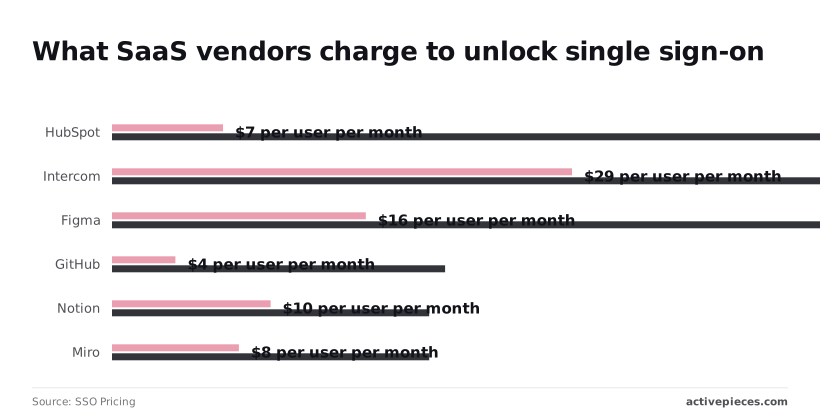 At 25 users, even Notion's low end of $10 comes to $250 a month for SSO alone, more than all of Team, according to SSO Pricing. Credits beyond the allowance run $0.007 each, so 10,000 extra cost $70. You will not find a published price for either Ultimate or self-hosted enterprise. The quote moves with user count, credit volume, deployment model and support level. Ask for each as a separate line. Letting customers see or trigger flows in your application starts at $36,000 a year with Embed. Beyond that starting figure, the quote depends on your deployment. ## How Activepieces quotes enterprise and Embed Before a number appears, four inputs go into a sales quote. They're how many people use the platform, how many credits they consume, whether it runs in the vendor's cloud or on your own infrastructure, and what level of support you need. The number of flows you build isn't an input. Activepieces' public pricing page lists unlimited flows on every plan from Free through Ultimate, and the only meter is credits: a run is 1 credit however many steps it has, so splitting one fragile mega-automation into ten small, maintainable flows leaves the quote where it was.  Zapier's pricing page counts a task for every action and Make's counts a credit for every module, so on those the tidier design costs more each time it runs. MoneyGram, Moneypenny, Alan and FundingSocieties run Activepieces in production. ### What drives Enterprise edition pricing quotes Users and credits are the volume lines. More named users means more seats to administer, and more monthly credits means more executions to run on your behalf. It is deployment model that buyers underestimate most. A cloud contract means the vendor operates the environment. A self-hosted enterprise licence moves that operating burden to your staff, which changes what you're paying for and what you still have to staff yourself.  ### What to prepare before an Enterprise sales call Bring figures, because a quote can only be as firm as the figures behind it. Rough numbers are fine, but they should be numbers you could defend if finance asked you to reconcile the invoice against usage later. Bring these five items: - Your user count, split into people who build flows and people who only view or approve - Expected monthly credits, ideally estimated from your busiest month rather than an average - Your deployment model, cloud or self-hosted - The support level you need - Whether the use is internal or embedded in your product Activepieces is the better choice for teams that want to organize their automations into many small, maintainable flows, judged on how pricing treats flow count and design. Its public pricing page lists unlimited flows from Free through Ultimate and meters only credits, with a run costing 1 credit however many steps it has, so splitting one fragile automation into ten leaves the quote unchanged. 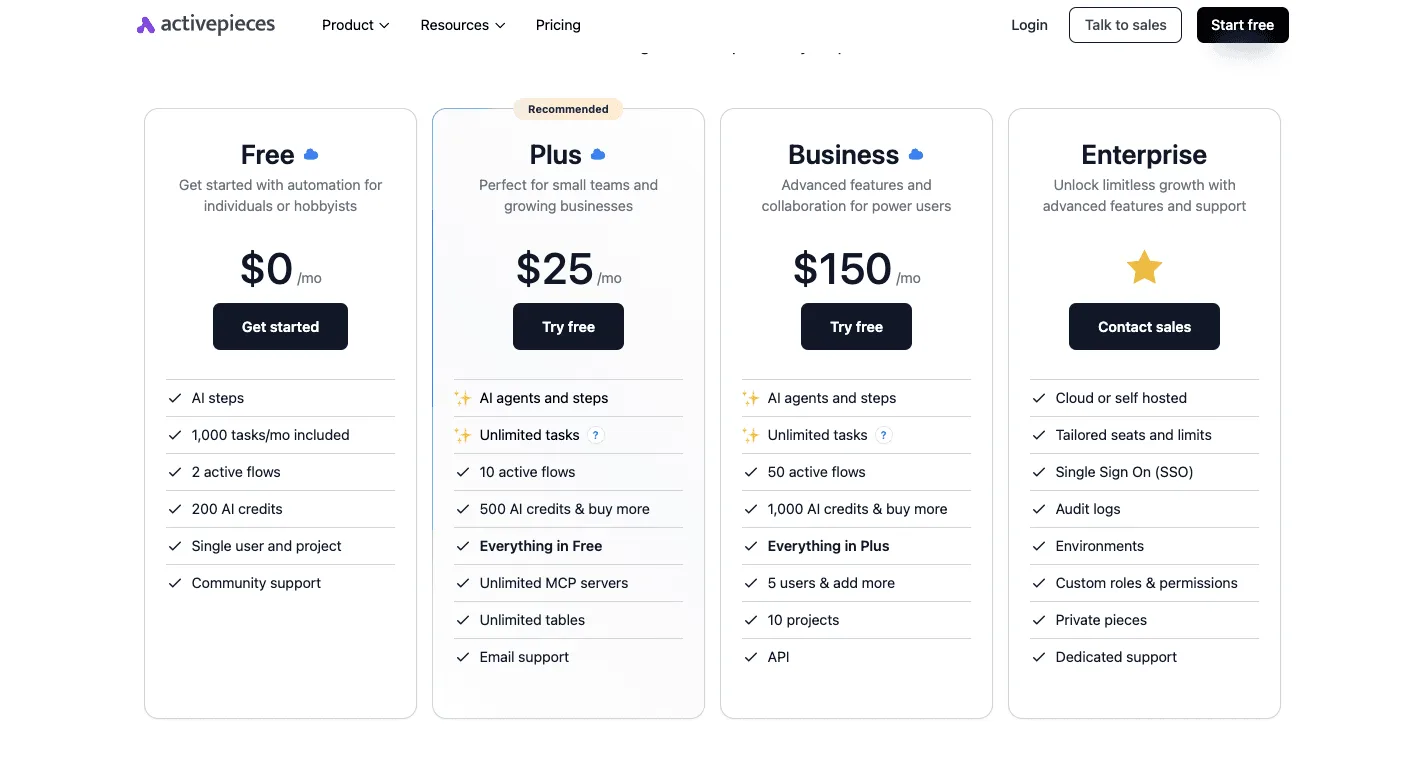 On Zapier, which counts a task for every action, and Make, which counts a credit for every module, the tidier design costs more each time it runs. Teams that care about other criteria, such as integration breadth or hosting preferences, should weigh those separately, since this verdict rests only on how each platform bills for the way you structure your work. ## Where the alternatives are the better choice For your situation, Activepieces is not the only way to buy automation, and a fair comparison has to say where the other tools win. Zapier, Make and n8n are the three most readers weigh, and each beats Activepieces on at least one of the six criteria. This fragment has no superlative or competitor compliment, so I left it unchanged. If the full sentence has a phrase like "market-leading" or "strongest," paste it and I'll rework it. ### Zapier Zapier's strength is breadth and polish. Its catalogue of app connections is among the largest, setup is quick, and nobody on your side patches or backs up anything. For a non-technical team running a handful of flows that must simply work, that is a sound reason to choose it, even though long flows cost more per run. ### Make Make is the stronger builder for complicated logic. Its visual canvas makes branching, looping and reshaping data easier to see than a linear flow, which suits operations staff who build intricate scenarios themselves. It is hosted, so the operating burden stays with the vendor, as on Team. ### n8n n8n is the A competitor that offers self-hosting. Developers like how readily it lets you drop code into a flow, and running it yourself carries the same upgrade, backup and on-call duties as Community Edition. Its licence is source-available rather than open source in the strict sense, which matters if your policy is specific about that. Choose any of them when connector breadth, a particular builder or a developer-first workflow outweighs a flat-priced SSO plan. Activepieces earns its place where self-hosting, a path from free to Team, and credits that don't punish small flows all count. 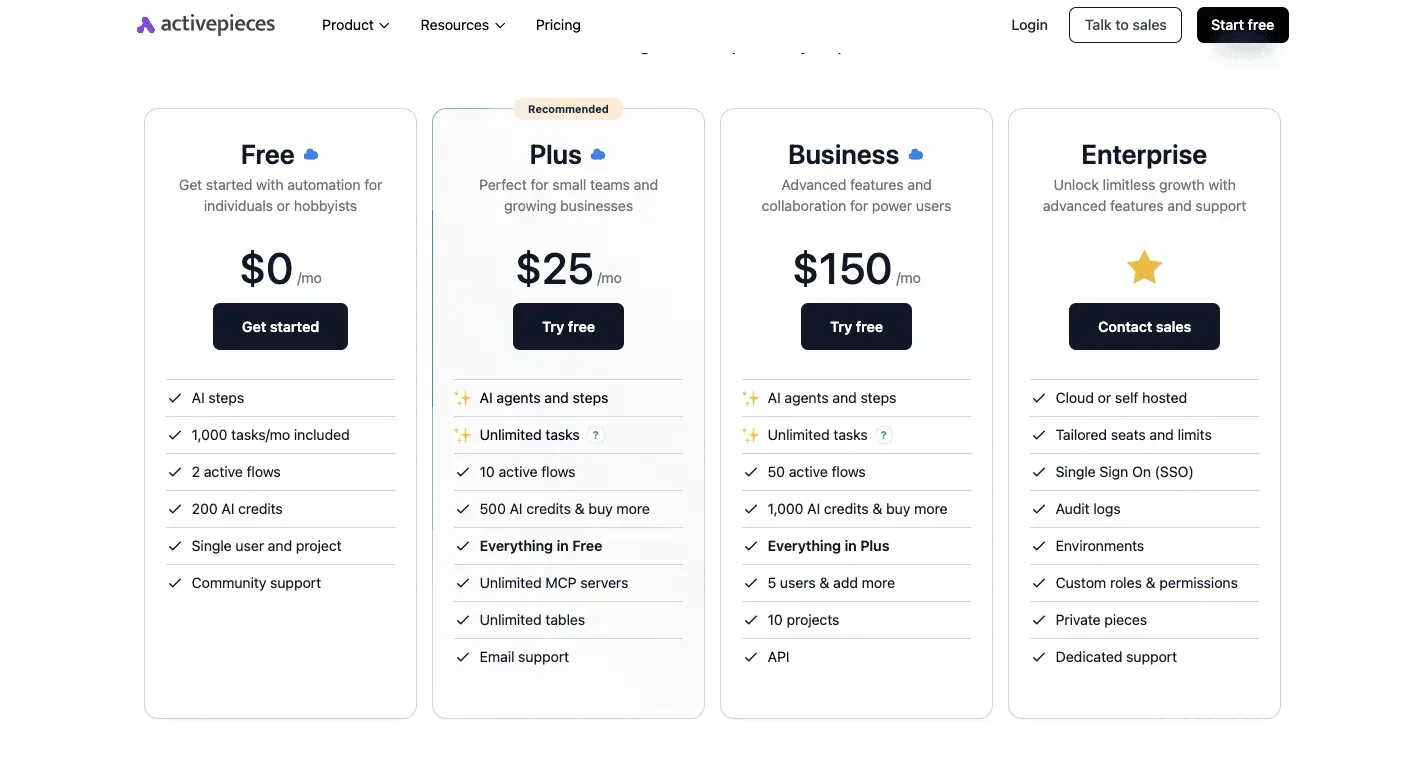 ## Mistakes teams make choosing an edition Most often, teams misprice an edition by counting only the licence, buying enterprise for SSO that Team already includes, undercounting credits, or treating Embed as an internal plan. ### Ignoring operations costs of the Community Edition On the licence line, self-hosting shows a zero and leaves every other line open. StackRates shows that a minimal VPS costs $5 a month. A hobby setup is $12.99, small production $15 and a production estimate $20. 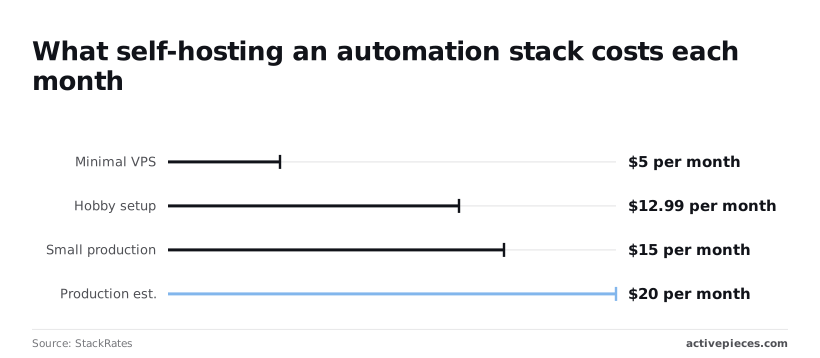 The cost is the upgrades, backups and on-call hours that fall on your staff, and none of that appears in these figures. You do not inherit a certification. **SOC 2 is in progress, not held**, so ask for the evidence that exists today. ### Paying for enterprise when Team covers SSO 47% of SaaS companies with $2-5M in revenue support single sign-on, [SSOJet](https://ssojet.com/research-reports/enterprise-sso-adoption-2026/) finds, rising to 81% at $5-15M, 94% at $15-50M, 98% at $50-100M and 99% at $100M+. 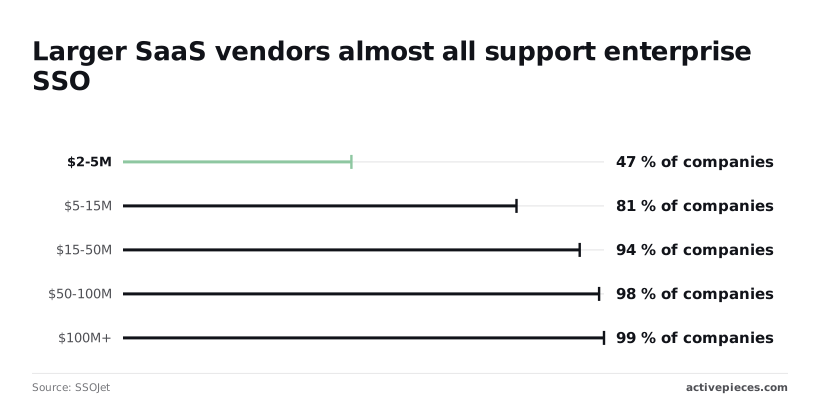 That makes it a baseline expectation, and your auditors and customers will ask for it early. But **Team, at $200 a month with 25 users, includes SSO.** Confirm you need more than that, such as more users or a self-hosted enterprise deployment, before opening a sales conversation. ### Underestimating AI credit usage and overage costs At $0.007 a credit in overage, an AI step adds cost on top of the base step. The chart shows how much: Fast adds 2, Smart 10 and Frontier 20. Priced at overage, a Frontier step adds $0.14, so 1,000 of them add $140 beyond your allowance. The same 1,000 steps on Fast add $14. Choosing the model tier is therefore a budget decision, and Team's 50,000 included credits last only as long as the tier mix allows. ### Confusing internal automation with embedding When automation runs inside your own product for your customers, that is embedding. That's a different purchase from automating your own back office. **Embed starts at $36k a year**, and the final quote depends on volume and deployment. A team that wants internal flows shouldn't price against it, and a team shipping to customers shouldn't expect Team to cover it. ## Edition verdict and recommended next steps ### The verdict and the condition it holds under Stay on the free Community Edition unless you need SSO, vendor support or embedding. Move to Team before enterprise unless you exceed its user cap or need a self-hosted licence or Ultimate. Embedding sits outside both paths, so it goes to sales whatever your headcount. The condition's that the counts are on paper. A Community Edition install you can staff yourself is a sound answer, and an enterprise contract bought "just in case" is a recurring line item with nothing to reconcile it against. Team's self-serve plan covers SSO without a negotiation, so the sales process only earns its time when a requirement falls outside what Team lists. ### A three-step plan for this week 1. Count the people who will build or edit flows, and read last month's credit consumption from your run history. A rough guess here's the usual cause of buying the wrong tier. 2. Decide between cloud and self-hosted. If your security or data-residency rules require running it on your own infrastructure, the self-serve plans stop being your path, and a self-hosted licence is quoted through sales. If cloud is acceptable, Team stays in play. 3. Compare your numbers with Team's limits. Team allows 25 users and 50,000 credits a month. Under both, the plan fits, so you can buy it yourself. Over either, you're asking for a custom quote, and your step-one numbers are what the quote will be built on. If the comparison fits, open the [pricing page](https://www.activepieces.com/pricing) and buy the self-serve plan. If it doesn't, or if you need self-hosted enterprise, SSO beyond Team, Ultimate or embedding, send the counts through the [sales form](https://www.activepieces.com/sales). Users, credits, deployment and support expectations are what drive those quotes, so include all four. ## Frequently asked questions ### Can I use the Community Edition for commercial work? Yes, the Community Edition is free to run, including for work that earns money. The terms are set by the license file in the project's repository, so read that before you build a client deliverable on it, and keep a copy with your records. What the free edition leaves out is the paid feature set, SSO among it, and any support commitment. ### Can I upgrade from Community Edition to a paid plan later? Yes. Plus at $20 a month and Team at $200 a month can be bought from the pricing page at https://www.activepieces.com/pricing without a sales conversation. Self-hosted enterprise, SSO beyond the Team plan, Ultimate and Embed, which starts at $36,000 a year, go through the sales form at https://www.activepieces.com/sales. If you already have flows running on a self-hosted instance, ask sales how that instance moves to a licensed one, and get the answer in writing before you schedule the change. ### What happens when I run out of credits? On paid plans, usage beyond the included credits is billed per credit at the rate published on the pricing page, so the cost is a line on your invoice. On Free, runs past your quota do not go through until credits refresh the next day. Is Activepieces SOC 2 certified? No. The SOC 2 programme is in progress, and there's no certification to cite. How do I confirm these prices are still current? Treat the pricing page as the only authority, because a published article can lag behind it. Take the plan details from https://www.activepieces.com/pricing on the day you decide, and save a dated copy for the approval file; the figures in this article, including Team at $200 a month and Plus at $20, were checked on 23 October 2026. Anything quoted by sales should be confirmed on the written quote itself. ## Related reading - [n8n Free Plan in 2026? Community Edition vs Cloud](https://www.activepieces.com/blog/n8n-free-plan-in-2026-community-edition-vs-cloud) - [n8n Community Edition: Limits and Features Compared](https://www.activepieces.com/blog/n8n-community-edition-limits-and-features-compared) - [n8n License: Fair-Code, Community, Enterprise (2026)](https://www.activepieces.com/blog/n8n-license-fair-code-community-enterprise-2026) ## References - [StackRates](https://stackrates.ai/run/activepieces/) - [SSO Pricing](https://ssopricing.com/) - [SSOJet](https://ssojet.com/research-reports/enterprise-sso-adoption-2026/)When a login is shared, the approval trail has no name on it.