# Activepieces Credits: Pricing and Usage (2026 Guide)
By Femi Adegoke · 2026-10-23 · Source: https://www.activepieces.com/blog/activepieces-credits-pricing-and-usage-2026-guide
---
Past your allowance, **each credit costs $0.007**, because [Activepieces](https://www.activepieces.com/pricing) meters usage in credits. Free's $0 with 1,000 credits a month, Plus is $20 with 10,000, and Team's $200 with 50,000, so you're forced to upgrade once you exceed the free tier.

Activepieces credits are the usage units the automation platform meters and bills against, with each plan including a monthly allowance and any credits used beyond it charged at $0.007 apiece.
Team also includes 25 users and SSO, which means you can't build a team on Free or Plus. Sales quotes Ultimate and self-hosted enterprise, and Embed starts at $36k a year, so these options exist only through direct negotiation.
Climb the tiers and included credits get cheaper per unit, but **overage's dearer than either paid tier's rate**. The table shows the self-serve tiers.
## Activepieces credits and what they cost today
| Plan | Monthly price | Credits included | Notes |
|---|---|---|---|
| Free | $0 | 1,000 | Testing a flow |
| Plus | $20 | 10,000 | $0.002 per included credit |
| Team | $200 | 50,000 | 25 users and SSO; $0.004 per included credit |
| Overage | n/a | n/a | $0.007 per credit |
| Pricing page checked | 23 October 2026 | n/a | Confirm before budgeting |
Because overage costs 3.5 times Plus's included rate, **a team regularly spilling past 10,000 credits should price the next tier up rather than pay overage.**
### What a credit measures
On top of a plain flow run, AI steps are billed in credits. Per [Activepieces community](https://community.activepieces.com/t/concern-question-about-ai-credit-consumption/12370), a fast-model step uses 2 credits, a smart-model step 10, and a frontier-model step 20.
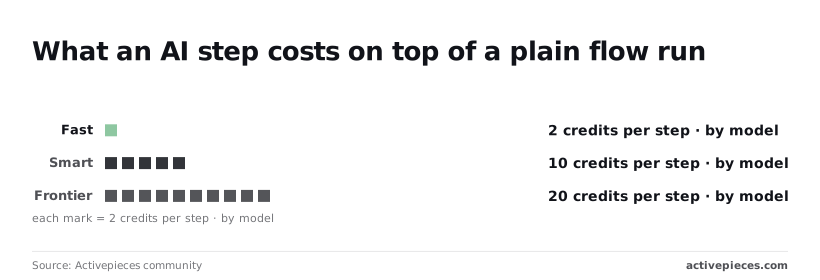
Pick the model and you have picked the bill: 1,000 fast steps use 2,000 credits, leaving you locked into a 2-credit-per-step cost. **1,000 frontier steps use 20,000**, double the whole Plus allowance, so you can't run even one frontier batch job on Plus.

At overage rates, that frontier step costs $0.14 against $0.014 for a fast one, **making frontier a 10-fold financial penalty** if you exceed your quota.
### Where these figures come from and when they were checked
I took the plan prices and allowances from the Activepieces pricing page, last checked on 23 October 2026. The per-step credit costs come from the community thread linked above, so treat them as a guide and confirm them against your own usage.
Plans can change, and sales-quoted tiers have no public number to check.
## Every Activepieces plan compared in one table
Compare any two plans and they differ on five things: credit allowance, user count, SSO, where it runs and how you buy it. Sales quotes the tiers that cost the most, and publishes no price for them.
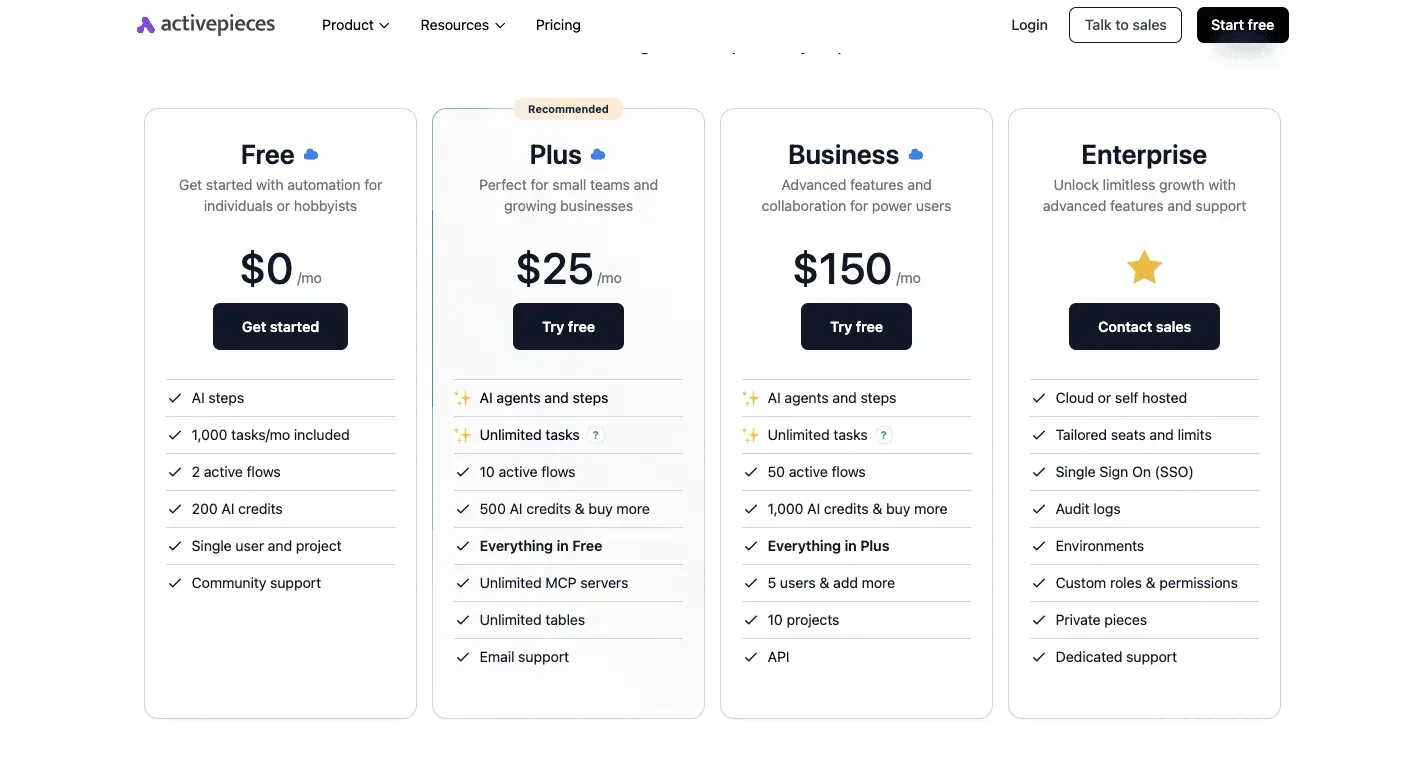
| Plan | Price | Monthly credits | Users | SSO | Deployment | How bought |
|---|---|---|---|---|---|---|
| Free | No charge | Smallest allowance | Fewest seats | Not included | Cloud, or self-hosted Community Edition | Self-serve |
| Plus | Fixed monthly fee | Larger allowance, pay per credit above it | More than Free | Not included | Cloud | Self-serve |
| Team | Higher fixed monthly fee | Largest self-serve allowance, pay per credit above it | Capped seat count | Included | Cloud | Self-serve |
| Ultimate | Quoted by sales | Quoted by sales | Quoted by sales | Quoted by sales | Quoted by sales | Sales form |
| Self-hosted enterprise | Quoted by sales | Quoted by sales | Quoted by sales | Quoted by sales | Your own infrastructure | Sales form |
| Embed | Quoted by sales | Quoted by sales | Quoted by sales | Quoted by sales | Quoted by sales | Sales form |
You can calculate your bill on Free, Plus and Team, which each have a monthly price and a per-credit rate. You can't calculate the last three from a page.
Free, Plus and Team are bought by card, and each differs in the credits it includes and the seats it allows. Team's the first tier with SSO, so a business that needs single sign-on for staff can stop there.

If one technical team runs its own instance and nobody needs SSO, the free [Community](https://community.activepieces.com/t/concern-question-about-ai-credit-consumption/12370) Edition's enough.
### Plans quoted by sales
I won't guess a price for Ultimate, self-hosted enterprise or Embed, because none is published. The quote moves with four inputs: how many users, how many credits, where it's deployed, and how much support you want.
For self-serve plans, use the [pricing page](https://www.activepieces.com/pricing). For self-hosted enterprise, SSO beyond Team, Ultimate or Embed, use the [sales form](https://www.activepieces.com/sales).
## What the plans cost at realistic monthly usage
At 5,000 and 30,000 credits a month, Plus is cheapest; at 100,000, Team is. Credits are the metered unit, and overage's $0.007 each on paid plans, so 10,000 extra credits cost $70.
Check in the docs how many credits one run of your flow uses before you map these figures to your own volume.
The cheapest plan changes once, somewhere between 30,000 and 100,000 credits.
### A solo user or small team at 5,000 credits
At 5,000 credits, [the pricing page](https://www.activepieces.com/pricing) works out to $20 for Plus and $200 for Team.
Free can't cover that volume: once its 1,000 credits are used, runs wait until the credits refresh the next day, whereas Plus's $20 flat fee covers all 5,000 within its 10,000 allowance.
At ten times the price of Plus, Team is worth paying for only if you need what it adds, such as 25 users and SSO.
### A department at 30,000 to 100,000 credits
At 30,000 credits the figures are $160 for Plus and $200 for Team, so staying on Free isn't an option.
Against Team, Plus saves you $40, but Team's flat price is almost level with Free's overage bill, so the upgrade from Free to Team costs little.
At 100,000 credits they become $693, $650 and $550. Team's now $100 cheaper than Plus. It's $143 cheaper than Free, because its 50,000-credit allowance covers half the volume.
Whenever the extra credits cost less than the price gap, overage beats the next plan up. Plus to Team's a $180 gap, which is about 25,700 extra credits at $0.007.
Because Plus covers 10,000 credits, Team pays off past roughly 35,700 monthly credits, if you don't need its users or SSO for other reasons.
## Spotting hidden costs and team limits
Watch for five limits that cost more than extra credits. The first two are the users and SSO that decide whether Team's $200 a month is enough:
- Team's 25-user cap
- Which tier carries SSO
- Whether unused credits roll over
- What level of support is included
- Engineering time to run a self-hosted install
### User and SSO ceilings
With 25 users and SSO included, Team can't hold a 40-person company building flows. Past 25 seats, or if you need SSO beyond what Team offers, you move to a sales quote, priced on users, credits, deployment and support.
Ask for rollover and support terms in writing during that quote, because they aren't part of the self-serve price either. **SOC 2's in progress, not certified**, so a procurement team that demands a report can't be satisfied today.
### Self-hosting: Community Edition versus a paid licence
When one technical team runs its own flows, needs no SSO and has someone to patch the server, the free Community Edition's enough.
A paid self-hosted licence is quoted by sales, and the quote buys the whole product rather than a trimmed build: SSO, SCIM, custom RBAC, audit logs, release management and secret managers work in the air-gapped edition as they do on the managed cloud.
Regulated and public-sector organisations run that edition in production, and MoneyGram, Moneypenny, Alan and FundingSocieties run Activepieces too. What never appears on the invoice is the hour spent on upgrades and incidents.
### Overage and budget surprises
Users run out of free credits before the month ends, because AI steps shrink the Free plan's 1,000 monthly credits faster than the headline suggests.

According to [Notelinker](https://www.notelinker.com/activepieces-pricing), a flow with no AI step gets 1,000 runs a month, one with the cheapest AI step gets 333, and one with the priciest gets 47.
That means a flow built around the costliest AI step **exhausts Free in under two working days** of heavy use.
Past the allowance, those 21 credits a run cost about $0.147 at $0.007 a credit, so test your real flow before assuming the per-credit rate makes it cheap.
## How Activepieces pricing compares with Zapier, Make and n8n
These four tools meter different things. Their sticker prices only compare once you cost the same flow on each, which is the test the credit math above already pointed to.
### Billing units aren't interchangeable
What each vendor counts, and whether you can run the software yourself, decides what a ten-step flow costs you per run, and the table shows both.
| Tool | Billing unit | Self-hosting |
|---|---|---|
| Activepieces | Credits | Yes, free Community Edition under the MIT licence |
| Zapier | Tasks | No, cloud only |
| Make | Credits (formerly operations) | No, cloud only |
| n8n | Workflow executions | Yes, under its own licence |
A task, a credit and an execution aren't the same size. If a tool counts each step, a long flow multiplies your bill. If it counts each run, the same flow costs the same however many steps it has.
A task, a credit and an execution aren't the same size.
### Self-hosting and licensing compared across tools
Two of the four let you host. That matters when data must stay inside your network, or when you want to pay for servers rather than per-run metering.
There's a catch: a free self-hosted edition usually leaves out features such as SSO, and those sit behind a paid licence. Check which features your chosen edition actually unlocks before treating self-hosting as free.

### When Zapier, Make or n8n fits better
Zapier suits teams that want the widest app catalogue and no servers to run. Make suits visual, branching flows where you want to see every route on one canvas. n8n suits technical teams comfortable with code nodes and their own infrastructure.
If you want self-hosting with an MIT-licensed core, the Activepieces row is the one to weigh: the Community Edition is free, and the repository carries 744 integrations and 25,179 GitHub stars. Pick on your heaviest flow and your hosting rules, not the headline rate.
## Choosing between self-serve, self-hosted and Embed
For an internal team, Plus or Team fits; a security-driven rollout fits self-hosted enterprise or Ultimate, and automation inside your own product fits Embed.
The table shows which plan matches each need and how you buy it, so you know whether to open a checkout or a sales call.
| Need | Best-fit plan | Why | How bought |
|---|---|---|---|
| Internal team | Plus or Team | Credits are metered and cheap, and Team adds SSO | Self-serve on the pricing page |
| Security-driven rollout | Self-hosted enterprise or Ultimate | Control over where flows run and who signs in | Quoted by sales |
| Embedded automation | Embed, from $36k a year | Automation runs inside your product for your customers | Through sales |
You can read a price without talking to anyone only in the first row. The other two depend on what you tell sales, covered below the table.
### Internal team on self-serve
If your team builds flows for its own use, start with Plus and move to Team when you need SSO or more seats.
For a security or compliance-driven rollout, self-hosted enterprise and Ultimate are priced by sales, so the quote follows your inputs. Bring your user count, expected credit volume, deployment model and support expectations.
Don't assume certifications: Activepieces' SOC 2 programme's in progress, so ask what evidence they can supply today.
For embedding automation in your product, Embed starts at $36k a year, and the final figure depends on the same inputs. Bring your customer count and your heaviest flow's credit use, since that sets your cost per customer.
## What to do this week before you buy
Before you open the sales form, spend the week turning one real workflow into a monthly credit count, because that count tells you whether you need sales at all.
The sequence below shows how a single test run becomes a budget line.
1. Pick one pilot workflow. Choose something you would run in production, not a demo. Include any AI steps, since a step that calls a language model is the likeliest place for credit use to differ from a plain data-moving step.
2. Run it on Free or Plus. Trigger it several times with realistic inputs, including the messy ones. Free's enough if you only want a reading, and Plus gives you more room if the workflow is long.
3. Read credits per run. Take the figure from the usage view, not from a guess. Average it across your runs, and note the highest, since a branch that fires rarely can still dominate a heavy month.
4. Multiply by monthly runs. Use the volume you expect from your real users, not the volume you hope for. Then repeat for each workflow you plan to add. The total's the number you compare against each plan's allowance and the overage rate.
5. Check the pricing page. If the total, your user count and your need for single sign-on fit a self-serve plan, [the pricing page](https://www.activepieces.com/pricing) is where you stop.
6. Use the sales form only if something doesn't fit. For self-hosted enterprise, single sign-on beyond the Team plan, and Ultimate and Embed (which are quoted, not listed), [the sales form](https://www.activepieces.com/sales) is the only route to those numbers. Arrive with your credit estimate, user count and deployment preference, because those drive the quote.
## Frequently asked questions
### Do unused Activepieces credits roll over?
Plan as if they don't: every allowance is quoted per month, so budget each month on its own rather than counting on a balance building up. The pricing page doesn't describe a carry-over, and a reader sizing a plan shouldn't assume one.
If your usage is spiky, ask sales directly before you buy a tier for headroom you may not be able to bank.
### Is the Community Edition free for commercial use?
Yes, the Community Edition's open source under a permissive licence. Running it inside your company or behind a product you sell is allowed, and you pay nothing for the software.
What you give up is the paid layer: the enterprise features, a commercial licence and vendor support. If your rollout needs single sign-on, a support contract or procurement paperwork, the free edition stops being enough and the quote from sales is the real cost.
### Can I pay for credits by the unit without upgrading?
Yes, on a paid plan: credits beyond the monthly allowance are billed per credit, so one heavy month doesn't force you up a tier.
On Free it's different, because there's no paid plan underneath it, so hitting its limit's the signal to move to a paid one.
Compare a month of overage against the next tier's flat price before deciding, since a steady overage means the bigger plan is the cheaper one.
Does Activepieces hold a SOC 2 certification? No. The SOC 2 programme's in progress, so there's no certification to cite in a security review today.
If your procurement process requires one, ask sales for the current status and for whatever security documentation they can supply in the meantime.
## Related reading
- [SAP S/4HANA Purchase Order Workflow for MS Teams](https://www.activepieces.com/blog/sap-s-4hana-purchase-order-workflow-for-ms-teams)
- [Content Creation Workflow: How Successful Teams Do It](https://www.activepieces.com/blog/content-creation-workflow)
- [GitLab Pricing in 2026: What Teams Pay](https://www.activepieces.com/blog/gitlab-pricing-in-2026-what-teams-pay)
## References
- [Notelinker](https://www.notelinker.com/activepieces-pricing)
- [Activepieces](https://www.activepieces.com/pricing)
- [Activepieces community](https://community.activepieces.com/t/concern-question-about-ai-credit-consumption/12370)