When your own team builds and maintains flows, you're comfortable running the server yourself, and nobody needs single sign-on or vendor support, the Community Edition is enough. It stops being enough when security asks for SSO, when you want the vendor on the hook for uptime, or when you embed flows inside your own product. ### Every current plan in one table (checked 23 October 2026) Team is the first tier that includes SSO. | Plan | Price | Included credits | Users | SSO | How bought | |---|---|---|---|---|---| | Free | $0 | 1,000 a month | Not specified | Not specified | Self-serve | | Plus | $20 a month | 10,000 a month | Not specified | Not specified | Self-serve | | Team | $200 a month | 50,000 a month | 25 | Included | Self-serve | | Ultimate | Quoted | Set in the quote | Set in the quote | Scoped in the quote | Sales | | Self-hosted Enterprise | Quoted | Set in the quote | Set in the quote | Scoped in the quote | Sales | | Embed | From $36k a year | Set in the quote | Set in the quote | Scoped in the quote | Sales | Past your included credits, each one costs $0.007. Ten thousand extra credits add $70, so a modest overrun on Team is cheaper than a negotiated contract. Where a cell says "Not specified", confirm it on the pricing page before you budget. 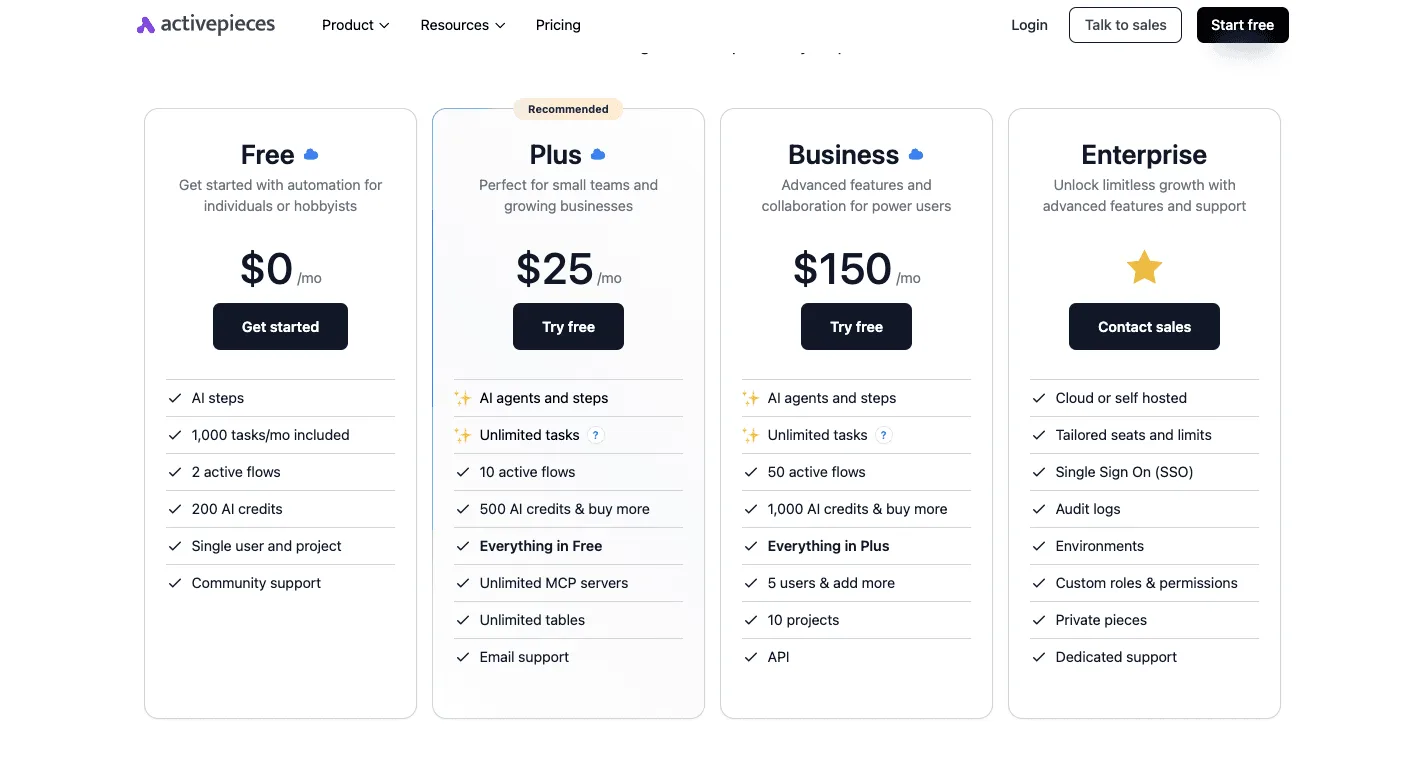 ### Which prices are quoted, not published You won't find a public price for Ultimate or self-hosted enterprise. Embed has only a floor of $36k a year, so treat that as the minimum, not the estimate. Four things move a quote: - how many users you need - how many credits you expect to burn - whether it runs on your infrastructure or theirs - the level of support you want For Free, Plus and Team, start at the [pricing page](https://www.activepieces.com/pricing). For self-hosted enterprise, SSO beyond Team, Ultimate or Embed, use the [sales form](https://www.activepieces.com/sales). ## What each plan costs at realistic monthly usage **Outside the sales-quoted tiers, the published price is $20 to $200 a month for most teams, and the switch from Plus to Team happens at roughly 36,000 credits.** 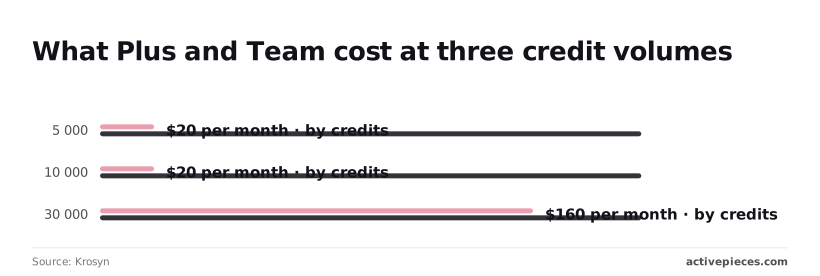 Credits per workflow depend on step count, so treat every figure here as an estimate and check it against your own run history. 1,000 credits a month come with the free plan, so a handful of low-step workflows costs nothing. Beyond that, [Krosyn](https://krosyn.com/blog/activepieces-pricing) notes, Plus is $20 a month with 10,000 credits. At 5,000 credits, [Krosyn's comparison](https://krosyn.com/blog/activepieces-pricing) puts Plus at $20 against $200 on Team, so you'd pay ten times more for headroom you're not using. Plus is the right plan until your usage proves otherwise. ### A small team: when Team's 50,000 credits beat overage on Plus At 30,000 credits Plus costs $160, because the 20,000 credits over the allowance add $140 at $0.007 each. Team is $200 flat, so you're paying $40 less on Plus. That lasts only for the next 6,000 or so credits. Past that point Team is cheaper. It also brings 25 users and SSO, so the $200/month price includes multi-user support and enterprise authentication features that Plus doesn't offer. At 50,000 credits Plus reaches $300 against Team's $200, a $100 monthly saving. If you need SSO or more than a few seats, Team is the plan you want regardless of the crossover. 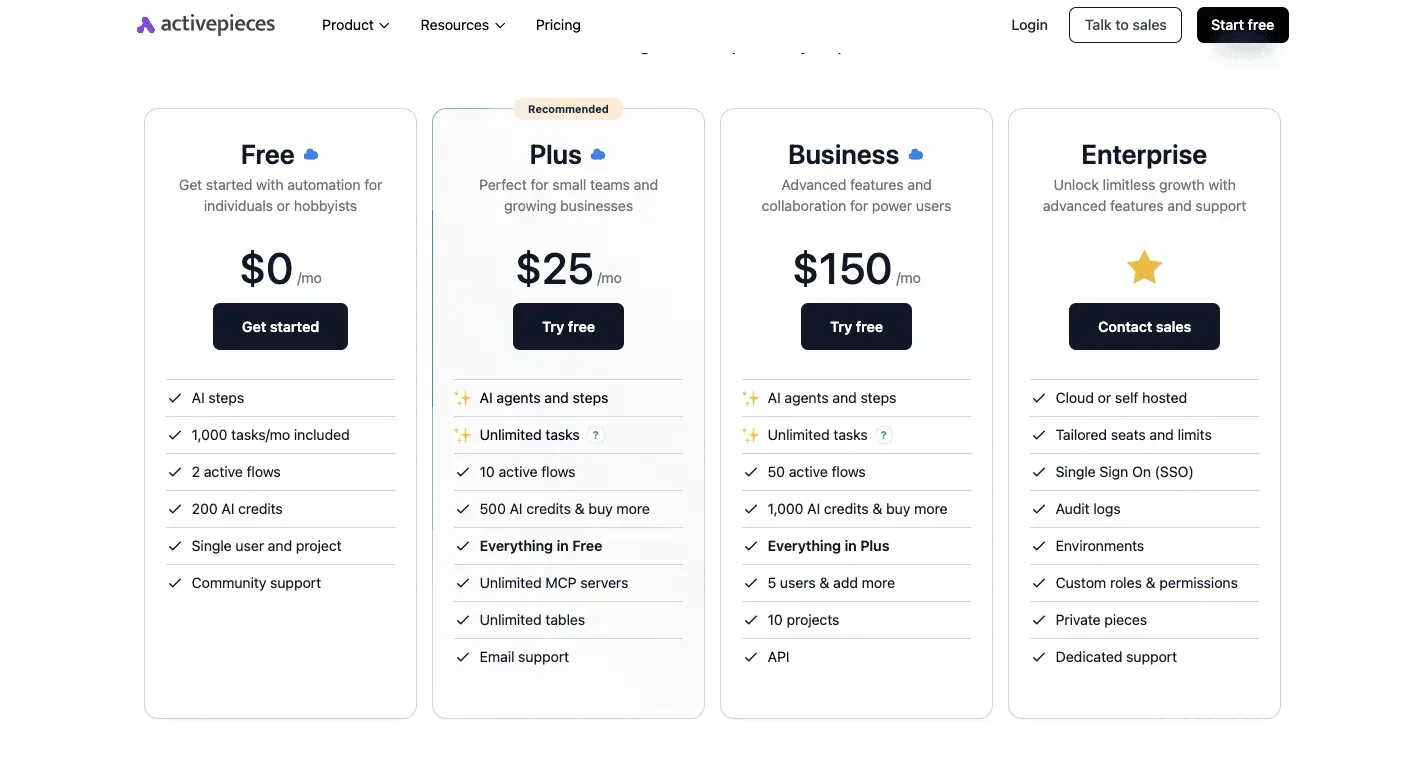 ### Heavy volume: overage maths at $0.007 a credit Past 50,000 credits every extra credit costs $0.007, so overages add up if you consistently exceed your plan. At 80,000 credits, Team comes to $410, which is $200 plus $210 for 30,000 extra credits. Plus at the same volume is $510, so the $100 gap you saw at 50,000 holds all the way up.  Talk to sales at this volume for deployment model, support or user count, not the credit bill alone. ## Identify hidden costs and limits per plan Five costs sit outside the headline price: - credit overage - AI step multipliers - the Team user cap - SSO gating - self-hosting overhead ### Credit overage and user caps Each extra credit past your plan's allowance costs $0.007. A month that needs 10,000 credits more than Plus includes adds $70. That's three and a half times the $20 plan fee.  Once AI steps are in the workflow, credits drain faster than on ordinary steps. A Fast step costs 2 credits, a Smart step 10 and a Frontier step 20. A workflow that makes 1,000 Frontier calls a month uses 20,000 credits, double Plus's 10,000, so pick the model tier before you pick the plan. When a department outgrows Team's 25 users, it goes to a sales quote. SSO is included on Team. SSO beyond Team is quoted by sales. Anyone whose security review requires SSO should settle that before choosing a tier. ### Self-hosting: the cost outside the license In a self-hosted budget, server rental is the smallest line, and the chart shows how small. [Hostinger](https://www.hostinger.com/applications/activepieces) lists three VPS sizes: - $6.49 a month - $8.79 a month - $12.99 a month Those intro prices cover only the machine. Upgrades, backups, monitoring and the person who gets paged when a workflow stalls aren't in them, and staff time will outweigh the VPS bill within a month or two.  If you want a paid self-hosted enterprise license, sales quotes it, and the quote depends on users, credits, deployment and support. SOC 2 is in progress, not certified, so don't promise an auditor a report that doesn't exist yet. ### When Community Edition is enough, and when it isn't When one technical team runs its own automations, needs no SSO, and can own upgrades and uptime, the free Community Edition is enough. Need SSO, vendor support or compliance paperwork, and the Community Edition stops being enough. viz type=stackrank title="What a VPS for self-hosting Activepieces costs" unit="$ per month" source="Hostinger - https://www.hostinger.com/applications/activepieces"2.99 for Large, before upgrades and staff time." Small: 6.49 Medium: 8.79 Large: 12.99 It also stops when you want to embed automation in your own product, which starts at $36k a year on Embed. If any of those apply, skip the VPS maths. ## Usage meters decide most of an automation bill Automation tools charge for something that scales with the work done: runs, steps or compute. Per-task and per-operation meters bill each action, per-execution meters bill each completed run, and credit systems bundle both into one balance. Self-hosted tools move the meter onto your own servers and your own staff. ## Licence models decide who carries the operating cost A proprietary cloud tool bundles hosting, upgrades and support into the meter, so the invoice is close to the whole cost. Open-source and fair-code tools sell the software cheaply or give it away, and the cost moves to servers, patching and whoever is on call. Permissive licences such as MIT allow resale and embedding, fair-code licences restrict some commercial uses, and enterprise add-ons usually sit behind a separate commercial agreement. ## Buying automation comes down to three routes Most teams end up on one of three routes. Hosted, metered software is cheapest to start and carries the least operating work, but the bill grows with every run. Self-hosted open-source software has a low licence cost and a high labour cost, so it pays off once volume is steady and someone already owns servers. Custom code, such as scheduled scripts, queues or a cloud provider's workflow service, avoids per-run fees entirely but turns every integration into software you maintain. Whichever route you take, the useful test is the same: estimate monthly volume, price it on each route including staff hours, and see where the lines cross. Low volume favours the hosted meter, and high, stable volume favours owning the infrastructure. ## How Activepieces pricing compares with Zapier, Make and n8n Put the quote next to the alternatives before you sign. Don't compare sticker prices directly, though: the four tools bill in different units, and only two of them let you run the software on your own server. | | Pricing unit | Entry paid price | Self-hosting option | Enterprise gating | Check date | |---|---|---|---|---|---| | Activepieces | Credits | Plus at $20 a month | Free Community Edition | Self-hosted enterprise and Ultimate quoted by sales | Confirm on the live pricing page | | Zapier | Tasks | Monthly plan scaled by task volume | None; cloud only | Enterprise features sit behind a sales conversation | Confirm on the live pricing page | | Make | Operations | Monthly plan scaled by operation volume | None on standard plans; cloud first | Enterprise tier sold through sales | Confirm on the live pricing page | | n8n | Executions | Cloud plan scaled by execution volume | Community Edition under a fair-code licence | Enterprise features licensed through sales | Confirm on the live pricing page | Because a task, an operation, a credit and an execution each count something different, a workflow with ten steps can cost very different amounts on each. Activepieces charges 1 credit per run however many ordinary steps it holds, so a ten-step flow costs the same as the two-step workaround it replaced, and splitting work into smaller, more reliable steps adds nothing to the bill. Zapier's pricing page bills per task and Make's per module, so the same split raises the bill there. ### Self-hosting: Community Edition versus n8n Both open the door to running on your own server, but the licences differ. Activepieces ships a free Community Edition whose core is under the MIT licence, and n8n offers a fair-code Community Edition, which restricts some commercial uses. If you resell automation or embed it in a product, read n8n's licence terms first, because that restriction can decide the whole choice. ### Where the alternatives win Zapier wins when nobody on the team wants to run infrastructure and you need the widest app catalogue off the shelf. Make wins when you build visually branching scenarios and want to see the data flowing through each step. n8n wins when your team writes code and wants heavy custom logic in a self-hosted setup. ## Get a firm Activepieces price this week You get a firm price by counting your own usage instead of trusting a plan's headline. Then you send the pricing page or the sales team a number they can work with. ### Estimate credits before you pick Start with the workflows you'd actually run, not the ones you might build someday. 1. List your top three workflows by how often they run or how much the business depends on them. 2. For each one, count the steps in a single run and note how many of them are AI steps. 3. Multiply by the number of runs you expect in a month, and add the three results together. 4. Check that total against the self-serve plans at https://www.activepieces.com/pricing. If it fits inside a plan, you can buy today. 5. If you need self-hosting, SSO beyond what the Team plan covers, Ultimate or Embed, skip the calculator and use https://www.activepieces.com/sales. ### What to bring to the sales call Those paid options have no public price, because the quote moves with four things. Arrive with an answer to each and the conversation shortens considerably. On users, know how many people will build or administer flows, and who needs single sign-on. On credits, bring the monthly total from your estimate, plus how much headroom you want for growth.  On deployment, decide between cloud, self-hosted, or embedded inside your own product, and who runs the infrastructure. On support, know the response times and help your team expects once this is in production. If your needs are a single team, no SSO and no hosting requirements, you probably don't need the call at all. If you're weighing the free Community Edition against a paid self-hosted licence, ask the sales team exactly what the paid tier adds for your case. ## Frequently asked questions ### Self-hosting and licence cost Is Activepieces free to self-host? Yes, the Community Edition is the MIT-licensed core and carries no licence fee, so your cost is the servers, backups and upgrades you run yourself. A paid self-hosted enterprise licence is a separate product, quoted by sales on users, credits, deployment and support, so don't budget it from the Community figure. ### SSO on the Free plan Does the Free plan include SSO? No. Free is for trying the product, and Team is the self-serve plan that adds SSO. Team's $200 a month covers SSO for 25 users. If you need more than that, such as SCIM or custom roles, which come with Ultimate, that's a sales conversation at https://www.activepieces.com/sales, so ask early if your security review requires it. ### Credit overage What happens when I use more credits than my plan includes? Credits beyond your plan's allowance are billed at $0.007 each on Plus and Team, as listed on the pricing page at https://www.activepieces.com/pricing. A busy month therefore raises the bill without forcing a plan change. Check your monthly run volume against the included credits before launch, because a noisy workflow can cost more than the plan itself. ### Moving from Community Edition to a paid plan Can I move from Community Edition to a paid plan later? Yes, nothing about starting on the free edition locks you out of paying later. The self-serve plans are on the pricing page, while a self-hosted enterprise licence goes through sales. I can't promise the exact migration steps for your setup, so ask sales how your existing flows and data carry over before you commit. ### SOC 2 certification Is Activepieces SOC 2 certified? Not yet. The SOC 2 programme is in progress, which isn't the same as a certificate you can hand to an auditor. If your procurement team requires one today, ask sales for the current status in writing before you sign. ## Related reading - [Self-Hosted LLM: Hardware, Cost, and Setup Guide for 2026](https://www.activepieces.com/blog/self-hosted-llm-hardware-cost-and-setup-guide-for-2026) - [d1 Ultra Decision Model: Specs, Pricing, and License](https://www.activepieces.com/blog/d1-ultra-decision-model-specs-pricing-and-license) - [n8n License: Fair-Code, Community, Enterprise (2026)](https://www.activepieces.com/blog/n8n-license-fair-code-community-enterprise-2026) ## References - [Hostinger](https://www.hostinger.com/applications/activepieces) - [Krosyn](https://krosyn.com/blog/activepieces-pricing)Look past the license, because that isn't where the money goes.