Since entry prices in the chart run from **free to $3,000 a month**, the real gap's in how each bill grows after the first invoice. 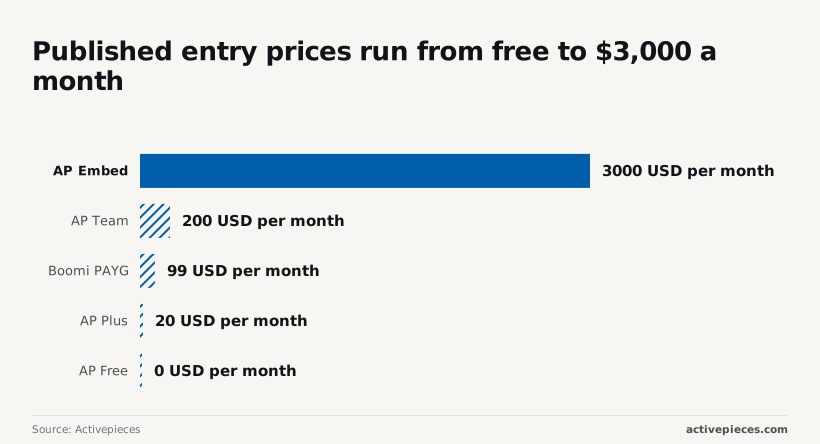 Treat the **Boomi bar as a floor, not a forecast**, because its $99 excludes usage and its higher tiers carry no published number. ### Building and testing workflows free At $0 on Free, a plan like that lets you build and test a real workflow before anyone approves a budget. It meters the run, not the steps inside it: a ten-step flow and the two-step workaround it replaced each cost 1 credit, where Zapier bills per task and Make per module. Splitting work into smaller, more reliable steps, which is what keeps a flow maintainable, never raises the bill. Plus is $20 a month and Team is $200 a month, so a small team knows its cost before it signs up.  According to the vendor's pricing page, Embed is $3,000 a month, billed from $36k a year, which puts it out of reach for most small organizations. That's the tier for putting automation inside your own product, and you should budget it as a product cost rather than a tooling cost. ### Boomi packaging and what's quoted by sales If you pick Boomi's Pay-As-You-Go tier, it starts at $99 a month plus usage. You can't read the usage part off a page, so your monthly bill moves with volume and you need your own run estimates to predict it.  Above that, Boomi's subscription tiers are custom quotes, while Pay-As-You-Go starts at $99 a month. You reach a price by talking to sales, which means the number depends on your estate, your connectors and your negotiation. ### Verdict on cost If you need a number today, a vendor with published plans gives you one at every self-serve tier, from $0 to $200 a month. Boomi's $99 is cheaper than Team on paper, but it's a starting point with usage on top. Anything larger's unpriced until a quote arrives, so buyers can't project true cost without a sales call. Choose by how well you can forecast: fixed tiers suit a team that wants a known bill, and quoted pricing suits an organisation that already buys software through procurement. ## Hosting, Licence, SSO and Admin Controls Compared One is open source and the other proprietary: the open-source tool can be self-hosted end to end, with an MIT-licensed core you can read, while Boomi has runtimes you can place in your own network but a platform Boomi hosts. That split shapes what you pay for and who you depend on. The table shows where each tool sits on the five points that usually decide a security review. | | Activepieces | Boomi | |---|---|---| | Deployment | Cloud, or self-hosted on your own infrastructure | Boomi-hosted platform, with runtimes in its cloud or in your environment | | Licence | Open source core, commercial licence for enterprise features | Proprietary, commercial | | SSO by plan | Not on Plus; included on Team; beyond Team via sales | Quoted by sales | | Admin controls | Roles and project-level controls, deeper on higher plans | Mature role-based access, environment management and governance | | Compliance | SOC 2 in progress, not certified | Publishes its own attestations on its trust pages | Read the table as a trade: the open-source tool gives you the source and the server, and Boomi gives you a longer governance track record. Run the whole open-source product on your own servers and your data never has to leave your network. With Boomi the control plane stays with Boomi, so your team maintains the runtimes but not the platform.  You can read, fork and audit the open-source core, so a stalled vendor roadmap doesn't strand you. Boomi's licence is commercial, so continuity rests on the contract. Enterprise features on the open-source tool sit under a separate commercial licence. ### SSO, roles and audit controls On the open-source tool, SSO starts at the Team plan, and anything beyond Team goes through the sales form. Plus has none. Boomi's governance is deeper: its role model, environment promotion and audit tooling were built for estates with many teams and many regulators. 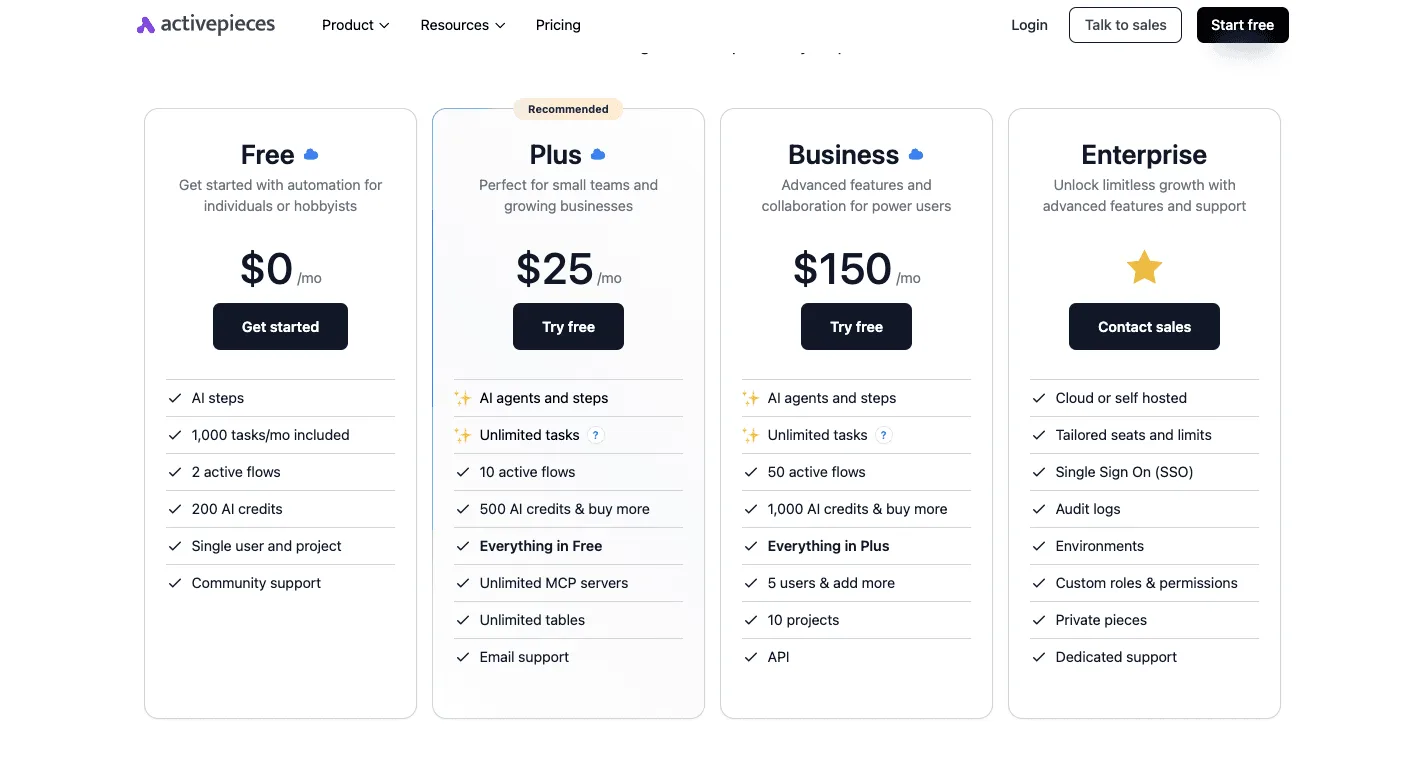 That tool's **SOC 2 programme's in progress, not certified**. If your auditors need an attestation today, that gap's real. ## Integrations, AI Agents and Embedding Compared Beyond compliance, a second gap also favours Boomi: breadth of integration type. Boomi covers EDI, API management and master data, which an app-connector tool doesn't try to replace. ### Integration count and integration depth Count the connectors and you know how many apps a tool can reach, not what kind of work it does once there. Boomi's platform goes beyond app connectors to EDI for trading-partner exchanges, API management, data integration and master data.  With 771 app integrations listed, an app-connector tool covers most SaaS-to-SaaS automation, but none of those integrations turns it into an EDI translator or a master data hub. If a retailer must exchange purchase orders with suppliers in agreed formats, or you need one governed record of each customer across systems, that's Boomi's territory. Buying a second tool for those jobs costs more in maintenance than the licence ever did. ### AI agents Both vendors document AI agents, but they sit differently. Boomi's agent features live inside its wider platform, alongside its governance and API layers, so agents inherit the controls a large estate already runs. 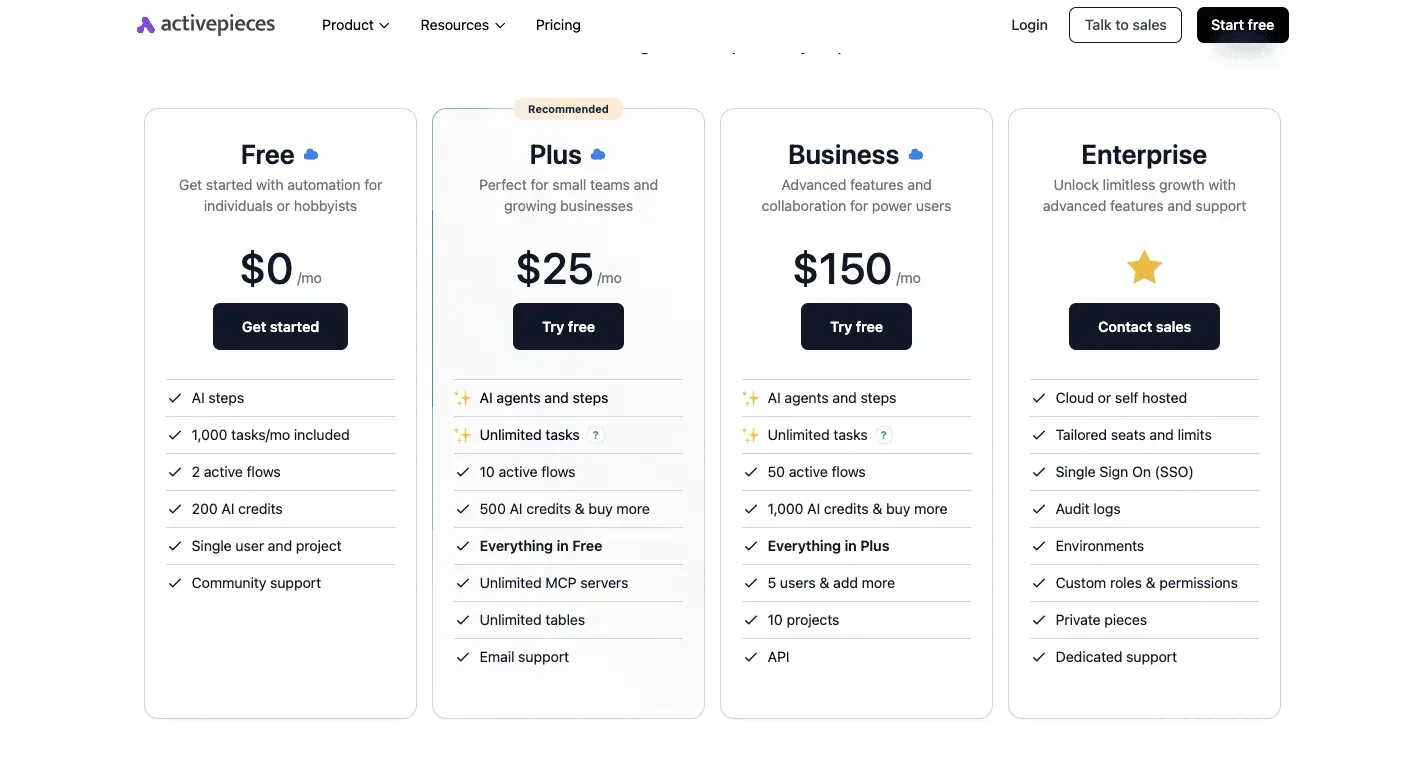 The lighter tool treats agents as another kind of workflow step, which makes them quick to build and easy to read. If your company already runs Boomi, agents there reduce the number of moving parts. A small team wiring an agent to a handful of apps has less to maintain with a lighter tool. ### Embedding in your own product Embedding means your customers build or run integrations inside your application, with your branding. The open-source tool's built with that in mind: it's open source, can be self-hosted, and has an embedding option you can discuss through its sales form. For vendors shipping integration as a major product line with partner support, Boomi supports embedding through OEM-style arrangements, usually negotiated commercially. The practical difference is how quickly you can prototype. With open source you can try it before talking to anyone; with an OEM deal you generally start with a contract. ## When to choose each tool Start with the open-source tool, which you can try without a contract, unless your integration problem's a large, connected estate where a sales conversation's part of the work anyway. In that case, Boomi's built for the job. ### Choose Boomi if You're connecting many systems across departments, including older on-premises applications and trading-partner exchanges, and you need central governance over all of it. Because Boomi's an enterprise integration platform, its pricing's quoted by sales. That suits a buyer who already runs procurement for large platforms, and it's a poor fit for a team that wants a workflow running by Friday. ### For workflow-level automation needs Your problem is a set of workflows rather than an estate. Activepieces's an open-source automation tool, so you can self-host it and read the code you depend on. It also lets you embed automation inside your own product. It's narrower in scope than Boomi, and it's not a replacement for a full integration platform with partner networks and enterprise-wide governance. For a small team, that narrowness means less to maintain and less to pay for. Do these in order, because each step narrows the next: 1. List the systems you need to connect and the flows between them, with a rough note on which direction data moves and what triggers it. 2. Check the Activepieces pricing page at https://www.activepieces.com/pricing. If a self-serve plan covers your list, you can start building without talking to anyone. 3. If you need self-hosted enterprise, use the sales form at https://www.activepieces.com/sales. 4. Use the same form if you need SSO beyond the Team plan, or if you want to embed Activepieces in your own product. 5. If your list is long and tangled, take your questions to Boomi sales: what the quote covers, which connectors and environments it includes, and what renewal looks like. The first step does most of the deciding: a short list points to one tool and a sprawling one points to the other. ## Frequently asked questions ### Can this work for enterprises? When the enterprise problem's a set of team-level workflows, not a company-wide integration estate, it is an alternative. Departments that want fast automations, self-hosting or embedded workflows fit it well. Boomi's built for a large, connected IT estate with central governance. One caveat for security reviews: the open-source tool's SOC 2 programme's in progress, so it's not certified. Check that against your procurement requirements before you shortlist it. ### How do hosting options differ? No, both can run inside your own infrastructure, but to different degrees. Boomi lets you run its runtimes in your environment, while its management platform stays in Boomi's cloud. The other tool's open source, so you can host the whole product yourself. If the requirement is that nothing leaves your network, that difference decides it. If you only need data processing to stay local, both can meet it. ### Does Boomi have a free plan? Boomi has no permanently free tier, but it offers a self-service Pay-As-You-Go edition starting at $99/month alongside quoted contracts. Its pricing page is the place to check for any trial or entry offer, since those change. Budget as if you'll go through sales, and expect the price to depend on your connection count and the edition you need. The open-source tool publishes self-serve plans, with sales involved for self-hosted enterprise, SSO beyond Team and embedding. ### Can you use both together? Yes. Both tools can call and trigger each other over webhooks and HTTP, so nothing forces a single choice. A common split is Boomi as the governed backbone between core systems, with the open-source tool handling lighter workflows that teams build and change quickly. Run both and you carry two places to monitor and two sets of credentials to maintain, so only split them if each side has a clear job. ### How often do vendor prices and features change? Often enough that you should treat any comparison, including this one, as a snapshot of the day it was checked. Plans get renamed, limits move and integration counts grow every few months. Before you commit, check the current pricing pages for both products and ask each vendor to confirm in writing anything your decision depends on, such as SSO, audit logging or hosting terms. ## Related reading - [Boomi vs Workato vs Activepieces: Updated Comparison in 2026](https://www.activepieces.com/blog/boomi-vs-workato) - [Activepieces On Premise: Pricing & Self-Hosting Guide](https://www.activepieces.com/blog/activepieces-on-premise-pricing-self-hosting-guide) - [Boomi vs Zapier: Which Platform Is Best for Automation?](https://www.activepieces.com/blog/boomi-vs-zapier) ## References - [Activepieces](https://www.activepieces.com/pricing)Maintainability's the cost that arrives last and stays longest, so count it first.