On the right, a single LLM app bundles a knowledge base, a model and a chat interface. ### Where Dify is the better choice If the deliverable is the assistant itself, such as a support bot grounded in your documents, Dify's built for it. Retrieval, model selection and the chat front end sit in one place. 159,579 GitHub stars: that is where [Gitstarclub](https://gitstarclub.com/langgenius/dify)'s [Github-Ranking-AI](https://github.com/yuxiaopeng/Github-Ranking-AI/blob/main/Top100/RAG.md) list puts Dify. It puts Flowise, another LLM app builder, at 55,537. That means Dify has the Has more examples, answered issues and third-party guides than the other two here. ### Where Activepieces is the better choice **25,286 stars** is what Activepieces has on the same list, and its MIT-licensed core carries 746 integrations, **roughly 60% of them community-contributed**, meaning most of the integration library is built by developers outside the core team. That's a smaller community, and it shouldn't be read as a weaker tool for this job. When the task is "a form arrives, the CRM updates, a model drafts a reply, the team gets a chat message," the product's the process, not a chat window. A process like that grows agents, integrations, shared team data, an AI chat and approvals, and Activepieces keeps all of it in one product, so access, history and releases are handled in one place: custom RBAC, SSO, SCIM, audit logs, event streaming, environments and git sync, on cloud or self-hosted.  MoneyGram, Moneypenny, Alan and FundingSocieties run it in production. Assemble that span from point tools and you have six vendors, six bills and six separate places to look when a run breaks. ### Using both together The two aren't mutually exclusive. A team can build a knowledge-base assistant in Dify and call it from a workflow as one step. The workflow handles triggers, routing and writes to other apps, while Dify handles the retrieval and answer. The cost is two systems to monitor and two sets of credentials, so it pays off only when both jobs actually exist. ## AI agents and knowledge features compared Dify goes deeper on the AI itself, with agents, retrieval and prompt tooling built into the product. The automation platform reaches wider, because its agents can act across far more outside apps. ### Agents Dify treats the agent as the product. You configure one with a model, instructions and tools, then publish it as an app. Its workflow canvas also has an agent node, so reasoning can sit inside a larger pipeline.  Read the fine print on the tool list: an agent can only call what has been registered as a tool. That catalogue's narrower than the app coverage of an automation platform. ### Knowledge and retrieval Retrieval is Dify's I only received the fragment "strongest ground." with no fact, numbers, or product names to preserve. Could you paste the full sentence you want rewritten? It has a built-in knowledge base with document ingestion, configurable chunking, and choices of keyword, vector or hybrid search, plus reranking. You tune these settings inside the product and test them there. On the automation side, retrieval is generally something you connect: you point a flow at a vector store or document source and handle the plumbing. That's more flexible about where data lives, but the retrieval quality knobs are yours to assemble. ### Dify model support and LLM tooling Dify supports many model providers behind one interface and includes a prompt editor, run logs and annotation features, so you can see what each step received and returned. For deeper tracing it can forward to external observability tools. A flow-based automation tool exposes models as steps instead. The screenshot shows how such a flow begins. It has a single trigger, "new flavor created" from the Ice-cream demo integration, wired to an End node, with a connection named ice-cream and sample data loaded for later steps to use.  That pattern's the trade. You get less AI-specific instrumentation, but every step, AI or not, is built, tested and monitored the same way. ## Pricing, hosting and licence side by side Cost follows the same split as the tooling: Activepieces' paid cloud entry point is **$20 a month against Dify's $59**. The two meter different things, so the cheaper one depends on your usage pattern. ### Entry price and free tier A team testing a few workflows pays nothing: [NodeSparks Data](https://www.nodesparks.com/data/automation-platform-pricing) puts Activepieces Cloud at $0 for 1,000 runs a month, so they can develop and iterate at zero cost. At 10,000 runs it's $25 a month, and at 100,000 runs $100. 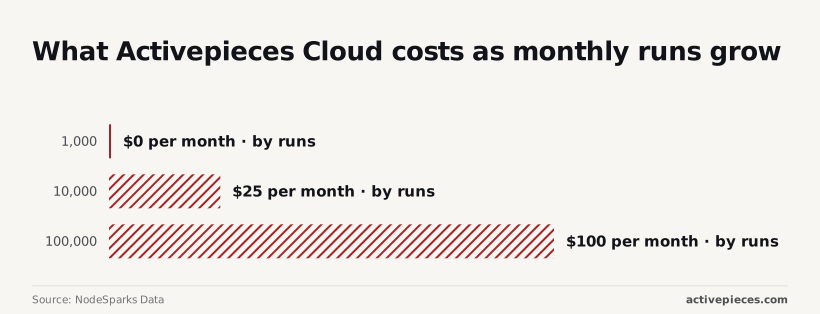 Ten times the volume costs four times the price, so high-volume automation gets cheaper per run as it grows. Activepieces is $20 for Plus and $200 for Team; Dify is $59 for Professional and $159 for Team, which means Activepieces is cheaper to start but Dify's cheaper at team scale. Check which limits each tier carries before you compare list prices, because the unit being capped's what drives your bill. ### Self-hosting and licence Both can be run on your own infrastructure. Activepieces' community edition is MIT-licensed, which permits commercial use and modification. Dify's source is available under its own licence, based on Apache 2.0 with added conditions. If you plan to resell it or run it as a multi-tenant service, read those conditions before you commit, because they apply to that use and not to running it internally. Neither vendor publishes every price. For Activepieces, self-hosted enterprise, SSO beyond the Team plan and embedding go through the [sales form](https://www.activepieces.com/sales), and no price is public for them. Self-serve plans are on the [pricing page](https://www.activepieces.com/pricing). Budget for a quote, not a list price, if you need any of those. Dify's tiers are priced for low volume and a single LLM app. With many workflows and high run counts, the run-based curve above favours Activepieces. If you're reselling or embedding, get the licence terms and a quote in writing first. ## SSO, admin controls and embedding in your product Both platforms offer SSO, roles and embedding, but they gate them differently. Dify's embedding publishes an LLM app into your site, while Activepieces' embedding puts the automation builder inside your product. ### SSO and admin controls Check the edition before you check the feature list. Dify's documentation splits its workspace model, which has members with defined roles, from its enterprise offering, where SSO and tighter administration sit. For internal governance, the questions are whether roles can be scoped narrowly, whether provisioning is automated, and whether you can export an audit trail. Ask each vendor for written answers on all three, because "supports SSO" in a feature table often means login only. Activepieces covers RBAC, SSO, SCIM, audit logs and git sync, and SSO past the Team plan goes through sales. ### Embedding in your own product Dify lets you publish an app as a chat widget, a web page or an API. Your customers get a finished LLM interface or a backend you call, and they never see the builder. Activepieces embedding is for a different case: your customers build or run automations inside your product. The rollout runs in this order, and the first step is the one that most often stalls a project: 1. Choose the tier that allows embedding. Treat this as a purchasing decision, not a settings toggle. 2. Set up SSO, so your users arrive already authenticated rather than hitting a second login. 3. Define workspaces and roles, deciding whether each of your customers gets an isolated space and what they may edit. 4. Wire the embed into your app, passing identity from your backend so the embedded view matches your session. 5. Brand it, once the plumbing works and not before. Steps one and two are the commercial ones. SSO beyond Team needs a conversation with sales, so start it before engineering does, or the timeline slips on a quote instead of on code.  Which product you're shipping decides the verdict. If it's an LLM feature, Dify's publish options fit. If it's workflow automation across your customers' apps, the embedding path above fits. ## Frequently asked questions ### Is Dify a replacement for Activepieces? No, because they're built for different jobs. Dify's designed for shipping a standalone LLM product, such as a chat assistant or a retrieval app. Activepieces connects systems and automates work across apps. If your goal is an LLM product, Dify covers it directly. If you're moving data and triggering actions between business tools, you would be bending Dify to fit. ### Can Activepieces and Dify be used together? Yes, you can run Activepieces and Dify together. The two tools sit at different layers, so they combine without overlap. Dify can serve the LLM application, and an automation flow can call it, pass in data from other apps, and route the answer onward. Check how each side authenticates the other before you commit, because that handoff is where integrations usually get fiddly. ### Which is easier for a non-developer? For a non-developer, which one is easier depends on the task, not the tool. A non-developer wiring one app to another is working in familiar territory with a trigger-and-action model. Designing prompts, tuning retrieval and judging model output is a different skill, whichever builder you use. Give a non-technical teammate a real task from your backlog and see where they get stuck. ### Is Activepieces SOC 2 certified? No, Activepieces is not SOC 2 certified. The SOC 2 programme is in progress, so there's no certification to cite yet. If your procurement process requires a report today, ask the vendor directly what documentation exists and don't rely on a badge. ### What should I check before buying either? Settle these before you pay, since they decide which plan you need: - Whether you need self-hosting or cloud, and who on your team will maintain it. - Whether SSO's included in the plan you're looking at or sits in a higher tier. - Whether you need to embed the tool inside your own product, which is usually a sales conversation and not a checkout. - Whether your auditors will ask for compliance documents that aren't yet available. Once those answers are written down, pick the route that matches your need. Use the pricing page at https://www.activepieces.com/pricing for self-serve plans, and the sales form at https://www.activepieces.com/sales for self-hosted enterprise, SSO beyond Team, or embedding. If you land in the second group, say which of the three you need in the form. That saves a round of questions. ## Related reading - [Simplify Your Workday: 9 Best Workflow Automation Apps](https://www.activepieces.com/blog/workflow-automation-apps) - [Dify Alternatives: 4 Options Compared (2026 Guide)](https://www.activepieces.com/blog/dify-alternatives-4-options-compared-2026-guide) - [Dify vs n8n: Features, Pricing and Use Cases (2026)](https://www.activepieces.com/blog/dify-vs-n8n-features-pricing-and-use-cases-2026) ## References - [GitStarClub](https://gitstarclub.com/langgenius/dify) - [NodeSparks Data](https://www.nodesparks.com/data/automation-platform-pricing) - [Github-Ranking-AI](https://github.com/yuxiaopeng/Github-Ranking-AI/blob/main/Top100/RAG.md)The difference is where the work lives: inside a model-centred product, or across the systems a team already runs.