# Activepieces vs Flowise: Features & Pricing (2026)
By Nalani Reeves · 2026-10-23 · Source: https://www.activepieces.com/blog/activepieces-vs-flowise-features-pricing-2026
---
Choose Flowise to build an LLM application or agent. Choose [Activepieces](https://www.activepieces.com/pricing) to automate business processes across the apps your company already runs, with access controls and audit trails built in. **They overlap less than their AI branding suggests**.
## Activepieces vs Flowise: the short answer and who each is for
### Who each tool is for
If you are a developer who needs to assemble prompts, retrieval and tool calls into something you can ship, Flowise is your tool: a visual builder for LLM applications, chatbots and agents.
[Activepieces](https://www.activepieces.com/pricing) is a workflow automation platform for business processes that cross applications, such as approvals, record syncing and notifications. It includes AI steps and agents, but the product is the process around them.

When the workflow touches personal data, the difference matters most. Under GDPR Article 30 you must record what you process, and under Article 32 you must secure it. That means knowing who changed a flow, who can run it and where its logs go.
Activepieces answers all three from a single product: **role-based access, SSO and SCIM provisioning**, audit logs and streamed events, and separate environments kept in step through git. It runs the same way on cloud or self-hosted, with no cut-down version on either side.
### At-a-glance comparison table
Read the table below as a map of what each product is for; it reflects each vendor's public pages on 2026-10-23. Where a cell says a detail isn't published or sales quotes it, ask the vendor before you commit.
| | Flowise | Activepieces |
|---|---|---|
| Built for | LLM apps, chatbots and agents | Cross-app business process automation |
| Hosting | Self-hosted or vendor cloud | Self-hosted or cloud, same product |
| Licence | Open source | Open source community edition |
| Pricing and entry price | Cloud plans published; entry price not confirmed here | Self-serve plans on the pricing page; self-hosted enterprise quoted by sales |
| SSO and admin | Not confirmed here | RBAC, SSO, SCIM, audit logs, log and event streaming |
| AI agents | Core purpose | Available inside workflows |
| Integrations | Not confirmed here | Broad app catalogue for business tools |
| Embedding | Not confirmed here | Available; scoped through sales |
## The criteria that decide between these two tools
Five criteria settle this choice, and governance and cross-app reach are two of them; the other three are the job, cost at the same usage, and hosting and licence.
- The job: what work must the tool do?
- Cost at the same usage: what does the same workload cost on each?
- Hosting and licence: where does it run, and under what terms?
- Governance: who can sign in, and what can they change?
- Reach into other apps: which systems can it read from and write to?
Flowise builds the LLM application or agent itself. Activepieces automates a business process that crosses several apps. If your deliverable is a chatbot, pick by that; if it's a process, pick by that.
### Total cost at the same usage
Compare platform fees alone and you see only half the bill, because model choice sets the other half.
On [OpenAI's pricing page](https://developers.openai.com/api/docs/pricing), GPT-6 Astra costs $10 input and $50 output per 1M tokens, while GPT-6 Luna costs $0.10 and $0.50, so Luna becomes the obvious choice unless Astra is proportionally better. The same workflow costs a hundred times more on the first model.

A forty-fold gap separates Claude Opus 5.5 at $4 and $20 from Claude Haiku 5.5 at $0.10 and $0.50, which means **cost becomes the primary factor in choosing** between them. Haiku is the rational default unless Opus is proportionally better.
Pick Flash-Lite unless Argon is proportionally better.
Compare both tools on one model, or the platform difference disappears into the model difference.
### Hosting, licence and governance
Once personal data leaves the EU, Article 44 of the GDPR requires a lawful transfer basis. Where the tool runs therefore decides where prompts and records travel.
Ask which plan includes SSO, role-based access, audit logs and SCIM provisioning. A control the vendor sells only on a higher tier is one a regulated team may not have when it starts.
Count the connectors your processes need, and check whether any app you rely on is missing. Each gap means custom code someone must maintain.
## What Flowise does well, costs, and lacks
Flowise is strong at building LLM applications, agents and retrieval pipelines on a visual canvas, and thin at coordinating business processes across everyday apps.
By connecting nodes for models, vector stores and memory, you assemble chains, agents and retrieval-augmented generation (RAG, where a model answers from your own documents) in Flowise.
The output is a chatbot or agent you can test and embed. If the thing you ship is the LLM app itself, that's the job it was designed for.
### Flowise pricing, hosting and licence
You can self-host Flowise, which is open source under Apache 2.0, and it also sells a managed cloud.
Cloud tiers are metered in predictions, meaning each call to your flow. The Free tier allows [100 predictions a month](https://comparedge.com/tools/flowise/pricing), according to CompareEdge, which covers a prototype but not a public chatbot.
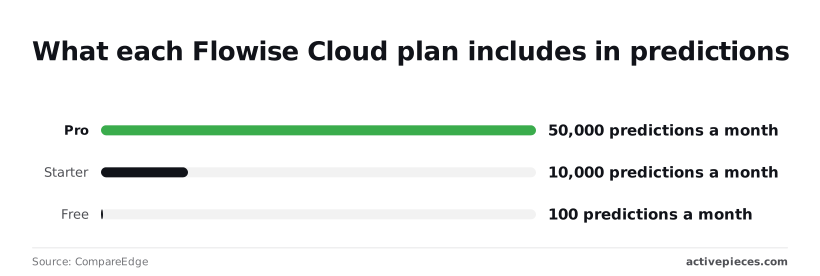
At 400 messages a day, a bot would exhaust Starter's 10,000 in about 25 days. Pro allows 50,000, five times Starter, which suits a modest production assistant but means a busy customer-facing bot needs headroom planning.
### Flowise admin controls and integrations
Check which tier a security review would require before you commit, because SSO and role-based access may not be included in every plan. Its integrations are mostly LLM-side: model providers, vector databases, document loaders and tools.
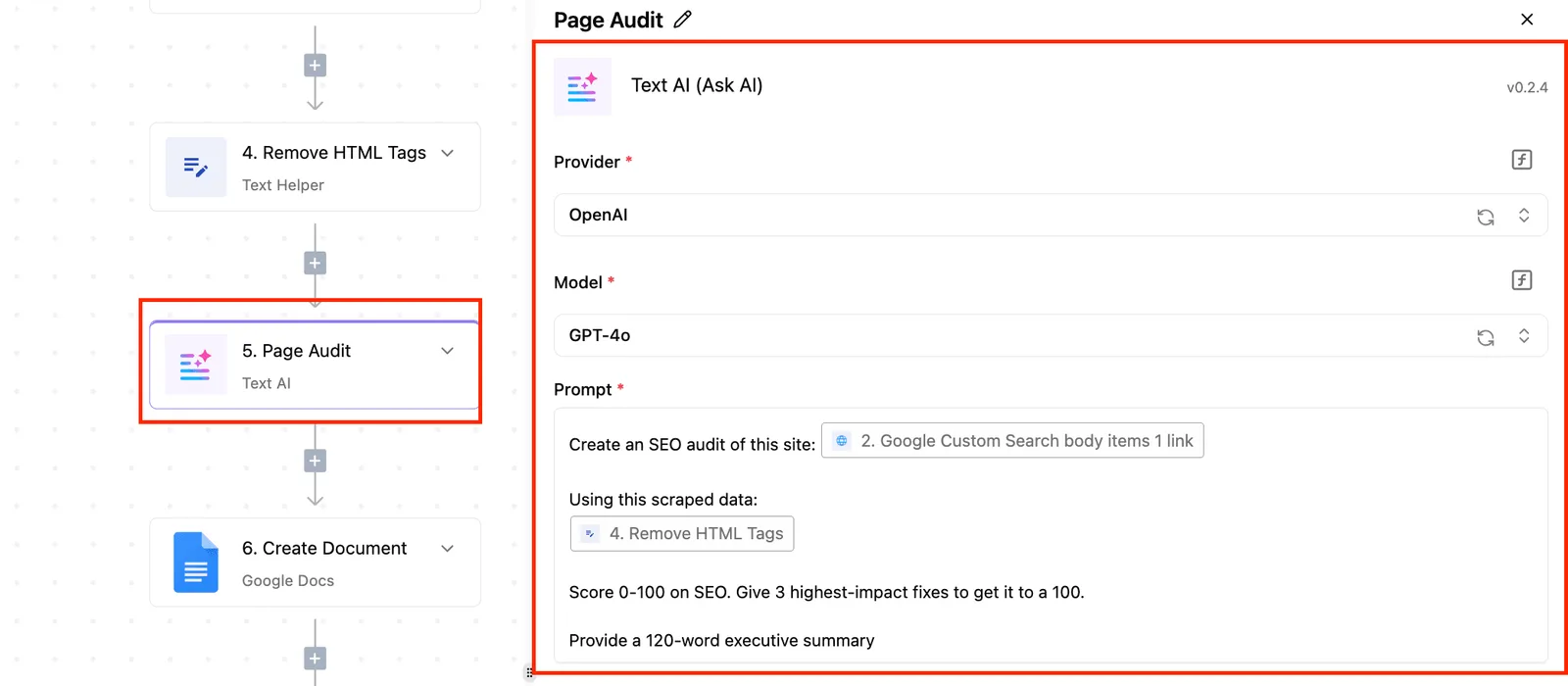
Consider a six-step flow. Step 4 strips HTML from a fetched page, step 5 asks GPT-6.1 Sol to score the site from 0 to 100 and write a 120-word summary, and step 6 creates a Google Docs document.
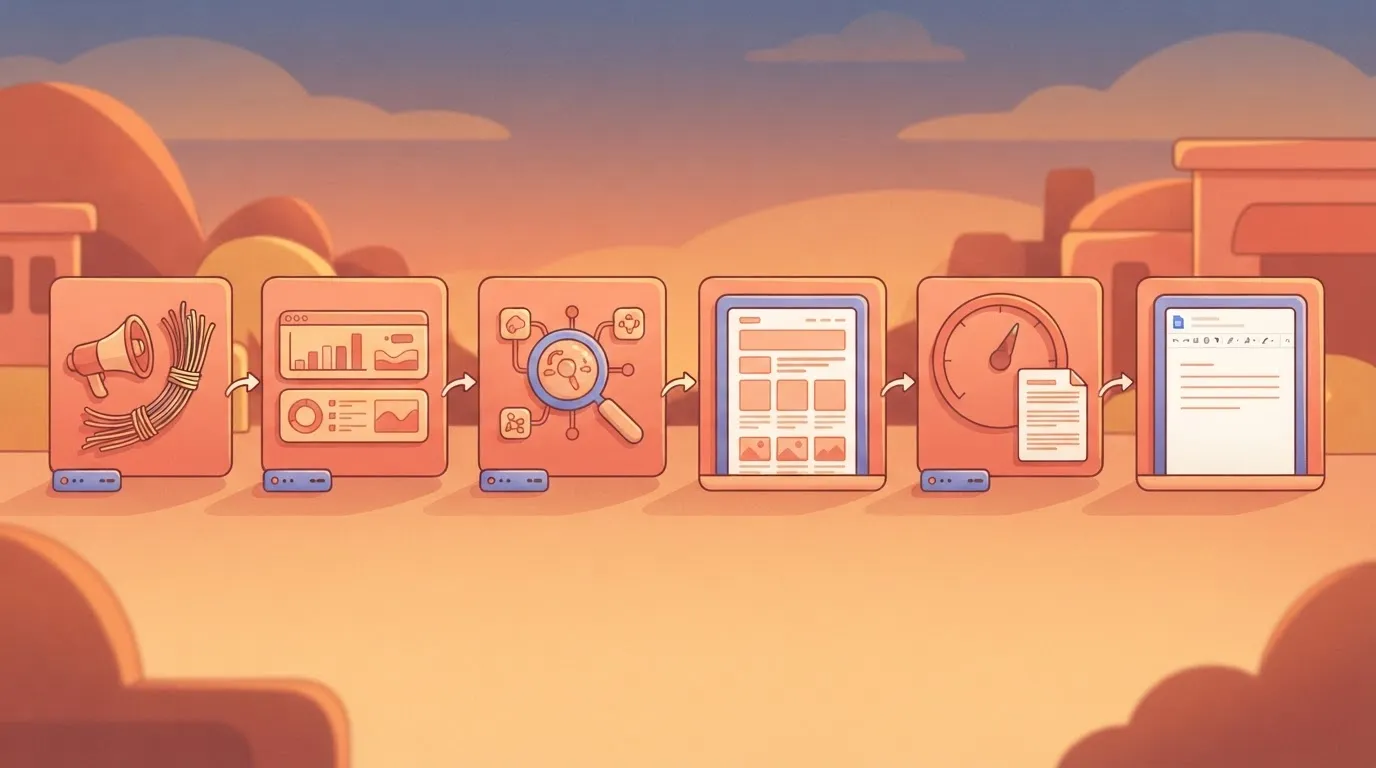
The model call is one step in six; the rest is fetching, cleaning and filing.
That ratio is the limit for non-LLM work. Flowise handles step 5 well, and the surrounding app-to-app steps are where you would be writing your own nodes or glue code.
If the deliverable is the agent itself, evaluate Flowise first: a RAG assistant over internal documents, or a chat widget with custom retrieval logic. Its LLM-specific nodes give finer control over that than a general automation tool does.
### Where the LLM builder is the right call
Judged on the job, Flowise wins whenever the deliverable is the model-facing app.
Its nodes for chains, memory, vector stores and agent tool use are the product rather than an add-on, so a developer tuning retrieval works closer to the problem than in a general automation tool.
On hosting and licence it is easy to defend. Apache 2.0 means a team can read, fork and run the code with no commercial agreement, and a small team can start on the free self-hosted build or the free cloud tier without a sales conversation.
For a prototype or a single-purpose assistant, that is a lighter start than a platform built for company-wide processes.
Governance and reach are where it gives ground, as the sections above show. But a few developers shipping one assistant, with no reviewer asking for SCIM or git-synced environments, may never need what Activepieces adds. For them the narrower tool is the better one.
## What Activepieces does well, costs, and where it falls short
Activepieces runs business processes across apps, starts free with unlimited flows and 1,000 credits a month, scales by monthly credits, and isn't a dedicated RAG framework.
It's a workflow builder for connecting business apps, and its reach is the clearest strength.
From 200 integrations in June 2024, the catalogue grew to 280 in March 2025, 400 in September 2025 and 500 in November 2025, according to the [Activepieces community forum](https://community.activepieces.com/t/scaling-pieces-with-ai-a-rolling-announcement/4327), meaning the integration catalogue is still growing, though more slowly than before.

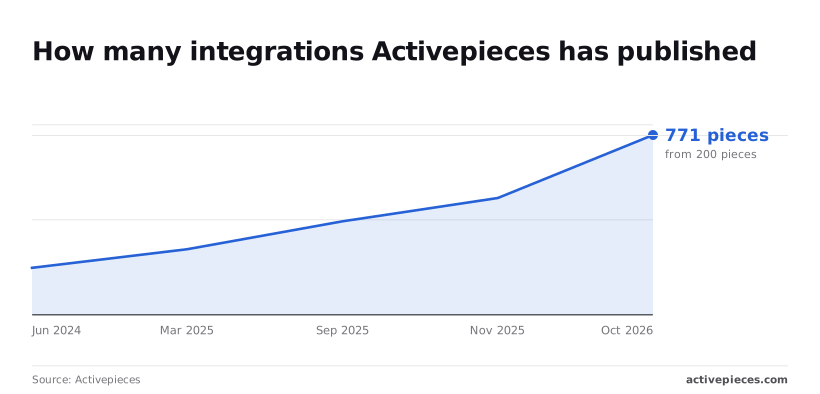
The catalogue stood at 771 in October 2026.
**Nearly four times the starting count** is where the catalogue now sits. About 25 integrations were added a month over the last eleven months, so a missing connector is less likely to block a workflow than it once was.
Free carries 1,000 credits, Plus 10,000 and Team 50,000, so a team that outgrows Free gets ten times the headroom at the first paid step. Sales quotes Enterprise, so the chart omits it.
Self-hosted or cloud, it's the same product with no cut-down version. For data-residency obligations under GDPR Chapter V, self-hosting lets you keep processing inside a boundary you control.
### Admin controls, AI agents and embedding
These controls ship in one product:
- RBAC
- SSO
- SCIM
- audit logs
- log and event streaming
- environments
- git sync
Audit logs and streamed events give you the evidence trail that GDPR Article 32 expects of security measures.
SSO beyond the Team plan goes through sales, as does embedding in your own product. AI agents run inside workflows, so they can act on the apps those workflows already connect. SOC 2 is in progress, not certified.
It isn't a dedicated RAG framework. If your main task is tuning retrieval and chunking for an LLM application, Flowise's LLM-specific nodes give you finer control. Activepieces is stronger when the agent is one step in a wider process.
## Mistakes teams make when choosing between Flowise and Activepieces
Matching a tool to its label instead of its job causes most of the usual errors.
Six recur, and each can be checked against a vendor's published page:
Matching a tool to its label instead of its job causes most of the usual errors.
- Choosing on the AI label
- Using an LLM app builder to run approvals and app-to-app syncs
- Using a workflow tool for a retrieval-heavy chatbot
- Ignoring the work self-hosting adds
- Assuming single sign-on is included in every tier
- Comparing tiers that aren't equivalent
The four below carry most of the cost.
Both products say "AI" on the front page, but one builds the LLM application itself, with chains, retrieval and agent logic. The other coordinates that application with the systems around it.
A free self-hosted download, a self-serve cloud plan and a quote-only enterprise plan answer different questions.
Put the same needs against each published page: users, environments, audit requirements, support. Where a plan is quoted by sales, say so in your comparison instead of filling the gap with a guess.
Once you self-host, patching, backups, uptime and log retention all land on your team.
It does give you control of where data sits, which matters when a regulator asks where personal data is processed and who can reach it. That control has an operating cost, so budget for the people, not just the licence.
## Verdict: which to choose, and when the other wins
**Pick by the deliverable**. Choose Flowise when the thing you ship is an LLM application, chatbot or RAG pipeline; Activepieces when the work moves data and decisions between business apps, or embeds automation in your own product.
Set each job against that rule in the table below; the right-hand column gives the condition that should override your first instinct.
| Job | Pick Flowise | Pick Activepieces | Deciding condition |
|---|---|---|---|
| LLM chatbot | Yes | Only as a trigger or notification layer around it | The chatbot's behaviour, memory and prompts are the product |
| RAG pipeline | Yes | Only to feed documents in or route answers out | Retrieval quality and chunking are what you're tuning |
| Approval workflow | No | Yes | A named person must approve, with an audit trail and access controls |
| App sync | No | Yes | Records move between systems on triggers or schedules |
| Embedded automation | No | Yes | Your customers need automation inside your product |
| Running both | Builds the model-facing app | Runs the surrounding process | The AI output feeds a business process |
### Choose Flowise when
If your team is composing chains, tuning retrieval, wiring a vector store or shaping an agent's tool use, Flowise is built around that canvas. Choose it when the deliverable is the LLM application itself.
Flowise earns that choice on its own terms. Judged on the job, it gives a developer finer control over retrieval and agent behaviour than a general automation tool, and an Apache 2.0 licence means no commercial conversation before the first prototype.
It also asks for less. A team with no reviewer demanding SCIM, audit streaming or git-synced environments carries none of that weight, and a single-purpose assistant is easier to reason about on a focused canvas.
Where Activepieces adds governance and reach, Flowise adds depth on the model-facing app, and for that deliverable depth is what counts.
### Choose Activepieces when
The deliverable is a business process. Triggers from your apps, approval steps, AI steps inside a larger flow, and handoffs between teams all belong here.
Embedding automation in a product you sell also belongs here. So does any case where access control, SSO, SCIM provisioning, audit logs and git-synced environments decide whether security will sign off. Those ship in one product, self-hosted or cloud, with no cut-down version.
Many teams need both. Build the retrieval app or agent in Flowise, expose it as an endpoint, then call it from an Activepieces flow that handles the trigger, the approval and the write-back.
## Check pricing and talk to sales
### Pricing and sales links
For Activepieces self-serve plans, go to https://www.activepieces.com/pricing. Read that page for what each plan includes and what it costs today, then compare it against Flowise's own pricing page, which is the authoritative source for its plans and limits.
If you require self-hosted enterprise, single sign-on beyond the Team plan, or embedding the product inside your own application, some of your needs aren't self-serve.
Use the form at https://www.activepieces.com/sales. The vendor scopes these arrangements, so a figure will come from a conversation rather than a table.
For answers, a short pilot beats a feature matrix, because it exposes the friction a matrix hides. Run it in this order:
1. Choose one real workflow your team already performs, ideally one that touches personal data and more than one application, so access and logging are exercised.
2. Check the Activepieces pricing page and Flowise's pricing page, and note which plan the pilot needs and which controls sit behind it.
3. Send anything beyond self-serve to https://www.activepieces.com/sales before the pilot starts, so you are not testing a configuration you cannot buy.
4. Build the workflow, run it for one week on real traffic, and keep the run logs.
5. At the end of the week, ask your security or compliance reviewer to read those logs and say whether they could reconstruct who did what.
That last check's the verdict. If the reviewer can trace each run without help from the builder, the tool fits the process. If they can't, you have found the gap before it became a finding.

## Related reading
- [Activepieces vs Zapier Pricing for Self-Hosted Teams](https://www.activepieces.com/blog/activepieces-vs-zapier-pricing-for-self-hosted-teams)
- [What is Intelligent AI Process Automation?](https://www.activepieces.com/blog/ai-process-automation)
- [9 Best Business Process Automation Tools in 2026](https://www.activepieces.com/blog/best-business-process-automation-tools)
## References
- [Activepieces](https://www.activepieces.com/pieces)
- [OpenAI](https://developers.openai.com/api/docs/pricing)
- [CompareEdge](https://comparedge.com/tools/flowise/pricing)