# Activepieces vs Lindy: Pricing and Features (2026)
By Indira Mehta · 2026-10-30 · Source: https://www.activepieces.com/blog/activepieces-vs-lindy-pricing-and-features-2026
---
Choose Lindy if you want a hosted AI assistant that someone on your team configures and runs without owning any infrastructure.
Choose an [open-source workflow platform](https://www.activepieces.com/pricing) if you want to build workflows yourself, read and debug them, and decide where the data lives, including on your own servers.
## Hosted assistant vs open-source platform in one table
### Who each tool is for
When a run misbehaves, you debug inside the vendor's product. That is the trade-off with Lindy, which suits teams that want an assistant doing a defined job, such as triaging an inbox or drafting follow-ups, and are happy for the vendor to run it.
If you treat automations as systems to maintain, a workflow platform suits you. You build flows from steps you can inspect, and the community edition is open source, so you can run it on your own infrastructure.
If a flow breaks at 2 a.m., you can see which step failed and what it received. If data must stay in your environment, or you want to embed automation inside your own product, that's the problem it addresses.

### At-a-glance comparison table
Read the hosting, licence and embedding rows first, because they separate the products more than the AI rows do.
| | Activepieces | Lindy |
|---|---|---|
| Built for | Building and maintaining workflows you own | Configuring a hosted AI assistant |
| Hosting | Vendor cloud or self-hosted | Vendor-hosted |
| Licence | Open-source community edition; enterprise features under a commercial licence | Proprietary |
| Pricing and entry price | Self-serve plans on the pricing page; self-hosted enterprise quoted by sales | Subscription plans on Lindy's own pricing page |
| SSO and admin | SSO on higher tiers; beyond the Team plan, talk to sales | Admin controls vary by plan |
| AI agents | AI steps and agents inside workflows you design | Agents are the core product |
| Integrations | Open-source library of pieces, extendable by you | Integrations maintained by Lindy |
| Embedding | Can be embedded in your own product | Not positioned for embedding |
*Checked 30 October 2026.*
Before you buy, confirm current terms on each vendor's pricing page, because plans change. Every row comes from the vendors' own public pages, checked on 30 October 2026.
## Two different kinds of product: what each one is
Everything that follows rests on one split: Lindy is a hosted AI-agent builder you configure, while the alternative is an open-source workflow platform with AI agents that you build on, in the cloud or on your own servers.
### Lindy: a hosted AI-agent product
You sign in, describe what an agent should do, connect your accounts, and adjust it through Lindy's own interface. Everything runs on the vendor's infrastructure. The product decides how the agent runs, where it executes, and what you can see when it misbehaves.
For a team that wants an assistant working this week, that's the appeal. Nobody provisions a server or owns an upgrade.
The trade-off shows up later, when an agent does something odd at 2 a.m. and the only debugging surface is the one the vendor chose to expose.
### Activepieces: an open-source workflow platform
Activepieces is a workflow platform: you build flows from triggers, steps, and branches, and AI agents are one kind of step you can place inside them.
The code is open source, so you can run it on your own infrastructure or use the hosted cloud version.
You own the build. A flow is something your team designed, can read end to end, and can trace step by step when it fails. Self-hosting also means you own the operations: patching, backups, and uptime become your job.
Five questions follow, each with a verdict, including where Lindy is the better fit. The questions are:
- Who owns the build: does your team design and maintain the logic, or configure a product someone else maintains?
- Where does data live: on the vendor's servers, or somewhere you control?
- What does it cost: how is pricing structured, and what grows it?
- What admin controls exist: how are access, sign-in, and oversight managed for a team?
- How does it extend: what happens when you need something the product doesn't ship with?
## Pricing and what each plan requires
For a team of five, the bill differs sharply: a flat-fee platform bills a flat monthly fee starting at $20, while **Lindy bills per user starting at $29.99**, so the flat-fee model is far more economical for teams.

The table shows how the two models differ, and the practical point is that Lindy's cost grows with headcount while the other doesn't.
| | Activepieces | Lindy |
|---|---|---|
| Pricing model | Flat monthly fee | Per user |
| Entry price | Plus, $20/month | Plus, $29.99/user/month |
| Free tier | Free, 1,000 credits/month | Not published |
| Next tier | Team, price not published | Pro, $99.99/user/month |
| Sales-quoted plans | Self-hosted enterprise, SSO beyond Team, embedding | Not published |
According to the flat-fee vendor's [pricing page](https://www.activepieces.com/pricing), Plus costs $20 flat per month and includes 10,000 credits. The Free plan includes 1,000 credits a month, enough to test a flow before paying.

Team includes 50,000 credits a month, so a busy automation moves you up a tier before a growing headcount does.
### Lindy plans and entry price
Per [Jetadmin's breakdown](https://www.jetadmin.io/blog/lindy-pricing/), [Lindy](https://www.lindy.ai/pricing) Plus is $29.99 per user per month, Pro is $99.99 and Max is $199.99, which means Max costs substantially more than Plus.
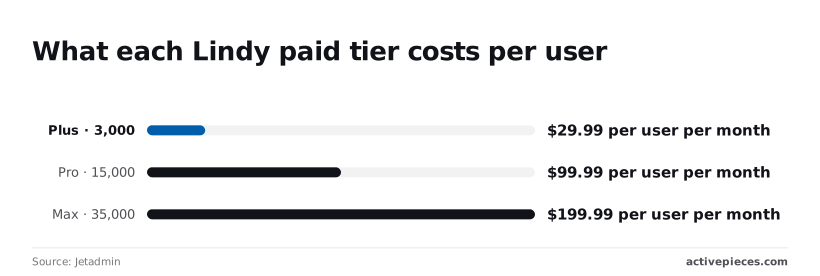
The [vendor's](https://www.activepieces.com/pricing) pricing page lists their credits as 3,000 for Plus, 15,000 for Pro and 35,000 for Max each month.
Moving from Plus to Pro multiplies the price by about 3.3 and the credits by five. Each added seat pays that rate again, so ten Pro users run $999.90 a month.

### Comparing different billing units
Don't line up 10,000 credits from a flat-fee platform against 15,000 Lindy credits. The two vendors define a credit differently, so equal numbers don't buy equal work.
Compare by running your busiest flow on each trial and watching what it consumes. Then price that against your seat count for Lindy and against the flat tier for the other product.
Prices may not be what decides this. Hosting and where your data lives can matter more, and the next section covers them.
## Hosting, licence and data control compared
If your data has to stay on infrastructure you control, only a self-hostable platform fits. From Lindy's published material that means looking beyond Lindy to an open-source platform; if a vendor-hosted service is acceptable, this question stops deciding anything.
I have seen **a lead-routing flow pulled from production** because it sent customer records through a service nobody had cleared with legal. That's the failure this comparison is meant to prevent.

Read the last row as the verdict by data need. The table shows what each vendor documents on the points that decide where data can live, with "not published" wherever Lindy is silent.
| | Activepieces | Lindy |
|---|---|---|
| Self-hosting | Yes | Not published |
| Open-source licence | MIT for the community edition, commercial licence for enterprise features | Not published |
| Data location | Wherever you deploy it | Not published |
| SSO | Beyond the Team plan, through sales | Not published |
| Admin controls | Scale with plan; enterprise through sales | Not published |
| SOC 2 | In progress, not certified | Not published |
| Verdict by data need | Data must stay in your own environment or region | Data may live with a hosted vendor, and you have confirmed its terms directly |
"Not published" is not "no". It means you have to ask Lindy before you can plan around it.
Self-hosting a platform like this, even fully air-gapped, doesn't mean settling for a stripped-down build: the access, audit and release controls (single sign-on, user provisioning, custom roles, audit logs, release management and secret managers) are the same list there as on the managed cloud, and regulated and public-sector organisations run the air-gapped edition in production.
MoneyGram, Moneypenny, Alan and FundingSocieties run the platform as well, so the control you need on your own servers isn't a lesser tier.
For Lindy I found no published self-hosting option or licence, so treat it as a hosted service.
Beyond the Team plan, single sign-on goes through the sales form. Lindy publishes nothing I could verify on SSO or admin controls, so ask before you roll it out to a department.
If your procurement checklist requires a finished report today, that's a gap: SOC 2 is in progress and not certified. For Lindy, ask for its report directly rather than assuming one exists.
## AI agents and integration breadth side by side
Sign in to Lindy and an agent is ready to configure; with a workflow platform you assemble a workflow and then put an AI step inside it.
### Building and running agents
In Lindy, the agent is the product. You describe what it should do, attach triggers and actions, and it runs on Lindy's infrastructure. When a run goes wrong, you debug inside Lindy's own interface, with whatever run history it exposes.
That's a fair trade for someone who never wants to open a config file, and a real limit for someone who needs to trace why step four received the wrong field.
In a workflow platform, an agent is one part of a flow you design. You choose the trigger, the branches, the model call and what happens with its output.
Every step is visible and can be re-run, so the failure's usually something you can point at.
### Integration counts and gaps
Don't read counts as a measure of fit; they are only a rough guide to coverage.
The open-source library has grown fast: it listed 280 integrations in March 2025 and 285 in June 2025, per the [pieces page](https://www.activepieces.com/pieces). That was almost flat for a quarter, so no one should assume a steady climb.
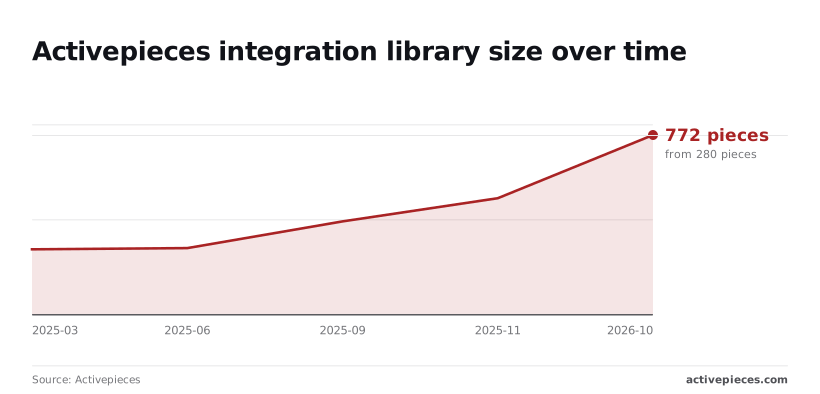
By September 2025 the library had reached 400, and in November 2025 it hit 500, which means a connector missing in spring may well exist now. **By October 2026 it stood at 772**, so check the current list before ruling anything out.
When a connector is missing, you have four options:
- Check the vendor's stated integration count and search by app name, since a count hides which apps are covered.
- Use a generic HTTP step: quick, but you handle authentication, pagination and errors yourself.
- Write a custom integration for the platform: reusable and cleaner to maintain, but it takes developer time.
- Ask Lindy to add it: no build work for you, but the timeline is theirs.
If one non-technical person needs a working assistant this week, Lindy is the better pick. There's nothing to host, no flow to design, and no integration to write.
## Embedding automation inside your own product
If customers need to build or run automations inside your product, an open-source workflow platform offers a route for it: the Embed plan, from $36,000 a year through sales, puts a white-label flow builder, AI agents and 760+ integrations inside your own product.
Lindy is built for your own team to use inside Lindy's app.
That gap shows up the first time a customer asks where their automations live and whose login they need.
### What embedding means
When you embed, your customers never leave your product. They build or switch on automations in your interface, under your branding and your authentication, while the workflow engine runs behind it.
A hosted assistant that your team configures is a different thing: the people using it sign in to the vendor's workspace, not yours.
The test is simple. If a customer would have to create an account with the automation vendor, you have integrated with it, not embedded it.
### Embedding with a self-hostable engine
Because the platform is open source and can be self-hosted, embedding is practical. You can run the engine in your own infrastructure, so customer workflow data stays where your product's data already lives. That matters when a customer's security review asks about subprocessors.
Embedding isn't a self-serve checkbox. It goes through the sales form at https://www.activepieces.com/sales, where you describe how you want to ship it and get terms for your case.
Plan for that conversation before you commit a roadmap date to it, and ask what's included for your deployment model.
### What Lindy publishes
I found no embedded or white-label offering described in what Lindy publishes. Its material describes assistants that you configure in its hosted app and connect to the tools your team already uses, so the documented path is customers or colleagues working in Lindy's own workspace.
You can still trigger a Lindy assistant from your product by other means, but your customers would be relying on a service they can't see into or branded as yours.
For shipping automation to your customers, the verdict is the open-source platform. For automation only your own staff use, this question doesn't decide anything.
## Verdict and next step by buyer type
Choose Lindy if you want a hosted assistant you configure without building anything. Choose Activepieces if you need self-hosting, embedding in your own product, or open-source control over the platform.
Nobody wants to maintain a workflow graph; your team just wants an assistant that answers email, books meetings or triages inbound requests. That is when Lindy fits.
Lindy is hosted, so there's no deployment to run and no upgrade to schedule. That suits a team where staff alone use the automation and a vendor's cloud is acceptable for the data involved.
If someone on your side will own the build and you want that build to live where you decide, a workflow platform fits.
**Self-hosting keeps data inside your own network**, **open source lets you read what runs**, and embedding lets you ship automation to your customers under your own product. If any of those is a requirement, a hosted-only assistant can't meet it.
### Mistakes buyers make
Choosing on features and discovering the constraint later is the usual failure. A team picks the hosted assistant, then security review says the data can't leave their network, and the migration starts from zero.
Choosing on features and discovering the constraint later is the usual failure.
The reverse also happens: a team adopts a build-it-yourself platform, **nobody is assigned to own the flows**, and the first broken step sits unfixed because it belongs to no one.
A third mistake is treating embedding as a later add-on. Decide it up front, because it changes the architecture.
Because each answer can end the search, the order of the questions matters:
1. Decide who owns the build: if nobody will, a configured assistant fits; if an engineer or ops owner will, a platform does.
2. Decide where data must live: if it must stay in your infrastructure, self-hosting is required.
3. Check whether you ship automation to customers: if you do, you need embedding.
4. Take the route: the [pricing page](https://www.activepieces.com/pricing) for self-serve plans, or the [sales form](https://www.activepieces.com/sales) for self-hosted enterprise, SSO beyond the Team plan, or embedding.
## Related reading
- [Activepieces vs Boomi for Self-Hosting and Embedding](https://www.activepieces.com/blog/activepieces-vs-boomi-for-self-hosting-and-embedding)
- [Activepieces On Premise: Pricing & Self-Hosting Guide](https://www.activepieces.com/blog/activepieces-on-premise-pricing-self-hosting-guide)
- [Activepieces on Kubernetes: How Self-Hosting Works in 2026](https://www.activepieces.com/blog/activepieces-on-kubernetes-how-self-hosting-works-in-2026)
## References
- [Jetadmin](https://www.jetadmin.io/blog/lindy-pricing/)
- [Activepieces](https://www.activepieces.com/pieces)
- [Activepieces](https://www.activepieces.com/pricing)