| | Node-RED (function nodes, JavaScript) | Activepieces (step builder with code steps) | |---|---|---| | Skill required | Working JavaScript and comfort with JSON message objects | Reading a form-style step; code is optional | | Editor model | Canvas of nodes joined by wires, with a palette of installable nodes | Linear list of steps with branches, each configured in a side panel | | How logic is written | Function nodes hold JavaScript that reads and modifies the message | Built-in steps for most logic, code steps when you need your own | | Versioning | Flows are exported as JSON files, so you manage history yourself unless you enable its Projects feature with Git | Handled in the product, with published and draft versions of each flow | | Handover | Easy for the next developer, hard for a non-coder | Easy for a non-coder, with code steps flagged for a developer | | Winner | Engineering teams | Mixed teams | ### Node-RED: nodes, function code and the palette On Node-RED's canvas, each node does one job and wires pass a message object between them. Anything that doesn't fit a ready-made node goes into a function node, which means writing JavaScript against that message. That's a strength if your builders already think in objects and callbacks. It's a wall if they think in spreadsheet formulas, because the first time a payload arrives in an unexpected shape, the fix is code.  ### Activepieces: step builder and code steps In Activepieces a workflow is an ordered list of steps, each filled in through a panel rather than written out. Most logic, such as branching, looping and mapping fields, is configured, not coded. When a step needs something custom, a code step lets a developer drop in a script, and everyone else can still see where it sits in the sequence. The hidden cost is that a code step becomes a spot only your one developer can maintain, so name an owner for each. If developers build and maintain the flows, Node-RED fits, and its JavaScript-first model costs them nothing. If operations or marketing staff own the workflows, Activepieces fits better, because the person who notices the failure can also fix it. 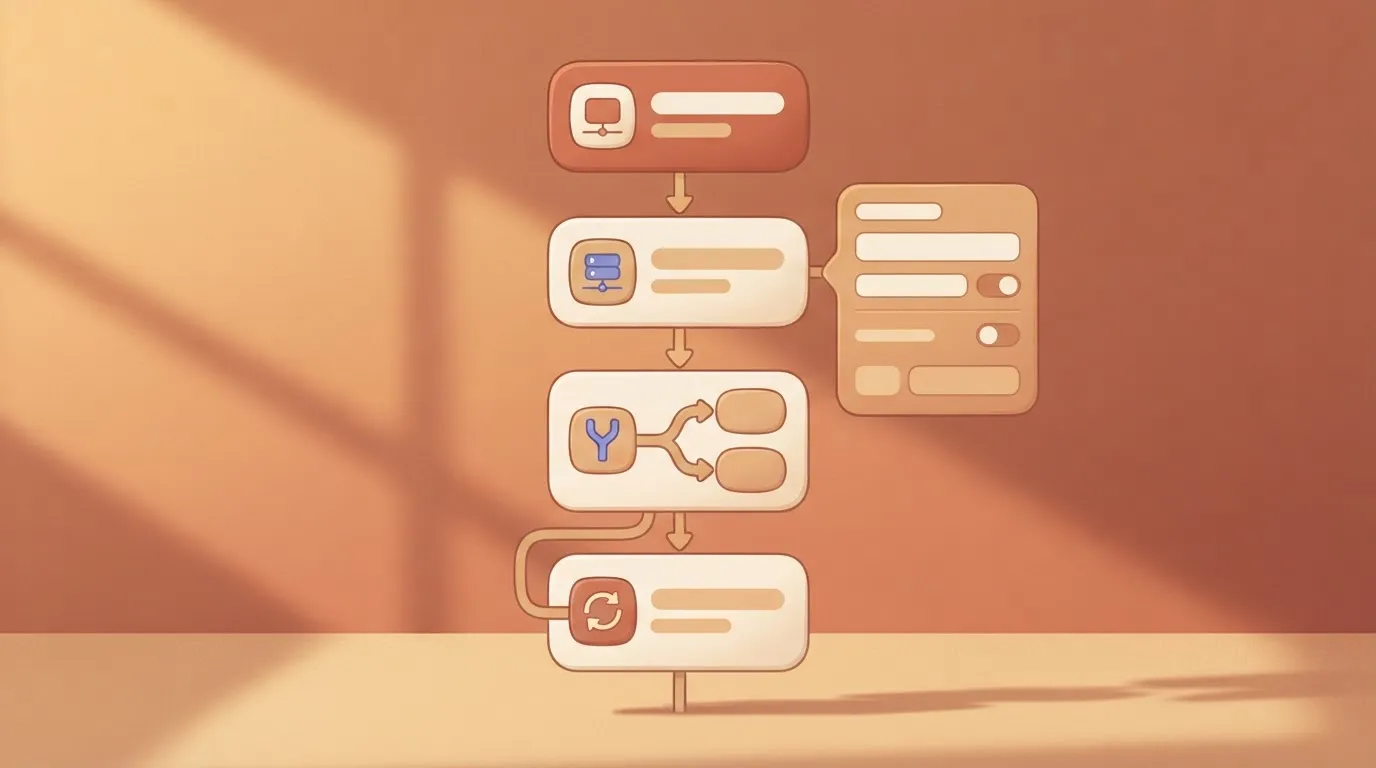 ## Device and business app connections Some things emit signals, and some are things people type into. Node-RED connects to the first, like sensors, controllers and message brokers. Business-app tools connect to the second, like CRMs, ticketing and inboxes. Out of the box, Node-RED ships MQTT, TCP, UDP, HTTP and WebSocket nodes in its core. Serial-port and Modbus support come as installable nodes, the Modbus ones from community packages. A flow that polls a Modbus register every second and publishes to an MQTT broker is therefore a handful of wired nodes. In a business-app tool, the same job means standing up a bridge service first. Community nodes are volunteer-maintained, so check a node's last update before you build a production line on it. ### SaaS apps and business systems For CRMs, ticketing, email and chat apps, the pre-built catalogue's what lets a mixed team build without a developer. The [Activepieces GitHub monorepo](https://github.com/activepieces/activepieces/tree/main/packages/pieces/community) shows the count rising from 100 integrations in 2023 to 280+ by March 2025, which means teams can automate workflows across far more of their existing tools without custom development. It passed 600+ by the end of 2025 and **reached 746 in 2026**. What matters is pace: the app your company adopts next year is more likely to be covered already, and each gap closed is one fewer set of hand-written API calls for someone to maintain. *(chart)* That pace only matters for the apps you actually run, and the next question is who wires them up. In Activepieces, someone in operations describes the process in the built-in chat, say an approval that touches the CRM and the billing system, and the chat builds and publishes it as a live flow in your account, identical to what a developer would have assembled by hand. 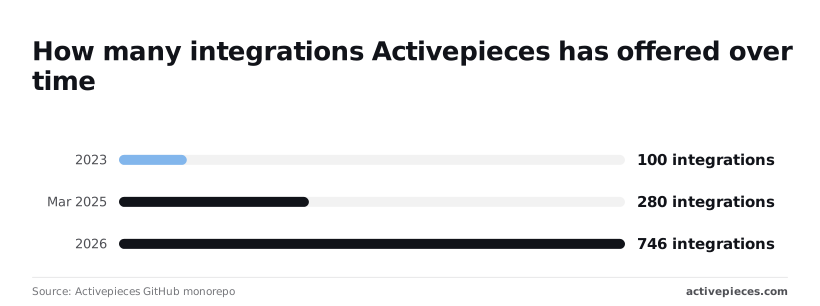 That flow answers to the same RBAC and audit logs as every other, and each run leaves a trace anyone on the team can open and read, no developer needed to interpret it. MoneyGram, Moneypenny, Alan and FundingSocieties run Activepieces in production. You don't hire for this, you describe it; Node-RED stays the answer for the Modbus line. ### Why connector counts mislead in comparisons Compare the counts and you're not comparing like with like. One side tallies packaged app integrations. The other includes protocol primitives and community-contributed nodes, which vary widely in depth and upkeep. A bigger number doesn't tell you whether your ten systems are covered.  List those ten systems and check each one against both catalogues. Where a connector is missing, a generic HTTP request step works in either tool. But you then own authentication, pagination and error handling yourself. It lands on whoever built the workflow, and it's the reason the next criterion is about who that person is. ## Licensing and hosting requirements You pay nothing for the software itself in either tool, so the real bill is hosting and whoever keeps the workflows alive after the person who built them moves on. ### Licence and self-hosting for Node-RED Under Apache 2.0, Node-RED can run on a server, a Raspberry Pi or a plant-floor gateway with no licence fee. The cost you take on instead is the machine, plus an engineer who patches it and restores it when it falls over. Activepieces' community edition is MIT-licensed and also self-hostable, so both tools can sit entirely inside your own infrastructure. ### Entry pricing and sales-quoted plans compared Because Node-RED has no price of its own, the managed-hosting figures below come from FlowFuse, a company that runs Node-RED for you. | | Node-RED | Activepieces | |---|---|---| | Licence | Apache 2.0 | MIT (community edition) | | Hosting | Self-host, or managed via FlowFuse | Cloud, or self-host | | Entry price | $0 self-hosted; FlowFuse $15 to $50/month | Free $0 (1,000 credits); Plus $20 (10,000); Team $200 (50,000); higher tiers quoted by sales | 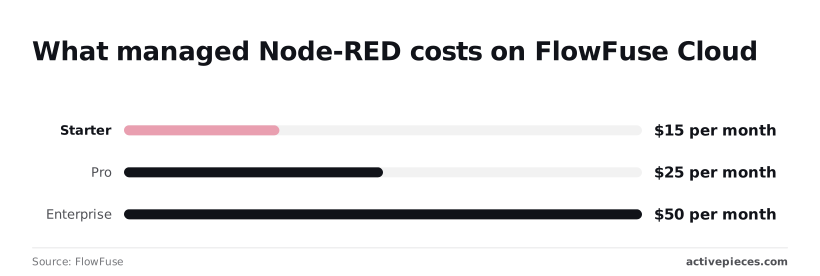 On [FlowFuse's pricing](https://flowfuse.com/changelog/2024/04/pricing-change/), Starter runs $15 a month, Pro $25 and Enterprise $50, allowing teams to start small and expand their investment as their automation needs grow. On [Activepieces' pricing page](https://www.activepieces.com/pricing), Free is $0, Plus is $20 and Team is $200 a month. **The jump from Plus to Team is tenfold**, so check your monthly volume against the credit allowances before you pick a tier.  Anything above Team, including self-hosted enterprise, is quoted by sales, so there's no public number to budget against. ### Hidden maintenance costs of self-hosted automation When a flow stops at 2 a.m., a $0 self-hosted instance turns out to need someone to answer, as well as someone to apply updates and manage credentials, so **the apparent cost savings hide real expenses**. If that person's a JavaScript-comfortable engineer, the cost's small and already in payroll. If the workflows belong to an operations team with no engineer on call, you're paying for a managed tier or for a favour from a developer. ## Admin controls, AI agents and embedding compared For a small team of developers on one trusted instance, Node-RED's built-in login is enough; past that, you add tooling or write it yourself. The table shows where each tool stands on the three criteria and where that login stops being enough. | Criterion | Node-RED | Activepieces | Verdict | |---|---|---|---| | SSO and admin controls | Local users or a custom login strategy in `settings.js`; access is essentially read or full edit | Admin features such as SSO and roles on paid plans | Built-in login suffices for a few developers; mixed teams need more | | AI agents | No agent builder; community nodes call model APIs | Agents built into the product | Node-RED if you want to code the agent loop; the other if non-developers build them | | Embedding | Runs as a Node.js module inside your app | Embedding offered for customer-facing automation | Depends on whether you embed a runtime or a builder | ### SSO, roles and audit To protect the editor, Node-RED's `adminAuth` setting takes local accounts or a login strategy you plug in, and permissions are coarse: someone can read flows or change them. There's no native audit trail, so "who changed that flow?" is answered by your version control or a managed layer such as FlowFuse. That's acceptable when everyone with access is a developer you know. It breaks once an operations lead needs edit rights without touching the flows beside theirs. Expect to build the agent yourself, because Node-RED ships no agent framework. You wire model calls with community nodes or an HTTP request, and you own the memory, tool-calling and retry logic. A JavaScript-fluent team gets full control that way, and everyone else inherits a flow only its author understands. Started from inside a Node.js application, Node-RED works well as a hidden runtime for device logic. It has no multi-tenant editor, though, so exposing flow building to your customers means building that isolation yourself. ## Final verdict and next steps Pick by who'll maintain the workflows: Node-RED when developers own device and data-stream work, the other tool when non-developers must own business workflows or you need SSO and embedding. Work through these in sequence and write down each answer: 1. Name who maintains the workflows, by role, including whoever inherits them after the original builder leaves. 2. List what they connect to: sensors, protocols and message streams, or business apps like a CRM, a help desk and a spreadsheet. 3. Check whether you need SSO or want to embed automation inside your own product. 4. Pick the tool the first three answers point to. 5. Take the next step: the [pricing page](https://www.activepieces.com/pricing) for self-serve plans, or the [sales form](https://www.activepieces.com/sales) for self-hosted enterprise, SSO beyond the Team plan, or embedding. Choose Node-RED if your maintainers are comfortable reading and writing JavaScript, and the work is wiring devices, gateways and message streams. Function nodes are ordinary code, which is a strength when the person on call writes code and a handoff problem when they don't. Choose Activepieces if operations, marketing or finance staff need to build and fix workflows themselves, and the list in step two is mostly business apps. The same applies if you need SSO or want to embed automation in your product. Those last two are the ones to take to the sales form rather than assume from a plan name. Before you commit, avoid these mistakes: - Comparing feature lists instead of asking who opens the editor at 9 a.m. on a Monday when a flow breaks. - Choosing for the builder you have today, not the person who inherits the workflows in a year. - Treating self-hosting as free. **Someone still patches, backs up and monitors it**. - Leaving SSO and embedding until after the pilot, when changing tools means rebuilding every flow. ## Related reading - [Node-RED Enterprise Edition? What to Buy or Build](https://www.activepieces.com/blog/node-red-enterprise-edition-what-to-buy-or-build) - [9 Best Business Process Automation Tools in 2026](https://www.activepieces.com/blog/best-business-process-automation-tools) - [DeepSeek R1 vs V3 for Business Workflow Automation](https://www.activepieces.com/blog/deepseek-r1-vs-v3-for-business-ai-2026-guide) ## References - [Activepieces GitHub monorepo](https://github.com/activepieces/activepieces/tree/main/packages/pieces/community) - [FlowFuse](https://flowfuse.com/changelog/2024/04/pricing-change/) - [Activepieces](https://www.activepieces.com/pricing)At 9 a.m., when the workflow breaks, the person who opens it should decide the tool.