## Identify steps requiring generative judgment Maintenance debt is the result of selecting the wrong tool, forcing you to either fix brittle regex for unpredictable data or audit hallucinating AI for simple logic. ### Check data format and structure first Parsers can validate predictable data that follows a schema. When data arrives in a fixed format, such as a JSON payload from the Stripe payment gateway, a deterministic script can map fields with absolute certainty. Conversely, unstructured data like a recorded sales call requires a generative model to extract intent. The lack of a fixed schema makes it impossible to write a permanent rule for every conversational variation. ### Assess decision complexity before choosing a tool "If-this-then-that" logic drives binary decisions where you know every possible outcome at the time of writing. A workflow that routes a ticket based on a dropdown selection in the Zendesk customer service platform is binary. Nuanced decisions require the contextual understanding of an AI agent. Determining if a customer’s tone in an email warrants an executive escalation is one example. The following table categorizes these requirements to help you identify which engine should power a specific step: | Criterion | Deterministic Logic (Code/Rules) | Generative AI (LLMs/Agents) | | :--- | :--- | :--- | | Data Predictability | Structured (API payloads, CSVs) | Unstructured (Audio, free-text) | | Decision Complexity | Binary (True/False, Fixed routing) | Nuanced (Sentiment, Synthesis) | | Error Tolerance | Zero-tolerance (Financials, Legal) | Directionally correct (Drafts, Summaries) | Activepieces runs these two distinct logic types on a single engine, allowing you to place an Agent step directly alongside deterministic automation steps in one flow definition. By avoiding the need to bridge separate products with a webhook, you can open a single run trace and see the entire execution logged from the initial rule to the final agentic judgment. ### How much error tolerance does the task allow A single character deviation in a zero-tolerance task results in a critical business failure. Deterministic systems are mandatory here because they produce the same output for a given input every time. AI agents are non-deterministic. The OpenAI GPT-4o model might return two different interpretations of the same prompt. This makes them suitable only for tasks where being "mostly right" provides value, such as drafting a suggested response that a human will later review.  ### The operational cost per run Token costs and high latency accompany every execution of a generative agent. A Python script running on a serverless function costs fractions of a cent. Calling a sophisticated model like Anthropic’s Claude 3.5 Sonnet is **orders of magnitude more expensive** per request. Reserving AI for only the steps that fail the first three criteria ensures your automation budget isn't consumed by tasks that a simple filter could have handled. ## Evaluating common business tasks against the execution criteria ### Automating inbound lead routing and normalization Because the decision tree relies on fixed fields like "Company Size" or "Country," deterministic logic handles lead routing more reliably than an agent. Relying on a non-deterministic LLM for this step introduces the risk of "hallucinated" territories. A high-value lead could be assigned to a representative who doesn't cover that region. ### Analyzing customer sentiment and drafting responses Subjective judgment defines the edge of deterministic capability. While a regular expression can flag the word "angry," it can't distinguish between a sarcastic complaint and a technical bug report. An AI agent is necessary here to interpret the nuance of the unstructured text and draft a context-aware response in Zendesk. However, the cost of this reasoning is high. A comparison of token consumption per execution shows that a Basic RAG Retrieval uses approximately 800 tokens per task. A Multi-step ReAct Agent consumes between **10,000 and 50,000 tokens** per task. ### Reconciling unstructured invoice data Reconciling invoices requires a hybrid approach where deterministic code validates the math and AI agents parse the layout. Use an Optical Character Recognition (OCR) tool to extract text from the PDF. Deploy an AI agent to map unstructured labels, such as "Handling Fee" or "Service Charge," to the correct general ledger codes in NetSuite. Pass the extracted totals to a deterministic script to verify that the line items sum correctly. Arithmetic is offloaded to a script to prevent the agent from making "calculator errors," which are common in LLMs.  ## Orchestrate hybrid agentic workflows using Activepieces ### Connecting deterministic triggers to LLM steps Activepieces runs non-deterministic AI agents alongside code-defined API events in a single execution engine, ensuring that probabilistic steps remain anchored to immutable triggers. The platform allows you to define a strict sequence. A webhook from a payment processor or a new row in a database is the immutable trigger, ensuring the automation only fires when verified data exists. By using the Data Selector to map specific variables into an LLM prompt, you dictate exactly which fields the agent can see. [Screenshot: The Activepieces flow builder with a Data Selector modal open in the center. The modal shows two tabs: "Data" and "Variables", with the Variables tab active. A search field labeled "Search variables" is visible, and below it is a list showing one variable "STRIPE_PROD" with a purple icon. On the right side, a Code step panel is open showing input configuration with a "context" field and an "Add Item" button. The flow canvas in the background shows a trigger step and a code step (step 2) which is currently selected.]  Granular mapping ensures the LLM receives only the necessary "STRIPE_PROD" metadata. Once the agent processes this input, the workflow must revert to a structured format to protect downstream systems. ### Adding human-in-the-loop approval guardrails Activepieces enforces reliability by inserting mandatory approval steps between the agent’s subjective output and the final execution of a business action. Approval Actions halt the flow until you click "Approve" or "Reject." This prevents a misaligned agent from committing permanent data errors. Branching Logic routes high-confidence outputs to automated paths while sending ambiguous results to a manual review queue. Error Handling Paths define exactly what happens when an API call fails or a model returns an empty string, so the system fails gracefully. Your AI agent is not just code; it is a user that requires a tenant, a role, and an audit log to operate safely. Activepieces places every agent inside the same access model as employees, using enterprise RBAC and SSO to govern what it may connect to. In the run detail view, each tool call is listed separately with its own input and output, ensuring that agent actions are never collapsed into one opaque result. By unifying deterministic triggers and agentic reasoning within a single execution engine, Activepieces eliminates the fragmentation of bridging separate systems via callbacks. Activepieces is the better choice for developers who require a single, transparent run trace to monitor hybrid workflows from start to finish. 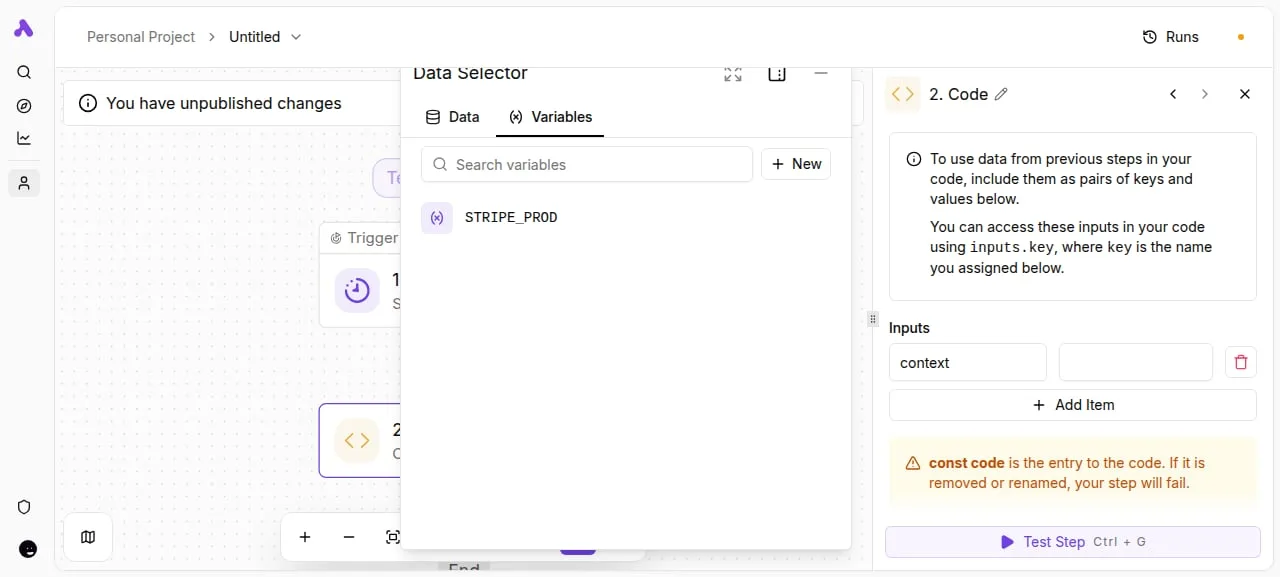 This integrated approach ensures that probabilistic AI steps remain strictly anchored to immutable data, providing superior reliability and oversight. ## The Monday morning workflow audit checklist Auditing the friction points where staff pause to interpret data will show you where to swap rigid code for AI agents. ### Step 1: Map the current manual bottlenecks Begin the audit by identifying every instance where a team member must open a source document to extract intent before they can proceed with a task. Identify steps where staff spend more than ten minutes "reading" before clicking. Flag "brittle" Regular Expression (Regex) steps with less than seventy percent accuracy. These failures force manual overrides that negate the speed of the automation. Calculate token spend versus task value for every AI call to ensure the cost of the LLM doesn't exceed the profit margin of the transaction it processes. ### Step 2: Score steps against the four criteria Every flagged bottleneck must be evaluated to determine if it requires a Large Language Model or if it simply needs better deterministic engineering. A task earns an AI agent only if it involves high-variance text, requires subjective classification, lacks a predictable schema, and carries a low cost of failure. Calculating a tax rate or moving a file between folders fails these criteria. These are mathematical or structural tasks that should remain in a standard automation tool like Zapier. ### The case for established deterministic platforms Zapier remains the industry standard for operations teams who prioritize a massive library of pre-built integrations over custom agentic reasoning. With over 7,000 supported applications, it allows non-technical users to connect almost any SaaS tool in minutes without writing a single line of code. The platform excels at high-volume, low-complexity tasks where the primary goal is moving data from point A to point B. If your workflow consists entirely of structured triggers and actions, the sheer breadth of the Zapier ecosystem provides a level of convenience that newer, agent-focused platforms cannot yet match. ### Step 3: isolate the AI agent steps in a test environment Sandboxing a non-deterministic agent is required before deploying it into a live production environment to prevent it from triggering unintended API calls. Isolation ensures that if an agent hallucinated a command, it only impacts test records rather than your primary database. MoneyGram and Alan run these hybrid environments in production, using the MIT-licensed core to maintain control over their automation strategy. By combining 735+ integrations with a unified execution engine, these teams ensure that judgment and rules work together without the overhead of bridging separate platforms. ## Frequently asked questions ### How much more do AI agent steps cost compared to standard APIs? High operational overhead is part of agent steps because they require multiple round-trips to large language models rather than a single request to a structured endpoint. In a standard API call to a CRM like Salesforce, you pay for a single transaction with a predictable execution time. Several reasoning cycles may be invoked to complete one task when using an orchestrator like LangChain. This means a single agentic decision can cost orders of magnitude more than a deterministic script. Using them for simple data entry rapidly inflates your monthly compute bill without adding functional value. ### What is an acceptable error rate for an AI agent step? The cost of remediation compared to the cost of manual processing defines an acceptable error rate. If an agent categorizing support tickets in Zendesk has a failure rate higher than your team's capacity to audit it, the automation creates a backlog rather than clearing one. Any step with a non-zero error rate requires a fallback mechanism because non-deterministic outputs can hallucinate facts or fail to follow formatting instructions. You're essentially paying for both the AI’s attempt and the human’s correction. ### How do you prevent an AI agent from breaking downstream automation? In agentic workflows, strict schema validation at the exit point of every step is the only way to prevent downstream failure. Since an agent might return a JSON object with missing keys or unexpected strings, a deterministic validator like Pydantic must sit between the agent and the next system to ensure only sanitized data passes through. Malformed data hits a hard stop here. A creative error in the agent step doesn't trigger a cascade of failures in the accounting or shipping software that follows it. ## Related reading - [What is an AI Agent Harness? A 2026 Guide](https://www.activepieces.com/blog/what-is-an-ai-agent-harness-a-2026-guide) - [Best AI Agent Platforms for Workflows: 2026 Guide](https://www.activepieces.com/blog/best-ai-agent-platforms-for-workflows-2026-guide) ## References - [Digital Applied](https://www.digitalapplied.com/blog/88-percent-ai-agents-never-reach-production-failure-framework)Flexibility becomes a liability as soon as an agent touches a live database.