A single runaway alerting loop on a high-frequency model like GPT-6 Luna can rapidly erode your month's operational margin. ### Why the 'immediate alert' default failed the business By defaulting to immediate, stateless alerts, you ignore the historical context of your system. It treats a momentary 500ms delay in a Claude Haiku 4.5 call the same as a total service outage.  Activepieces reduces noise by requiring sustained deviations before escalating to human responders, as shown in the following table where stateful logic is applied to the monitoring flow. | Dimension | Stateless Alerting (Event-Based) | Stateful Alerting (Threshold-Based) | | :--- | :--- | :--- | | Trigger Logic | Fires on every single error packet | Fires only when condition persists for N minutes | | Data Context | Single isolated packet | Historical window of previous 5–15 minutes | | Notification Volume | High; scales linearly with traffic spikes | Low; one notification per state change | Only when the system moves from a 'Healthy' to a 'Degraded' state (rather than for every transient hiccup) does stateful logic ensure your system pages an engineer. ### How alert overload delays outage remediation 14,000 alerts arriving at once collapses the "signal-to-noise" ratio, extending the time-to-remediation for actual outages. Honeycomb reports that while the cloud median for observability spend is 7% to 12%, high-performing teams often see this rise to **15% to 25% to manage the complexity** of modern stacks. By the time a lead engineer manually filters the logs for a Grok 4.7 deployment, your system has likely breached the service level agreement (SLA). This results in financial penalties and a loss of client confidence. ## Define thresholds for noise and risk  Compliance monitoring thresholds are the mathematical boundaries that distinguish expected model drift from actionable regulatory violations. Without these quantified limits, you can't maintain a defensible audit trail or direct high-value engineering resources toward genuine systemic failures. ### Static limits vs. dynamic probability scores While rigid boundaries are effective for binary infrastructure requirements, they fail to capture the probabilistic nature of modern large language models. A hard limit on request latency is necessary for maintaining service level agreements, but assessing the qualitative output of a model like Claude Opus 5.5 requires dynamic scoring. Probability-based thresholds allow your compliance officers to ignore minor semantic variations while triggering an investigation only when the model’s confidence score for a specific regulatory constraint falls below a pre-calculated percentage. ### Setting sensitivity levels for PII detection To prevent the accidental exposure of sensitive data during model inference, protecting Personally Identifiable Information (PII) requires a tiered sensitivity approach. When deploying a model such as Gemini 3.8 Flash for enterprise workflows, your monitoring system must distinguish between public-facing data and internal records.  1. Any detection of social security numbers or banking routing codes triggers an immediate session termination and an automated report to the Data Protection Officer. 2. The system redacts potential names or addresses in real-time. 3. This allows the process to continue while creating a record for periodic compliance review. 4. The system flags ambiguous strings that resemble protected identifiers for manual audit without interrupting the user experience. ### Why 'alert on every error' is not a compliance strategy Upstat provides data illustrating the danger of unfiltered telemetry. At 2:55 AM, the system is stable. A minor API handshake failure at 3:02 AM causes alert volume to spike from 0 to 14,000 alerts per minute.  Compliance frameworks must shift toward state-based monitoring to avoid this. The system only triggers an alert if the error rate exceeds a sustained percentage of total traffic over a specific window. Activepieces provides the sandboxed environments and Git Sync required to test these threshold adjustments against historical logs before they reach production. By promoting versioned flows through Release Management, teams ensure that a change to alerting logic is a reviewed software deployment rather than a silent UI update. Check the Git Sync and Release Management documentation for how this operates identically on self-hosted or cloud infrastructure. ## The technical architecture of stateful tracking To move beyond stateless triggers, your infrastructure must maintain a memory of recent events. This requires a storage layer that acts as a buffer between the raw event stream and the notification engine.  ### Tracking error counts with Redis caching A common pattern for tracking error frequency involves incrementing a counter in a fast, in-memory store like Redis. When an error occurs, the system increments a key associated with that specific error type and sets a short expiration time. If the counter exceeds your defined threshold before the key expires, the system transitions from a healthy state to an alerting state. ### Using Prometheus to query sliding error windows For more complex compliance monitoring, practitioners use time-series databases like Prometheus to evaluate sliding windows of data. Instead of looking at a single packet, the system executes a query that calculates the error rate over the last five or ten minutes.  This mathematical smoothing ensures that a single failed request to a model like GPT-6 Luna does not trigger a page unless the failure rate represents a statistically significant deviation from the baseline. ### Using dead man's switch alerts for missing heartbeats In scenarios where the absence of data is the primary risk, a dead man's switch logic is required. The monitoring system expects a "heartbeat" signal from the AI agent at regular intervals, and the alert only fires if the stateful tracker fails to receive this signal within a specific grace period. This ensures that a silent failure or a complete service hang is detected even when no explicit error packets are being generated. ## The high cost of missing the threshold When your monitoring architecture treats every individual API anomaly as a terminal system failure, you reach operational paralysis. Without state-based thresholds, a single transient error from a high-velocity agent like Claude Opus 5.5 can trigger a cascade of redundant alerts that bury your audit team in noise. ### Deduplicating alerts to filter retry noise The collapse of monitoring efficiency is typically caused by a failure to distinguish between a persistent security breach and a momentary burst of agentic retry logic. When a developer uses Gemini 3.8 Flash for enterprise workflows, the model may attempt to navigate complex permission structures that result in several rejected requests within a single second. Specific technical deficiencies turn these routine operations into a systemic crisis. Your monitoring tool floods the communication channel with a separate alert for every rejected packet because it lacks rate limiting on notification nodes. A threshold of 1 for UnauthorizedAPICalls during agent bursts means a single misconfigured header triggers the same emergency response as a coordinated data exfiltration attempt. ### Why flat notification channels fail compliance needs Because they lack the hierarchical approval structures necessary for financial-grade compliance, fragmented alerting systems fail. If an automated script using GPT-6 Astra encounters a rate limit, sending that technical metadata directly to your Chief Risk Officer’s dashboard creates a "crying wolf" effect that devalues critical security signals. Every agent tool call and the specific data it processed is captured in the Activepieces Run Details, allowing for a step-by-step trace of agentic decisions alongside deterministic workflow steps. These traces export via event streaming into existing SIEMs, ensuring that an agent's reasoning is audited with the same rigor as a standard system log. Check the Observability and Monitoring documentation for the per-step agent decision trace and audit log export features. ## Standard industry patterns for stabilizing compliance alerts Stabilizing compliance alerts requires a shift from binary triggers to statistical smoothing that accounts for expected model variance. ### Calculating moving averages for error rate baselines By calculating a moving average over a sustained window, you ensure that your engineers only respond to systemic degradation. 1. Your team calculates the 7-day moving average to establish a baseline for typical model behavior. 2. They define the cooldown period to prevent multiple alerts from firing during a single known incident. 3. The workflow maps tiered severity levels (P1 to P4) to ensure the response effort matches the financial or operational risk. 4. Finally, your team sets the 'M of N' rule, such as 3 failures out of 5 checks, to confirm that an issue is persistent before escalating. ### Tiered escalation: Slack for warnings, PagerDuty for breaches A tiered approach ensures that your business handles minor drift in a cost-sensitive model like GPT-6 Luna during business hours. P3/P4 Warnings go to Slack. This is a collaborative communication platform where developers can review non-critical drift or minor hallucinations without interrupting production workflows. P1/P2 Breaches go to PagerDuty. This incident response tool wakes an on-call engineer when a model violates core safety or financial accuracy thresholds. Mapping these tiers to specific communication channels prevents the "crying wolf" effect that leads to ignored notifications. ### Using cooldown periods to stop alert loops Without a cooldown period, the resulting flood of alerts can crash the notification infrastructure itself. By locking the alert state for a set duration after the initial notification, your system provides your engineering team the necessary air gap to implement a fix. This administrative control ensures your audit log remains readable and your response team remains focused on restoration rather than inbox management. ## Building a resilient monitoring circuit with Activepieces Activepieces automates the construction of compliance circuits that transform raw logs into structured, state-aware oversight workflows, a capability companies like FundingSocieties use to manage complex automation environments. ### Using the 'Wait' integration to batch compliance anomalies A compliance officer reviews a unified report of model behavior. They don't have to read thirty separate alerts for the same drift event. The flow builder interface is a visual canvas where you can drag the Google Sheets or Microsoft Excel 365 integrations into the sequence to log these events systematically, ensuring that data capture remains consistent without requiring manual coding, which means your team can automate record-keeping while eliminating the risk of human error. 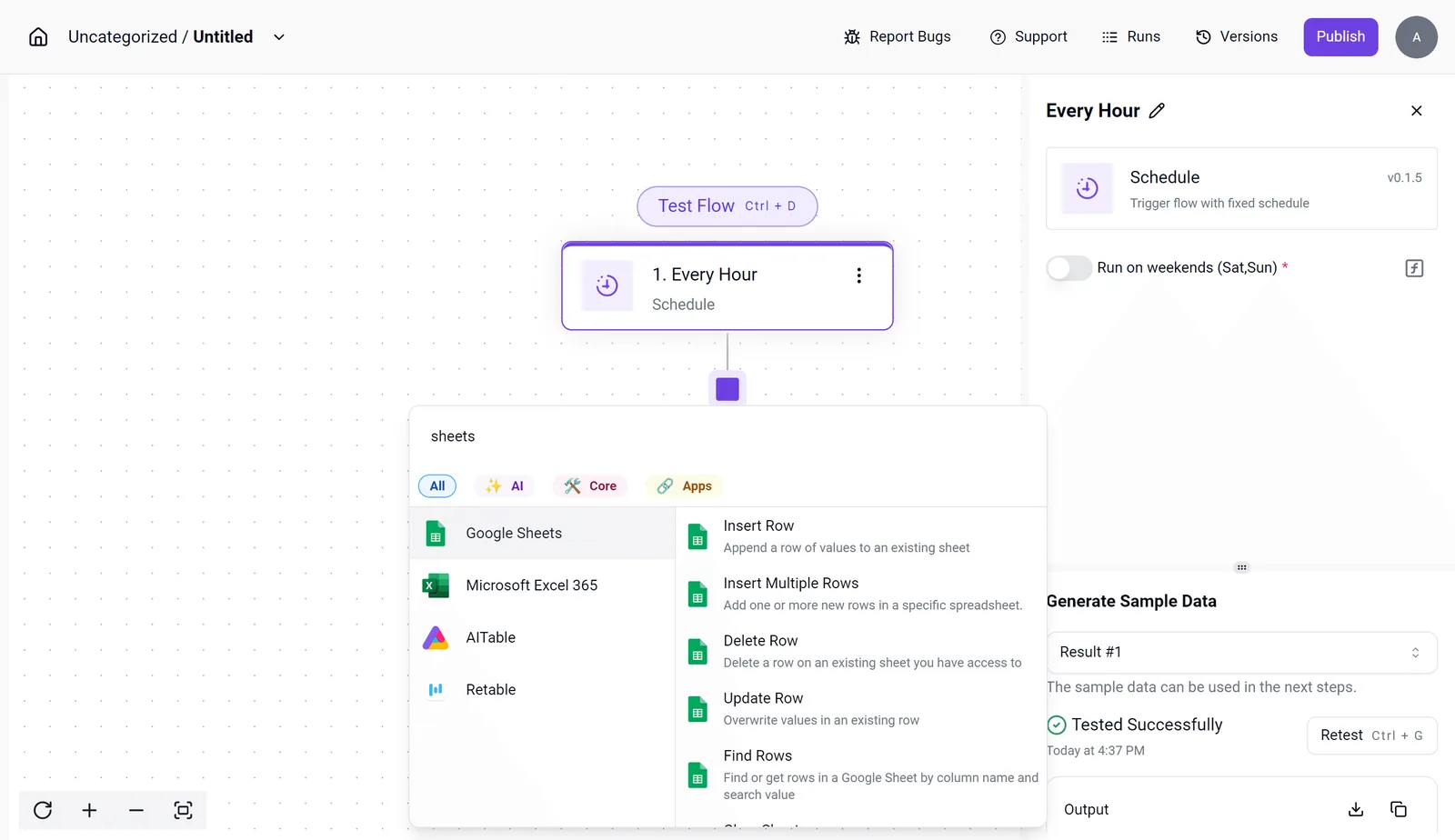 Selecting the "Insert Row" action within the Google Sheets integration allows your system to append state data to a central ledger automatically. Under the [EU AI Act](https://www.aiact-info.eu/regulation/AIACT/article/99/penalties), this structured logging is critical for avoiding the €15,000,000 maximum fine for non-compliance with "other obligations", so failing to implement these workflows could jeopardize the organization's entire annual budget. ### Setting up conditional branching for high-confidence threats By using conditional branching within Activepieces, you ensure that your system escalates only those anomalies that exceed pre-defined safety thresholds, such as a model hallucinating restricted financial advice. Examples of prohibited practices include a model utilizing biometric categorization in a forbidden context. This distinction matters because prohibited practices carry a maximum fine of **€35,000,000 under the EU AI Act**.  By using the "Find Rows" action to compare current model outputs against a database of prohibited keywords, your system can determine if a model like Gemini 3.8 Flash is operating within its safety envelope. ### Integrating human-in-the-loop approvals for threshold adjustments Before any automated change to a model’s operational threshold is finalized, Activepieces triggers a human-in-the-loop approval to verify the integrity of your compliance data, using its MIT-licensed core to ensure these governance steps remain auditable. ### Mitigating regulatory fines through accurate reporting Financial Risk Mitigation prevents the €7,500,000 fine for providing misleading information to notified bodies, effectively shielding the company from the severe fiscal consequences of regulatory inaccuracy, thereby preserving capital that would otherwise be lost to oversight failures, which means the organization retains significant liquidity to reinvest in core operational growth. Segregation of Duties ensures that the developer who builds the Gemini 3.1 Pro agentic workflow isn't the same person who approves the monitoring thresholds. Audit Persistence creates a time-stamped record of who authorized a threshold change. This provides a clear chain of custody for regulatory reviews. The following visual demonstrates the Activepieces flow builder during a test phase, showing how a scheduled trigger coordinates with spreadsheet integrations to maintain this persistent state. Once the schedule and data logging steps are verified, your architect can extend the logic to include the specific reasoning capabilities of frontier models. ## Frequently asked questions about AI monitoring thresholds ### Do higher thresholds increase the risk of a regulatory fine? By ensuring that your compliance officers focus on sustained deviations, state-based thresholds actually reduce regulatory risk. These indicate a systemic failure of internal controls. When an architect sets a threshold that ignores transient noise, they prevent the alert fatigue that causes staff to overlook genuine breaches of the Sarbanes-Oxley Act or similar financial reporting requirements. ### How often should we recalibrate thresholds for LLM drift? Whenever a vendor pushes a significant update to the underlying weights or when your enterprise changes its internal risk appetite, recalibration must occur. Because models such as Gemini 3.8 Flash are frequently optimized for speed, their performance on specific reasoning tasks can shift. Your team should re-baseline performance against the existing golden dataset after a model version update to ensure the threshold still captures true failures. ### Can we automate the adjustment of thresholds based on traffic volume? Provided the logic maintains a strict segregation of duties between the system and the auditor, automating threshold adjustments is a viable strategy for managing infrastructure costs. 1. Your team then establishes a Floor and Ceiling range for operational metrics like response time. 2. The monitoring agent is programmed to widen operational alerts during high-volume periods while locking safety-critical reasoning checks. 3. Every automated adjustment is logged to a read-only ledger for end-of-month compliance review. ## Related reading - [Automate AI Compliance Monitoring: Data Supply Chain Guide](https://www.activepieces.com/blog/automate-ai-compliance-monitoring-data-supply-chain-guide) - [How To Automate Competitor Price Change Alert](https://www.activepieces.com/blog/how-to-automate-competitor-price-change-alert) - [EU AI Act fines & penalties: A 2026 Compliance Guide](https://www.activepieces.com/blog/eu-ai-act-fines-penalties-a-2026-compliance-guide) ## References - [Honeycomb](https://www.maximaconsulting.com/newsroom/observability-needs-its-own-finops-strategy) - [EU AI Act Info](https://www.aiact-info.eu/regulation/AIACT/article/99/penalties)Nearly a third of your budget is spent simply watching the other two-thirds work.