You can develop in the cloud and promote to your own infrastructure via Git Sync, ensuring that enterprise features like SSO and audit logs remain available regardless of the deployment target. The following logic components are typically lost during export: * Multi-agent "Helper" routing * Context window management (auto-truncation) * Proprietary prompt templates * Managed RAG chunking strategies An exported workflow is an inert artifact without the vendor's internal orchestration. Your team must manually reconstruct the decision trees that previously handled error recovery and state management. ### Why nested agent loops break on migration Moving off-platform exposes the fragility of recursive reasoning loops that specialized platforms usually hide. When a workflow relies on "Helper" agents to validate the output of a primary model like Claude Opus 5.5, the export only provides the final prompt. It doesn't provide the conditional logic that triggers the second agent.  Hallucinations or execution timeouts are the result when edge cases, previously handled by internal routing, fall into this logic vacuum. This forces engineers to write custom state machines just to reach baseline performance. ### Rebuilding context window management yourself Proprietary layers perform aggressive, invisible optimization of tokens to prevent "out of memory" errors. This feature disappears during a move to raw infrastructure. If your strategy involves feeding large datasets into Gemini 3.8 Flash, the platform likely uses a hidden auto-truncation algorithm to stay within limits. API calls will simply fail without it when the context exceeds the model's threshold. You're then forced to build your own chunking and summarization logic from scratch. This delays deployment and introduces new risks of data loss during the truncation process. ### Replacing multi-model routing between AI providers Modern workflows depend on switching between dozens of models to balance cost and speed, a capability that breaks when you lose the vendor’s integrated router. Concentrate reports that developers must manage specific integrations for 26 OpenAI models, 20 Anthropic models, 18 Google models, 15 Meta models, and 12 Mistral models to maintain full coverage.  Five separate API clients and custom error-handling are now required for a single workflow using GPT-6 Astra for reasoning and Mistral Small 4 for classification. This increase in the surface area for technical debt complicates the maintenance of the system. ## Data connectors revert to unmanaged API endpoints Decoupling your orchestration layer forces a return to raw API management. Specialized platforms like Dust wrap third-party data access in proprietary abstractions that don't export to your own infrastructure. While these platforms provide "one-click" connectors, moving to a self-hosted or code-first approach requires you to interface directly with the source schemas, losing the normalized data layer you previously relied on. | Source | Managed Access (Platform) | Raw Data Access (API) | | :--- | :--- | :--- | | Slack (Messaging) | Search-based retrieval | JSON event streams | | Notion (Knowledge Base) | Page-level indexing | Block-by-block API calls | | GitHub (Version Control) | Repository-wide scraping | Webhook-driven REST/GraphQL |  This shift transforms a simple data fetch into a complex engineering requirement where your team must now maintain the translation logic for every external service. ### Re-authenticating individual workspace permissions You must implement your own OAuth flow and token management for every connected service when moving away from managed connectors. Specialized platforms handle the heavy lifting of scoping permissions, but a manual migration requires you to define specific scopes for tools like the GitHub version control system. Security overhead increases because a single over-scoped token grants write access to your entire codebase rather than just the documentation folders. You now own the liability for credential rotation and leak prevention. ### Rebuilding real-time RAG indexing triggers Specialized platforms maintain persistent "listeners" that update your RAG (Retrieval-Augmented Generation) context automatically, but raw API integrations require you to build and host your own webhook consumers. Without a managed middleware, a spike in Notion page updates can overwhelm a simple listener, leading to dropped packets and a stale knowledge base. You're no longer just consuming data. You're managing the infrastructure that ensures a change in a Slack channel is reflected in your GPT-6 Astra reasoning window within seconds. ### Handling API rate limits without a vendor router **1950 is the cost of LangChain** according to Aramb, reflecting the high premium for a library that attempts to standardize these disparate connections. In contrast, Dust costs 1200, while Flowise sits at 740, representing the varying levels of convenience you lose when moving toward raw integrations. Even a tool with a 0.00 cost basis requires significant internal engineering hours to replicate the rate-limiting logic these platforms provide out of the box. ## Three architectural paths for replacing Dust functionality Choosing a migration path requires weighing the immediate cost of development against the long-term tax of technical debt. While specialized platforms offer convenience, the underlying architecture determines whether your team owns its logic or merely rents a temporary interface for it. The following table compares the primary structural choices based on their operational impact. | Path | Maintenance | Lock-in | Feature Parity | | :--- | :--- | :--- | :--- | | Open Source | High | Zero | Partial | | DIY Code | Extreme | Zero | Full | | Alternative iPaaS | Low | High | High | The trade-off for total sovereignty is a permanent increase in internal engineering overhead. Selecting the right direction depends on whether your team prioritizes rapid deployment or the elimination of vendor-induced friction. ### The DIY Python and LangChain approach Building a custom orchestration layer using Python and the LangChain framework, a library for composing LLM chains, provides the the degree of control over the execution environment. This path allows engineers to swap models like Gemini 3.8 Flash for Claude Opus 5.5 without rewriting the core business logic, ensuring the system remains resilient to shifting API pricing or performance benchmarks. However, this freedom forces the team to build and maintain their own infrastructure for document parsing, vector storage, and observability. Without a managed platform, developers are responsible for the entire lifecycle of a request, which increases the risk of silent failures in production environments where a third-party API update might break the custom parser. ### Transitioning to open-source agent frameworks Adopting open-source frameworks for agentic workflows offers a middle ground by providing pre-built components for common patterns such as Retrieval-Augmented Generation (RAG). These tools provide the scaffolding for connecting data sources to models such as GPT-6 Astra, which reduces the initial development time compared to a pure DIY approach. The primary constraint is that these frameworks often lag behind proprietary platforms in terms of user interface and collaborative features. Because these projects are community-driven, critical security patches or updates for new model capabilities may arrive later than they would in a commercial product, requiring internal teams to maintain their own forks of the codebase to meet enterprise compliance standards. ### Moving to modular automation platforms Retries, memory, and tool-calls are what define an agent, and in Activepieces, this logic resides in an MIT-licensed core. Every decision an agent makes is visible in the run trace, and because the engine is public code, teams like MoneyGram and Moneypenny can verify the execution logic against the documented monorepo rather than trusting a closed config panel. By using a decoupled orchestration layer, an organization can run high-volume tasks through a cost-efficient model like deepseek-flash while reserving complex reasoning for Gemini 3.1 Pro within the same workflow. This modularity prevents the "all-or-nothing" migration trap, though it still requires trust in the platform provider's ability to maintain a wide array of stable connectors for the external tools your business relies on daily. 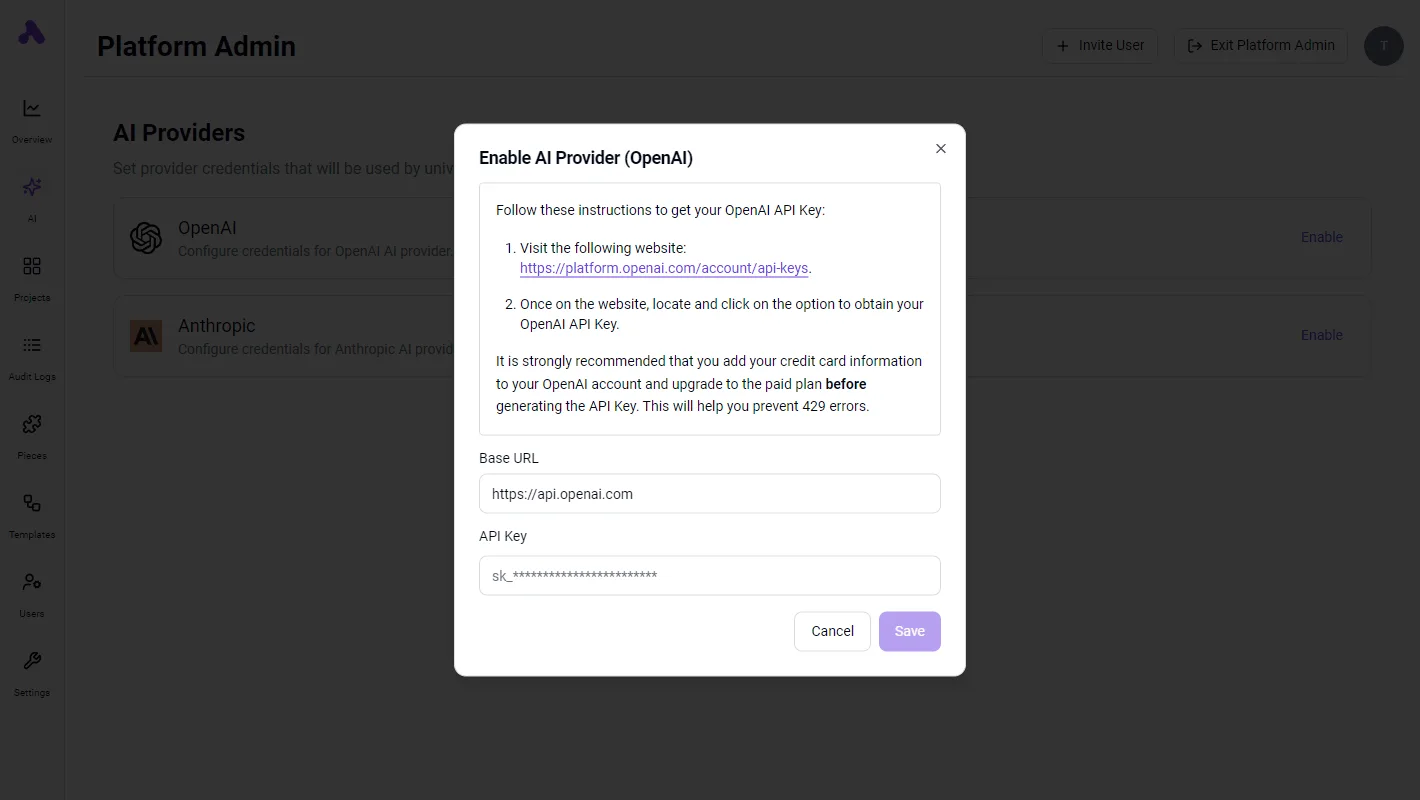 ## How Activepieces maintains workflow continuity during migration Activepieces provides a self-hostable AI automation platform that decouples your business logic from the specific LLM provider, ensuring your intellectual property remains portable across infrastructure changes. By shifting the orchestration layer to a platform you can self-host, you remove the risk of a vendor deprecating the proprietary blocks your agents rely on to function. ### Recreating Dust Blocks with custom code steps The platform mirrors the modularity of specialized AI builders but replaces black-box internal functions with standard TypeScript or JavaScript environments. In the Activepieces interface, a workflow typically begins with a trigger from a business app like HubSpot, followed by an "AI Agent" step that handles initial analysis. A lead enters the system, is qualified by an agent, and then hits a "Custom Logic" step where the team can inject specific data transformation code, as seen in the Activepieces canvas. 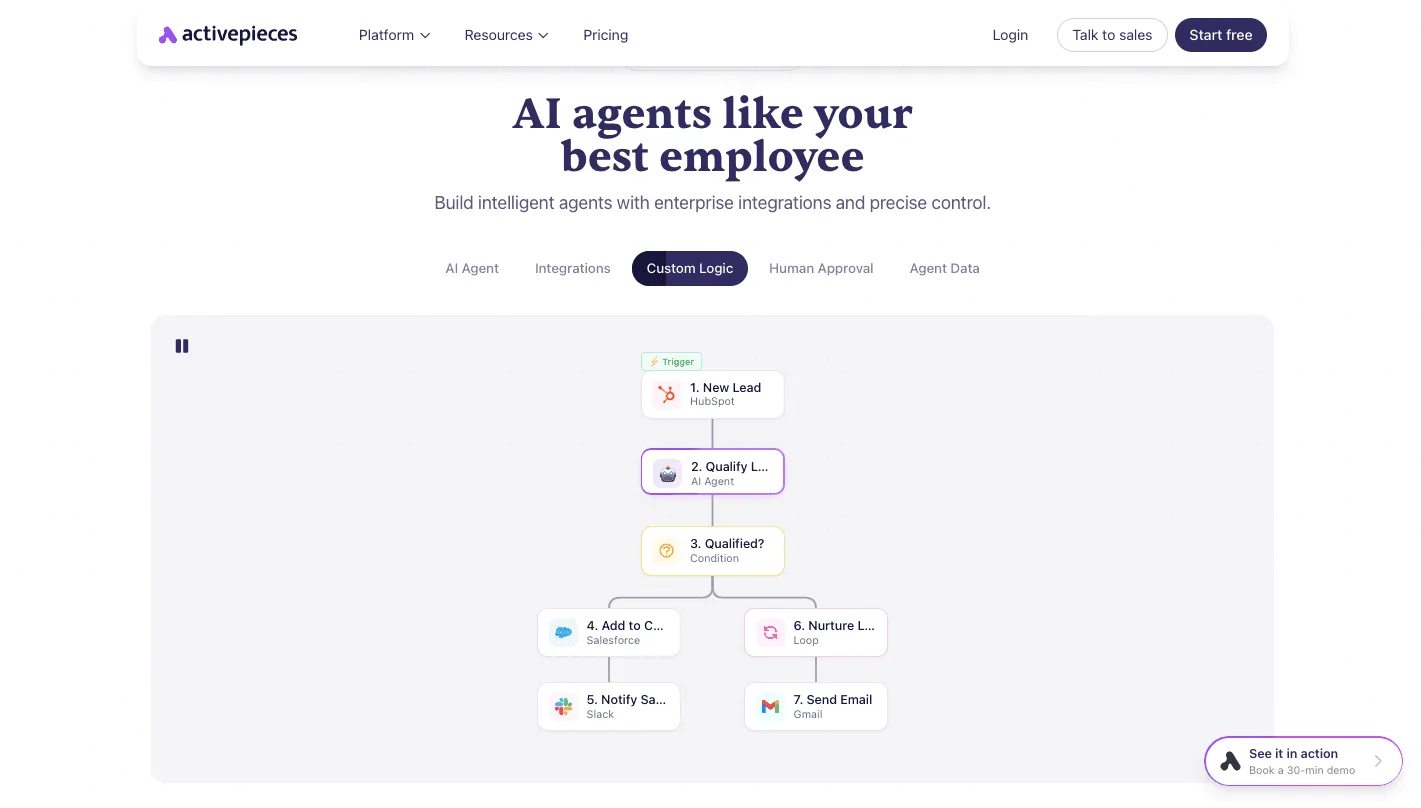 This visibility means that when a reasoning model like Claude Opus 5.5 requires a specific input schema to execute long-running agentic tasks, you can modify the transformation logic directly in the UI rather than waiting for a platform update. This granular control ensures that the "Qualified?" condition in your workflow remains accurate even if you switch the underlying model. ### Connecting LLMs to business apps without proprietary middleware Bypassing proprietary middleware allows you to route data directly between your enterprise stack and frontier models like Gemini 3.8 Flash or GPT-6 Astra. Activepieces uses a library of verified connectors to link steps (such as adding a row to Salesforce or notifying a Slack channel) without wrapping that data in a vendor-specific format that is difficult to export later. 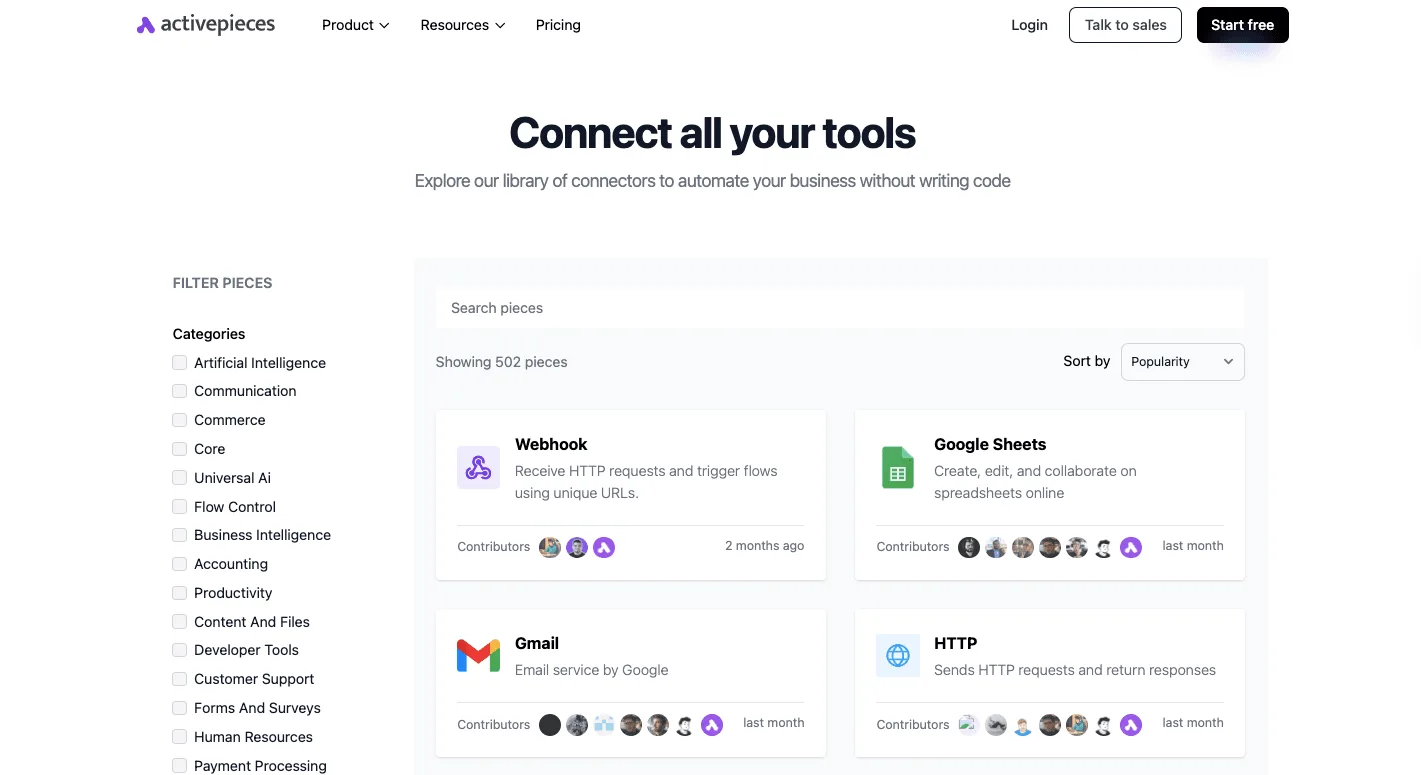 HubSpot and Salesforce connectors handle the authentication and API handshakes for CRM data. Slack and Gmail integrations manage the downstream communication after the AI step completes. The Loop and Condition steps provide the control structures necessary to nurture leads or retry failed API calls. This architecture ensures that the "glue" holding your workflow together is composed of standard API calls rather than a proprietary orchestration language. ## The migration checklist for a seamless transition A successful migration requires a structured audit of every active prompt and a staged cutover of model dependencies to prevent service interruptions. Moving logic out of a black-box platform means you're finally responsible for the version control and deployment lifecycle of your own intellectual property. ### Auditing hidden system prompts before migration A comprehensive audit identifies every instance where a platform-specific feature, such as a proprietary "system instruction" field, obscures the actual logic being sent to the model. You must extract these strings into a centralized repository to ensure your new orchestration layer can reproduce the exact behavior of your production agents. 1. Locate every hidden instruction block within the legacy UI so that persona constraints aren't lost during the transfer to your own codebase. 2. Document the specific input-output pairs used for in-context learning so that you can maintain output consistency across different model providers. 3. Record the temperature, top-p, and frequency penalty settings for every individual node so that your new API calls don't result in unexpected hallucinations or repetitive text. ### Building a model-agnostic workflow baseline Establishing a model-agnostic baseline involves mapping your existing workflows to standardized API structures that work across different model families. This prevents your logic from being tied to a single vendor's specific formatting requirements or token limits. Replace vendor-specific SDK calls with a unified interface that can handle a request to Gemini 3.8 Flash for high-volume enterprise workflows or GPT-6 Astra for complex reasoning without changing the core business logic. Convert proprietary JSON formats into a common schema so that a response from Claude Sonnet 5.5 can be processed by the same downstream function that handles deepseek-v4-pro. Configure a secondary model, such as Mistral Medium 3.5 for agentic use cases, to take over if your primary endpoint experiences a service outage or rate limiting. ### Validating output quality after migration Validating output parity ensures that the new infrastructure produces results that meet or exceed the quality of the legacy system before you redirect live traffic. You must run your extracted prompts through the new stack and compare the results against your historical production logs. | Test Phase | Objective | Success Metric | | :--- | :--- | :--- | | Logic Verification | Confirm that the decoupled code executes the same sequence of steps as the original platform. | 100% path alignment between old and new workflows. | | Output Comparison | Compare the semantic meaning of responses from new models like Grok 4.7 against the legacy outputs. | High cosine similarity scores in your vector-based evaluation suite. | | Latency Benchmarking | Measure the round-trip time of the new orchestration layer compared to the old platform. | Response times that remain within your existing Service Level Agreements. | ## Frequently asked questions about leaving Dust ### Can I export my Dust data to another vector store? Exporting data from the Dust platform is restricted to raw document retrieval because the platform doesn't provide direct access to the underlying vector embeddings or the specific indexing configurations. This limitation means you can't simply point a new database at your existing indices; you must rebuild your entire knowledge base from scratch. Extract your source documents to move your RAG (Retrieval-Augmented Generation) pipeline. Re-process them through an independent embedding model, such as Gemini Embedding 2, to ensure your new vector store is compatible with your chosen orchestration layer. ### What happens to my proprietary prompts and logic? Proprietary logic within Dust is encapsulated in internal "Dust Apps," which use a specific YAML-based syntax that isn't natively executable by other frameworks. Because this logic is trapped in a non-standard DSL (Domain Specific Language), migrating requires a manual translation of every conditional branch and prompt template into standard Python or TypeScript. You will find your core intellectual property inaccessible if you fail to decouple this logic before a platform outage or price hike. There's no automated bridge to move these workflows into an open-source execution engine. ### Is it more expensive to host my own orchestration layer? Shifting to a self-hosted or decoupled orchestration layer typically reduces long-term operational costs by eliminating the per-seat markup applied by specialized AI platforms. While managed services bundle compute and model access into a single premium tier, a decoupled architecture allows you to route simple tasks to Gemini 3.5 Flash-Lite and reserve high-reasoning workflows for GPT-6 Astra.  This granular control ensures you only pay for the specific compute cycles your agents consume, rather than subsidizing the platform's overhead for every user interaction. ## Related reading - [ChatGPT Apps SDK: How to Build Business Workflows](https://www.activepieces.com/blog/chatgpt-apps-sdk-how-to-build-business-workflows) - [SaaS Audit Trail Requirements for Vendor Pitches](https://www.activepieces.com/blog/saas-audit-trail-requirements-for-vendor-pitches) - [AI Vendor Questions for Audit Trail Integrity in 2026](https://www.activepieces.com/blog/ai-vendor-questions-for-audit-trail-integrity-in-2026) ## References - [Concentrate](https://concentrate.ai/docs/api-reference/endpoint/supported-models) - [Aramb](https://aramb.ai/blog/flowise-pricing/) - [Johal](https://johal.in/we-ditched-custom-rag-pipelines-langchain-03-pinecone-ditched)Where a flow runs should never decide whether you can leave.