When events come from your own backend, they count the same as events from your app screens, so your real total's higher than the number of taps you can picture. Doing nothing about this has a cost. If you cross the cap without having priced the next step, you decide under pressure, with your data already inside the tool. ### Which plans publish a price and which need sales Free's the only plan with a plainly stated price, which is nothing. Plus and Growth are listed on the pricing page, but what you pay depends on the volume and add-ons you choose, so there's no single figure to quote.  Enterprise is "contact sales," so you can't budget for it until you have a conversation. Count your monthly events first, then read the Plus and Growth rows against that count. ## What a small production app pays per month While its monthly event count stays under the free tier's cap, a small production app pays nothing. After that it pays a bill that follows event volume and add-ons, not the plan's name. Read the slope in [Elsop](https://www.elsop.com/analytics-tools/amplitude/pricing/)'s chart below, which plots the Plus plan's monthly cost at 2, 3, 5 and 10 million events and marks the 1M, 10M and 50M cases worked through here. The steeper the line, the more a month of unexpected traffic costs you. ### A side project near the free limit At about 1M events a month, the question is which side of the free cap you sit on. If you're under it, the bill's zero and moving to a paid plan early only spends money you didn't need to spend.  If you're over it, you've a real decision, and it deserves a real count. If you wait for a warning to arrive, you're choosing a plan in a hurry, which is the most expensive way to choose. ### A small SaaS with a few thousand active users At about 10M events a month, you're at the far end of the chart, on the Plus plan. Here the bill is driven by volume, so **one chatty feature can move it**.  Make one button fire three events instead of one and that part of your cost triples without a single new user. Before you pay, list your most frequent events and ask which ones you'd actually look at. Dropping the rest is the cheapest fix available, and it's free. After volume, the second line on the bill is add-ons. Each one's priced separately from the plan headline, so add them up only for the features you'll open every week. ### A growing app past 10 million events At about 50M events a month, you're off the end of the chart and into the Growth row. At this volume the plan headline matters least. Event volume and add-ons set the total, so a quote built on your own count is worth more than any published starting price. Get that quote before you commit. Stay on Plus past the point where Growth's cheaper and you've made the same mistake as upgrading too early, just in the other direction. ## Usage fees driving Amplitude bill growth Several separate meters feed Amplitude's bill, but event volume's the one that moves it fastest. Your own monthly count decides what you pay far more than the plan name does.  ### How Amplitude meters events and MTUs An event is one recorded action, such as a tap or a page view. A monthly tracked user (MTU) is one distinct person seen in a month. Depending on the plan, usage is counted in one or the other, so check which unit your quote uses. To see how steeply events convert to dollars, look at Elsop's Plus-plan price list: - At 2M events the cost is $0 a month, so a small app under that line pays nothing - At 5M it's $281, the first real bill - At 10M it's $719, so **doubling your traffic more than doubled the charge** At 20M events the price is $1,575, which is a mid-sized software subscription. At 50M it's $4,139, and at 70M it's $5,863, meaning a company expanding through that range can't ignore which tier it lands in.  Growth you might not notice in your analytics turns into a bill you can't miss. Doing nothing costs what those figures show. An app whose traffic doubles twice in a year pays for it unless someone checks. ### Amplitude overage and add-on charges Beyond the base volume, several separate meters can each add a line to the invoice. Event volume's the count above that drives the base price. MTU metering is the per-user count, on plans that bill that way. Overage covers charges for usage beyond what your plan includes. If you want your history kept longer, data retention can cost extra. Session replay beyond 10K means replays past the first 10,000 are billed separately. Guides & Surveys is a paid add-on, not part of the base plan. Ask for each rule in writing before you sign, because each meter runs independently of the others. ### The crossover point where the next plan is cheaper Because overage is billed at the rate of the plan you're on, staying put is the expensive choice once volume and add-ons together pass what the next tier would cost. Look at the climb from $4,139 at 50M to $5,863 at 70M: that is where a quote for a higher plan deserves a real comparison, so the extra cost is a decision, not a default. Otherwise it becomes a forced choice once you've hit 50M events. Price your own count against both plans, then decide. ## Limits and hidden costs teams face Once you've priced your own event count, the next surprises are the ones that never show up in an event total: - features held back by plan - the time it takes to set tracking up properly - contract terms that only appear in a sales conversation Each has a documented limit, and each is cheaper to learn about before you sign. ### Feature gating by plan When you move up a plan, session replay, which records what a user did on screen so you can watch it back, doesn't grow smoothly. According to Amplitude's session replay documentation: - Free and Plus both include 10,000 replays per month, so paying for Plus buys you no extra replay room - Growth doubles that to 20,000 - Enterprise reaches 50,000  The chart that follows shows the flat start and the late jump. **If replay is the reason you're upgrading, Plus won't solve it.** Ignore this and you pay for a plan that costs more and still runs out of recordings partway through the month. Check how many sessions your app has, and what share you'd realistically want to record, before treating replay as a reason to move up. ### Instrumentation and tracking-plan time Before you record anything, you need a tracking plan, the written list of which user actions you record and what each one's called. Amplitude only counts what you send it, so someone has to decide on that list and add the code for each action. That someone's usually an engineer, and the hours are a real cost that no plan page lists. Skip the plan and you pay later: inconsistent names mean the same action is counted under two labels, and your reports quietly undercount. Keep the first version small. Track the handful of actions that tie to a decision you'll actually make, and add more when a question demands it. This also keeps your event count, and therefore your bill, down. ### Contract terms and quote-only pricing At the higher tiers, pricing is often by quote rather than from a public list, and they tend to be sold as annual contracts. That means you commit to a year of spend before you know how your usage will settle. **$64,000 per year is the median Amplitude contract**, according to [Vendr](https://www.vendr.com/marketplace/amplitude)'s marketplace data. 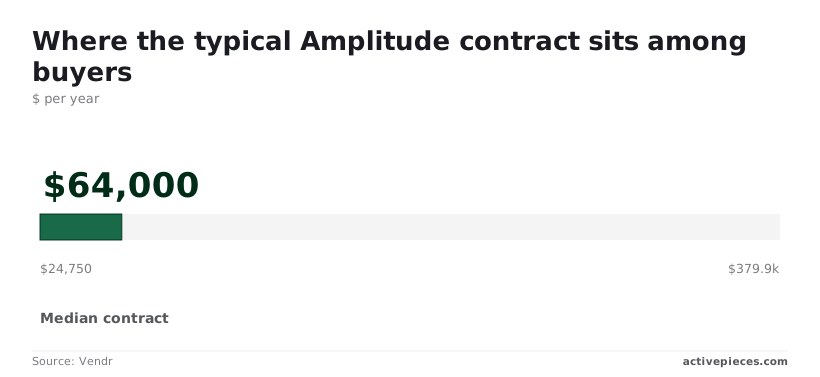 [Vendr](https://www.vendr.com/marketplace/amplitude)'s figures come from buyers who negotiate through it, who are mostly larger than a small production app, so read that number as a ceiling on the conversation, not a forecast for you. Stay on self-serve pricing as long as it fits. Ask for written terms on usage overages and renewal before you commit to a year. ## Amplitude versus Mixpanel, PostHog and Heap on cost Start cheap and you'll usually start on PostHog or Mixpanel. Amplitude costs more unless you use what its plans bundle. I'm giving no dollar figures here, because all four vendors change their pricing pages often and a stale number would mislead you more than none. Pull each vendor's current page, note the date you read it, and run your own monthly event count through it. ### Free tier allowance and entry price Free entry is on offer at all four vendors, but the allowances differ and so does what happens when you cross them. The table shows how each one packages its product and what moves the bill, which tells you where a surprise is most likely. | Tool | Self-host option | How features are packaged | What moves the bill | |---|---|---|---| | Amplitude | No, hosted only | Core analysis in the plans, extras priced separately | Event volume, then add-ons | | Mixpanel | No, hosted only | Core reports in the plans, some extras priced separately | Event volume, then add-ons | | PostHog | Yes, open source | Each product billed on its own usage | Usage per product | | Heap | No, hosted only | Ask the vendor what is included | Quoted volume | Only PostHog lets you run the software on your own servers. That removes the vendor's per-event fee, but you then pay in server costs and your own time, so it suits a team that already runs its own infrastructure. At 10 million events a month, the headline plan matters least. Whether the bill doubles depends on the add-ons you switched on, such as session replay, and on whether the vendor bills each product separately. Price this volume with every feature you actually use turned on, not with the bare plan. Doing nothing about it means finding out on the invoice. ### Where Amplitude is worth the premium When several people who aren't engineers need to answer product questions without asking you each time, Amplitude pays for itself. It also pays off when its bundled analysis replaces a second tool you'd otherwise buy. If you're a solo builder who checks one dashboard a week, you're paying for depth you won't use, and PostHog or Mixpanel will usually cost less for the same answers. Choose Amplitude when the team's questions outgrow simple counts, and put the add-on and renewal terms in writing first. ## Connect Amplitude to the rest of your stack with Activepieces It will not shrink your bill. Activepieces, an automation tool that moves data between apps without custom code, can feed events into Amplitude and carry Amplitude signals out to Slack, a CRM or a database. It reaches them through 747 integrations, counted from its open source monorepo, and its core is MIT-licensed. But every event it forwards counts toward your monthly volume like any other, so treat it as extra plumbing you pay for in events. Activepieces has its own meter, and it never counts how many flows you build: a run costs 1 credit however many steps it has, the Free plan includes 1,000 credits a month, and the public pricing page lists "unlimited flows" on Free, Plus, Team and Ultimate alike.  Zapier's pricing page bills a task per action and Make's a credit per module, so there, splitting a sprawling flow into ten small ones raises the cost of every run, while here it adds nothing. That cuts both ways. Wiring in more sources makes Amplitude more useful, and it also makes your event count climb without anyone touching the app. **A flow nobody priced's the kind of surprise** that shows up on the invoice a quarter later. ### Sending events from forms, billing and support tools Much of what you want to analyze never passes through your app's own code. Examples are a signup form on your marketing page, a payment processor recording a subscription, a help desk logging a ticket.  Roughly 60% of those 747 integrations were contributed by the community rather than built in-house, so the form, billing and help desk tools you already use are likely covered. Activepieces can watch for each of those, reshape the record into an Amplitude event, and send it along. You get a single timeline per customer, so you can see that the people who opened a support ticket in week one're the ones who cancel. Each of those tools now adds to your count, and that's the cost. Decide which of them answer a question you actually have, and leave the rest unconnected. ### Pushing Amplitude signals to Slack or a CRM Look the other way and the flow runs back out. A second arrow carries an alert back out to Slack. Take from it that the same flow works in both directions: it collects from the tools on the left and delivers a result to wherever your team already looks, and MoneyGram, Moneypenny, Alan and FundingSocieties run Activepieces in production. That return arrow's where the value's for a small team. A drop in a key action can post to a channel, or update a customer's record, so nobody has to remember to open a dashboard. Keep it to a few alerts, since a channel that pings all day gets muted. Start with the count, because everything else depends on it. 1. Pull your current monthly event total from Amplitude's usage page. 2. List every tool you'd connect through Activepieces and estimate the events each would add. 3. Add those to your total, and compare the result against the paid plan's volume tiers and add-on terms in writing. 4. Pick the plan that fits that number, not the one with the friendliest headline. If the free tier still covers the total, stay on it and connect only the sources you need. ## Frequently asked questions Is Amplitude free for small apps? Yes, the free plan's usable for a small production app, as long as your monthly event count stays under its cap. Past that cap you either stop getting full data or move to a paid plan. So count your events for a typical month before you launch, not after the first surprise. ### Does Amplitude offer a startup discount? Whether you qualify is a question for sales. Amplitude has run a startup program that discounts paid plans for early-stage companies, but eligibility and terms change, and I have no confirmed details to quote. Ask Amplitude's sales team directly and get the terms in writing. If you qualify, the discount's worth having, yet it still applies to a bill driven by event volume, so you should know your own volume first. ### Can I export my data if I leave Amplitude? Yes, Amplitude lets you export your event data, so leaving doesn't mean losing your history. Export options and limits can depend on your plan, so check what your current plan allows before you need it. Run a test export early; it's cheap insurance: you find out whether the files are usable while you still have time to fix a problem. ### Does Amplitude charge per user or per event? **Per event, not per user**. Event volume's what moves the bill, and add-ons sit on top of it. The number of people using your app matters mainly because each of them generates events. Track chattily and a small app can cost more than a larger app that tracks only what it needs. Trim the events you never look at, then price the paid plan from the count that remains. ## Related reading - [Cohere Pricing 2026 for Trial, Production and Enterprise](https://www.activepieces.com/blog/cohere-pricing-2026-for-trial-production-and-enterprise) - [ADP Payroll Pricing for Small Businesses in 2026](https://www.activepieces.com/blog/adp-payroll-pricing-for-small-businesses-in-2026) - [DeepSeek Search API vs Exa Pricing for Small Teams (2026)](https://www.activepieces.com/blog/deepseek-search-api-vs-exa-pricing-for-small-teams-2026) ## References - [Elsop](https://www.elsop.com/analytics-tools/amplitude/pricing/) - [Amplitude](https://amplitude.com/docs/session-replay) - [Vendr](https://www.vendr.com/marketplace/amplitude)Put two apps on the same plan and they can pay very different amounts, because every paid row moves with volume.