Logging and data transfer start to rival the request charge, so turning on full access logs for every call can quietly add as much as the gateway itself. ### 1 billion requests a month At this scale the volume discounts on REST help, but they don't close the gap with HTTP. The add-ons now dominate planning. Since a WAF rule set evaluates every request and egress scales with response size, a lean response payload saves more than a cheaper API type. Price this tier from your own traffic profile, not from the headline rate. ## Unexpected charges and hard limits **Nothing in the per-million-request rate covers the surprises**: the always-on cache, data transfer out, log storage and a few hard limits. Each needs its own line in your estimate. ### The case that the request rate is the whole bill If you never enable a cache, never log bodies and serve small responses, the add-ons barely register, and the request rate is the bill. That is the strongest counter-argument, and it holds for low-volume, uncached APIs. Once a requirement, such as latency, an audit trail or an inspection layer, switches on a feature billed by the hour or by the gigabyte, the claim stops holding. ### Data transfer, caching and logging **A provisioned REST cache bills every hour it exists, traffic or not.** Per C3x, the smallest, 0.5 GB, costs $0.02 an hour, or [$14.60 a month](https://kejyuntw.gitbooks.io/aws-learning-notes/content/api-gateway/api-gateway-pricing.html), which is easy to absorb. 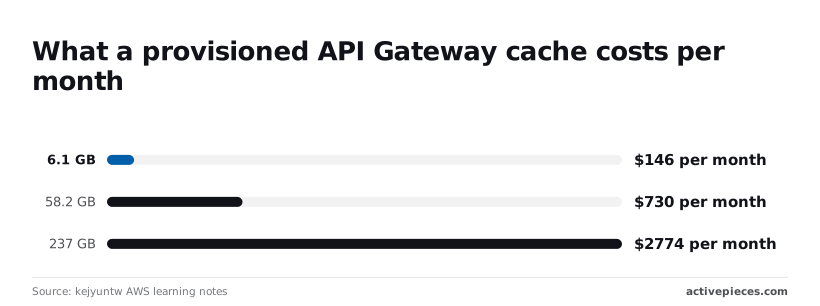 At 1.6 GB it's $0.038 an hour and $27.74 a month, which means about $330 per year. At 6.1 GB the price jumps to $0.20 an hour and $146 a month, ten times the entry size. That means a cache sized "to be safe" can cost more than the requests it saves.  Beyond that point, sizes climb steadily. 13.5 GB is $0.25 an hour ($182.50 a month), 28.4 GB is $0.50 ($365), and 58.2 GB is $1.00 ($730). The top size, 237 GB, reaches about $2,774 a month, so a cache sized for a worst case becomes a standing cost larger than many whole services. *The chart shows monthly cost climbing from $14.60 at 0.5 GB to about $2,774 at 237 GB in us-east-1, so your data volume will determine whether you spend $15 or $2,774 monthly. The lesson is that cost scales with the memory you reserve, not the hits you get.* Size the cache to your hot set of responses, then check the hit rate before stepping up a tier. ### Data transfer out and logs Anything leaving AWS is billed as data transfer out per gigabyte, and CloudWatch access logs are billed for ingestion and storage. Logs deserve a second look because they can hold request data, which carries retention and location obligations of its own. ### API Gateway payload size and timeout limits Because REST APIs cap payloads at 10 MB and default to a 29-second integration timeout, large uploads and slow backends need a different pattern, such as direct-to-storage uploads or asynchronous jobs. Finding that out after launch means rebuilding the request path, so check both limits against your heaviest call before choosing an API type. Where the asynchronous job is only a Lambda function that receives a webhook and calls SaaS tools, Activepieces can take that work instead, and its [pricing page](https://www.activepieces.com/pricing), checked 21 November 2026, lists a run as 1 credit however many steps it has. A three-step webhook handler and a ten-step one meter identically, where Zapier's pricing page bills per task and Make's per module, and the free plan includes 1,000 credits a month with unlimited flows. ## API gateway versus Azure, Google, Kong While Amazon bills per request, Azure bills a flat monthly fee per tier. Once you have checked your limits, the next question is whether your traffic is steady enough to justify a fixed fee. The comparison below dates from 21 November 2026. ### Per-request vs flat-fee pricing models Only Amazon and Kong scale cost directly with traffic, while Azure and Apigee price capacity. The table shows how each vendor charges and what a 100-million-request month looks like. | | Pricing model | Entry price | Free tier | Cost at 100M requests a month | Best-fit team | |---|---|---|---|---|---| | Amazon API Gateway | Per million requests, by API type | No minimum | Introductory allowance for new accounts | Grows with request volume and API type | Spiky or unpredictable traffic | | Azure API Management | Flat monthly fee per tier | $48.04 (Developer) | None in the paid tiers | Tier fee, plus extra units if capacity runs out | Steady traffic, Microsoft-centred stack | | Google Apigee | Subscription or pay-as-you-go | Set by Google's plan | Evaluation access | Depends on the plan you negotiate | Large API programmes | | Kong Konnect | Per request plus gateway services | Usage-based | Trial access | Request charges plus per-service fees | Hybrid and multi-cloud teams | 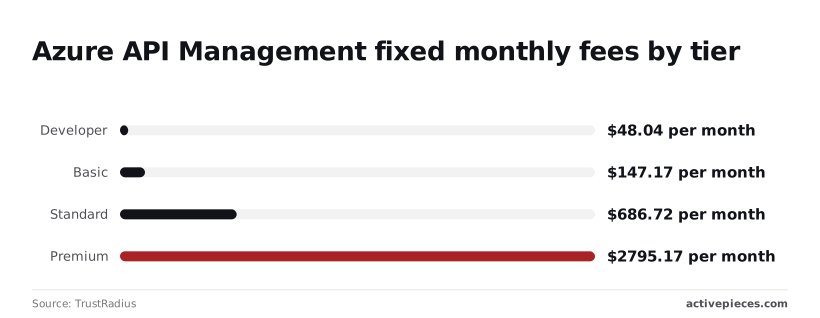 To see the flat-fee logic most clearly, look at the Azure tiers. According to [TrustRadius](https://www.trustradius.com/products/azure-api-management/pricing), Developer costs $48.04 a month, which is a non-production tier, so it suits testing but not live traffic. Basic is $147.17, Standard is $686.72 and Premium is $2,795.17. You pay the same whether you send ten requests or ten million, because each step up buys capacity; the bill only jumps when you outgrow a tier. That flat structure favours predictable load. A spiky workload pays for idle capacity on Azure, whereas on Amazon the bill falls when traffic does. ### Which gateway suits which team Pick by traffic shape and by where your data must stay. Amazon API Gateway suits teams whose traffic swings, because **you owe nothing in a quiet month**. Azure API Management suits teams with steady load already on Azure, where the fixed fee is predictable enough to budget. Google Apigee suits organisations running many APIs under central governance, who will negotiate a contract anyway. Kong Konnect suits teams spanning several clouds or on-premises sites, where the gateway runs near the data. Residency matters here too. Under GDPR Chapter V, moving personal data out of the EEA needs a lawful transfer mechanism, so a gateway pinned to an EU region is a design constraint, not paperwork. Confirm each vendor's regional options before you compare prices. ## Where Activepieces fits next to an API gateway When a Lambda function only receives a webhook and calls SaaS tools, Activepieces can replace it, with 750 integrations in its MIT-licensed core to call from. It's a workflow engine, not a gateway, and it doesn't replace one. You just asked the regional question of each vendor, and it applies here too. Under GDPR Chapter V, every service that touches a payload is a place personal data can cross a border, so a replacement tool needs the same scrutiny as the gateway. ### When a workflow tool replaces the glue code Look at what much Lambda code behind an API Gateway route does: three things, which are to accept a POST, branch on a field in the body, and call Slack, email or an internal HTTP endpoint. That's a workflow, and paying for a gateway integration plus function code and its logs to express it's the kind of add-on cost this article warns about. Built exactly this way, an audit event handler is shown in the screenshot below. A "Catch Webhook" trigger receives the event, a router named "Event type check" splits it into "Flow created", "Flow published" and "Otherwise" branches, and each branch holds its own actions. 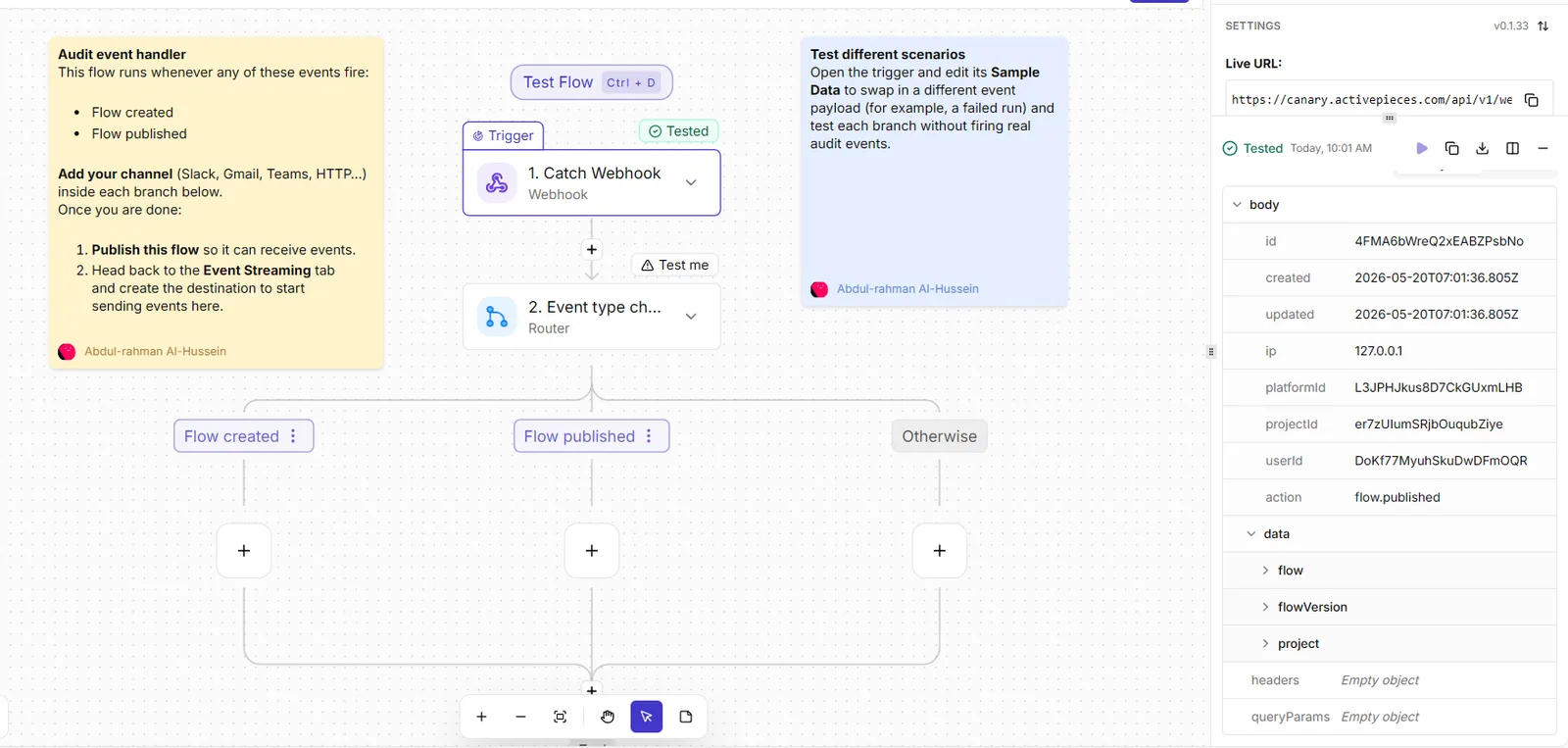 The settings panel shows a live webhook URL marked "Tested", with a sample payload (id, ip, platformid, projectid, userid, action) that you can inspect before wiring anything downstream. The takeaway is that the receive, branch and notify logic needs no deployed code, so there's no function to patch or package. Next comes the limit of that substitution, which matters more than the saving. ### When you still need a gateway Answering requests is what a workflow tool does; governing who sends them is not. Activepieces, which MoneyGram, Moneypenny, Alan and FundingSocieties run, isn't a gateway, and I wouldn't rely on it for throttling, usage plans, authorizers or WAF rules. If the endpoint faces the public internet, or serves partners with different quotas, those controls are what you're paying a gateway for. Keep the gateway at the edge for authentication, rate limits and filtering, and let it forward to a workflow webhook where the work behind it is only orchestration. That also gives you a clean record of which system handled the payload, which is what a data protection assessment will ask for. ## Frequently asked questions Those records have a price too, and these are the questions readers most often ask about it once the architecture is settled. ### Is Amazon API Gateway free? Only partly, and the answer depends on when your account was created. Accounts opened after 15 July 2025 get a credit-based free plan instead of the older per-service request allowance. Credits are spent on cache, logging and data transfer as well as requests, so a free plan doesn't mean a free request path. Check your own billing console for what applies to you. ### Is an HTTP API always cheaper than a REST API? No. The HTTP API has the lower per-request rate. It lacks several features that REST APIs offer, including built-in caching, usage plans with API keys, and direct AWS WAF attachment. If your design needs those, you'll either pay for the REST type or build the equivalent elsewhere. Compare the finished request path, not the headline rate. AWS bills cache capacity on a REST API by the hour, whether or not traffic arrives. ### Do I pay for requests that return errors or are throttled? Not always, and the rule varies by API type and by where the request fails. A request rejected before it reaches your integration, for example by a missing API key or a failed authorizer, is treated differently from one that reaches your backend and returns an error. Read the current pricing page for your API type before you assume an error rate is free. Does API Gateway charge for a private API inside a VPC? The private REST API itself is billed like any other REST API. The network path is billed separately. The VPC interface endpoint that carries the traffic has its own hourly and data processing charges, and those appear under a different service on your invoice. Data transfer isn't bundled into the request rate either. To estimate your bill before launching, list every component the request touches, then price each one separately: 1. Requests, at the rate for your chosen API type. 2. Data transfer out, based on typical response size. 3. Cache, if you use it, billed by size and hours. 4. Log ingestion and storage. 5. WAF rules and inspected requests. 6. The backend the gateway calls. Enter your expected traffic in the AWS Pricing Calculator, then confirm it with a short load test against a staging stage. ## Related reading - [Bright Data Pricing: Proxies, APIs and Datasets (2026)](https://www.activepieces.com/blog/bright-data-pricing-proxies-apis-and-datasets-2026) - [What Is Respan AI Gateway? (2026 Guide)](https://www.activepieces.com/blog/what-is-respan-ai-gateway-2026-guide) - [LiteLLM: Open-Source AI Gateway & LLM Proxy (2026)](https://www.activepieces.com/blog/litellm-open-source-ai-gateway-llm-proxy-2026) ## References - [kejyuntw AWS learning notes](https://kejyuntw.gitbooks.io/aws-learning-notes/content/api-gateway/api-gateway-pricing.html) - [TrustRadius](https://www.trustradius.com/products/azure-api-management/pricing)If you have data-residency obligations, a cache in the wrong region is a compliance problem, not a rounding error.