## Activepieces Self-Hosted Edition [Activepieces](https://www.activepieces.com/docs/install/overview) publishes a self-hosting option, and the LICENSE file in its activepieces/activepieces repository puts the core under MIT, with the enterprise directories (`packages/ee/`) under a separate commercial licence. Only the community edition is clearly open to you without a sales conversation. ### How VPC deployment works When you self-host, the vendor's documentation has you run the workflow engine on your own infrastructure with Docker or Kubernetes. Self-hosting means your workflow definitions, connector credentials and run history sit in a database you control.  If the vendor's cloud goes down, your instance keeps running, because the data plane is yours. I haven't tested a deployment, so I'm reporting what the docs describe, not what I observed. The community edition is the free, self-hostable version: - I would read its license file in the vendor's repository and quote the exact grant before relying on it, because the license decides which features you may use in production - The pricing page, checked 2026-11-22, shows four tiers: Free, Plus, Business and Enterprise - Only Enterprise lists cloud or self-hosted deployment, alongside custom roles and dedicated support - The three lower tiers are cloud subscriptions, so paying for one doesn't buy you a place inside your VPC You can't budget from the pricing page alone, because it doesn't say which features are held back from the community edition. The next section depends on that gap. ### n8n self-hosted gaps and unconfirmed details Three gaps remain, and the pricing page closes none of them. First, which features the community edition omits. Second, whether Enterprise self-hosting carries any support commitment, since I found no service-level wording to quote. 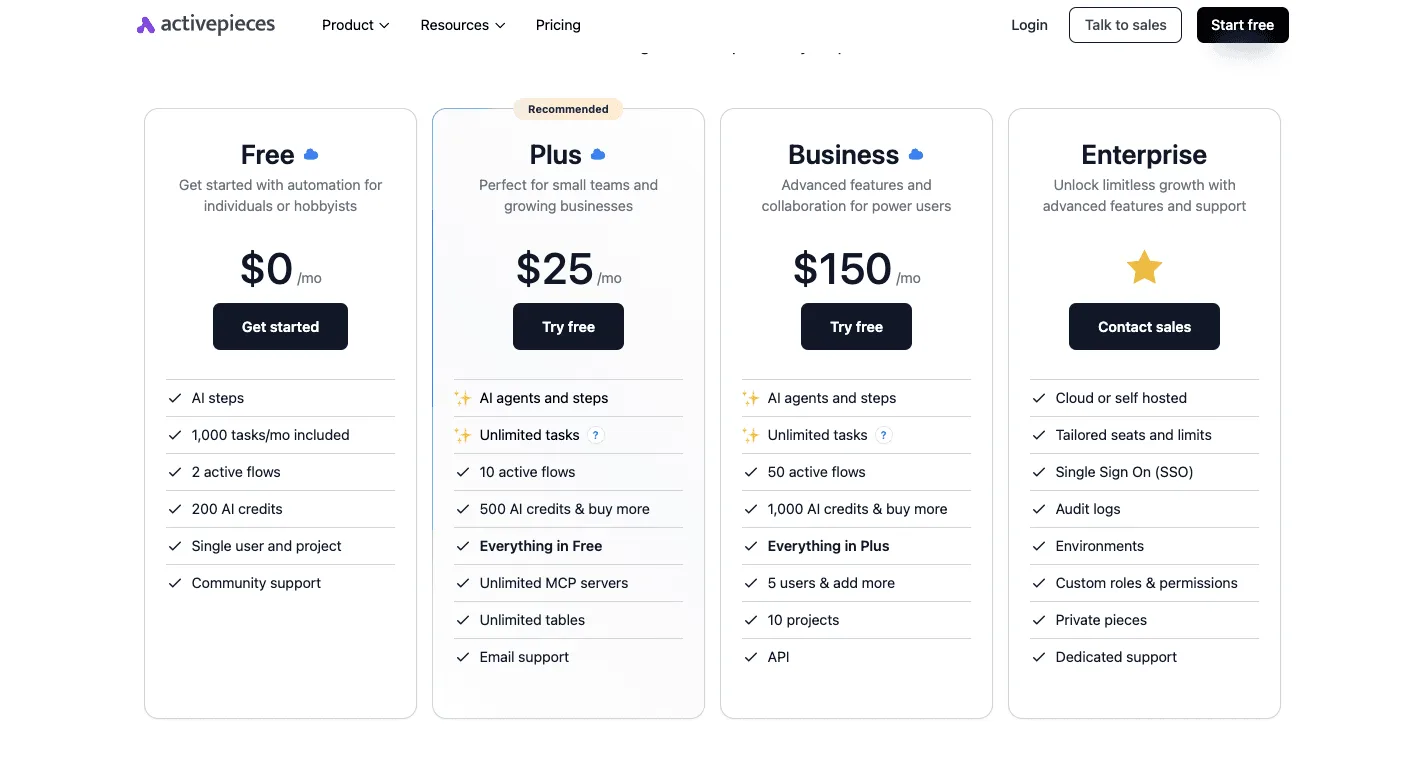 Third, whether controls such as single sign-on or audit logging are in the free edition or reserved for a paid one. I wouldn't call this deployment compliant with any control until the vendor names the edition that includes it. If your engineers can operate Docker or Kubernetes and your workflow data has to stay inside your network, Activepieces suits you, with an MIT-licensed core you can read and 750 integrations counted in its open source monorepo. Confirm the edition-by-feature list in writing before committing. ## n8n Self-Hosted Plans You can run n8n inside your own VPC, but read the license first. Its own license page calls the code **source-available, not open source**, so the license text decides what your company may do with it. ### Self-hosting options and license terms You can read and run source-available code, but the license sets limits that an open-source license wouldn't. Those limits govern commercial use, such as embedding n8n in a product you sell, and the license page is the document that draws them. Ask legal to read it against your actual use before anyone installs anything. If your use is internal automation, get the vendor to confirm that in writing. A forum answer doesn't bind n8n. If n8n's cloud goes down, your workflows keep running, because self-hosting also moves the data plane to you. Executions run on your infrastructure. Your own outage stops them, though, and so does every patch you delay.  ### n8n self-hosted pricing per its pricing page Reported by Krosyn, not confirmed against n8n's pricing page: - [Krosyn](https://krosyn.com/blog/n8n-pricing) lists **Cloud Pro at 120.83 € per month** - That's the entry price for a hosted plan - It's the comparison point for whether running your own servers saves anything At 40k runs, the Business plan, which n8n prices by run volume, is 667 € per month, roughly 5.5 times the Cloud Pro price. The step up buys the plan that carries the self-hosted features, so check which features justify it.  At 500k runs it reaches 5245 € per month, so a high-volume team pays nearly eight times the 40k price and should model its expected runs before signing. ### n8n self-hosted limits and best fit Even when you self-host, the licensing question doesn't go away, and that is the limit. A low price on the page tells you nothing about which controls sit in which edition. Request the edition-by-feature list and check any control you need, such as single sign-on or audit logging, against it by name. If execution data must stay inside your own network and you have engineers to run and patch it, n8n suits you. It suits you less if nobody owns that operational work. ## Windmill Self-Hosted Deployment Yes, Windmill runs inside your own VPC. The question that matters is which edition the license lets you run there, because the open-source build and the enterprise build carry different license terms. ### Self-hosting and licensing In a self-hosted deployment, as Windmill's docs describe it, you run the servers and the workers on your own infrastructure. That puts the data plane, meaning the place where scripts execute and run history is stored, in your account rather than the vendor's. **If their cloud goes down, your instance doesn't**. The core is published under an open-source license, and I understand it to be AGPLv3. An enterprise edition sits on top under a separate commercial license. Read the license file in the repository and the enterprise terms before you commit. Which controls you need, such as single sign-on or audit logging, decides which edition you have to hold. I haven't named a control as satisfied here because that depends on the edition and the contract text you are given. ### Windmill self-hosted pricing and limits I'm not reproducing a figure here. Windmill's own pricing page sets the enterprise price (checked 2026-11-22), so confirm it on that page and keep a dated copy for your records. Not everyone can use it, and that is the limit. Windmill is built around code: scripts in several languages, chained into workflows. A marketing or finance user who expects a drag-and-drop connector library will depend on an engineer to build and maintain flows. That's a staffing cost the license fee doesn't show. If your team is engineering-led, already writes scripts and wants them turned into scheduled jobs and multi-step workflows, with execution kept inside its own network, Windmill suits you. It fits teams with an owner for upgrades, backups and worker scaling. It fits less well where non-technical staff are expected to build their own automations. ## Camunda Self-Managed deployment If you are the opposite reader, an engineer who runs a workflow engine in your own cluster, Camunda 8 Self-Managed is built for you. It's free outside production and under an enterprise license once it carries real work. ### What Self-Managed means in the docs Between its hosted SaaS offering and Self-Managed, Camunda's documentation draws a line: with Self-Managed you install and operate the components yourself. The data plane, meaning the engine that executes your processes and stores their state, sits in your infrastructure. If Camunda's cloud goes down, your instance doesn't, but if your cluster goes down, nobody at Camunda restarts it. Its strength is BPMN orchestration. BPMN (Business Process Model and Notation) is a standard for drawing a process as a flow that both analysts and engines can read. Long-running, multi-step processes with human tasks and service calls are the use case it's designed around.  Camunda's license page, read for the points that decide a shortlist, states four things: - Free for non-production use, so development and testing cost no license fee, but the free status ends the day a workflow serves real users. - An enterprise license for production, so any production deployment needs a commercial agreement before go-live. - Price as published, otherwise contact sales. Where the page shows no figure, you can't budget from it, so get a written quote before comparing against platforms with public list prices. - Kubernetes resources you run yourself, so cluster capacity, upgrades and monitoring are your cost and your staff time, outside the license. Quote the clause and the page date in your procurement file. A license page changes, and the version you reviewed is the one you can hold the vendor to. ### Camunda Self-Managed best fit for VPC If your developers will model processes, write the service workers behind each step, and operate Kubernetes, this fits. It suits regulated environments where the process engine must stay inside your VPC. This is developer-led tooling, so it doesn't suit a team expecting operations staff to assemble their own automations without engineering help. That is the limit the previous section ended on. ## Verifying a vendor's VPC claim To verify a self-hosting claim, plan on an engineer's afternoon: request five documents from the vendor, then prove their answers yourself inside a network you control. The seven steps below run in the order that saves the most wasted effort, because each one can end the evaluation early. 1. Request the deployment document. 2. Read the license file. 3. Check the edition feature matrix. 4. Get the data-flow statement. 5. Check the support clause. 6. Run the sandbox-VPC test. 7. Log the findings. **Five steps of paperwork, then two of proof**, so proof cannot proceed until all five paperwork steps are completed. What follows explains what to look for in each. ### Documents to request for VPC claims Ask for the deployment document by name and confirm it describes installation in your cloud account, not a vendor-hosted instance. In the license file, copy the grant language verbatim and note which edition it covers; a feature you need may sit in a paid edition even when the code is open. Next, check whether single sign-on, audit logs or role controls survive in the self-hosted edition; the edition feature matrix shows it. Ask for a written data-flow statement listing everything that leaves your network, including telemetry, license checks and update calls. Finally, read the support clause: does it cover self-hosted deployments, or only the vendor's cloud? ### What to test in a sandbox VPC Deploy the edition you would actually buy into an isolated VPC with egress denied by default. Run a real workflow, then open outbound access only for destinations the data-flow statement names. Any blocked call that breaks the product, or any connection the statement omitted, is a gap between the claim and the software. Ask what happens when the vendor's cloud is unreachable: does your instance keep running, or does it stop at a license check? Record each finding with its date, the document's version, the page URL or file name, and the quoted line. Vendors revise pricing pages and licenses without notice, so an undated note proves nothing. Log what couldn't be confirmed as "not confirmed", never as a pass. ## Frequently asked questions No, self-hosted isn't the same as deploying in your own VPC. Self-hosted means you run the software; it doesn't say who operates the control plane, where state is stored, or whether the product calls out to the vendor. A VPC deployment is a network-boundary claim, so ask the vendor which components run inside it and which don't. A self-hosted platform can still send data to the vendor, and the vendor's own documentation is the only place to settle it. Look for a telemetry or diagnostics setting, and for licence checks that need an outbound connection. If the platform can't start without reaching the vendor, your workflows depend on the vendor's uptime, which defeats the isolation you bought. Since most buyers start with Zapier and Make, the two hosted automation services, note that neither vendor's pages gave a self-hosted option we could confirm. Until a vendor document names one, assume execution and stored data sit on their infrastructure. Ask for a written statement of where workflows run, not a sales answer. ### Is a source-available license safe for commercial use? Not by default. Source-available means you can read the code, not that the licence permits your use, so quote the clause that covers internal commercial use and have counsel read it. The table records what we could and couldn't confirm. | Open question | Vendor-sourced answer | Source URL | Date checked | |---|---|---|---| | Community Edition commercial use | Not confirmed | Not confirmed | Not confirmed | | n8n phone-home behaviour | Not confirmed | Not confirmed | Not confirmed | | Camunda production use | Not confirmed | Not confirmed | Not confirmed | Until it carries a vendor URL and a date, each row stays open, so get the answer written into the contract or order form before you deploy. You patch and upgrade a self-hosted automation platform yourself. The vendor publishes releases, but applying them, testing your workflows against them, and rolling back a bad one fall to your team. Ask the vendor how long it supports an older version with security fixes, because that window sets how often you must upgrade. ## Related reading - [Customer Support Automation Platform: 2026 Guide](https://www.activepieces.com/blog/customer-support-automation-platform-2026-guide) - [Restrict App Connections Automation Platform: 2026](https://www.activepieces.com/blog/restrict-app-connections-automation-platform-2026) - [SOC 2 Automation Platform: Top Picks Compared (2026)](https://www.activepieces.com/blog/soc-2-automation-platform-top-picks-compared-2026) ## References - [n8n](https://n8n.io/pricing/)**A restrictive license decides the shortlist before features do.