# Automation Tools That Don't Train on Your Data: 2026 Guide
By Alex Kim · 2026-11-22 · Source: https://www.activepieces.com/blog/automation-tools-that-dont-train-on-your-data-2026-guide
---
## Which automation tools don't train on your data
### Automation tools that don't train on your data
**No platform qualifies on its name alone**. **A tool passes only if the vendor's own written terms state it won't train on your data, for the plan you actually pay for.**
//zapier.com/legal/terms-of-service), Make, n8n, Workato, Power Automate and [Activepieces](https://www.activepieces.com/blog/activepieces-license-cost-pricing-by-plan-2026) (MIT-licensed core, 750 integrations) the same way.
Treat staff behaviour as part of the risk. [PagerDuty's 2026 shadow-AI survey](https://www.pagerduty.com/newsroom/shadow-ai-workplace-survey-2026/) charts office staff using AI tools their employer banned and reports a figure of 2, with the unit not stated.
Read that as evidence the behaviour exists, not as a rate. A ban doesn't stop it, so the terms on whichever tools people really use are what protect you.
### What 'no training' does and does not cover
When a vendor says it won't train on your data, it means the vendor won't use your content to improve its models. It usually says nothing about retention, logging, human review or sub-processors, which are separate promises in separate documents.
It also often depends on the plan.
Where a statement covers a business tier, it may not cover a free one, so **a free account can fall outside the promise**.
[Activepieces](https://www.activepieces.com) can run self-hosted or fully air-gapped on your own servers, with SSO, SCIM, custom RBAC, audit logs and secret managers, so the question shifts from what the vendor promises to what you control, though any AI provider you connect keeps its own terms.

### How each tool was checked and on what date
Checked on 22 November 2026, four criteria apply to every tool.
The criteria are a written no-training statement on the vendor's own page, not a reseller, forum or press summary; the plan that statement covers; the list price, with the date it was checked; and whether self-hosting exists.
Where the vendor's own page gives no statement, the cell says "not confirmed" rather than guessing, and list prices go stale quickly, so check the date beside each one. The table that follows applies those four criteria to each platform.
## Comparison table of the six platforms
### Table: price, strength, limit, best for
**Nothing in the no-training column matched a statement** on a vendor's own page. That is the main result of the table, which judges all six platforms on the same seven points.
Each "not confirmed" is a task for you before purchase, not a verdict on the vendor.
On price the status is the same: read the figure off the vendor's pricing page on the day you buy.
| Platform | Own page states no training | Plan | List price (22 Nov 2026) | Self-hosted | Strength | Limit | Best for |
|---|---|---|---|---|---|---|---|
| Zapier | Not confirmed | Not confirmed | Not confirmed | Not offered | Very broad app catalogue | Cloud-only data path | Fast, simple integrations |
| Make | Not confirmed | Not confirmed | Not confirmed | Not offered | Visual builder for branching logic | Cloud-only data path | Multi-step scenarios |
| n8n | Not confirmed | Not confirmed | Not confirmed | Offered; terms for your own instance not confirmed | You control where data runs | You operate and secure it | Teams with engineering capacity |
| Workato | Not confirmed | Not confirmed | Not confirmed | Cloud service; on-premises agent for local systems | Enterprise governance | Sales-led purchase | Large, regulated organisations |
| Power Automate | Not confirmed | Not confirmed | Not confirmed | Cloud service; gateway reaches on-premises data | Fits Microsoft 365 estates | Strongest inside Microsoft's ecosystem | Microsoft-centred companies |
| Activepieces | Not confirmed | Not confirmed | Not confirmed | Offered; terms for your own instance not confirmed | Open source, self-hostable | Training terms not confirmed | Teams wanting control without building from scratch |
Only on self-hosting do the platforms differ in kind. Where the data never leaves your infrastructure, the question shifts from the vendor's promise to your own configuration, and that's a different audit.
### What a "not confirmed" no-training claim means
When a cell says "not confirmed", the vendor's own page didn't state the point in terms we could quote, so you should assume nothing in either direction.
Treat the absence as an open question for the vendor's sales or security contact, and ask for the answer in writing, because a reply on a call binds nobody. The next section covers which document or contract clause to request.
## Zapier and Make for hosted simplicity
Because Zapier and Make both run only on the vendor's cloud, your protection against training use is whatever their written terms say. You can't move the workload onto servers you control, which leaves the contract and published policy as your only controls.
### Why an AI step adds a second set of terms
That matters more once you add an AI step. In the workflow below, the automation reads a spreadsheet row, loops over it, and passes it to a third-party Perplexity model with a prompt asking for product, industry, audience, company size and location.
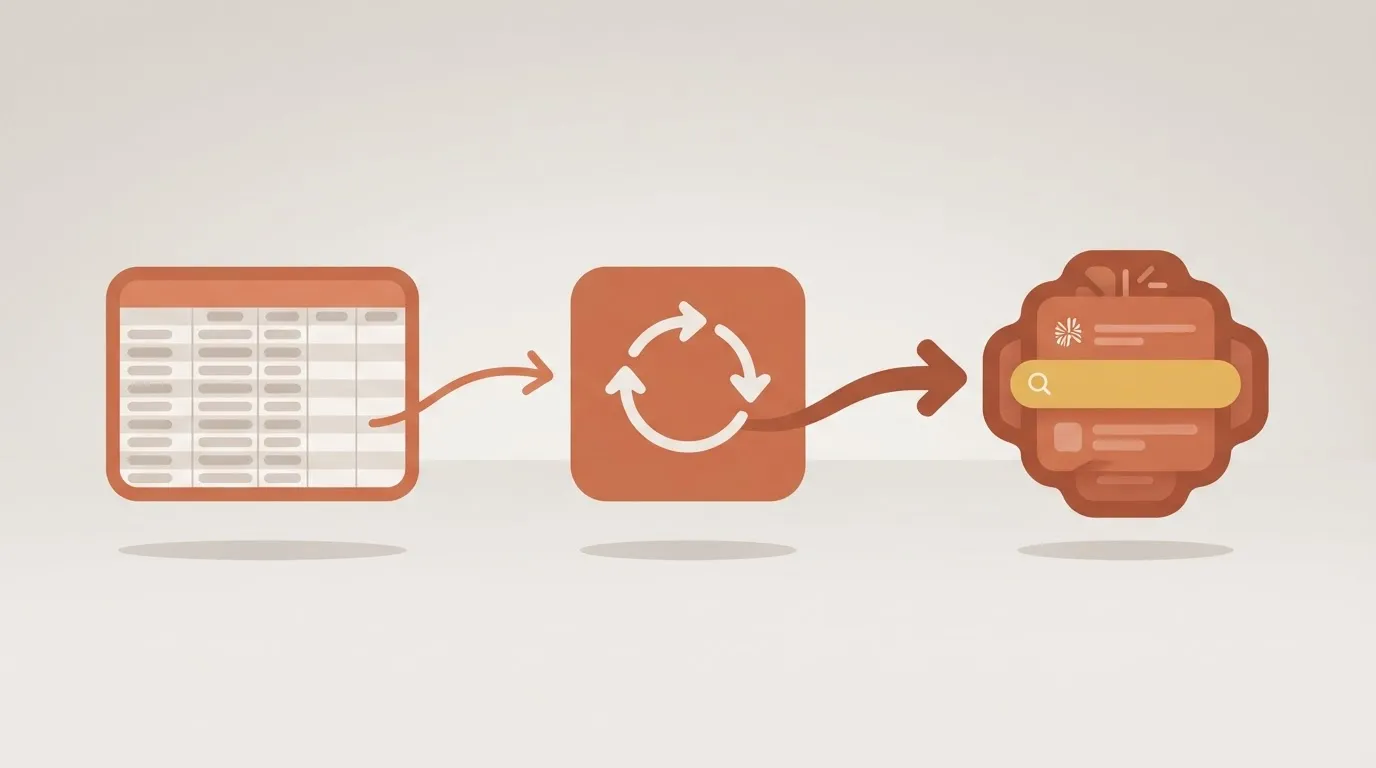
At the selected step, company data leaves the automation vendor for a second provider. The automation platform's no-training promise doesn't automatically cover that second hop, so you need to read two sets of terms, not one.
To apply the same check to each vendor in turn, work through the entries that follow.
### Zapier entry
If you want your own network controls behind a data-handling promise, Zapier can't give you that: it is hosted only, with no self-hosted edition. Whether the promise holds depends entirely on Zapier's published terms and privacy material.
Before relying on any statement about training, find where Zapier's own pages make it and note which plan the statement covers.
A promise written for one tier doesn't carry to another, and a free account may sit under different wording than a paid or enterprise agreement.
Don't take list prices from a comparison table. They change often, so confirm them on Zapier's pricing page. If Zapier's AI features call an outside model provider, ask which provider and under what terms.

### Make entry
There's no self-hosting route with Make either, because it is cloud only. As with Zapier, the document you hold is the control, because you can't inspect or isolate the infrastructure yourself.
Read Make's own security and privacy pages for the training statement, and record which plan the statement is attached to. Check the pricing page for the plan that actually includes the protection you need, since a cheaper tier may not.
Where a scenario calls an external AI module, treat that provider's terms as a separate document to obtain, because Make's commitments describe Make's handling, not the model vendor's.
## n8n and Activepieces for self-hosted control
Self-hosting n8n or Activepieces (whose core is MIT-licensed) puts the workflow tool and its database on your own server. It doesn't bring the AI model provider's handling of your prompts under your control. That distinction decides what each entry below can and cannot tell you.

### n8n entry
If you self-host n8n, execution data and stored credentials stay in infrastructure you run. Its documentation describes the licence terms and which capabilities depend on a paid plan, and that's where to check before committing.
Confirm that the features you need, such as access controls and audit-related settings, are included in the plan you would actually run, not only in a higher tier. The vendor's list prices are in this article's comparison table.
Now yours, not the vendor's: patching, backups and access management.
### Verify licensing for self-hosting
You can self-host Activepieces, whose core is under the MIT licence while its enterprise directories (`packages/ee/`) sit under a separate commercial licence, and that's what the repository's LICENSE file confirms.
The pages reviewed for this article don't confirm a written commitment about whether a connected AI provider trains on your data.
Treat that as not confirmed, not as a quiet yes.
Self-hosting gives you control over where flows run and where their records are stored. Whether any plan-gated feature you rely on is available when self-hosted is a question for its pricing and edition documentation, and you should ask for the answer in writing.

### The AI model you connect is a separate decision
Look at the arrow below. Your server holds the workflow tool and database, the model provider sits outside it, and prompt data leaves along that arrow.
Whatever the provider's terms say about retention and training then applies to that data, regardless of where your workflow tool runs.
You have to obtain and read the model vendor's terms as its own document, and match the plan or API arrangement you use to the terms you read.
Pair a self-hosted install with a permissive model account and you are less protected than with a hosted tool paired with a well-documented one.
## Workato and Power Automate for enterprise contracts
Because both vendors sell on contract, the signed data processing addendum (DPA), not the web page, is what binds them on customer data. A hosted tool is only as protected as the clause you hold.
Pair a self-hosted install with a permissive model account and you are less protected than with a hosted tool paired with a well-documented one.
For a training-on-your-data promise, the table shows what each document type is worth and what each platform charges.
Read the first four rows as a ranking of enforceability, and the price row as a rough scale rather than a quote, so you won't treat these as fixed prices.
| | Workato | Power Automate |
|---|---|---|
| Web statement | Marketing page, not contractual | Marketing page, not contractual |
| Docs | Can change without a contract amendment | Can change without a contract amendment |
| Data processing addendum | Binding once signed; request it | Binding once signed; request it |
| Licence | Negotiated enterprise subscription | Per-user licence |
| Price | About $15,000-$25,000 entry; $84,787 SMB average a year | Per-user; $18,000 a year for 100 users |
Don't read the cost figures as like-for-like, as the next two entries explain.
### Workato entry
**$84,787 a year** is what SpendHound gives as the average Workato SMB contract, meaning even adoption by smaller organizations requires substantial annual commitments. It puts the average enterprise contract at $372,376.
Those are averages of what buyers actually signed, so they include usage, connectors and services, and you should budget against them, not against the entry range.
Because the licence is negotiated, the DPA and any training restriction are negotiable too, and that's the moment to get them in writing.
### Microsoft Power Automate entry
$18,000 a year for 100 users is SpendHound's Power Automate figure, so individual users cost roughly $180 annually. That's a per-seat calculation, not an average contract. Set beside Workato's $84,787, it looks about a fifth of the cost.
Don't lean on that comparison: one is a 100-seat list price, the other a blended average that includes more than seats, which means the apparent savings is unreliable. The per-user model also means cost grows with headcount, not with workflow volume.
Whatever the price, ask for the DPA and check that its wording on customer data and model training matches the documentation you relied on.
## Verify a no-training claim before you buy
Verify a no-training claim by finding the vendor's own statement, confirming it covers your plan, and getting written confirmation. Few buyers do.
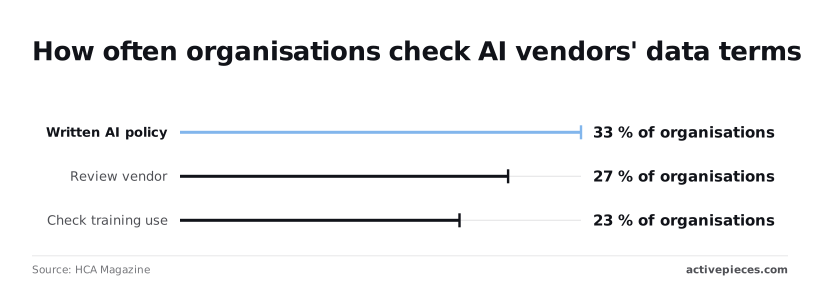
In a [HCA Magazine](https://www.hcamag.com/ca/specialization/transformation/few-canadian-firms-vet-ai-vendors-as-staff-share-sensitive-data-report/594053) report, only **33% of organisations had a written AI policy**, so two in three have no standard to hold a vendor to.
Just 27% review vendor terms, which means nearly three in four accept them unread. Only 23% check whether the vendor trains on their data, so the question this article turns on goes unasked at most firms.
1. Find the vendor's trust or AI page.
2. Confirm which plans that page covers.
3. Request the DPA.
4. Check the admin opt-out.
5. Get written confirmation for your plan.
6. Record the URL and the date.
For steps two to five, the detail sits in the documents, settings and contract wording below.
For documents, ask for the DPA, the list of subprocessors and the page that states the training policy. Read the plan scope on each.
A promise written for an enterprise tier doesn't cover a starter plan, and a DPA that omits the AI features leaves them unprotected.
### Account settings that control training on your data
Where the vendor has an admin opt-out, open it on your own account and screenshot it with the date. If the default is opt-in, a setting nobody has changed means your data is already in scope.
For a self-hosted deployment, there's no vendor dashboard to trust. Check whether any AI feature forwards data to a third-party model provider, and confirm in your outbound network logs that nothing leaves that you didn't approve.
### Contract wording for a no-training guarantee
Ask for a clause that says customer data isn't used to train models, names your plan and covers subprocessors. If the vendor will only point to a web page, request an email from an authorised contact that confirms the same terms.
Store the page URL, the DPA version and the date together, because a web page can change after you sign.
## Frequently asked questions
### Does a free plan get the same no-training protection as a paid plan?
Not automatically. A vendor's no-training commitment may be written for specific plans, so a free tier can fall under different terms from a paid or enterprise one.
Read the clause for the plan you actually use, and if the document doesn't name your plan, ask the vendor in writing. Until they answer, assume the protection isn't confirmed for your account.
### Does self-hosting guarantee my data is never used for training?
No. Self-hosting keeps workflow data and credentials on infrastructure you control, which removes the vendor from the data path for the core engine. **It doesn't cover everything else**.
Configure an AI step and content still goes to a model provider, and optional telemetry or usage reporting may still leave your network. Check which features call out, and what each one sends, before you treat the deployment as closed.
### Does 'we don't train' mean the AI provider doesn't either?
No. An automation vendor's promise covers its own use of your data. When a workflow calls a model from Anthropic, OpenAI, Google or another provider, the prompt reaches that provider under its own terms, and those terms often differ between API access and consumer products.
Look at the subprocessor list in the data processing agreement (DPA) to see who receives your data, then read each provider's API terms. If you bring your own API key, the contract that matters is the one between you and the provider.
### How often should I recheck a vendor's data terms?
Recheck at every renewal, whenever you change plan, and before you switch on any new AI feature. Recheck whenever the vendor announces a change to its terms or subprocessors.
Compare the live page against the URL, DPA version and date you stored at signing. If the text has changed, find out whether your contract pins the older version or follows the current one. That question decides which version binds you.
## Related reading
- [Best Data Automation Tools of 2026 for Analytics Teams](https://www.activepieces.com/blog/best-data-automation-tools-of-2026-for-analytics-teams)
- [8 Data Integration Tools: Key Features, Benefits & Top Picks](https://www.activepieces.com/blog/data-integration-tools)
- [Data Quality Check Automation: A 2026 Guide](https://www.activepieces.com/blog/data-quality-check-automation-a-2026-guide)
## References
- [HCA Magazine](https://www.hcamag.com/ca/specialization/transformation/few-canadian-firms-vet-ai-vendors-as-staff-share-sensitive-data-report/594053)
- [PagerDuty](https://www.pagerduty.com/newsroom/shadow-ai-workplace-survey-2026/)
- [SpendHound](https://www.spendhound.com/marketplace/workato-pricing)