### Where the 'black box' code generation hits a limit Complexity plateaus when an application requires sophisticated backend workflows, such as custom authentication or multi-step webhooks. This visualizes the boundary where automated UI generation fails to account for idiosyncratic enterprise rules. Developers seeking modular automation must often fight against the platform's opinionated structure to gain necessary hooks. ### Direct code manipulation and version control Lovable provides a direct "Sync to GitHub" feature that pushes the underlying React and Vite code to a repository you own. This transparency allows a developer to step in and fix specific bugs that the AI might struggle to resolve through chat alone. By maintaining a live connection to GitHub, the platform ensures that the generated code is not trapped in a proprietary editor. A team can use the AI for rapid layout changes while using standard pull requests to manage critical logic updates.  ### Integrated database management with Supabase The platform shines by automatically configuring Supabase as the backend for every new project. It generates the necessary SQL schemas and row-level security policies based on the natural language description of the app. This integration means a user does not have to manually set up tables or manage connection strings. For a prototype, having a pre-configured database that scales to a production environment is a significant time-saver that reduces initial configuration errors. Retries, memory, and tool-calls are what an agent actually is, and in Activepieces that logic sits in the open, MIT-licensed core. Every tool call an agent makes in a run appears in the run trace, and the code that produced that decision sits in the same public repository. A developer can verify this by matching the Flow Execution Engine and AI Integration pages in the public monorepo against the step-by-step trace in the run-details UI for the same run. ### The transition from prototype to production-grade software Moving beyond a Minimum Viable Product necessitates a shift toward code portability to ensure the application can scale without vendor lock-in. Exporting generated files often reveals tightly coupled components that are difficult to refactor. Furthermore, production systems require business rules to live in a transparent layer rather than being buried within AI-generated React hooks. ## Comparing the top five Lovable alternatives for 2026 The decision to migrate from Lovable depends on whether a team prioritizes browser-based speed or the ability to export a full stack to private infrastructure. ### Comparison table: Pricing and core strengths | Platform | Target User | Logic Depth (1-5) | Code Portability | | :--- | :--- | :--- | :--- | | Lovable | Designers/Founders | 2 | Locked | | Replit Agent | Full-stack Developers | 4 | Exportable | | Bolt.new | Frontend Engineers | 3 | Exportable | | Anvil | Python Developers | 5 | Exportable | | Softr | Operations Managers | 1 | Locked |  ### Replit Agent for integrated hosting and IDE access Replit Agent operates as an autonomous coding assistant within an Integrated Development Environment (IDE). It handles the configuration of PostgreSQL databases and virtual machines automatically. Replit Agent utilizes Gemini 3.8 Flash for rapid iteration, minimizing latency between a prompt and a live preview. ### Bolt.new for open-source frontend generation Bolt.new operates as a browser-based tool that generates full-stack web applications using Vite. It uses a WebContainer environment to run Node.js directly in the browser. By leveraging Claude Sonnet 5.5, the platform produces modular React code that can be downloaded as a standard ZIP file, ensuring the project is not tied to a proprietary host. ### Anvil for Python-based professional web apps Anvil allows developers to build full-stack web applications using only Python. It includes a drag-and-drop UI designer that generates Python objects, so a backend engineer can manipulate the interface using standard library calls. The platform has an Open Source App Server for private hosting to meet strict data residency requirements. ### Softr for data-driven internal business tools Softr functions as a no-code layer that transforms data from Airtable or Google Sheets into functional web portals. It uses pre-built blocks for lists and forms, so an administrator can launch a client portal without writing frontend code. It is best suited for scenarios where business rules live inside a spreadsheet. Judgment and rules run in the same flow, on the same engine, in the same run trace. Activepieces places an Agent step alongside deterministic automation steps inside one flow definition, rather than stitching two products together with a webhook.  Placing an Agent step next to a deterministic automation step in the flow builder results in one execution logged from start to finish, which is why MoneyGram and Moneypenny run Activepieces in production. ## Why modular stacks outperform monolithic AI app builders Modular stacks separate the user interface from operational logic. This architecture ensures that a change in frontend design does not inadvertently break data processing rules. ### The risk of AI-generated technical debt Relying on a single AI prompt to generate both visual layout and backend functions creates a monolithic block that is difficult to audit. When business logic becomes entangled with CSS classes, a simple UI refresh can corrupt order processing or lead leading. ### Decoupling the frontend from business logic A modular stack treats the user interface as a disposable layer while keeping core operations in a stable hub. By using tools like Lovable to generate a React frontend that communicates via API to a dedicated logic controller, teams can swap their UI without reconfiguring integrations. ### Maintaining data sovereignty in AI development Decoupled architectures prevent vendor lock-in. In a closed ecosystem, the platform owns the execution environment, making migration difficult. By hosting logic in a standalone engine, developers can route data through specific models (like Gemini 3.8 Flash for high-volume workflows or Claude Opus 5.5 for agentic coding) without being restricted by a UI builder's default model.  ## Hidden scaling costs for AI apps Scaling requires a decoupled strategy because the price of managing 100,000 users **varies by over 18,000%** depending on the provider. ### Monthly cost for 100k users | Provider | Monthly Cost (USD) | | :--- | :--- | | PropelAuth | 4,650 | | Kinde | 1,533 | | Clerk | 1,025 | | Supabase | 25 | | Appwrite | 25 | | WorkOS | 0 |  According to [AgentDeals](https://agentdeals.dev/auth-comparison-2026), PropelAuth costs $4,650 per month, which could exhaust a startup's runway on identity management alone, leaving little capital for core product iteration, so founders must weigh the convenience of a managed service against the survival of their business. ### Infrastructure savings for AI features Supabase and Appwrite both charge $25, allowing developers to reallocate thousands of dollars toward high-reasoning models like GPT-6 Astra, thereby maximizing the budget available for advanced AI integration. WorkOS currently has a $0 tier for this volume, providing the highest possible margin for consumer-facing apps, so founders can scale their user base without incurring immediate infrastructure costs. ### Why 'free' tiers can lead to vendor lock-in Generative platforms often default to proprietary backends lacking standardized data export schemas. If a builder relies on a closed ecosystem, migration becomes a manual engineering sprint. Using an open-core backend like Supabase ensures you can self-host if costs or features diverge from your needs.  ### Balancing developer experience with infrastructure overhead A sustainable 2026 stack balances AI generation speed with decoupled logic control. Running workflows through Gemini 3.8 Flash ensures reliability without being tied to a UI builder's internal limits. Selecting providers like WorkOS or Appwrite keeps user records accessible via standard APIs. ## Activepieces manages the complex logic AI agents miss Activepieces executes the multi-step business logic Lovable cannot natively compile, running these workflows under the MIT-licensed core to ensure logic remains auditable. ### Connecting AI frontends to 100+ business tools Activepieces connects an AI interface to enterprise software by providing 738+ integrations that function as tools for the agent. When a user submits a request through a Lovable frontend, Activepieces routes the payload through these connectors for tools like Slack or HubSpot. 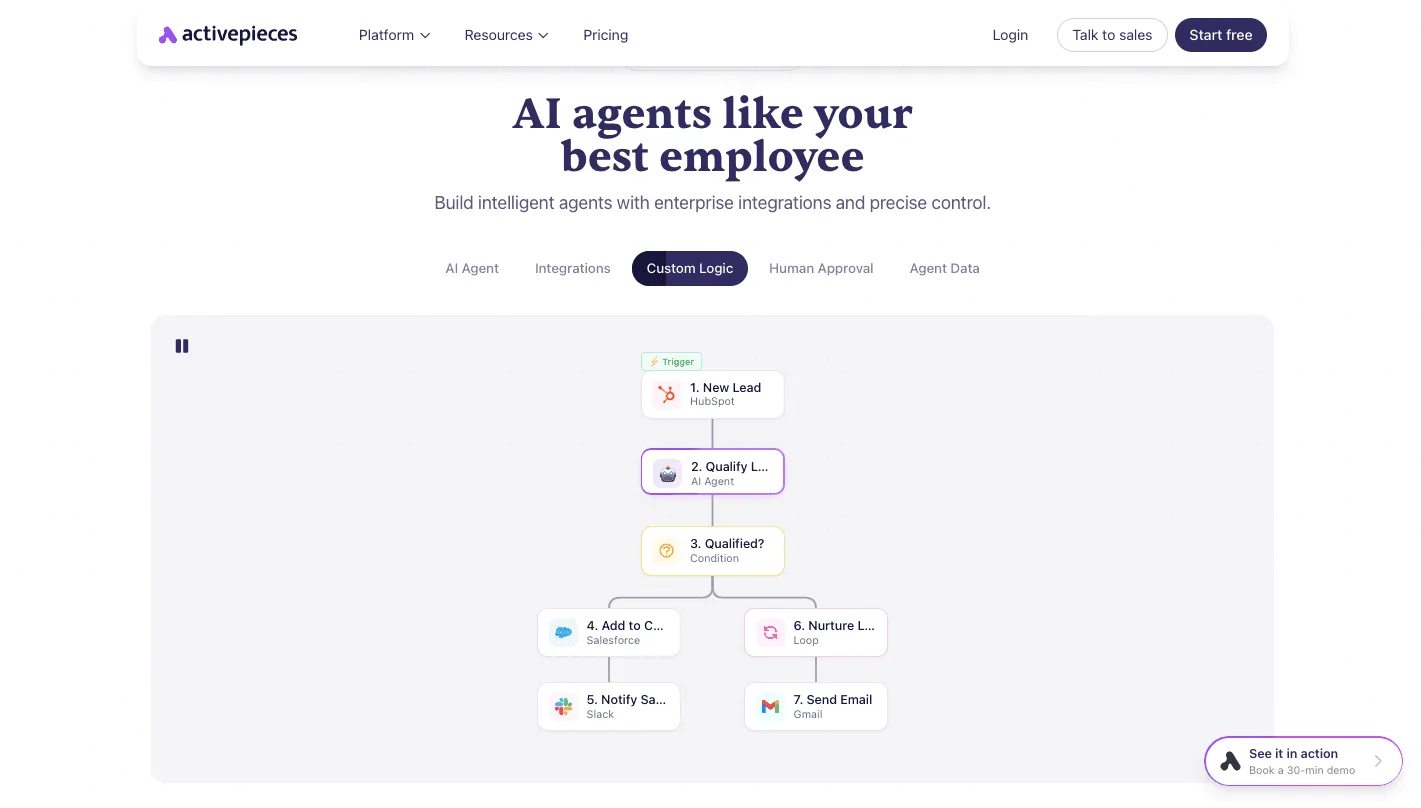 This ensures logic remains portable even if you migrate your frontend framework. ### Building 'human-in-the-loop' approval workflows The platform has a "Wait for Approval" mechanism that pauses sequences until a team member verifies the AI’s output. > By inserting a manual checkpoint before an agentic model like Claude Opus 5.5 triggers a high-stakes action, you mitigate the risk of model hallucinations causing public-facing errors. ### Scaling backend operations without writing custom boilerplate Activepieces allows developers to replace brittle scripts with visual flows. By using Gemini 3.8 Flash to categorize tickets, you can build routing trees that send high-priority issues to engineers while logging routine data to PostgreSQL, reducing technical debt. By providing an open-source execution engine where the underlying code directly mirrors the visual trace, Activepieces ensures that complex agent logic remains fully auditable and transparent. Activepieces is the better choice for developers who require a verifiable, public-code foundation to manage the multi-step integrations and business logic that extend beyond a frontend's native capabilities. ## How to migrate your project Transitioning requires systematic extraction of business intelligence. Because these tools bundle styling and functionality, you must treat migration as a clinical recovery of assets. ### Audit your generated code portability Test if your exported frontend can run in a standard React environment without proprietary dependencies. 1. Audit current Lovable project for 'Black Box' logic; 2. Export frontend assets or React components; 3. Map external API dependencies; 4. Rebuild core logic in a decoupled engine; 5. Connect UI to the new backend. ### Identify your primary bottleneck: UI or Logic? If your team spends time adjusting CSS, your bottleneck is the UI layer. If you struggle with conditional branching or data transformations, your bottleneck is the logic layer. ### Run a 48-hour pilot on a modular stack A time-boxed pilot allows you to test a single feature using Gemini 3.8 Flash or Claude Opus 5.5. Rebuilding a specific workflow in a modular environment proves your data can flow between services without vendor lock-in. ## Frequently asked questions about Lovable alternatives ### Can i export my code from Lovable to another platform? Lovable provides a direct "Sync to GitHub" feature that pushes the underlying React and Vite code to a repository you own. ### Which alternative is best for non-technical founders? FlutterFlow is best for mobile apps, while Bubble is suitable for founders needing built-in database management. Replit Agent is ideal for rapid iterative prototyping using natural language. ### Do these tools support custom LLM integration? Most modular platforms allow you to swap the default AI provider by connecting to external APIs. | Model | Primary Use Case | | :--- | :--- | | Claude Opus 5.5 | Long-running agentic coding and complex knowledge work. | | GPT-6 Astra | Flagship performance for complex reasoning and architectural decisions. | | Gemini 3.8 Flash | High-speed enterprise workflows and agentic coding at scale. | ### What are the hidden costs of AI app generation? Beyond subscriptions, the primary cost is "inference debt," where repeated prompting to fix UI bugs consumes high-tier model credits. ## Related reading - [Best AI Agent Builders in 2026: Ranked & Reviewed](https://www.activepieces.com/blog/best-ai-agent-builders) - [Best Suno Alternatives in 2026](https://www.activepieces.com/blog/best-suno-alternatives-in-2026) - [Best Zapier Alternatives in 2025](https://www.activepieces.com/blog/best-zapier-alternatives-in-2025) ## References - [AgentDeals](https://agentdeals.dev/auth-comparison-2026)For early-stage startups, this speed is a competitive advantage that outweighs architectural purity.