[Activepieces](https://www.activepieces.com) offers unlimited flows on every plan, including free, and its credits meter AI usage rather than runs or steps. Bring your own model key and that spend moves to your own bill, with caps per project and per person, so a repeating job has a ceiling before it starts. ### How prices were checked Every price and credit allowance here comes from vendor pages, and from [Crosswalk](https://crosswalk.to/agents/manus/pricing) for the Manus tiers. They're as they stood on 21 October 2026. Credit allowances and billing units change without notice, so treat any figure as stale if you read it long after that date. The chart that follows shows what each paid Manus tier buys in monthly credits. 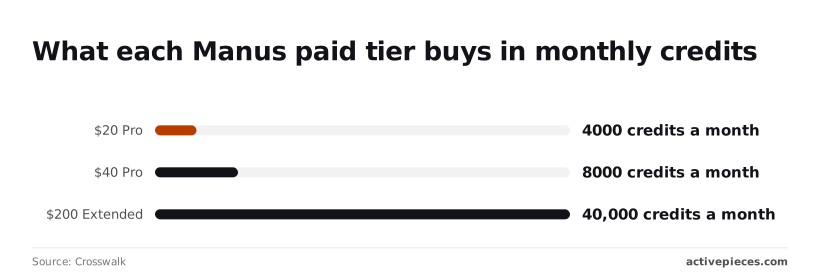 ## ChatGPT agent mode pricing as a Manus alternative For one-off research and multi-step browsing, ChatGPT agent mode fits. It meters messages inside a flat subscription, so the monthly bill is fixed and the cap is what you hit instead. On Plus, OpenAI's [Help Center](https://help.openai.com/en/articles/11752874) gives 40 agent messages per month. At $20, that's $0.50 per message. A daily recurring job would use 30 of them, leaving 10 for everything else.  At the $100 price, Pro's 400 messages a month come to $0.25 per message. Business and Enterprise get 40 per month, per the same page, so a team plan doesn't raise the per-user allowance above Plus.  To see which tier matches the volume you expect, set each plan's price beside its agent allowance in the table below. | Plan | Monthly price | Agent messages per month | Who it suits | |---|---|---|---| | Go | $8 | No allowance listed | Light chat use, not agent work | | Plus | $20 | 40 | Occasional one-off research | | Pro | $100 / $200 / $500 | 400 | Heavy, frequent research by one person | The main limit is the cap itself. When the allowance runs out, the agent stops until the next month, and an unfinished task doesn't buy you extra messages. That's more predictable than a credit balance that drains at an uneven rate, because you know the ceiling in advance. But the cap is a count of messages, not of work done. A long browsing task and a quick lookup each cost one message. **Tenfold more allowance for fivefold more price**: that is the jump from 40 to 400 messages at the lowest Pro tier. That's cheaper per message, but only if you actually use the volume. For a handful of research tasks a month, Plus is enough. For the same job on a schedule, the allowance runs out within weeks. ## Genspark subscription tier pricing For the same research, slides and documents work as Manus, [Genspark](https://www.genspark.ai/helpcenter/membership-plans) sells a subscription tier, so the monthly price is fixed before the first task runs. That matters when you're deciding how much a month of agent work will cost. On Manus, credits are the meter, and a task's credit burn is only known after it finishes. The table below puts the two side by side. The Manus free tier gives 300 refresh credits every day. Both Manus Pro tiers work out to $0.005 per credit, so the upgrade buys headroom, not a lower rate.  | Plan | Price | Billing unit | Predictability | |---|---|---|---| | Manus Free | $0 | 300 credits/day, 1,500/month cap | Capped, but one task's credit use is unknown in advance | | Manus Pro | $20 | 4,000 credits | Fixed price, variable credits per task | | Manus Pro | $40 | 8,000 credits | Same as the $20 tier, with double the credits | | Genspark Plus | $24.99 | Subscription plan | Plan price is fixed in advance | | Genspark Pro | $249.99 | Subscription plan | Plan price is fixed in advance | Plan around the gap between Genspark's two tiers. Pro costs about ten times Plus, so moving up is a budget decision, not a small step. Manus offers several steps in between, and you can stop at a size that fits. If you do one-off research or a slide deck now and then, and want a known bill at the end of the month, Genspark suits you. If a job repeats on a schedule, Genspark gives you no extra structure, because every run is still an agent working from a prompt. That distinction leads into the workflow tools that follow. ## Claude flat monthly subscription pricing Instead of per-task credits, [Claude](https://claude.com/pricing) charges a flat monthly subscription with usage limits. A month of research and document work arrives as one known charge instead of a meter running per task. That's the opposite of the workflow tools above, which bill by the run. With Claude, you pay for access, and the limits, not a credit balance, decide how much you can do. Writers, analysts and developers tend to find this easier to budget. Drafting a report, summarising a stack of PDFs or working through a codebase all happen inside a conversation, and a long session doesn't turn into a surprise invoice. If you hit a limit, you wait or move up a tier, and nothing is charged on top of the plan. The trade-off is autonomy. Claude is built around you directing the work, not around handing it a goal and leaving a browser running for hours. Long, unattended browsing runs hit usage limits and aren't what the subscription is designed around. If your Manus use was mostly "set it going and come back later," expect to stay more involved. ### Entry tiers compared In the chart's entry paid tiers for the flat-subscription rivals, Claude Pro, Google AI Pro and ChatGPT Plus all sit at roughly $20 a month, so the starting price won't decide between them. 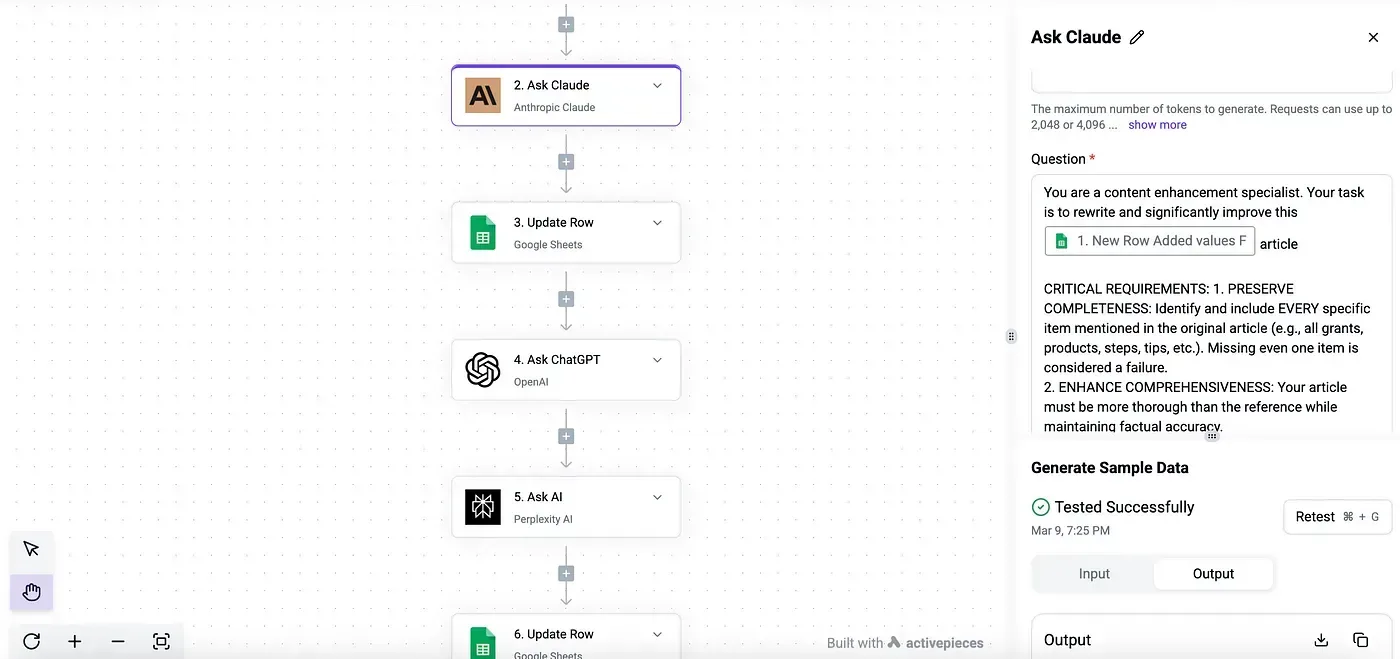 Past the entry tier, Claude's Max 5x at $100 and Max 20x at $200 are the steps up. Each costs five to ten times the entry tier, which makes them worth considering only if you keep hitting Pro's limits. What follows from the chart is that a flat plan's cost is fixed at the tier you pick. The question to ask is how much work your usage fits inside that tier, not what each task costs. ## Google Gemini subscription tier pricing Google answers the question of how much work your usage fits inside a tier with a flat plan. AI Pro at $19.99 and Ultra starting at $99.99 bundle Deep Research and agent features, so the metered unit is the subscription, not the task. At about 12.5 times the price of Pro, Ultra only pays off if you regularly hit Pro's ceiling on research runs. viz type=groupedbars title="Flagship API prices across Claude, OpenAI and Gemini" unit="$ per 1M tokens" source="Anthropic - https://platform.claude.com/docs/en/about-claude/pricing" cols="Input,Output"0 in and $50 out per million tokens; Gemini lists at $2 and If your source material already sits in Google Drive, the Pro plan's 5 TB of storage matters, because the agent reads and writes in the same place you keep files. For a team on Google Workspace (Gmail, Docs, Drive and Calendar), research output lands in documents colleagues can already open, and nothing needs reconnecting. The limit is the reverse of that strength. If your customer data lives in a CRM, a billing system or a project tracker outside Google, the agent has no native view of it. You export, paste or build a connector, and each of those is manual work you pay for in time rather than credits. ### Gemini API token pricing Call Gemini through the API and you pay a separate, token-based price that has nothing to do with the subscription. Using [Anthropic's published pricing](https://platform.claude.com/docs/en/about-claude/pricing) as the reference, Claude Fable 5.1 and GPT-6 Astra each cost $10 to $50 per 1M tokens. Gemini 4 Argon costs $2 to $10. **One fifth of the other two**, at both ends: that is Argon's range. At a million tokens that's a saving of $8 to $40. It grows linearly with volume, so a pipeline processing hundreds of millions of tokens sees the gap in the invoice. That comparison covers token pricing only. It says nothing about output quality on your task, so test your own prompts before moving a workload over. ## Activepieces For a Manus job that repeats, Activepieces fits. It's an open-source workflow platform with an MIT-licensed core and 742 integrations, not an autonomous agent, so you fix the steps once and credits are spent only where the AI step runs, rather than on an agent's open-ended effort. That also makes your prompt test easier. Because the AI step is one fixed prompt, you can run it against real inputs until the output is right, and it then behaves the same on every run. Billing is where Activepieces differs most from Manus. You can self-host the MIT-licensed core free, in which case you pay for your own server and your own AI model usage instead of a vendor's meter. The cloud plans give unlimited flows and meter credits for AI usage, and the paid tiers begin with Plus at $20 a month. Set a cap per project or per person and you have a ceiling rather than a surprise, and with your own model key the model spend sits on your own bill. Check the current plan limits on the vendor's pricing page before you commit. 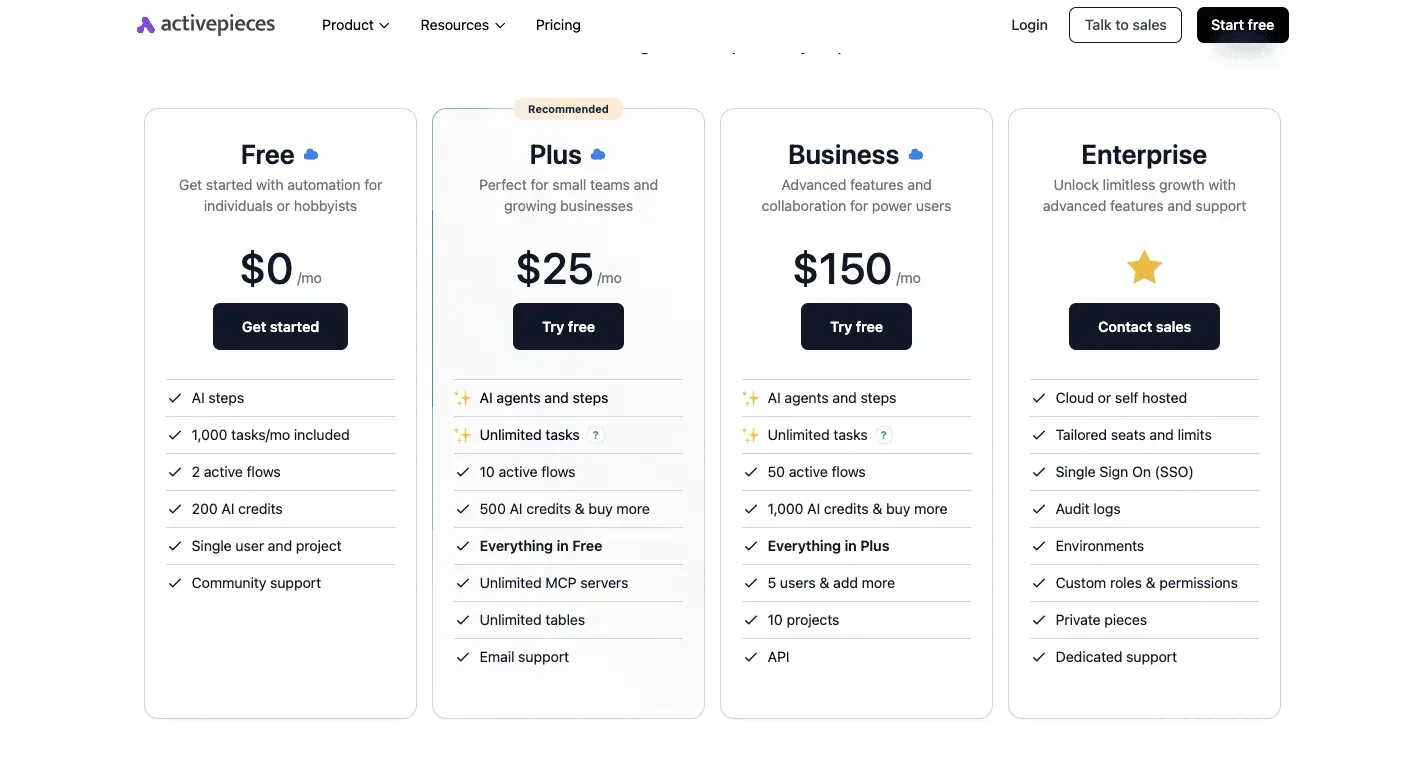 To turn a recurring research chore, such as a weekly digest of a competitor's changelog, into something you build once, use the flow below. It shows the whole job as five fixed steps, with one place where the AI is involved. 1. Add a schedule trigger set to the cadence you need, such as every Monday morning. 2. Fetch the source page or feed with an HTTP request step. 3. Add an AI summarise step with the prompt you already tested. 4. Send the summary to email or Slack. 5. Run a test, check the output, then turn the flow on. Setup is the limit. Someone has to build and maintain the flow, and it won't improvise a one-off question the way a general agent does. If the task changes every time, this is the wrong tool. You can build this flow free in Activepieces: the free plan has unlimited flows and 1,000 credits a month. Activepieces is the better choice for anyone automating a repeating job where cost predictability matters more than per-step flexibility, because its published pricing counts one credit per flow run however many steps the flow contains. Zapier bills per task and Make per module, so a longer workflow costs more on those platforms, while on Activepieces **the run is the meter** and adding steps doesn't raise the bill. Teams that want an even tighter cap can self-host the MIT-licensed core and pay only for their own server and AI model usage. ## Steps before switching from Manus Spend one Monday morning on five steps, in this order, before you move any work off Manus. The credit bill only tells you what to switch to once you've matched it against the work behind it. Start by exporting your Manus tasks and credit spend. Pull the task history and the credits each task used. Credits are the unit Manus meters, so the export shows what each job cost in that unit rather than what you remember it costing. If the export is incomplete, the gaps are tasks you can't price later, so note them now. Next, sort every task as one-off or repeating. A one-off is research you won't run again in that form. A repeating job is the same steps on new inputs: a weekly report, a lead check, a form that triggers a summary. Since one-off work points toward a general agent and repeating work points toward a workflow tool, the split decides the rest of the article. ### Testing and costing the alternatives You should run one real task on two alternatives. Take an actual task from your export, not a demo prompt. Give the same input to one candidate from each category if you have mixed work, or two from the same category if you don't. A real task exposes retries, failed steps and re-prompting, which are the places where unpredictable cost hides. Record the cost per finished task. **Divide total spend by tasks that produced a usable result, not by tasks started.** A run you had to repeat or discard still costs money, so counting only completed output gives you the figure you'll pay at volume. Compare it with the same number from your Manus export. Re-check each pricing page before you commit. The figures in this article were checked against vendor pages on 21 October 2026. Vendors change plans, limits and metered units without notice. Confirm the current page for any tool you're about to pay for. ## Related reading - [Best ElevenLabs Alternatives in 2026 Compared](https://www.activepieces.com/blog/best-elevenlabs-alternatives-in-2026-compared) - [8 Best Monday.com Alternatives for 2026 Compared](https://www.activepieces.com/blog/8-best-monday-com-alternatives-for-2026-compared) - [Botpress Alternatives: Best Options Compared (2026)](https://www.activepieces.com/blog/botpress-alternatives-best-options-compared-2026) ## References - [Crosswalk](https://crosswalk.to/agents/manus/pricing) - [Anthropic](https://platform.claude.com/docs/en/about-claude/pricing) - [OpenAI Help Center](https://help.openai.com/en/articles/11752874)If you can't estimate what one task burns, upgrading doesn't fix that. It only gives you more room to be surprised.