# Best Vapi Alternatives: Which Voice AI Platform Is Better?
By Amit Patel · 2026-10-01 · Source: https://www.activepieces.com/blog/best-vapi-alternatives-which-voice-ai-platform-is-better
---
Selecting a voice AI provider in 2026 requires balancing the sub-second response times necessary for human-like turn-taking, which often involves connecting various LLM endpoints through [Activepieces](https://www.activepieces.com) to maintain workflow fluidity, against the computational overhead of high-fidelity emotional synthesis.
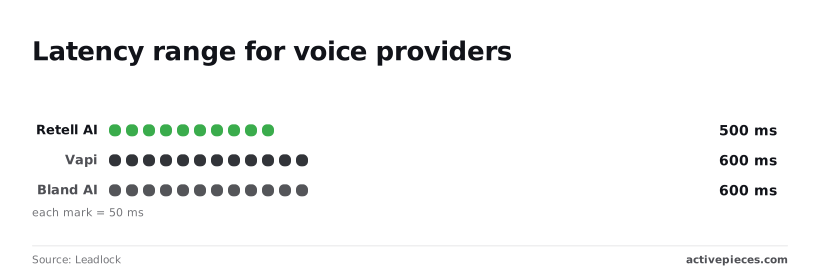
When you use [Vapi](https://vapi.ai/blog/elevenlabs-alternative) as a functional wrapper for rapid prototyping, production workloads often hit a ceiling where the underlying orchestration adds **600ms to 900ms of end-to-end latency** according to [Leadlock](https://www.leadlock.ai/blog/retell-ai-vs-bland-ai-choose-the-right-voice-agent-for-your-business/).
This delay forces users to wait nearly a full second before the agent acknowledges a finished sentence, frequently causing conversational overlap. To eliminate this friction, you'll want to move closer to the metal by selecting providers based on specific performance bottlenecks.
## Latency, Realism, and Scale Selection Criteria
| Provider | Primary Strength | Typical End-to-End Latency |
| :--- | :--- | :--- |
| Vapi | Orchestration | 600ms – 900ms |
| Retell AI | Latency | 500ms – 800ms |
| Bland AI | Scale | 600ms – 1000ms |
| ElevenLabs | Realism | 800ms – 1200ms |
_Prices and plan limits checked against [vapi.ai](https://vapi.ai/blog/elevenlabs-alternative) on October 1, 2026._
The selection matrix above illustrates the trade-offs between various voice AI providers and infrastructure:
* Retell AI achieves a tighter 500ms to 800ms range per [Leadlock](https://www.leadlock.ai/blog/retell-ai-vs-bland-ai-choose-the-right-voice-agent-for-your-business/), reducing the "dead air" that breaks immersion.
* Specialized TTS providers like Neuphonic have pushed raw synthesis down to 25ms so that the bottleneck shifts entirely to the LLM's time-to-first-token.
* Leadlock notes that for teams prioritizing human-grade inflection over speed, ElevenLabs remains the baseline despite higher latency.
* [Bland](https://www.bland.ai/pricing) AI targets massive outbound concurrency where a 1000ms delay is acceptable for automated high-volume dialing.
* Activepieces is a per-project MCP server that makes every connected integration available to the AI as a tool, so a voice agent can reach any of its 738+ integrations without being re-integrated or wired up twice.
As we move toward GPT-6 Astra or Gemini 3.8 Live for the reasoning core, the choice of transport layer becomes the deciding factor for reliability.
## Use Retell AI for stability
Retell AI is a developer-first platform optimized for sub-second response times and conversational stability in high-stakes customer service environments. By treating the entire audio pipeline as a single, low-latency stream, Retell prevents the unnatural pauses that cause users to hang up.
### Ultra-low latency architecture
The platform minimizes the round-trip time between a user finishing a sentence and the AI beginning its response by integrating specialized providers directly into its transport layer.
According to Vapi, benchmarked latencies show that Neuphonic clocks in at 25ms, which means the system captures the user's intent almost instantly.
Ultravox achieves a similar 26ms in the synthesis stage. The generated audio stream begins before the human ear can detect a delay.
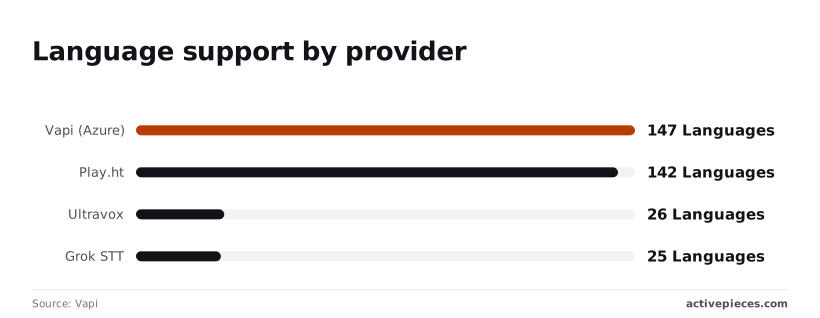
In contrast, legacy configurations like Vapi using Azure support up to 449 neural voices across 147 languages but average around 40ms response times, creating a noticeable "processing" gap that breaks the flow of natural conversation.
Even specialized synthesis tools like Play.ht support 142 languages across four TTS models (2.0, 2.0 Turbo, 3.0 mini, and PlayDialog), so you'll have to weigh the trade-off between the phonetic richness of those models and the raw speed required for reactive, high-volume support lines.
### Developer-centric dashboard and logs
You will find a granular view of the state machine in the Retell dashboard, allowing you to inspect exactly where a call failed or why the system ignored a tool call.
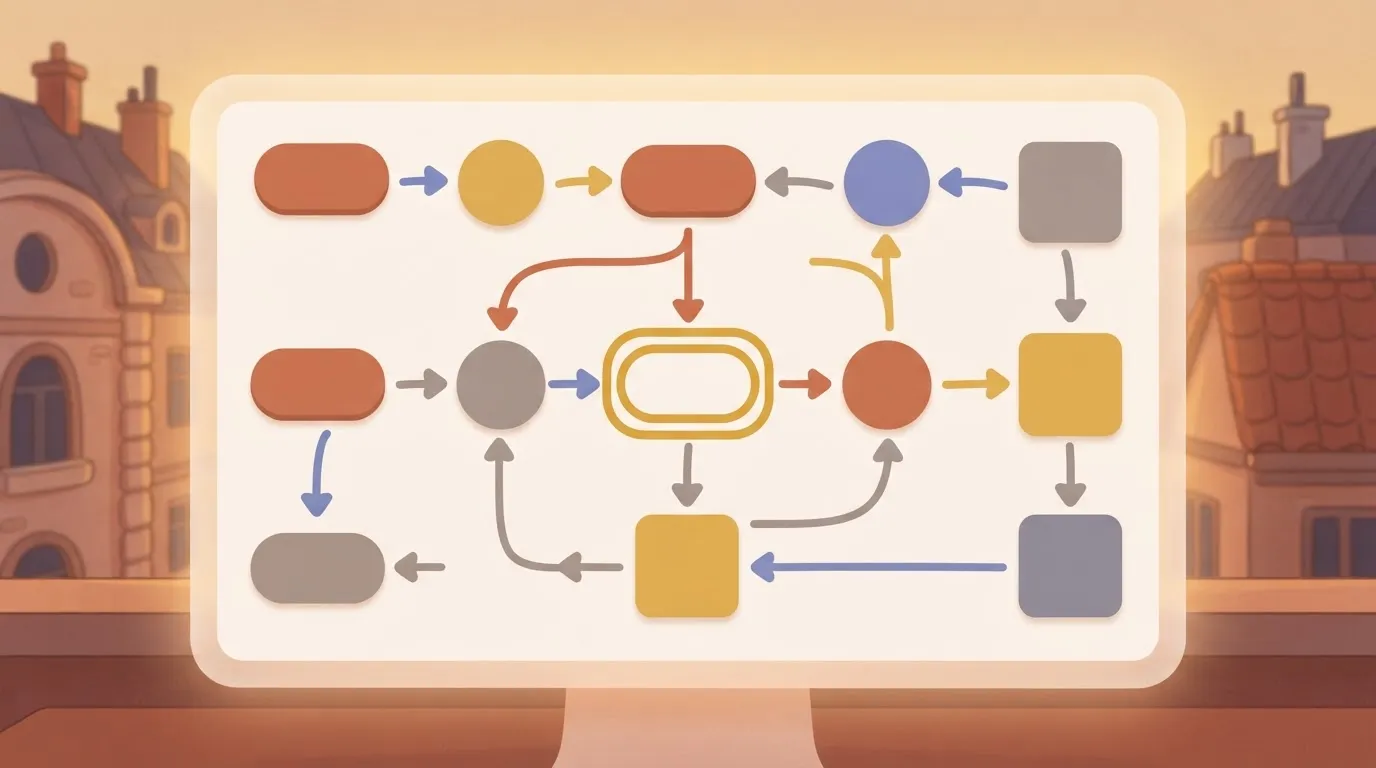
Each execution log breaks down the latency of the individual components (STT, LLM inference, and TTS).
You can see if a delay resulted from a slow response from Gemini 3.8 Live or a network hiccup in the WebRTC stream.
This level of visibility means that instead of guessing why an agent hallucinated during a transfer, you can pinpoint the exact JSON payload that triggered the error. You can then implement a retry logic or a fallback prompt immediately.
### Stability for complex turn-taking
Managing interruptions is the primary failure mode for voice agents, and Retell uses a proprietary "back-channeling" logic to handle users who speak over the AI.
The system distinguishes between meaningful interruptions that require the agent to stop and pivot (such as a customer providing a new account number) and ambient noise or "mhm" sounds that the agent should ignore.
By maintaining a persistent websocket connection to models like GPT-6 Astra, Retell ensures that the agent’s internal state remains synchronized even if the audio stream pauses or restarts.
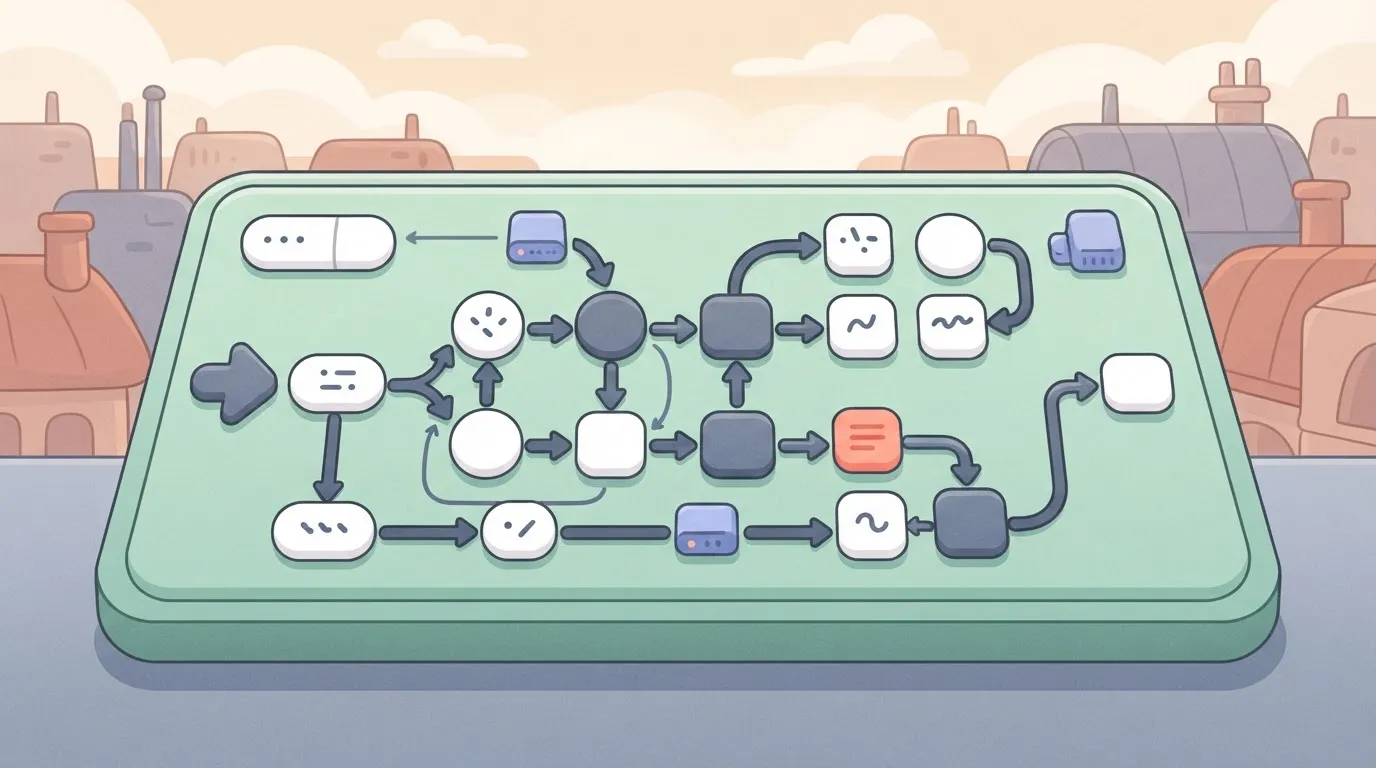
This prevents the "double-talk" scenario where an agent continues finishing a previous sentence while the user is already asking a new question. This is a critical requirement for maintaining professional authority in outbound collections or technical support.
## Use Bland AI for volume
Bland AI is a dedicated infrastructure for high-volume outbound voice operations, prioritizing concurrent call capacity and telephony reliability over the low-latency conversational nuances required for inbound support.
Bland AI executes thousands of simultaneous interactions, making it the primary choice for automating debt collection, lead qualification, or large-scale appointment setting.
### Hyper-realistic outbound calling
The platform utilizes a proprietary stack optimized for the specific cadence of outbound solicitation, where the first five seconds determine whether a recipient stays on the line.
By integrating Gemini 3.8 Flash TTS for high-fidelity speech synthesis, the system generates prosody that mimics human sales representatives, reducing the "robotic" footprint that triggers immediate hang-ups.
This realism is paired with a persistence engine that manages redial logic and voicemail detection. The agent only engages the LLM when it confirms a live human is on the other end.
### Enterprise-scale infrastructure
Scaling an outbound operation requires more than just an API endpoint; it requires a telephony backbone that navigates global carrier networks without being flagged as spam. The three pillars of Bland AI outbound scale include:
* Hyper-parallel dialing allows for multiple concurrent calls even on entry-level plans.
* Enterprise-grade telephony infrastructure manages SIP trunking and number reputation to maintain high connection rates.
* Automated scheduling and debt collection workflows integrate directly with your existing CRM records to update payment statuses or calendar slots in real-time.
Because this infrastructure is robust, call volume increases do not cause the system to suffer from socket exhaustion or API rate-limiting. These issues often plague DIY wrappers built on top of standard Twilio implementations.
### Dynamic pathway management
To handle the non-linear nature of outbound debt collection or complex sales, Bland AI uses a "Pathways" system that is a state machine for the conversation.
Instead of relying on a single long-form prompt, you define specific nodes (such as "Refusal to Pay" or "Wrong Person") which the agent transitions between based on the user's intent.
This prevents the agent from hallucinating off-script during sensitive financial discussions. It also ensures that every call follows the regulatory compliance guardrails required for enterprise operations.
## Why ElevenLabs prioritizes vocal quality
ElevenLabs focuses on industry-leading vocal quality and emotional nuance, suited for brands that prioritize human-like delivery over raw orchestration speed. This platform emphasizes the phonetic accuracy and cadence required for high-stakes customer interactions where a robotic tone would damage brand trust.
### Unmatched emotional range and prosody
The primary advantage of using this engine is its ability to maintain consistent prosody across long-form speech generation.
Unlike standard text-to-speech services that often flatten the intonation at the end of sentences, ElevenLabs uses deep learning models to predict the appropriate emotional weight based on the context of the text.
In production environments, this means a virtual agent can shift between a helpful, rising inflection for questions and a calm, authoritative tone for troubleshooting steps without manual tagging.
This prevents the "uncanny valley" effect that occurs when a synthesized voice fails to match the urgency or empathy of the words it's speaking.
### Multilingual voice cloning capabilities
The platform is a unified architecture for cross-lingual voice synthesis that preserves a speaker’s original vocal characteristics across different languages. By decoupling the speaker's identity from the language-specific phonemes, the system allows a single professional voice clone to be used for global deployments.
This ensures that a brand’s signature voice sounds identical in Tokyo as it does in London. This removes the need to manage separate voice actors or distinct audio assets for every regional market.
### Integration with external LLM providers
The API is designed to sit at the end of a modular inference chain. This allows you to pipe text from high-reasoning models like GPT-6 Astra or Gemini 3.8 Flash directly into the speech engine.
Because the platform doesn't force you into a specific internal LLM, you can utilize Claude Fable 5.1 for complex reasoning.
You can then rely on ElevenLabs solely for the final audio delivery. This separation of concerns lets you replace the reasoning layer as new models emerge without requiring a complete overhaul of the voice identity or the audio processing logic.
## Deepgram for transcription speed
Deepgram provides the foundational speech-to-text layer for teams building their own custom orchestration stacks. By utilizing an end-to-end deep learning architecture, it achieves transcription speeds that are significantly faster than traditional recursive neural networks.
This speed is essential for real-time agents that need to process user speech in chunks rather than waiting for a full sentence. The platform also offers high accuracy in noisy environments, which is a common failure point for mobile-based voice agents.
## Hume AI for emotional intelligence
Hume AI focuses on the empathic layer of voice interaction by analyzing vocal expressions and adjusting the agent's response accordingly. This goes beyond simple sentiment analysis to detect nuanced states like confusion, excitement, or frustration.
By integrating these emotional insights into the conversational loop, the agent can de-escalate tense situations or provide more supportive feedback. This makes it a strong choice for healthcare or wellness applications where the tone of the interaction is as important as the information provided.
## Play.ht for diverse voice libraries
Play.ht offers one of the most extensive libraries of high-fidelity voices, making it a versatile choice for applications requiring specific regional accents or character types. The platform provides a simple API for streaming audio, allowing for quick integration into existing conversational flows.
While it may not reach the sub-100ms latency of specialized speed providers, its focus on phonetic variety makes it ideal for educational content or storytelling agents. The ability to fine-tune pronunciation ensures that technical terms or brand names are spoken correctly every time.
## Vocode for open source orchestration
Vocode provides an open-source framework for building voice-based LLM applications, offering a modular approach to the entire stack. It allows developers to swap out STT, LLM, and TTS providers with minimal code changes, providing a level of flexibility that managed platforms lack.
This framework is particularly useful for teams that want to maintain control over their infrastructure while benefiting from a pre-built orchestration layer. It supports various transport protocols, including WebRTC and SIP, making it suitable for both web and telephony applications.
## Tavus for video-first interaction
Tavus extends the voice agent concept into the visual realm by providing automated video generation that syncs with the synthesized audio. This allows for the creation of "digital twins" or avatars that can engage in face-to-face conversations with users.
For high-touch sales or personalized marketing, the addition of a visual element can significantly increase engagement rates. The platform handles the complex task of lip-syncing and facial animation in real-time, providing a more immersive experience than audio-only agents.
## Activepieces
Activepieces connects voice agents to 738+ integrations, allowing you to automate post-call actions without maintaining custom middleware or risking a CRM failure that hangs the voice socket.
An MCP (Model Context Protocol) server acts as a standardized interface that allows an AI model to securely access local or remote tools and data sources.
By using Activepieces as a per-project MCP server, you provide your agent with a secure sandbox where it can execute actions (like looking up a customer's last order) without needing direct access to your entire database.
### No-code workflow automation for voice
Automating the lifecycle of a voice interaction requires a reliable bridge between the real-time event stream and your internal databases.
Activepieces maps webhook payloads from providers like Retell AI or Bland AI to specific downstream actions in a visual environment, eliminating the need for boilerplate Express.js servers.
The screenshot below illustrates this orchestration. It shows a multi-step agent workflow that triggers from a HubSpot lead, qualifies the data via an AI step, and branches into Salesforce and Slack notifications.
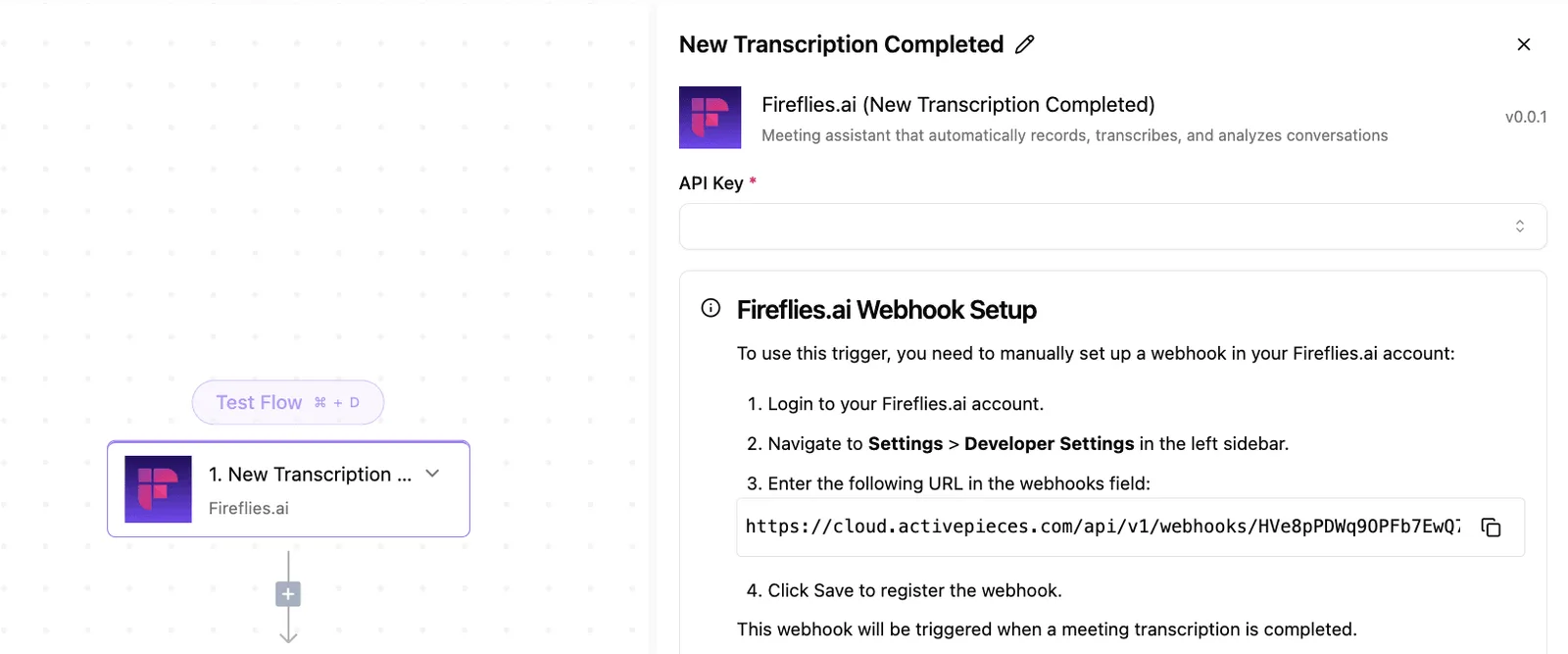
This visibility allows you to audit the decision-making logic of an agent without digging into Python scripts or JSON configuration files.
Because the platform handles retries and error states natively, a momentary timeout in a third-party service won't result in a lost lead or a silent failure in your pipeline.
### Connecting voice agents to CRMs and ERPs
An SDK provides an agent with code, but it does not provide the governance required for production. Activepieces treats the voice agent as a user, applying enterprise RBAC, SSO, and SCIM to determine which tools it may access.
Companies like MoneyGram and FundingSocieties run this in production to ensure every tool call is logged with its specific inputs and outputs, rather than being hidden inside an opaque code execution block.
### Self-hosted privacy for voice data logs
For organizations operating in regulated environments, Activepieces provides an MIT-licensed core that can be run as a self-hosted Docker deployment to keep sensitive call metadata within your own virtual private cloud.

This deployment model ensures that PII (Personally Identifiable Information) extracted from voice logs never touches a third-party automation cloud, satisfying strict data residency requirements.
By running the orchestration layer on your own infrastructure, you maintain full control over execution logs and API keys. This reduces the attack surface of your voice AI stack.
By unifying its extensive library of integrations with the Model Context Protocol, Activepieces ensures that every connector functions natively as an agent tool. Activepieces is the better choice for developers who require a secure, sandbox-ready MCP server that eliminates the need for custom middleware.
Its ability to expose the same robust actions to both automated flows and real-time voice agents makes it the superior framework for scaling reliable AI interactions.
## Why Ultravox offers model control
Ultravox is an open-weight, high-performance speech-to-speech model for teams that require deep control over the underlying AI architecture. By bypassing the proprietary black boxes of managed providers, you can inspect the model's internal weights and fine-tune the weights for specific acoustic environments or industry-specific vocabularies.
### Open-weight speech-to-speech model
Running an open-weight model like [Ultravox](https://www.ultravox.ai/pricing) ensures that the intelligence layer isn't subject to sudden upstream deprecation or unannounced behavior changes by a third-party vendor.
This architecture allows for the deployment of a native speech-to-speech system.
The audio is processed directly rather than being converted to text first, which preserves the emotional prosody and non-verbal cues often lost in traditional pipelines.
Because the model is portable, it can be hosted in any environment that supports the necessary compute, preventing vendor lock-in and ensuring that data never leaves a private perimeter.
### Reduced token-to-speech overhead
The native speech-to-speech approach eliminates the typical architectural bottleneck where a separate transcription model must finish its pass before a language model can begin generating a response.
By unifying these steps, the system minimizes the total execution time required for the agent to perceive and respond to user input.
This consolidation reduces the number of moving parts in the stack. This simplifies the debugging process when troubleshooting audio artifacts or synchronization issues during high-concurrency calls.
### Customizable inference environments
Deploying Ultravox requires a dedicated infrastructure strategy to handle the real-time demands of a multi-modal transformer. The following steps outline the process for establishing a self-hosted voice agent:
1. Provision GPU instance;
2. Pull Ultravox speech-to-speech model weights;
3. Configure WebSocket endpoint;
4. Set custom system prompt for the specific agent persona.
This sequence establishes a direct line of communication between the client and the dedicated inference hardware. Once the environment is live, the agent can be integrated into broader workflows to trigger external events based on the detected intent of the conversation.
## Migrating Your Voice AI Stack
### Transitioning to specialized infrastructure
Migrating a voice stack requires a systematic transition from general-purpose wrappers to specialized infrastructure that prioritizes low-level latency controls and cost-efficient scaling.
**While Vapi provides an excellent starting point, production environments demand a shift toward providers like Retell AI for raw speed or Bland AI for high-volume outbound tasks.**
### Auditing the audio pipeline
This transition involves auditing every hop in the audio pipeline, as the bottleneck in a voice agent is rarely the reasoning engine itself.
Data from [Dograh](https://dev.to/dograh/we-analyzed-10000-voice-ai-calls-the-llm-was-rarely-the-problem-3dod) indicates that **transcription errors account for 38%** of call failures, which means the model is often failing due to poor input quality rather than its own reasoning capabilities.
**34% of failures are caused by initial silence**, forcing users to repeat themselves or hang up before the agent acknowledges the connection, so the system is effectively failing to establish a reliable first impression.

The interaction is failing before it even begins.
As reported by Dograh, interruptions represent 28% of issues, where aggressive Voice Activity Detection (VAD) cuts off the user mid-sentence and breaks the conversational flow, thereby frustrating users who feel they are not being heard, which means nearly a third of all interactions are actively damaging the user experience.
The interaction is failing before it even begins.
The system is actively preventing the user from completing their thought.
### Connection and integration stability
22% of failures come from extended silence, typically indicating a breakdown in the WebSocket connection or a timeout in the audio stream, leaving the user waiting indefinitely for a response that will never arrive.
This leaves the user waiting for a response that will never arrive.
Even when the audio stream is stable, external integrations introduce significant lag.
**19% of failures are caused by tool latency**, which means your agent appears unresponsive whenever it queries a database or updates a CRM record.
Only 15% of issues are caused by actual LLM failure. This suggests that switching from Gemini 3.8 Flash to a more complex model like Claude Sonnet 5.5 won't solve a "broken" experience if the underlying transport layer is unoptimized.
Total cost of ownership must therefore account for the combined per-minute rates of STT, TTS, and the orchestration layer, alongside the compute costs of your chosen inference provider.
## Related reading
- [Boomi vs Zapier: Which Platform Is Best for Automation?](https://www.activepieces.com/blog/boomi-vs-zapier)
- [Best Suno Alternatives in 2026](https://www.activepieces.com/blog/best-suno-alternatives-in-2026)
- [Best Zapier Alternatives in 2025](https://www.activepieces.com/blog/best-zapier-alternatives-in-2025)
## References
- [Dograh](https://dev.to/dograh/we-analyzed-10000-voice-ai-calls-the-llm-was-rarely-the-problem-3dod)
- [Vapi](https://vapi.ai/blog/elevenlabs-alternative)
- [Leadlock](https://www.leadlock.ai/blog/retell-ai-vs-bland-ai-choose-the-right-voice-agent-for-your-business/)