### Product at 100,000 and 1,000,000 queries At 100,000 queries the bill is [$495 on Search or $395 on Answers], so you need to budget for this cost if you reach this volume. At a million it's [$4,995 or $3,995], which means operating at that scale requires serious justification. Each step up multiplies the bill by almost exactly ten. That is $100 a month at the lower volume and $1,000 at the higher: what the choice between the two tiers is worth, which makes it a decision to price out before launch, not after. ## Know hidden Brave Search API costs and limits Past the sticker price there are other meters, and they run on limits and habits you may not have priced yet. You can be well under the quota and still get refused because two requests landed in the same second. The free plan caps you at one query per second, and that's a separate limit from your monthly quota.  ### Retries and agent loops that multiply queries Rarely does one user question mean one search. **33.8 search calls per task** is what a web research agent makes, so one question there costs about 34 of your queries. Deep research makes 24, Google AI Mode 9.06, and ChatGPT 2.17. 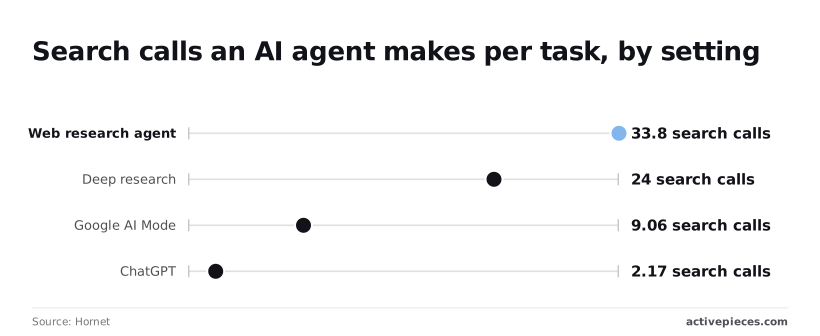 **Multiply your expected tasks by the high end, not the low one, and add retries on top.** At 34 queries a task, you will want a counter in front of every call, and a closed tool only gives you the one it shipped with. If the connector or step you need is missing, you wait on the vendor's roadmap. Activepieces lets you generate the missing integration with AI and add it privately to your own instance, with no release to wait for. Roughly 60% of its 746 integrations were contributed by the community, meaning most integrations are maintained by volunteers, and the count comes straight from the [community pieces folder of its open-source monorepo](https://github.com/activepieces/activepieces/tree/main/packages/pieces/community), where the core sits under an MIT licence. ### The model bill on top of search If a language model reads the results and writes the answer, you pay for its output tokens too (a token is roughly three-quarters of a word). The chart shows the [ThinkHard price list](https://thinkhard.si/prices/) per million output tokens. Claude Fable 5.1 and GPT-6 Astra cost $50 each, so a long answer from either can cost more than the searches behind it. At $20 sit Claude Opus 5.5 and, in ThinkHard's listing, the older GPT-5.6 Sol, and at $10 Claude Sonnet 5.5 and GPT-6.1 Sol, which means you must pay $20 to access Opus 5.5. Picking the cheaper tier cuts that line fivefold. Whether you may store results, for how long, and whether you must credit Brave on screen is governed by Brave's terms. I can't give you the exact limits here, so read them before building a cache. ### Know which Brave Search API endpoints bill separately Not everything sits under the web search price. The Answers feature, which has Brave generate the reply, bills tokens on top of the query. Check each endpoint you plan to call, because a feature you add later can arrive with its own meter.  What happens when you hit the quota isn't something I could confirm in Brave's documentation. It might block requests, or it might bill overage. Test it in a sandbox, or ask Brave, before launch. ## Compare Brave against other search APIs If you want an independent index and terms you can model in advance, Brave is the safer pick. The others win on narrower jobs, and no price here should be trusted over the vendor's own page. ### Price at 10,000 and 100,000 queries I'm not quoting rates, because every one of these vendors changes them and a stale number in your budget is worse than none. Do the arithmetic yourself instead: take your expected monthly queries, divide by 1,000, and multiply by each vendor's per-thousand rate at your tier. Do it twice, once at 10,000 queries and once at 100,000, because the jump between plans is where surprise bills come from. Then check the free tier's rules and the rate limit. ### Compare Brave Search API index ownership and quality A vendor with its own index controls its own supply. A vendor that scrapes someone else's results can lose access without warning, and your product breaks with it. | Provider | Source of results | Output ready for a language model | |---|---|---| | Brave | Its own independent index | Partly | | Tavily | Aggregates results from other sources | Yes | | Exa | Its own index, built around meaning-based search | Yes | | SerpAPI | Scrapes other engines' result pages | No | | Google | Its own index | No | **Only two of the five** give you both an owned index and output a model can use with little cleanup, the table shows. "Ready" saves you the code that trims web pages down, and without it you pay for that trimming yourself. That's a reason to test Brave's results on your own questions before choosing it. ### Choose another search API over Brave Choose Tavily if you want the least glue code between a search call and an AI agent. The tradeoff is that you're buying a layer on top of other sources. Choose Exa if your queries are vague descriptions rather than keywords, such as "companies that do X." Choose SerpAPI if you need the exact page a person would see in a particular engine, and you can live with the scraping risk. Choose Google if your users expect Google's ranking and you can work within its terms. Otherwise, run your real queries through two vendors and compare the bills. ## Cap Brave Search API spend with an Activepieces workflow Don't expect a small Activepieces workflow to lower Brave's price. It will count every query and warn you at 80% of your quota, so you hear about a runaway bill before it arrives. Activepieces lets you chain steps together on a canvas instead of writing code, and a run costs 1 credit however many steps it has, so the counter and the alert add nothing to the meter. Setup takes roughly 20 minutes, so you can get started quickly. ### Stage 1: call the API from a test workflow You need a working call before you can count anything. Otherwise you're counting guesses. Create a key in your Brave Search API dashboard and copy it somewhere private. In a new workflow, add an HTTP step that sends a GET request to Brave's web search endpoint. Put your key in a header named `X-Subscription-Token` and your search words in a parameter named `q`. 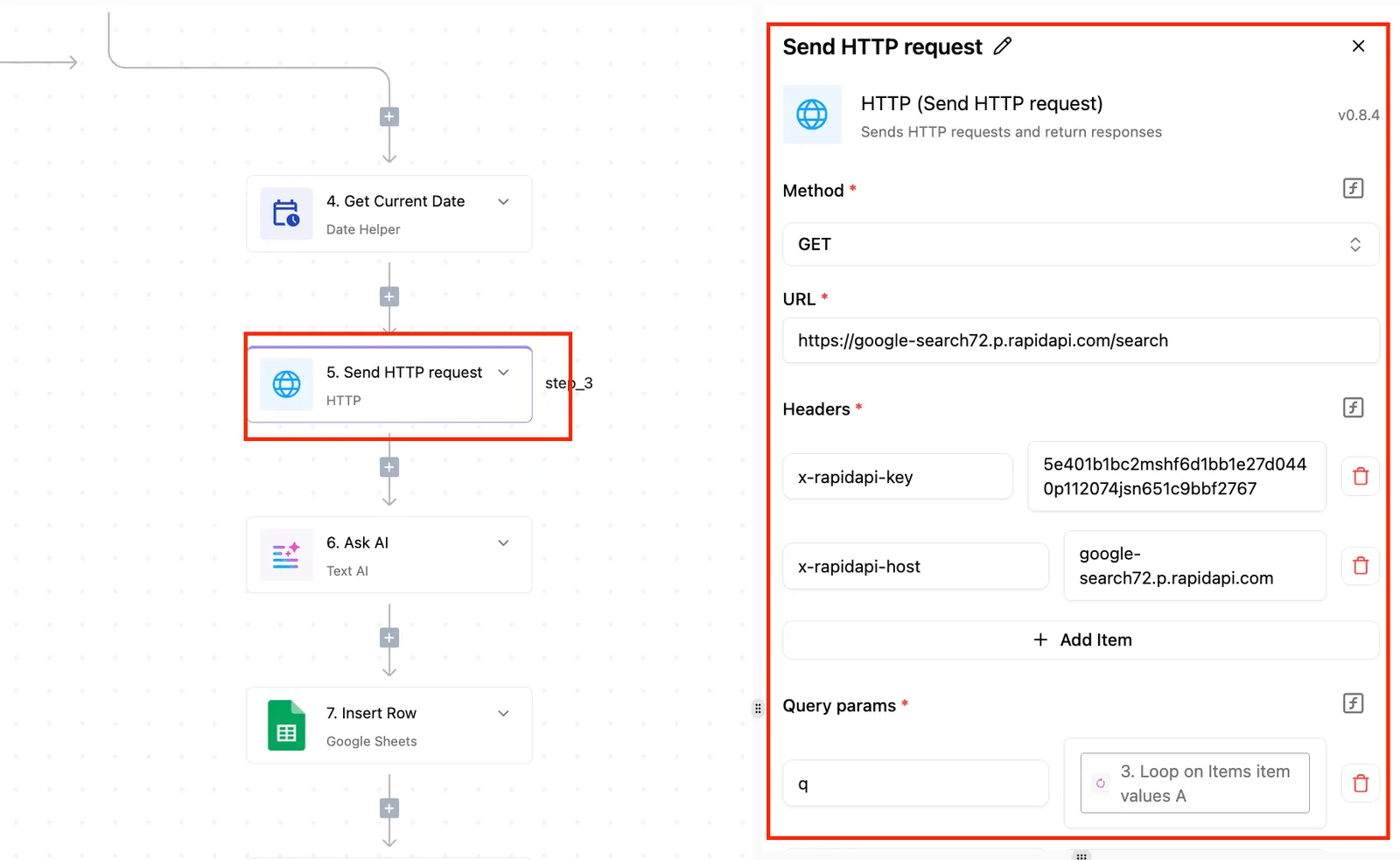 Run it once. If results come back, the plumbing works and everything after it's bookkeeping. ### Stage 2: count every query Add a storage step after the HTTP call that reads a saved number, adds one, and writes it back. Route every search your product makes through this workflow, not around it. A query that skips the counter is one you pay for and never see, which defeats the point. Reset the saved number when your billing period turns over, since your plan's quota resets then too. ### Stage 3: alert before the quota 1. Add a condition that compares the running count to 80% of your plan's monthly quota, which means you know when you're approaching it. Type the quota in by hand from your plan page. 2. On the "yes" branch, add an email or chat message step that tells you the count and how much of the quota is left. 3. Before trusting it, set the quota artificially low, run a handful of searches, and confirm the alert actually lands in your inbox. At 100% you're already throttled or billed, so you need to monitor usage before reaching it. At 80% you can still slow down, cache results, or upgrade on your own terms, so you're acting from choice, not necessity. Be clear about what this does. It controls usage, not price. The per-query rate, storage terms and attribution rules are still whatever Brave's pricing page says. On Monday morning: - Reread the current pricing page and write down your plan's quota and rate cap. - Estimate your real monthly query volume and compare it to that quota. - Build the three stages above and run the low-quota test. - Set the real quota and put the alert in the inbox someone actually reads. ## Frequently asked questions Before anyone has a key in hand, five questions come up. Each answer below names the Brave page that settles it, because these are the details most likely to change. Whether an entry-level plan exists today, and what it includes, is decided by the pricing page on Brave's API site, though Brave has offered one at times. Read it the day you sign up. If you build a prototype on a remembered free allowance and it has since changed, your first real bill arrives unplanned. ### Can I use Brave Search API results to ground an AI model? Only if your plan's terms allow it, and plans differ on what you may do with results. Grounding means feeding search results to a language model so its answer rests on current sources. Whether that use, and storing results to reuse later, is permitted on your tier is spelled out in Brave's plan descriptions and its terms of service. Skipping this check risks a contract breach, which costs far more to fix than a plan upgrade. ### What happens if I exceed my Brave Search API quota? Either your requests stop succeeding or you start paying for the overage, and which one happens depends on your plan. Brave's API documentation describes the error responses and the rate-limit headers that come back with each reply. Those headers tell your code how much room is left, so have it read them. Set a spending ceiling in your own account or code rather than trusting the default to protect you. ### How often does Brave change its API pricing? I can't point you to a published schedule, so treat any price you've seen as dated. Brave's plans have been reorganized over time, and the pricing page is the only source that shows the current arrangement. Put a recheck on your calendar before each renewal and before any jump in your query volume. A short look at the page costs you nothing, while a plan change you missed can cost you real money. ### Do I need a credit card to get a Brave Search API key? It depends on the plan you pick, and the signup flow shows the requirement before you commit. Brave's pricing page and the account screens will tell you whether a card is requested, and whether it's charged automatically past your allowance. If a card is on file, that's exactly when a spending cap matters most. Without one, an overrun usually just stops service, which is an outage rather than a bill. ## Related reading - [Cohere Pricing 2026 for Trial, Production and Enterprise](https://www.activepieces.com/blog/cohere-pricing-2026-for-trial-production-and-enterprise) - [Gemini 4 Argon API Pricing: Tokens and Search (2026)](https://www.activepieces.com/blog/gemini-4-argon-api-pricing-tokens-and-search-2026) - [DeepSeek Search and Fetch API: Pricing and Reliability](https://www.activepieces.com/blog/deepseek-search-and-fetch-api-pricing-and-reliability) ## References - [Hornet](https://hornet.dev/blog/this-is-what-agentic-retrieval-looks-like.md) - [Katteb](https://katteb.com/blog/brave-search-ai-agent/) - [ThinkHard](https://thinkhard.si/prices/)The catch is the edge: query 1,001 starts billing, and a looping script can cross it in an afternoon.