A team could triple their execution frequency for the same dollar spent by using GPT-4o, which cost $10 per 1M blended tokens at the time, so choosing the alternative model allowed for significantly higher throughput on a fixed budget.  The most aggressive pricing comes from Google. Gemini 1.5 Pro sat at $7 per 1M blended tokens at the time, which positioned it as a highly competitive option for high-volume enterprise workflows, allowing companies to scale complex AI operations without proportional budget increases. A business could run over four times the volume of Claude 3.5 Opus while staying within the same operational budget. ### When paying the Opus price premium pays off The "Opus Tax" is a necessary expense for workflows where the cost of a logic failure exceeds the high API fees. Claude Opus 5.5 is one of the models in the current Anthropic lineup designed for long-running agentic coding and knowledge work.  If a $20-per-million-token call prevents a senior engineer from spending two hours debugging a failed deployment, the model has paid for itself. Using Opus for simple data extraction or classification is a waste of capital. Those tasks don't leverage the specific architectural strengths that justify the $30 price point. ### Switching costs and provider lock-in risks Because Claude Opus 5.5 handles nuance differently than GPT-6 Luna or Gemini 2.5 Pro, a system built solely around Opus’s specific quirks will require significant engineering hours to migrate if the $20-per-million rate becomes unsustainable. 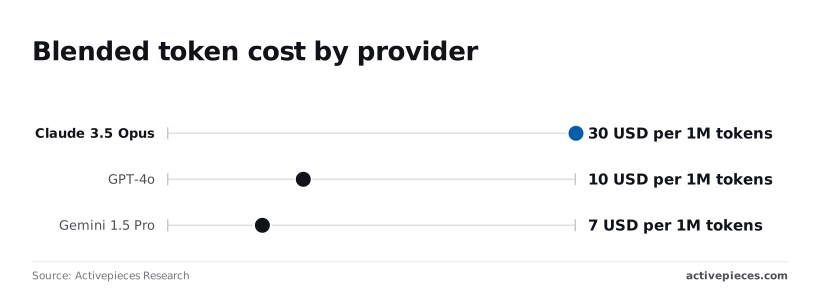 * Anthropic: Claude 3.5 Opus (previously $30 per 1M tokens) * OpenAI: GPT-4o (previously $10 per 1M tokens) * Google: Gemini 1.5 Pro (previously $7 per 1M tokens) This price distribution forces a choice. You either build a rigid system tied to one premium provider, or you invest in a routing layer that can swap between tiers based on the complexity of the incoming request. ## Hidden variables that inflate the Claude API bill Output token density acts as the primary driver of Claude Opus 5.5 bill shocks because the pricing architecture heavily weights generative synthesis over context ingestion. ### The 5x output token premium impact The most significant factor in month-end budget overages is the pricing disparity between reading and writing. The model charges a substantial premium for every token it generates compared to every token it consumes. Chatty system prompts or agentic workflows that require the model to explain its internal logic before providing a final answer now carry a financial penalty. Users who treat input and output as equal commodities will find their margins collapsing as the model’s creative density increases. ### Overhead costs of multi-step agentic loops Redundant processing compounds costs in sophisticated autonomous workflows that repeatedly pass the entire conversation history back to the model. The drivers of this "bill shock" include: Output token density, where the 5x premium on generated text inflates the cost of every intermediate step, effectively penalizing users for the length and complexity of the AI's responses, so developers must optimize their prompts to avoid runaway expenses. * Prompt caching misses, which force the system to re-process static instructions at a higher write cost. * High-frequency polling overhead, where agents constantly check for status updates, generating a trail of metadata. * Unoptimized system prompts that fail to constrain the model’s verbosity. ### Latency costs and the 'Time to First Token' trade-off Choosing a luxury model like Claude Opus 5.5 introduces a hidden productivity cost for the following reasons: * The time spent waiting for the first token to appear is significantly higher than with leaner models like Claude Haiku 5.5. * This latency isn't just a user experience issue; it represents a functional bottleneck for real-time applications where every second of compute delay prevents the system from moving to the next automation step. * When an agent is stuck in a "thinking" state, the operational cost is measured in both the premium API fees for that reasoning and the idle time of the downstream services waiting for its output. * For high-volume classification or simple extraction, the intelligence of a flagship model is often eclipsed by the sheer financial and temporal drag of its processing requirements. ## Real-world cost projections for Opus 5.5 workloads Significant pricing premiums are generated when deploying Claude Opus 5.5 for standard support workflows. It only yields a return when the task requires its specific high-reasoning capabilities. ### The cost of a 200k context window fill Every single call that loads a full 200,000-token context window into Claude Opus 5.5 represents a substantial upfront investment. The model doesn't currently support persistent state across independent sessions. The distinction is clear on the [Anthropic model overview](https://docs.anthropic.com/en/docs/about-claude/models/overview). This flagship is built for demanding reasoning, so using that massive window for simple search tasks is effectively paying for a supercomputer to perform a filing cabinet’s job. ### Comparing Opus to Sonnet for high-volume tasks Structural risk occurs when scaling high-volume classification or extraction tasks due to the financial gap between Claude Sonnet 5.5 and Opus 5.5. | Task Type | Cost Per 1k Tokens | Description | | :--- | :--- | :--- | | Simple RAG | $0.45 | Baseline for basic document retrieval where the model summarizes a few search results. | | Data Extraction | $1.10 | Identifying and structuring specific fields from messy, unstructured inputs. | | Agentic Coding | $2.80 | Premium rate for multi-step reasoning where the model must self-correct and execute code. | Moving from simple retrieval to agentic work **nearly sextuples the cost** per thousand tokens. ### Estimating monthly spend for a 10-person team Four-figure monthly bills arrive faster for small engineering teams utilizing Claude Opus 5.5 for daily development than for those using mid-tier models. Activepieces uses credit-based AI billing to meter usage, which allows teams to set strict cost caps per person and department. This prevents unconstrained Opus calls from exhausting a budget, ensuring that complex logic steps remain governed without the risk of an unexpected bill shock at the end of the month. ## Managing Opus costs with Activepieces automation Activepieces enables granular model routing by allowing users to build branching logic that directs traffic based on task complexity across 739+ integrations. ### Automating model routing to reduce token waste Stage your workflows so that cheaper models act as the triage unit for the flagship reasoner. By using the Activepieces "Branch" integration, you can inspect the incoming payload and only trigger the expensive Claude Opus 5.5 API call when specific logical triggers are met. 1. Receive user request via webhook or app trigger. 2. Use Claude Haiku 5.5 to classify the intent and complexity of the prompt. 3. Route 'Reasoning' tasks, such as long-horizon agentic work, to Claude Opus 5.5. 4. Route 'Extraction' tasks, such as pulling dates or names, to Claude Sonnet 5.5. 5. Consolidate the response into the final destination app. ### Building human-in-the-loop cost gates Before any high-cost Claude Opus 5.5 request is finalized, Activepieces allows for the insertion of an "Approval" step. This means a manager or lead developer must manually click a button in a Slack notification or email to authorize the execution of a particularly long-context prompt. ### Monitoring API usage by department or project Use the Activepieces "HTTP" integration to log every model call into a centralized database like Airtable or a Google Sheet to gain visibility into which teams are driving costs. Regulated organizations like MoneyGram and FundingSocieties run Activepieces in production to maintain this level of control over their automated environments. The enterprise feature list in the self-hosted air-gapped documentation, including SSO and audit logs, matches the managed cloud exactly to support these high-governance requirements.  ## Frequently asked questions about Claude API billing Anthropic manages API costs through a tiered credit system that separates individual subscriptions from developer resources to ensure scalability for high-volume applications. ### Does Anthropic offer volume discounts for Opus? Standardized volume discounts for Claude Opus 5.5 are not provided by Anthropic. The cost per million tokens remains fixed regardless of how much traffic you route through the model. Monitoring usage logs is critical because of this lack of bulk pricing. A sudden spike in agentic loops can consume an entire budget without the safety net of a declining cost curve. ### How do I increase my Claude API rate limits? Lifetime spend and the age of your developer account determine your rate limit increases. As you reach specific spend thresholds and successfully pay your invoices, Anthropic automatically moves your account into higher usage tiers. You must submit a formal request through the developer console if your project requires an immediate capacity jump beyond these automated increases. Approval is subject to manual review and current hardware availability. ### Do unused API credits expire each month? Prepaid billing system credits do not reset at the start of the month, but they do carry a definitive expiration date based on the purchase time. Credits typically remain valid for one year from the date of deposit. Any funds not utilized within that window are forfeited to the provider. ### Is there a difference between Claude Pro and API pricing? Claude Pro is a flat-rate monthly subscription for individual use of the web interface, while the API uses a metered, pay-as-you-go model based on specific token counts. A Claude Pro subscription doesn't grant any credits or access to the API environment. If they use both the chat interface and custom integrations, teams must maintain two separate payment streams. ## Related reading - [Claude Opus 5.5: What's New, Benchmarks, and Pricing](https://www.activepieces.com/blog/claude-opus-55-whats-new-benchmarks-and-pricing) - [Twilio MCP Server Setup for Claude in 2026](https://www.activepieces.com/blog/twilio-mcp-server-setup-for-claude-and-ai-agents-2026) - [Claude Sonnet 5.5: Speed, Cost & Performance](https://www.activepieces.com/blog/claude-sonnet-55-speed-cost-performance) ## References - [Activepieces Research](https://kickllm.com/tools/claude-api-pricing.html)The financial gap between these models is wide enough to dictate the entire architecture of an enterprise AI stack.