Assume one embed, one rerank and one chat call per question in each row, so embed and rerank grow in lockstep with chat and never become rounding errors. For a 10,000-query internal assistant, the plan decision matters more than the per-call math. Price it once with your real prompt length: retrieved passages inflate chat input tokens, which is the line people forget. ### Cohere cost for 100,000 search queries Here the rerank line stops being a footnote. Rerank is billed per search, and if you send it a long candidate list for every query, you're paying for that list every time.  Trim candidates to what the reader will actually see, then compare the rerank total against chat output. ### Cohere Embed cost to index a corpus You pay once per document to embed a 100k-document corpus, so it doesn't recur monthly the way query calls do. Multiply document count by average tokens per document by the embed rate. If your documents change often, re-indexing turns the one-off bill into a recurring one. Chunk size also moves the total, since overlapping chunks mean you pay to embed the same text twice. ## Hidden costs and limits Cohere users hit Beyond overlap, three things add cost the price page never shows: trial throttling, per-search rerank billing and re-embedding after a model change. ### Trial key limits and commercial-use rules Put a paying user on a trial key and you are breaking the terms, since the keys are free but meant for non-commercial use. The throttling shows the same intent. According to [Cohere's rate-limit docs](https://docs.cohere.com/docs/rate-limits): - Chat on Command A allows 20 calls per minute on a trial key against 500 on production - Rerank goes from 10 to 1,000 calls per minute - Image embedding goes from 5 to 400 calls per minute 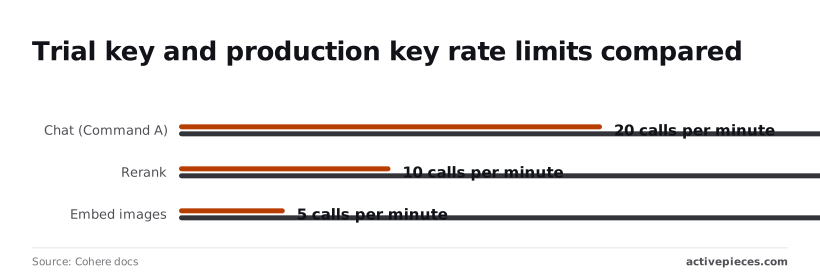 Loop a prototype over a few hundred documents and it will stall at the trial ceiling; the Rerank ceiling of 10 is the first one you'll hit. ### Cohere Rerank and Embed billing surprises Because rerank is billed per search unit, and one unit covers a query against up to 100 documents, sending 150 candidates costs two units, so trimming candidate lists to 100 halves that line.  Retrieval then inflates the chat bill, because every chunk you pass to Command becomes input tokens, and output tokens cost more per token than input. Pass fewer, better-ranked chunks and the Command input shrinks; that's the real return on paying for Rerank. ### Cohere re-embedding and index maintenance costs Change embedding models and you re-embed the whole corpus, because vectors from different models aren't interchangeable. At 10 million chunks, a model swap is a full second indexing bill, plus the overlap duplication from the previous section. Pin the model version, store it with each vector, and treat a switch as a budgeted migration. ### Enable batching and automatic retries For the dull parts of this bill, Activepieces suits well. It is an MIT-licensed core with 746 integrations, a count taken from the community integrations directory in its open source GitHub monorepo, and you reach Cohere through its Cohere integration or a plain HTTP step. A scheduled flow can embed new documents in off-hours batches, so you stop re-sending unchanged text. A retry step with backoff handles 429 responses when you hit the limits above, instead of dropping the request. Add a logging step that writes token counts and search units to a sheet or database, and you get a cost-per-run figure you can check against the invoice. Activepieces' published pricing page lists 1 credit per flow run, whatever the number of steps, whereas Zapier's pricing page bills per task and Make's per module, so the embed, retry and logging steps cost the same as a flow with one. 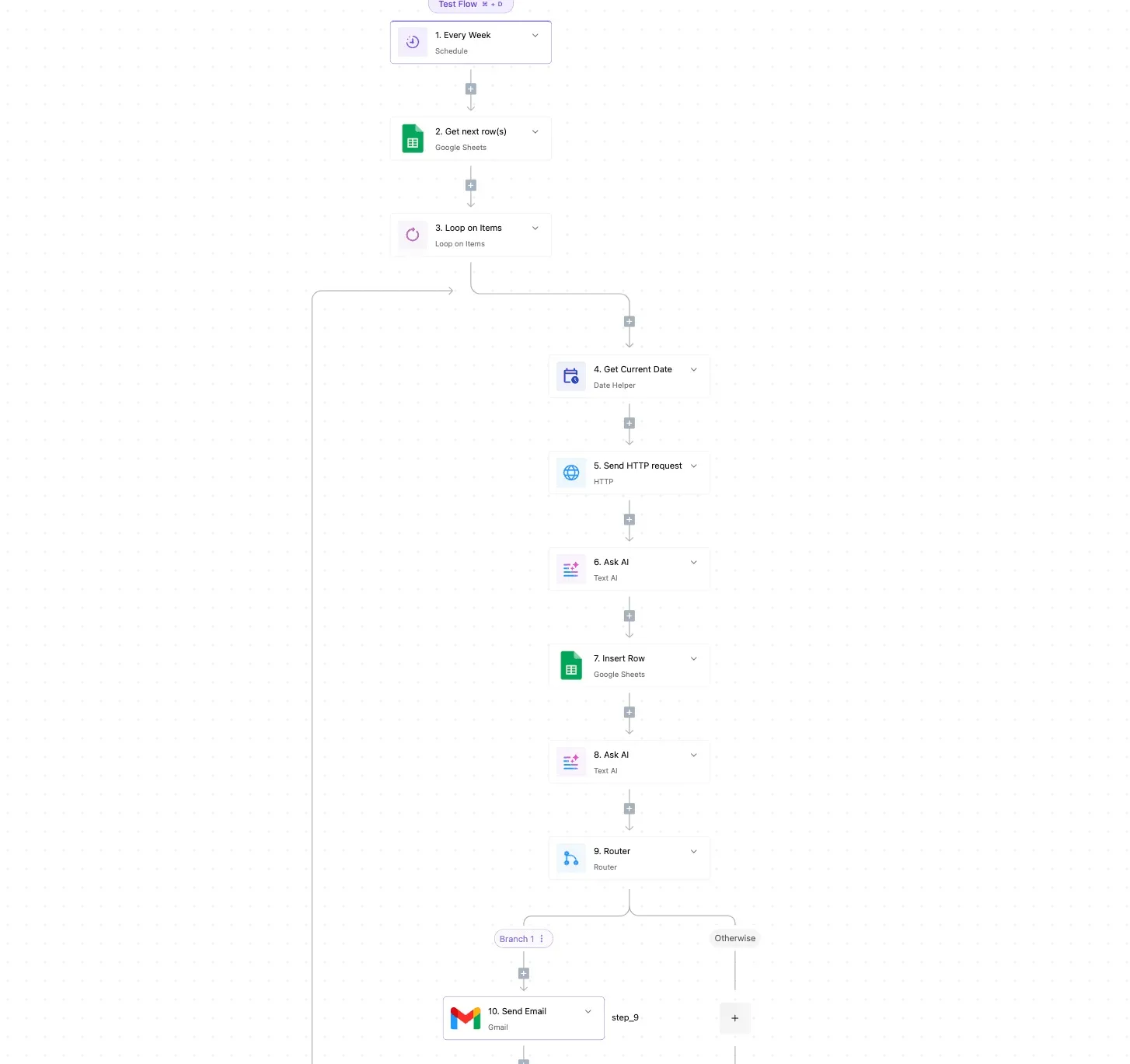 ## Cohere pricing against OpenAI, Anthropic and Voyage Though Cohere's chat tokens cost more than OpenAI's on input, it's the only one of these four vendors selling chat, embeddings and rerank on a single account. ### Cohere chat model pricing compared Take a run with 10,000 input tokens and 1,000 output tokens, a typical retrieval answer. On Command A at $2.50 in and $10 out per million, that's about $0.035. On GPT-5, at its earlier list price of $1.25 in and $10 out, the same run came to about $0.0225; check OpenAI's page for current GPT-6.1 Sol rates. In that older comparison output prices matched, so the gap came entirely from input, and it widens the more retrieved context you stuff into each prompt. Prices move, so confirm each against the vendor's own page before you commit. | Vendor | Chat price per 1M in/out | Embedding | Rerank | Free tier | Private deployment | |---|---|---|---|---|---| | Cohere | Command A: $2.50 / $10 | Yes | Yes | Rate-limited trial key | Yes, in your own cloud or on-premises | | OpenAI | GPT-6.1 Sol; see OpenAI's page | Yes | No | No free API tier | Through Azure only | | Anthropic | Claude Sonnet 5.5; see Anthropic's page | No | No | No free API tier | Through AWS and Google Cloud | | Voyage AI | No chat model | Yes | Yes | Free token allowance | Through cloud marketplaces | ### Cohere embed and rerank pricing compared Anthropic sells no embedding model and points customers to Voyage, so a Claude pipeline already means two vendors. OpenAI covers embeddings but not rerank, so you add a third party or skip reranking and send more chunks to the chat model. Embeddings and rerank, nothing else: Voyage is the specialist. Compare its per-token rates with Cohere's line by line, because retrieval calls often outnumber chat calls. ### When Cohere is the better buy Cohere wins when you need embed, rerank and chat together, or when private deployment is a requirement rather than a preference. It loses on a chat-heavy workload with long prompts and no reranking, where a chat model with lower input pricing, such as OpenAI's GPT-6.1 Sol, may compound the difference. ## What Activepieces does about this The problem in this article is that the bill is set by calls you don't see: embeds, reranks and retries wrapped around the chat model. Activepieces gives you a place to control those calls and to measure them. It is an MIT-licensed core with 746 integrations, a count taken from the community integrations directory in its open source GitHub monorepo, showing the community has substantially invested in the platform's ecosystem. You can self-host it and read the code that runs your flows, or use the hosted version. On the cost side, a scheduled flow can batch new documents into off-hours embed runs, so unchanged text isn't re-sent. A filter step before the rerank call can cut candidate lists to 100 documents, which is the line where one search unit becomes two. A retry step with backoff handles the 429s you'll meet on a Trial key, where Rerank allows 10 calls a minute, instead of dropping the request or looping it into more billable calls. On the measuring side, add a step that writes token counts and search units for each run to a sheet or database. You then have a cost-per-run figure to check against Cohere's invoice, which is the number this article keeps telling you to compute from your own traffic. Activepieces' published pricing page lists 1 credit per flow run regardless of step count, so the logging and retry steps add nothing to the automation bill. None of this changes your Cohere rates, which stay set by your plan. It doesn't replace the sales conversation if you need SSO or private deployment. What it does is keep the embed and rerank lines predictable while you stay on a Production key, and show you early when one of them starts to outgrow the chat line. ## Frequently asked questions Your token counts settle the arithmetic, but four questions sit outside it, and the short answers decide whether you can start spending at all: - Trial keys are free but not licensed for commercial use, so anything customer-facing needs a paid key. - Rerank is billed per search rather than per token, so the cost scales with how often you call it. - Enterprise prices aren't published, so budget from your pay-as-you-go usage and expect a sales conversation. - A production key comes from adding billing details in the dashboard, with no approval call for standard usage. The five questions below cover the rest. Is the Cohere API free to use? Only for testing. The trial key costs nothing, but it's rate-limited and meant for evaluation and prototyping, so a free-tier habit won't survive contact with real traffic. Treat it as the cost of finding out whether the models fit, then price the paid path. Can I use a Cohere trial key in production? No. **Trial keys aren't for commercial use**, and the rate limits would throttle a live product long before the license became an issue. Switch to a production key before launch, because discovering the limit through failed requests is an expensive way to learn it. Does Cohere charge per seat or per token? Per token for chat and embeddings, and per search for rerank. There's no seat count to multiply, which means a team of two and a team of twenty pay the same rate per call. Because your bill follows volume, not headcount, a chatty pipeline costs more than a large team that rarely calls the API. ### Is Cohere cheaper on AWS Bedrock or Azure than direct? I wouldn't assume so. Cloud marketplaces can price the same model differently, and their appeal is usually consolidated billing and spend that counts against an existing cloud commitment. If you already have such a commitment, that matters. If you don't, compare the marketplace rate against Cohere's direct rate using your own token counts, and note which route gives you the newer models first. ### How do I cap my Cohere spend? Start with the spend and billing controls in the dashboard, and confirm what your account offers before relying on them. Then add a guard in your own code: a daily call budget on embed and rerank, since those run around every chat request and are where runaway loops quietly multiply the bill. Review usage weekly during the first month, when your estimates are least reliable. ## Related reading - [SendGrid Pricing 2026: Plans, Free Trial and Costs](https://www.activepieces.com/blog/sendgrid-pricing-2026-plans-free-trial-and-costs) - [Command A+ from Cohere: Specs, Pricing and a Test Run](https://www.activepieces.com/blog/command-a-benchmarks-pricing-specs-for-2026) - [How to handle errors in production AI agents](https://www.activepieces.com/blog/how-to-handle-errors-in-production-ai-agents) ## References - [Data Sketchers](https://data-sketchers.com/wiki/tech-stack.ai-llm.cohere.docs-model-vault-standard-pricing) - [Cohere docs](https://docs.cohere.com/docs/rate-limits)In a retrieval assistant one question triggers four billable calls, not one, so the monthly bill is queries multiplied by what each query triggers.