### Command A+ cost at monthly run volumes Here is the email summary priced at three volumes. The cheaper model is an assumption: one priced at a tenth of Command A+ per token, not a specific product. | Runs a month | Assumed tokens per run | Command A+ cost | Cheaper-model cost | Saving | |---|---|---|---|---| | 1,000 | 800 in / 150 out | 1,000 × $0.000465 = $0.47 | $0.05 | $0.42 | | 10,000 | 800 in / 150 out | 10,000 × $0.000465 = $4.65 | $0.47 | $4.19 | | 100,000 | 800 in / 150 out | 100,000 × $0.000465 = $46.50 | $4.65 | $41.85 | Whatever the volume, the saving per step stays proportional, because cost rises in a straight line with runs. Only the dollar gap grows, and that gap is what you recover by routing the simple steps to the cheaper model. ## Hidden costs and limits in Command A+ billing Compare input prices and you miss five line items; the largest is that output tokens cost more than the input you compared. - Output priced 5x input: $1.50 against $0.30 per million tokens - Long retrieval prompts that resend context on every run - Retries after 429 rate-limit errors - Separately billed embed and rerank calls - The trial key's no-commercial-use limit At 5x, a chatty reply costs more than the email it answers, which means support teams can't afford thoroughness. Cap the maximum output length and ask for a label rather than a paragraph. When you hit your tier's ceiling, Cohere returns a 429. A naive retry loop resends the whole long prompt, so Cohere bills again for any attempt it processes. Add backoff and a retry cap.  ### Embed, Rerank and other separately billed calls Run a retrieval step and it can bill three times, because embedding and reranking are metered apart from generation. If you would rather not pay per call, you can rent hardware instead. The [Vast.ai median via Codelace](https://codelace.com/gpu-prices/h100) shows H100 rates from $2.56 per hour on Akash to $2.90 on Ori and $2.93 on the marketplace, confirming that shopping for the lowest provider saves $0.37 per hour, so provider selection matters over a full month. Leave a GPU on for a 730-hour month and it costs roughly $1,870 to $3,010 whether or not it's busy, implying that idle capacity still commands the full bill. The Ornn index sits at $3.21, the 57-provider figure at $3.54 and the 9-provider figure at $4.13, indicating that narrow samples systematically overestimate costs. Self-hosting only pays when volume keeps it saturated. 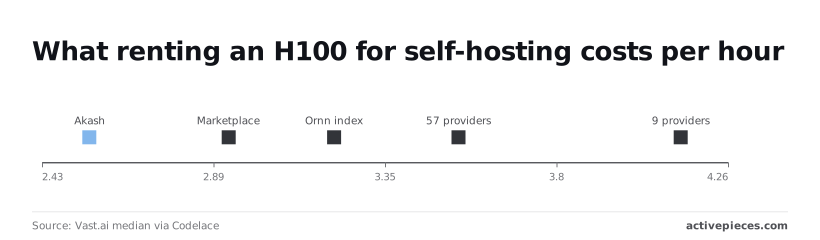 ## Command A+ compared with the closest alternatives At $1.50 per 1M output tokens, Command A+ ties with the cheapest comparable rival, leaving no basis for a cost-driven choice between them. It's worth paying for only when a step needs its quality. ### Price and context window side by side Command A+ sits at the bottom with Mistral Large 3, and the older Command R+ (08-2024) costs $10.00 per million output tokens, so there's no price reason to stay on them. Beyond that, other rivals, per [Token Barometer](https://shurco.ai/tools/llm-api-pricing/cohere/), run higher. Qwen3-235B is $1.82 per 1M output tokens, about 21% above Command A+. Qwen3-Max is $3.90, so a long-answer step costs 2.6 times as much. Gemini 2.5 Pro is $10, Claude Opus 5.5 is $20 and GPT-6 Astra is $50, so your model selection controls a fivefold cost multiplier. Claude Fable 5.1 also sits at $50 on the chart. At $50, one million tokens of output **buys thirty-three times less than at $1.50**. ### When a cheaper model beats Command A+ A cheaper model is good enough for classification, extraction, short summaries and routing, because the answers are short and a wrong one is easy to catch. On steps where the answer is long or the reasoning is multi-part, such as drafting replies from several documents, Command A+ earns its $1.50, validating this price point for tasks where output complexity is the deciding factor. Paying $10 to $50 for a frontier-class model only makes sense when a failure costs more than the price gap. Route by task, not by habit. ## Routing cheap steps away from Command A+ in Activepieces To do this in Activepieces, build the routing as separate flows by task type. Flows are available on every plan, including free, within each plan's credits, so splitting a classifier from a drafter adds nothing to the plan price.  ### Sending each step to the right model Send classification and summary steps to a cheap model, and hard reasoning and long documents to Command A+. To see whether this pays, look at the [RouteLLM project at UC Berkeley's Sky Lab](https://sky.cs.berkeley.edu/project/routellm/), which measured how much cost drops when cheap queries are kept off the expensive model. On MT Bench the reduction was 85%, so for conversational, open-ended prompts most of the bill disappears. On MMLU it was 45%, so knowledge questions still save close to half. On GSM8K it was 35%, so maths-style reasoning saves the least, because fewer queries can safely go to the cheaper model. 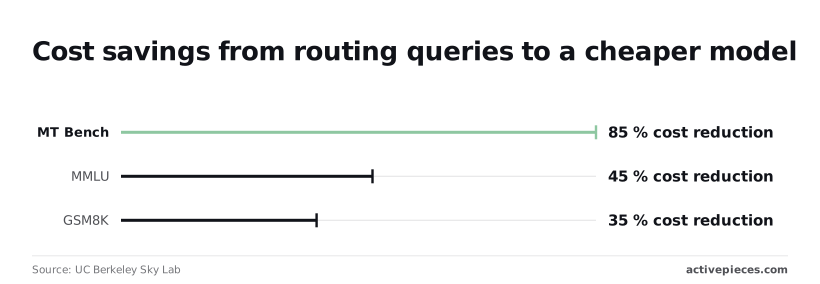 The same router gives three very different savings, which means your own saving depends on your mix of steps, not on a headline number. Those results come from a research router, not from Activepieces. In Activepieces you write the routing rule yourself, as a branch condition. The models run on your own provider key, so the Command A+ calls bill at Cohere's per-token rates on your Cohere account rather than at a markup on a model the platform resells. Bring-Your-Own-Key availability is listed by tier on the Activepieces pricing page, where Free is $0 with 1,000 credits a month and unlimited flows, Plus is $20 a month and Team is $200 a month.  Set the rate on your own Cohere account against what a platform charges when it resells its own model, and that gap is your markup. Among Activepieces' 741 integrations, we couldn't confirm a Cohere-published page for Command A+, so the call is best treated as an HTTP request step to Cohere's API. ### Capping spend with conditions and run history On the Free plan, credits run out at 1,000 a month and flows then wait for the next day's credits, so a flow that branches early keeps expensive steps to a minimum. Add a condition on input length before the Command A+ path, so only genuinely long documents reach it. Once runs accumulate, run history shows which path each run took. You can count how many runs hit Command A+ and tighten the condition if that share is higher than your task mix justifies. It's a review loop, not an automatic spend cap. ## Your Monday checklist for Command A+ pricing **Run these six steps in order on Monday** and you'll have a bill estimate built from your own tasks, not from the list price alone. 1. Count monthly runs per task. Pull the run history from whatever executes your automations and tally each task separately: email summaries, ticket classification, drafting replies. 2. Measure input and output tokens on 20 real samples (see below). 3. Price the tasks using the table. Multiply each task's average input and output tokens by its monthly runs, then by the per-million-token rates in this article's pricing table. Keep input and output as separate lines, because output is billed at a higher rate and usually decides the total. 4. Set a spend alert. Put a threshold in the provider dashboard at a level you would be unhappy to cross. As the previous section made clear, it tells you after the fact, so someone has to be assigned to read it. 5. Test a cheaper model (see below). 6. Re-check Cohere's pricing page. Rates and rate-limit tiers change, so confirm them on the page itself before you commit a budget, and again whenever you review the alert. ### Measure tokens on real samples Take 20 actual inputs per task, not invented ones. Real emails carry signatures, quoted threads and forwarded chains, and these inflate input tokens well beyond what a clean test sentence suggests. Record input and output counts for each call, then average them and note the largest. The average sets your estimate; the largest tells you whether a few long outliers are driving cost. ### Test the cheaper model before committing Run the same 20 samples through a smaller, cheaper model and compare the outputs side by side. If classification labels match and summaries are acceptable, that task doesn't need a frontier-class model, and you reprice it at the lower rate. Where quality slips, keep Command A+ for that step only. ## Frequently asked questions Is there a free Command A+ API tier? Cohere's trial key is free to create, but it's for evaluation, with tighter rate limits than a paid key. Since the bill is metered in tokens, treat the trial as a way to measure your token counts per step before you commit to a production key. Can I use a trial key in a commercial product? No. Cohere's terms limit trial keys to prototyping and non-commercial use, and a production key is the one meant for live workloads. If an automation serves customers or runs inside a paid product, switch to a production key first. Otherwise you risk a key being throttled or revoked in the middle of a run. ### Does Cohere charge for failed or rate-limited requests? When a request is rejected at the rate limit, it comes back as an error and never reaches the model, so there are no output tokens to meter. The practical cost is retries and delay, not a charge. Add backoff to any flow that calls the API in bursts. Check your usage dashboard against your own logs for the first few days. Errors that happen partway through generation are a separate case from an upfront rejection, and you want to see how your own failures are billed. ### Are there volume discounts on Command A+? On volume, Cohere's public pricing page lists a per-token rate and no published volume schedule that I can confirm. Discounts, committed-spend terms and higher rate-limit tiers are handled through Cohere's sales team. Ask once your monthly token volume is steady enough to quote, and bring your measured input-to-output ratio, because output tokens decide what a discount is worth. Check the live pricing page for current rates before any estimate goes into a budget. ## Related reading - [Command A+ benchmarks, pricing & specs for 2026](https://www.activepieces.com/blog/command-a-benchmarks-pricing-specs-for-2026) - [What Is Command A+? Cohere's AI Model Explained (2026)](https://www.activepieces.com/blog/what-is-command-a-coheres-ai-model-explained-2026) - [FTP File Drop Automation for Modern Workflows](https://www.activepieces.com/blog/ftp-file-drop-automation-for-modern-workflows) ## References - [Vast.ai median via Codelace](https://codelace.com/gpu-prices/h100) - [Token Barometer](https://shurco.ai/tools/llm-api-pricing/cohere/) - [UC Berkeley Sky Lab](https://sky.cs.berkeley.edu/project/routellm/)Output is under a fifth of the tokens but nearly half the cost, so capping summary length cuts the bill more than trimming the email.