# Elicit Pricing 2026: Plans, Costs and Usage Limits
By Dario Espinoza-Blum · 2026-11-17 · Source: https://www.activepieces.com/blog/elicit-pricing-2026-plans-costs-and-usage-limits
---
[Elicit](https://elicit.com/pricing), the AI research assistant at elicit.com, runs from a free Basic plan up to Enterprise, a spread that teams wiring up their own workflows with tools like [Activepieces](https://www.activepieces.com) will recognize.
Elicit pricing is the tiered structure of plans, from free Basic to Enterprise, that sets what each Elicit subscriber pays and how much research work, such as paper searches, data extractions and reports, each plan allows before its usage limits apply.
**Pro is $69 to $75 a month** and **Scale $149 to $375 a month**, depending on whether you're academic or industry, so your actual monthly cost depends on your institutional type.
## Elicit Plans, Prices and Limits
### The one table: plans, prices, limits
Price gaps stay small until Scale. The table below lists every plan as shown on elicit.com/pricing, checked 17 November 2026.
The extraction limit (how many fields Elicit pulls from each paper) is where a plan runs out first. Pick a plan on that number, not on the monthly price.
| Plan | Monthly price per user | Annual price per user | Extraction columns | Papers screened per review |
|---|---|---|---|---|
| Basic/Free | Free | not published | 2 | not published |
| Plus | not published | not published | – | not published |
| Pro | $69–$75 | $588 | 20 | not published |
| Scale | $149–$375 | not published | 30 | not published |
| Enterprise | not published | not published | 40 | not published |
Going from Basic to Pro takes you **from 2 extraction columns to 20**. A review that needs more than 2 fields from each paper is therefore already past the free plan.

### Academic versus industry pricing
Between $69 and $75 a month, Pro barely moves, according to [AIVario](https://aivario.com/tools/elicit). The gap is only $6, so the audience you fall into barely changes the bill.
Scale is different. AIVario lists it at $149 to $375 a month, a difference of $226, so the top rate is about two and a half times the bottom one.
An industry team that budgets from the academic figure will be well short when the invoice arrives. Confirm which rate applies to you before you commit.

### Elicit pricing details the page leaves out
The pricing page does give annual prices, such as [588 dollars a year](http://elicit.com/pricing) for Pro. It also gives no figure for papers screened per review.
That's the number a team doing a large literature review most needs, and without it you can't tell whether a plan will last through a big review or cut off partway. Enterprise shows custom pricing and a 40-column extraction limit.
If you're wiring review steps around Elicit, [Activepieces](https://www.activepieces.com) counts a run as 1 credit however many steps it has, and its Free plan gives you 1,000 credits a month with unlimited flows, a limit that stays unlimited on every paid plan too.

Separate small flows for screening, extraction and export therefore cost nothing extra to exist, whereas Zapier bills a task per action and Make a credit per module, so the tidier build costs more with every run.
Ask Elicit for the screening limit in writing before you size a plan.
## Elicit usage limit cutoff in a three-person review
When a team skips the written answer and buys on price, it hits its limit at 14:10 on a Tuesday. The lost afternoon **costs more than the upgrade would've**.
The timeline below is illustrative, not a customer's account. It shows that the cutoff lands when the work is half done, which is the worst moment for it.
1. 09:00: the team picks the plan with the lowest monthly price.
2. Morning: shared screening starts, with all three people drawing on one allowance.
3. Late morning: extraction columns run across the papers that passed screening.
4. 14:10: the plan's limit is hit.
5. 14:10: extraction is blocked, and the columns stop mid-run.
6. Afternoon: the team argues over whether to upgrade.
7. 17:30: work resumes.
Nobody asked what a full review would consume. The cheaper plan looked fine against the budget, so it won. The cost of that shortcut is invisible until the allowance runs dry, and by then the review is already underway.
Halfway through a batch, extraction stops. Some papers have their columns filled and others sit empty, so the team can't tell at a glance which results are complete. They have to check before they can trust any of it.

Three hours and twenty minutes go to checking finished rows, deciding on an upgrade, and re-running the interrupted batch. Nobody is extracting during most of that time.
Anyone tempted to pull the remaining papers by hand is paying a researcher's hourly time for work the tool does automatically.
### Elicit limit downtime cost versus upgrading
By the end, the team had lost most of an afternoon for three people, and a batch of papers stayed unextracted until the next day's checking was done. They ended up buying the upgrade anyway.
The only difference was the timing: paid at 09:00, it cost the price difference, and paid at 14:10, it also cost the afternoon. Next comes how to size the plan so the cutoff never arrives.
## Hidden Elicit Limits Behind the Cutoff
**It's rarely the price on the plan card** that stops a review. It's one of five quieter rules, and each is easy to misread until it halts the work. Here's where each lives and how it gets misunderstood:
- Extraction columns per table (pricing page): read as a one-time setup choice, when it caps every table you build.
- Papers screened per review (pricing page, help docs): read as a total for the account, when it may apply to each review.
- Monthly allowance reset (pricing page): read as a rolling refill, when it's a calendar date you can run out before.
- Export caps (help docs): read as a formatting detail, when it decides whether results leave the tool.
- Seat restrictions (pricing page, changelog): read as a headcount, when it decides who shares what.
Each of these is a place the work can stop, so the paragraphs below take them in the order a review hits them.
On the pricing page, confirm whether each allowance belongs to one seat or to the team. If it's per seat, a colleague's unused allowance can't cover your heavy week, and the cutoff lands on whoever screens the most.
### Elicit extraction and paper-count limits
To see where the load sits, look at a published review. [European Review's PRISMA diagram](https://www.europeanreview.org/wp/wp-content/uploads/Figure-S1-PRISMA.pdf) records 4,236 screened, so the paper-count limit is tested at the very first step.
Only 146 were sought for retrieval, 142 assessed for eligibility and 133 included, roughly 3% of what was screened, so the review's findings are drawn from a comparatively small subset of all published research. Screening is the volume problem.
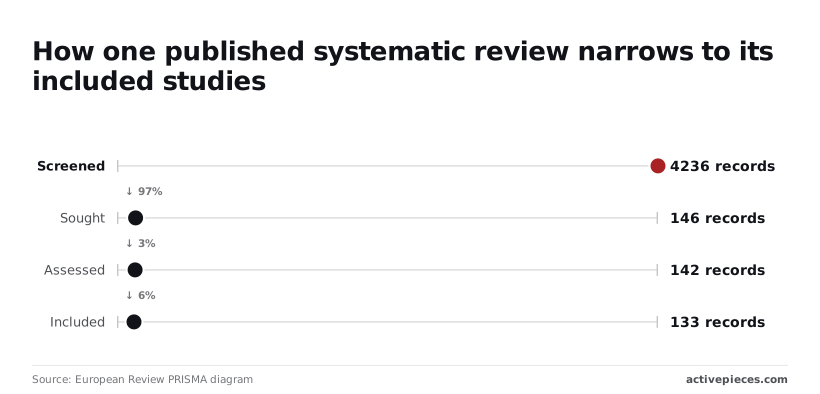
Extraction columns matter later, but across only about 133 papers.
Exports come at the end, so a cap here surfaces after weeks of work, when you need the table to leave the tool. Read the export rules in the help docs before you start, not after.
Plans get reshuffled, so check the changelog against the pricing page before you commit. A limit you relied on last quarter may have moved, and that's the cheapest mistake on this list to catch.
## Elicit Against Consensus and Closest Alternatives on Price
If your work is quick evidence checks, Consensus or Scite is the better buy. Elicit's paid tier is the better buy when you're running a full literature review, because the review is what burns through a cap.
The table below sets Elicit (elicit.com), Consensus (consensus.app) and Scite side by side. Read the "what the limit counts" column first, since it tells you which tool runs dry on your kind of job.
| | Elicit | Consensus | Scite |
|---|---|---|---|
| Free-tier limits | Free plan; cap on elicit.com/pricing | Free plan; cap on consensus.app/pricing | Check scite.ai for current trial or free terms |
| Cheapest paid, monthly | On elicit.com/pricing | On consensus.app/pricing | On scite.ai |
| Annual price | On the same page, billed yearly | On the same page, billed yearly | On the same page, billed yearly |
| What the limit counts | Papers screened and data pulled out in a review | Searches and AI-written summaries | Searches and assistant questions |
| Best for | Literature review | Quick evidence search | Checking whether a paper has been supported or disputed |
They weren't confirmed for this edition, and a made-up price is worse than none.
Open each vendor's own pricing page on the day you buy, and write the date next to what you find. Limits move, as the last section said.
What follows from the table is simple. If you ask one-off questions like "does this supplement help sleep?", you're using searches, and a cheaper plan that counts searches will last you.
If you screen hundreds of papers in one sitting, you're using extraction, and a plan that counts it can stop you halfway through. That cutoff costs you the afternoon and the rerun.
So match the plan to your heaviest week, not your average one. If one review would exhaust the cheaper plan, the dearer plan is the cheaper decision.
## Where Activepieces Fits in an Elicit Workflow
Activepieces, an MIT-licensed automation tool that moves information between apps without anyone retyping it, can keep a team's Elicit work visible and on schedule. It can't raise a single Elicit limit or lower the price of a plan.
If one review would exhaust the cheaper plan, the dearer plan is the cheaper decision.
That distinction matters because the cutoff this article warns about happens inside Elicit, and nothing outside it can stretch the allowance.
What Activepieces can do is make the allowance harder to forget and the work easier to see. Whether a spreadsheet or chat connector exists is something you can check yourself: the open source repo lists 750 integrations in packages/integrations/community, under an MIT-licensed core.
The three jobs that earn their place are these:
- Send exported Elicit results to a shared spreadsheet, so everyone on the team reads the same list of papers instead of keeping private copies.
- Log screening decisions to a tracker, so you can tell how far through the review you're and how much of the plan's allowance the remaining work will need.
- Post an allowance reminder to the team's chat, so someone says out loud that the month is running down before the month's finished.
The first two jobs show you the real size of the review while it's still in progress, which is the number the plan decision depends on, in time to change course.
If the tracker shows a long stretch of papers still unscreened and the allowance is thin, you learn that on a Tuesday with time to upgrade, not on the day the work stops.

The third job is a nudge, nothing more. It's a smoke alarm, and it doesn't put out a fire.
Be honest about whether you need it. A solo researcher who opens Elicit, checks their own usage and keeps one spreadsheet can skip this entirely, and setting up automations would cost more time than it saves.
It pays off when several people touch the same review and nobody owns the count.
Choose the plan from the size of the job. Treat any automation as a way to watch that job, never as a substitute for the right plan.
## Plan sizing rules after cutoff
**The rule is to size the plan to the largest job you'll run, then check it before you start.** A review that stops halfway costs more than the plan that would've finished it.
### Which plan is enough for each of three uses
For a quick scan of a topic or a solo weekly reading habit, Pro for one person is enough. At [588 dollars a year](http://elicit.com/pricing), it's the cheapest way to keep working, and neither job needs a long run through many papers at once.
A full systematic review is different. It pulls many papers through many extracted columns in one sitting, so it's the job that hits a limit. If the limits page shows Pro can't cover your count, that review belongs on Scale.
### The break-even point for the next plan up
At 2,748 dollars a year, one Scale seat costs 2,160 more than one Pro seat. Three Pro seats cost 1,764 dollars, while three Scale seats cost 8,244, which means each Scale seat costs roughly **4.7 times as much as a Pro seat**.
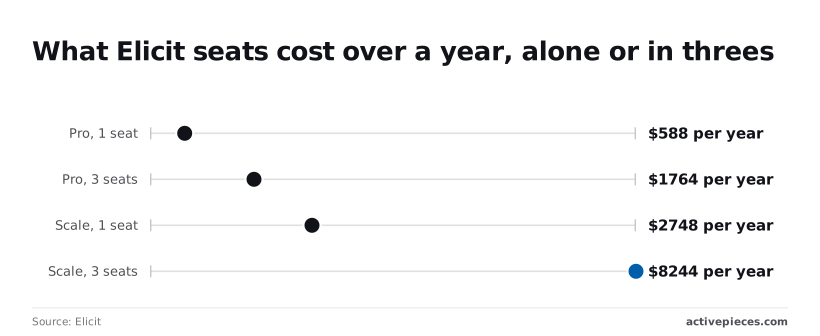
That gap of 6,480 dollars is why you shouldn't put a whole team on Scale for one person's review. Scale pays for itself when a stalled review would burn more paid hours than the difference.
Put one seat on Scale and the others on Pro.
Each check costs minutes, and skipping them is what caused the cutoff. Here's the order for Monday:
1. Read the limits page at elicit.com/pricing for the plan you hold.
2. Count the papers the review needs and the columns you'll extract from each.
3. Name the plan for each use: scan, full review, solo reading.
4. Set a calendar reminder for mid-month to check your usage against the limit.
5. Decide whether the team needs one seat or three, using the yearly costs above.
Do these in order, because the count in step two decides the plan in step three, and the plan decides the seats. Once they're done, the cutoff is a number you saw coming rather than a surprise.
## Frequently asked questions
Before you pay, settle the five questions below, because each decides whether your cutoff date stays predictable. Where I couldn't confirm a detail, I say so rather than guess, and every answer points back to Elicit's own pages, which are the final word.
### Is Elicit free to use?
Yes, Elicit has offered a free plan you can start on without a card.
That makes it a fair way to test your real workflow, but the free allowance is the one most likely to run out mid-review, so run a realistic batch of papers before you trust it for a full project.
The limits are listed on Elicit's pricing page.
### Does Elicit offer a discount for annual billing or students?
Annual billing is the usual place for a saving, and Elicit's pricing page is where you toggle between billing periods and see the difference for yourself.
I couldn't confirm a student or academic discount. If you're at a university, ask Elicit's support before paying full price. The worst answer is no.
### Can I cancel Elicit or downgrade mid-month?
I couldn't confirm the exact terms. Whether a downgrade takes effect immediately or at the end of the billing period decides whether you pay for capacity you no longer need.
So read the billing section of your account settings and Elicit's terms before you commit, especially on an annual plan.
### Does Elicit have team or enterprise pricing?
Elicit's pricing page lists plans beyond the individual ones, and larger organizations are generally handled by contacting Elicit directly.
If you're three people sharing one review, price the team option against separate individual plans, since shared limits are what you're really buying.
### Do unused Elicit credits or allowances roll over?
Don't assume they do. Most usage allowances are built to reset on a cycle, so work you leave undone can simply vanish.
Check how Elicit describes your plan's allowance on the pricing page, then schedule the heavy extraction work early in the cycle rather than saving it for the end.
## Related reading
- [Compare Taskade Pricing for Small Teams](https://www.activepieces.com/blog/compare-taskade-pricing-for-small-teams)
- [DeepSeek Search API vs Exa Pricing for Small Teams (2026)](https://www.activepieces.com/blog/deepseek-search-api-vs-exa-pricing-for-small-teams-2026)
- [No-Code Automation Statistics 2026: Adoption for Small Teams](https://www.activepieces.com/blog/no-code-automation-statistics-2026-adoption-for-small-teams)
## References
- [Elicit](http://elicit.com/pricing)
- [European Review PRISMA diagram](https://www.europeanreview.org/wp/wp-content/uploads/Figure-S1-PRISMA.pdf)
- [AIVario](https://aivario.com/tools/elicit)