# Factory AI Pricing in 2026 and What Each Plan Costs

By Dario Espinoza-Blum · 2026-10-28 · Source: https://www.activepieces.com/blog/factory-ai-pricing-in-2026-and-what-each-plan-costs

---
<aside class="tldr"><p class="tldr-label">Summary</p><p>Factory AI's six pricing tiers include per-seat billing on Teams ($60/mo plus $40/mo per seat).</p><ul><li>12 of 27 surveyed companies spend over $1,000 monthly on AI coding.</li><li>McKinsey found 1 in 5 organisations held back from AI by token costs.</li><li>Claude Opus 5.5 Fast leaves less than a third of headline allowance.</li></ul></aside>

[Factory](https://factory.com/pricing) AI sells six tiers: Pro, Plus, Max, Teams, Business and Enterprise.

**It meters tokens rather than seats**, so the tier name tells you less than the model you run and how often your agents run, whether they fire on demand or on a schedule set up through a workflow tool like [Activepieces](https://www.activepieces.com).

![Token meter dial beside a plan card and schedule calendar](https://ap-marketing-media.fra1.cdn.digitaloceanspaces.com/uploads/fa2ede74-63fb-43bc-a2e1-2692235c7fcd/factory-ai-pricing-in-2026-and-what-each-plan-co-0905d473.webp)

Factory builds coding agents, which it calls Droids, that take on software tasks such as writing, reviewing and fixing code.

## Factory AI pricing today, plan by plan

### The plan table, checked against Factory's own page

I compared each plan against factory.ai/pricing on 2026-10-28. The table shows what I could confirm and what I couldn't. Read every "Unconfirmed" as a number to get in writing before you commit, not as a number that doesn't matter.

| Plan | Monthly price | Token allowance | Seats | Models | Limits |
|---|---|---|---|---|---|
| Free | Free by name; terms unconfirmed | Unconfirmed | Unconfirmed | Unconfirmed | Unconfirmed |
| Pro | Unconfirmed | Unconfirmed | Unconfirmed | Unconfirmed | Unconfirmed |
| Max | Unconfirmed | Unconfirmed | Unconfirmed | Unconfirmed | Unconfirmed |
| Enterprise | Unconfirmed | Unconfirmed | Unconfirmed | Unconfirmed | Unconfirmed |

### Factory AI pricing assumptions used in this guide

The sections below use a 20M-token Pro allowance, a $2.70 overage rate per million tokens and three model multipliers. I could not tie any of them to the pricing page, so they are working assumptions for the arithmetic, not quoted plan terms.

Their job is to show how the bill is built: allowance, then overage, then model multiplier. Swap in the numbers from Factory's page on the day you buy, and the same steps give you a real estimate.

### What Factory AI token allowances count

A token is a small chunk of text, roughly a word or part of one. Your allowance is a pool of them, and every file an agent reads, every instruction you send and every line it writes draws from it.

![Jar of word tiles drawn from by file, instruction and code line](https://ap-marketing-media.fra1.cdn.digitaloceanspaces.com/uploads/e80a556d-fd7c-44da-916c-0b7616a8947e/factory-ai-pricing-in-2026-and-what-each-plan-co-9650b3c7.webp)

Ask these before you pick a tier:

1. What happens when the allowance runs out: a hard stop, a slowdown, or overage billing?
2. Do all models draw from the pool at the same rate, or do some cost more tokens per task?
3. Does a plan's seat count limit who can log in, or only how many people share the pool?
4. Are there separate limits on how many agents can run at once?
5. Is the Enterprise price fixed, or negotiated against your expected usage?

## Developer costs per plan

Past the plan's allowance, extra usage is billed on top of the subscription, so a solo developer's monthly bill scales with actual usage.

For each tier, work through the same four steps:

1. Multiply daily tokens by working days to get tokens per month.
2. Subtract the plan's allowance.
3. Multiply what's left, in millions, by $2.70, which calculates your overage charge.
4. Add the subscription.

![Four step cards leading to a calculator](https://ap-marketing-media.fra1.cdn.digitaloceanspaces.com/uploads/e3f9ee33-110a-446b-a1bb-4846ab0f69ef/factory-ai-pricing-in-2026-and-what-each-plan-co-b969ef6c.webp)

### Monthly AI coding tool spend by company

[Stackness](https://stackness.dev/blog/how-much-do-developers-spend-on-ai-coding-tools-per-month-october-2026) sorted 27 companies by monthly AI coding spend. [Stackness](https://stackness.dev/blog/how-much-do-developers-spend-on-ai-coding-tools-per-month-october-2026) found that ten spend under $300, so a plain subscription is the realistic budget for more than a third of them. Five land between $300 and $1,000, where overage starts to matter.

Eight spend $1,000 to $3,000, and four spend over $3,000. That makes 12 of 27 above $1,000 a month, **nearly half**.

## Factory AI token limits and when to upgrade

20M tokens on Pro is a ceiling on the cheapest model, not a promise, and each pricier model shrinks it by its multiplier.

### How model choice affects Factory AI token use

Here the 20M Pro allowance is divided by each model's multiplier, and the table then counts how many continuous-integration (CI) runs, the automated checks that fire on each code change, fit at 30k to 80k tokens apiece.

Choosing the fast variant of Opus 5.5 leaves you with **less than a third of the headline allowance**.

| Model | Multiplier | Effective tokens | CI runs covered |
|---|---|---|---|
| Claude Opus 5 | 2× | 10M | 125–333 |
| Claude Opus 5.5 | 1.6× | 12.5M | 156–416 |
| Claude Opus 5.5 Fast | 3.2× | 6.25M | 78–208 |

At 300 runs a month at the upper size, a team is already over the line on two of these rows, meaning they're paying overage charges at normal usage levels.

Runs that fire on every code change raise the question of what the tool starting them charges.

[Activepieces](https://www.activepieces.com/pricing) runs the triggers, branches and schedules around an agent, and it charges 1 credit per flow run however many steps the flow has, so a ten-step flow costs what a two-step one does.

Zapier bills per task and Make per module, which taxes splitting work into smaller, more reliable steps; here the run is the meter.

[McKinsey](https://www.mckinsey.com/capabilities/quantumblack/our-insights/the-state-of-ai) found that 1 in 5 organisations had AI use held back by token costs.

![Organisations held back by AI token and operating costs](https://ap-marketing-media.fra1.cdn.digitaloceanspaces.com/uploads/a80eab48-4063-4aab-9bba-e57eefa66234/factory-ai-pricing-in-2026-and-what-each-plan-co-6acf2388.svg "Source: McKinsey")

## Hidden costs beyond the Factory AI subscription

Five costs never make it onto the pricing card. They are your own model provider's bill, seat minimums, contract terms, security features reserved for Enterprise, and the hours people spend checking what the agents produce.

None of these has a published figure, so each one below is marked "ask vendor".

### Bring-your-own-key and double billing on Factory

Plug in an account with a model company and pay that company directly for the tokens, and you are doing bring-your-own-key. If you skip this question, **you can pay twice**: once for the plan and again for the provider.

Ask the vendor whether keyed usage still draws down plan tokens, and what the provider bill runs for your workload. Both figures: ask vendor.

viz type=distribution title="How surveyed companies split on AI coding spend per developer" unit="companies" source="Stackness - https://stackness.dev/blog/how-much-do-developers-spend-on-ai-coding-tools-per-month-october-2026",000–$3,000 and four above $3,000, so a large minority spend well past typical plan prices."
Under $300: 10
$300–$1,000: 5
$1,000–$3,000: 8
$3,000+: 4

### Factory AI seat minimums and contract terms

A seat floor can set your lowest possible bill, whatever your usage. Before you sign, get answers in writing on these:

- Minimum seats on each tier (ask vendor)
- Monthly versus annual commitment (ask vendor)
- What happens to unused tokens at renewal (ask vendor)
- Notice required to cancel or downgrade (ask vendor)

If your company requires single sign-on and the stronger security controls, you're buying Enterprise regardless of workload, because those are often reserved for that tier. Ask vendor which controls sit where, and what Enterprise costs.

![Activepieces pricing page displaying four subscription tiers with features and costs.](https://ap-marketing-media.fra1.cdn.digitaloceanspaces.com/uploads/841ec84e-02e4-4761-aca2-e92f6d457f41/self-host-mistral-ai-enterprise-deployment-guide-c7d7dca9.webp)

### Review time as the real cost

Every change still needs a person to check it, and that person's hours never appear on an invoice.

Time a small batch of real tasks, count the minutes spent reviewing each one, and multiply by what those hours cost you. That number often outweighs the subscription, and no vendor can quote it for you.

<blockquote class="pull"><p>Every change still needs a person to check it, and that person's hours never appear on an invoice.</p></blockquote>

## Factory pricing versus competitors

Of the four, Factory's real cost depends on your workload and plan rate limits. The others lean on a monthly plan with an allowance, which makes their real cost easier to guess but not always lower.

### Entry and top-tier price side by side

To compare the four on the points that move a bill, use the table below. I've left dollar figures out because plan prices change often, and a number quoted here would go stale before you priced your own work.

| | Factory | Cursor | Claude Code | Copilot |
|---|---|---|---|---|
| Entry price | Paid tiers with a token allowance | Plan with a usage allowance | Comes with a Claude subscription | Per-seat plan |
| Top individual price | Highest tier, larger allowance | Highest individual plan | Highest Claude plan | Highest individual plan |
| Billing unit | Tokens | Plan plus usage | Plan limits or API tokens | Seat plus extra requests |
| Model choice | Multiple vendors' models | Multiple vendors' models | Anthropic's Claude models | Multiple vendors' models |
| Bring your own key | Check the plan page | Check the plan page | Yes, through an Anthropic API key | Check the plan page |
| Agent autonomy | Agents run tasks end to end | Agent mode inside the editor | Agent that works in your terminal | Agent mode in the editor |
| Enterprise controls | Business tier | Business tier | Team and enterprise plans | Business and enterprise plans |

### Which billing model suits which workload

If your agents run a few times a day, a seat-style plan keeps the month predictable. If they run constantly, or you choose the priciest model by habit, **token billing exposes the true cost**, and that's Factory's strength and its risk.

Claude Code suits people content with one model family. Cursor and Copilot suit people who work mostly by hand in an editor and use agents occasionally.

## Triggering Factory AI from automated workflows

You can start a Droid from a ticket, an alert or a pull request without anyone typing a command. A workflow tool calls Factory's documented CLI or API when the event happens.

### When automating Factory AI Droids is worth it

**Automate the jobs you already repeat by hand**, and leave the one-off questions alone.

If someone on your team opens the same kind of ticket every few days and then pastes it into Factory to get a first draft of the fix, that's a job a machine can start for them.

Expect ten Droids and a noisy alert source can start a hundred. So begin with one trigger, such as a new pull request, watch what it consumes for a week, and only then add a second.

### What the orchestration layer costs

Beyond your Factory tokens, the workflow tool in the middle is a second bill, and it's usually metered by how many times a flow runs.

Factory's own usage charges stay on Factory's bill, so set the credit rate on the pricing page beside your Factory estimate.

## Plan selection checklist

**Spend one week of real work on the cheapest paid tier before you pick anything bigger, because a guess at your workload costs you more than the week does.**

1. Sign up for the cheapest paid tier and use it only for jobs you'd do anyway, such as fixing a bug, drafting an automation, or reviewing a pull request.
2. After each task, write down the tokens it used and what the task was. Tokens are the units the plan meters, so this log is your real price list.
3. Set a spend alert in the billing settings before the first task, so a runaway agent shows up as an email rather than a surprise on the invoice.
4. Repeat a few of the same tasks on a cheaper model and compare the token count and the quality of the result. If the cheaper one does the job, that's money back every week.
5. Recheck Factory's pricing page at the end of the week, since plans and limits change and your estimate should rest on today's page.
6. Write down your upgrade triggers, as the next subsection explains.

### Setting a Factory AI plan upgrade trigger

"We'll upgrade when it feels tight" is how teams drift into overspending. Instead, write one sentence per trigger: upgrade when weekly tokens pass a figure you chose from your log, or when the alert fires twice in a month.

## What Activepieces does about this

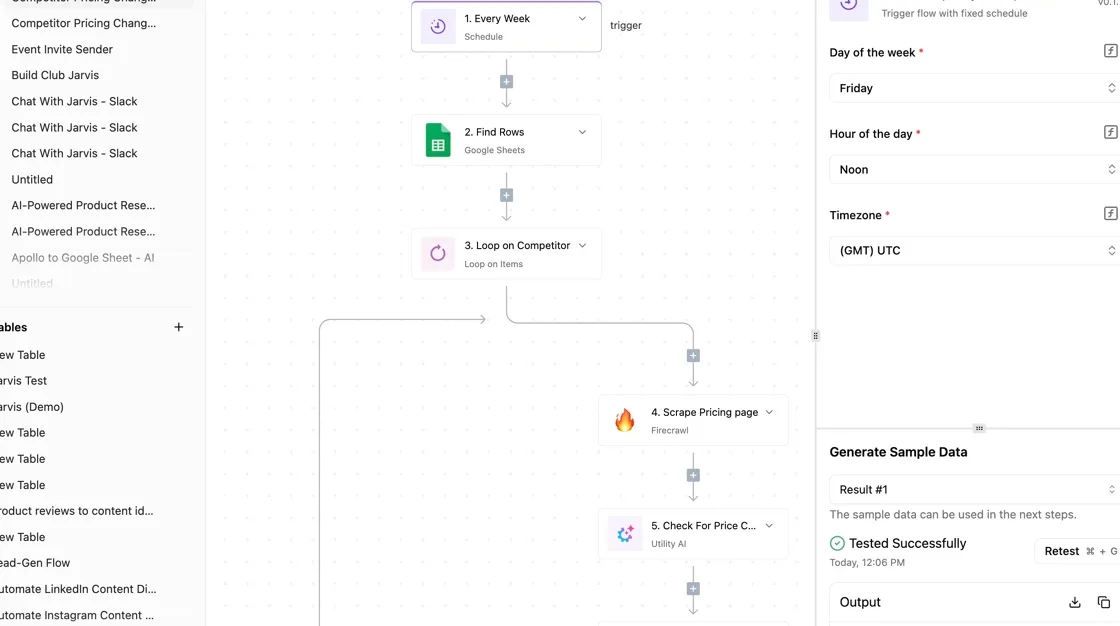
The problem in this article is that a Droid costs the same tokens whether you started it or an alert did, so the thing deciding your bill is how often something fires it. Activepieces sits at that point.

It is the layer that decides when a Droid starts, and you can put a limit on that layer before the tokens are spent.

The meter is simple: [Activepieces](https://www.activepieces.com/pricing) charges 1 credit per flow run, however many steps the flow has. A ten-step flow that filters an alert, checks for a duplicate ticket, calls Factory's CLI or API and posts the result back costs what a two-step flow does.
![Activepieces workflow builder showing a five-step competitor price monitoring automation with schedule trigger, Google…](https://ap-marketing-media.fra1.cdn.digitaloceanspaces.com/uploads/0a2a8ed3-423a-4bec-884d-43cb1cb21bcd/cursor-business-plan-pricing-in-2026-costs-vs-pr-e429c609.webp)

That means you can add the filtering steps that stop a noisy source from starting a hundred Droids, without paying more for each guard you add. Zapier bills per task and Make per module, so the same guards cost more there.

The core is open source under the MIT licence, and you can self-host it. If the orchestration bill matters to you, you can run the flows on your own infrastructure and keep only Factory's token charges as the variable cost.

MoneyGram, Moneypenny, Alan and FundingSocieties run it in production.

To use it for the checklist above, build one flow with one trigger, such as a new pull request, and count its runs for the week next to your token log.

Then you have both meters priced against the same events, and you can set the upgrade trigger from real numbers. Activepieces does not change what Factory charges for tokens, but it can reduce how many runs reach that bill.

## Frequently asked questions

### How to read these answers

Read these answers as of late October 2026, because they rest on Factory's public pricing page and documentation as we read them then. Pricing pages change without notice, so check the live page before you commit money.

### Free plans and your own keys

Does Factory AI have a free plan? Check the pricing page for whether a free tier or trial is listed on the day you read it. We won't promise one.

If you find one, spend it measuring your own workload, because the allowance you burn through in a week tells you which paid tier you need.

Can I bring my own API keys to Factory AI? Factory's documentation has described connecting your own model provider keys. Confirm that this applies to your plan before you build around it.

If it does, part of your spend moves to the model provider's invoice, and you then have two bills to watch instead of one.

### Billing basis and discounts

Is Factory AI billed per seat or per token? Per token, as covered above. Adding a teammate doesn't set your bill.

The model they pick and how often their agents run do. A small team running heavy agents can cost more than a large team that rarely uses them.

Does Factory AI offer discounts for annual billing or startups? We could not confirm either from the public page, so don't budget for one.

If the page lists nothing, ask Factory's sales team directly, since the worst answer is no and you'll have the real number instead of a guess.

### Pricing changes

How often does Factory AI change its pricing? We have no schedule to point to. AI tools of this kind adjust allowances, model options and plan names fairly often, so a figure you saw months ago may be wrong.

Reread the page right before you sign, and again when your renewal comes up. Otherwise you may be paying for a tier that no longer fits your usage.

## Related reading

- [n8n Business Plan Pricing: What It Costs in 2026](https://www.activepieces.com/blog/n8n-business-plan-pricing-what-it-costs-in-2026)
- [Cursor Business Plan Pricing in 2026: Costs vs Pro](https://www.activepieces.com/blog/cursor-business-plan-pricing-in-2026-costs-vs-pro)
- [Synthesia Pricing 2026: Plan Costs and Cost per Video](https://www.activepieces.com/blog/synthesia-pricing-2026-plan-costs-and-cost-per-video)

## References

- [Stackness](https://stackness.dev/blog/how-much-do-developers-spend-on-ai-coding-tools-per-month-october-2026)
- [McKinsey](https://www.mckinsey.com/capabilities/quantumblack/our-insights/the-state-of-ai)
