This architectural flaw prevents the "separation of duties" required by NIST SP 800-53. An auditor can't verify if someone sanitized the logs to hide unauthorized activity. The following table illustrates the structural differences between standard commercial logging and the specific configurations required to survive a forensic investigation under FedRAMP guidelines. | Dimension | Standard Cloud Logging | FedRAMP Compliant Logging | | :--- | :--- | :--- | | **Storage Location** | Same Account | Isolated Account | | **Immutability** | Soft-delete enabled | WORM/Object Locking | | **Access Control** | Shared Admin Credentials | Cryptographic Signature Verification | For forensic record integrity, implementing these isolated architectures is the only way to ensure that a breach of your primary application environment doesn't result in a total loss. ### Avoid logging audit records to ephemeral storage Storing audit records on the local disk of a container or virtual machine results in immediate data loss during a scaling event or a system crash. Any log not offloaded to a persistent, external service disappears when the instance terminates. ### Fix inconsistent metadata in multi-cloud audit logs Discrepancies in how different providers format timestamps and identity headers prevent your security teams from reconstructing a single timeline of an attack. Without a unified schema, a login event in one cloud can't be programmatically linked to a database query in another. ### Log injection and unauthorized record modification Systems that lack Write Once, Read Many (WORM) protections allow users with high-level permissions to alter existing entries, effectively "gaslighting" the audit trail. When a system allows the `DeleteObject` or `PutObject` commands on historical log files, a rogue administrator can overwrite a record of their own privilege escalation, rendering your entire compliance posture unverifiable. ## Centralize audit trails in management buckets Establishing a logically isolated, Write-Once-Read-Many (WORM) storage environment ensures that even if a production database is compromised, the attacker can't delete the evidence of their own lateral movement. ### Enforce separation of duties for audit logs Separation of duties prevents a single administrator from both performing a privileged action and subsequently erasing the audit log of that event. The complexity of these safeguards scales directly with the sensitivity of the data, as evidenced by the [Precision Federal](https://precisionfederal.com/insights/fedramp-high-vs-moderate-decision) breakdown of control requirements.When audit trails reside within the same security boundary as the workloads they monitor, they fail to meet federal standards.
| FedRAMP Impact Level | Total NIST SP 800-53 Controls | Security Implications | | :--- | :--- | :--- | | Low | 156 | Basic hygiene for non-sensitive public data. | | Moderate | 323–325 | Standard for most SaaS; requires robust identity and access management. | | High | 410+ | Strict isolation for law enforcement and emergency services data. | 410 controls must be satisfied for a system to reach the FedRAMP High baseline, according to Precision Federal. Your engineering team must implement nearly triple the security measures of a Low-impact system (156 controls) to account for the increased risk of state-sponsored tampering.  Even a Moderate-impact system requires 323 controls. This forces a clear division where the team managing the Amazon S3 storage bucket (a scalable cloud object store) doesn't have the credentials to access the production Kubernetes cluster. ### Automate audit log offloading and rotation Automated offloading moves telemetry from volatile memory to permanent storage every 60 seconds. This minimizes the "window of invisibility" where a system crash could result in the loss of recent forensic data. 1. The application generates a JSON-formatted event. 2. A sidecar container immediately replicates the log to a remote management VPC. 3. The management VPC applies a bucket lock, preventing any modification for the duration of the retention period. ### Set long-term audit log retention policies FedRAMP mandates a minimum one-year retention period for audit logs. This ensures that investigators can reconstruct the timeline of "low-and-slow" exfiltration attempts that may not be detected for months. A codebase you can read closes reviews faster than a vendor's word. Activepieces ships an MIT-licensed core that allows teams to clone the repository, read the queue and worker architecture, and run it self-hosted or fully air-gapped to provide the evidence required to close a review. This field must represent the moment of the action rather than the moment the log was eventually written to disk. Without this distinction, a three-hour delay in log processing could lead a forensic examiner to misidentify the sequence of a multi-stage breach. ## How Activepieces automates the generation of FedRAMP-ready logs Activepieces generates immutable audit records by capturing the specific identity and input parameters of every workflow execution. ### Capturing automated approval metadata The Activepieces workflow engine attaches a unique cryptographic signature and timestamp to every approval step. An auditor can verify that a specific administrator authorized a deployment rather than a system-level bypass. By recording the exact JSON payload of an approval response, the platform creates a non-repudiation layer. This granular capture transforms a generic "Success" status into a forensic record of intent and authorization. 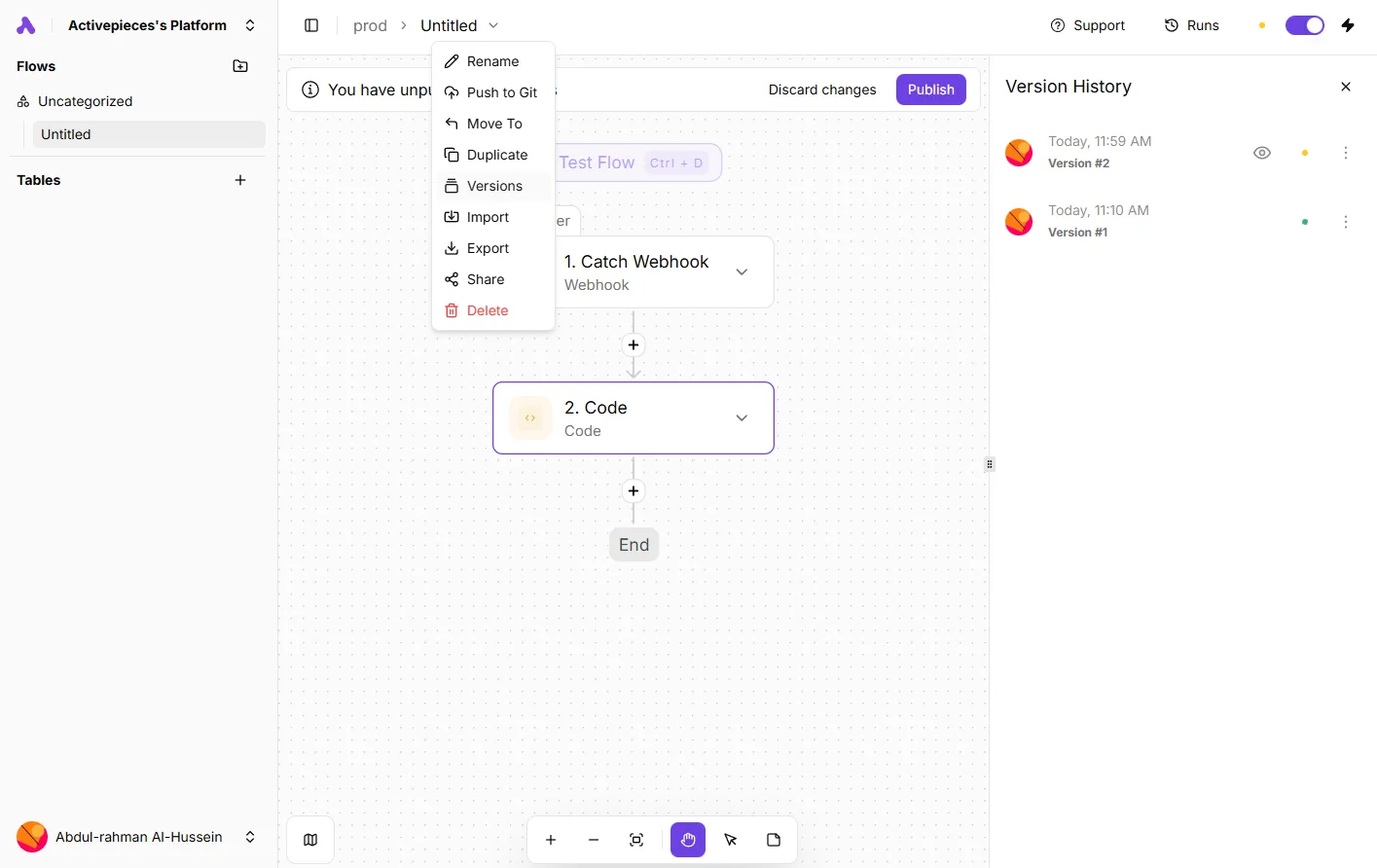 ### Exporting execution history to secure SIEM providers The platform uses a standardized webhook egress to stream execution logs to Security Information and Event Management (SIEM) tools like Splunk or Datadog. Every agent tool call and the data it acted on is traced alongside deterministic flow steps, allowing these event streams to be exported to the SIEM your security team already runs. You can verify this by checking the Run Details and Debugging UI for the per-step agent decision trace and the audit logs feature for export configurations. Because these exports are formatted as structured telemetry, your security teams can set automated alerts for unauthorized changes to workflow logic, repeated execution failures, and flow executions triggered by credentials flagged for revocation.  ### Gain visibility into low-code automation triggers Activepieces provides a transparent mapping between the trigger event and the subsequent actions taken by the automation. By exposing the underlying code of each "integration" (the modular connectors), Activepieces allows your engineers to audit the logic that generates the log itself. This process ensures that a hidden internal function hasn't tampered with the audit trail. ## Monday morning cloud audit readiness checklist ### Verify audit log delivery to central storage Audit readiness begins with confirming that telemetry streams from every production sub-network are reaching the centralized storage bucket. Your engineers must validate the heartbeat of log forwarders across all zones to guarantee that the record of truth remains continuous. This systematic check prevents a scenario where a tenant’s sensitive configuration changes are lost to a local buffer overflow. ### Test the searchability of specific user actions To ensure logs are useful for an auditor, you must simulate a specific administrative event and verify it can be queried in the SIEM. Attempt to locate the exact record of a test configuration change using only the timestamp and user ID. If the query fails to return the full payload and success indicator, the audit trail is functionally broken. ### Metadata requirements for actionable logs If a developer rotates an API key or modifies an ingress rule, the resulting log must contain the specific actor ID and source IP. Otherwise, your team can't distinguish between a routine maintenance task and a credential compromise. ### Criteria for forensic reconstruction The following criteria determine if a log entry is actionable: The presence of a unique request ID links the initial load balancer hit to the final database execution. A timestamp synchronized via Network Time Protocol (NTP) ensures the sequence of events isn't inverted during a forensic reconstruction. Clear-text identification of the resource modified eliminates the need to guess which microservice triggered a system-wide alert. ### Track workflow changes with automation lineage The ability to track a change from its origin to its execution is demonstrated in the versioning controls of modern automation engines. The interface displays a clear lineage of flow modifications, showing exactly when a logic change was committed and providing a direct link to the specific version of the code that handled the data.  ### Detect and prevent shadow logic changes This transparency ensures that an auditor can see not just that a change happened, but the exact state of the system before and after the deployment. ### Audit the auditors: review who has access to the logs For those auditing the auditors, restricting access to the audit repository itself is the only way to prevent a malicious actor from "cleaning" their tracks after an unauthorized privilege escalation. You must perform a weekly review of Identity and Access Management (IAM) policies to ensure that the "DeleteLogGroup" permission is restricted to a separate security principal. This separation of duties prevents a single compromised account from both causing an incident and erasing the evidence of the breach. ## Frequently asked questions about FedRAMP audit requirements ### How long must FedRAMP audit records be retained? FedRAMP requires agencies to retain audit records for at least one year. This ensures that forensic investigators can reconstruct the timeline of a breach even if the intrusion is discovered months after the initial compromise. ### Does FedRAMP require logs to be encrypted at rest? Federal mandates require all sensitive data, including audit logs, to be encrypted at rest using FIPS 140-2 validated cryptographic modules. This ensures that an unauthorized party gaining physical or logical access to the storage volume can't read the event history. ### What is the difference between a system log and an audit record? A system log captures operational telemetry like service heartbeats or memory usage. A FedRAMP audit record must contain specific metadata (who, what, where, and when) to provide a legally defensible account of system access. ### Can third-party SaaS logs satisfy FedRAMP requirements? Third-party logs only satisfy FedRAMP requirements if the provider can prove the logs are immutable and capture every state change. This is rarely possible when the logging logic is proprietary and hidden from the auditor. ## Related reading - [FedRAMP Authorized Vendors List (2026): Integration Guide](https://www.activepieces.com/blog/fedramp-authorized-vendors-list-2026-integration-guide) - [How Automation Triggers Tell New Records From Updated Ones](https://www.activepieces.com/blog/how-automation-triggers-tell-new-records-from-updated-ones) - [How to Insert new Google Sheet rows from Airtable records Step by Step Guide](https://www.activepieces.com/blog/how-to-insert-new-google-sheet-rows-from-airtable-records-step-by-step-guide) ## References - [Precision Federal](https://precisionfederal.com/insights/fedramp-high-vs-moderate-decision)Separation of duties prevents a single administrator from both performing a privileged action and subsequently erasing the audit log of that event.