# Flowise vs n8n (2026): Which Tool Should You Use?
By Amara Osei · 2026-10-17 · Source: https://www.activepieces.com/blog/flowise-vs-n8n-2026-which-tool-should-you-use
---
Flowise is for building the AI agent itself; n8n is for the business workflow around an agent, a space where tools like [Activepieces](https://www.activepieces.com) also sit. If your hard problem is how the agent reasons, start with Flowise.
If it's the apps and approvals around it, start with n8n.
## Flowise vs n8n by intended purpose
### Flowise is a visual builder for LLM agents and chains
You drag and connect nodes to build LLM chains and agents in Flowise, an open source, low-code tool. You design the agent's prompts, memory, tools and retrieval on a canvas, so the work centres on how the agent thinks and what it can call.
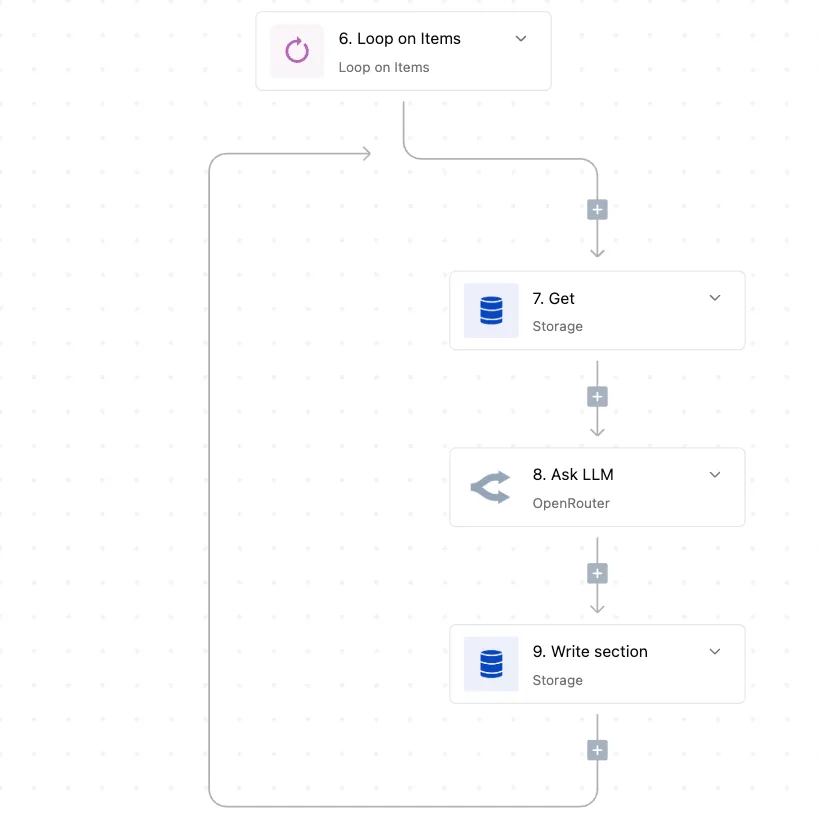
That suits a team whose pipeline problem is a bad answer, not a missing integration.
### n8n is a workflow automation platform with AI agent steps
n8n is a workflow automation platform with a node-based editor, and it includes AI agent steps alongside its many app connections. The agent is one stage in a longer process: a trigger fires, data moves between systems, the agent decides something, and the flow continues.
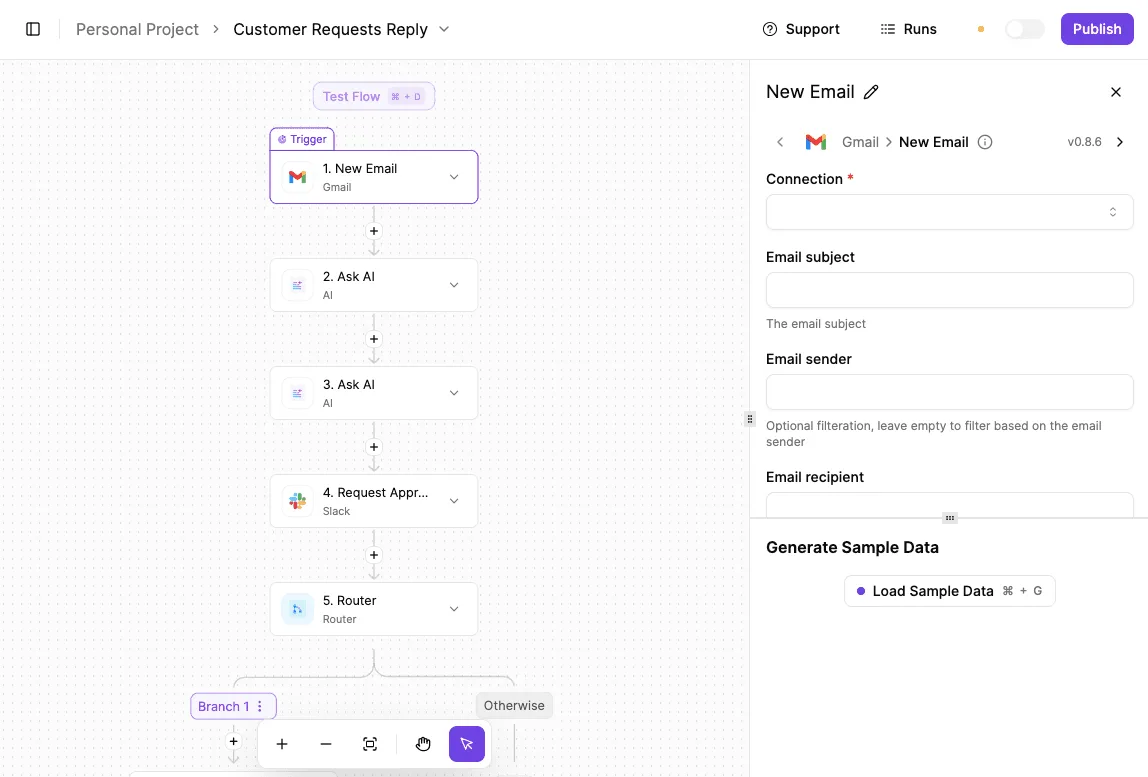
That suits a team whose pipeline problem is handoffs between a CRM, an inbox and an approver.
Most buyers aren't yet at the stage where this choice is locked in. In [Teradata](https://www.teradata.com/insights/white-papers/why-agentic-ai-stalls-enterprise)'s research on stalled agentic AI, 28% of organisations are experimenting, 40% are developing, 25% are building and only 7% are operationalizing.

That means **93% have no agent running** as a dependable part of operations.
A platform that's easy to start with but hard to govern will be tested later, when the cost of switching is higher. **Pick for where you'll be in a year, not for the demo.**
From here on, each tool is judged on the four criteria below.
- Apps the agent can act in: the number and depth of systems where the agent can read and write, because an agent that can't reach your CRM or ticketing system only produces text.
- Human approval before it acts: whether a person can review and release a high-stakes step, such as a refund or a customer email, before it executes.
- Self-hosting: whether you can run the tool on your own infrastructure, which decides where sensitive data lives.
- Price as runs grow: how the bill changes when volume rises from hundreds of runs to hundreds of thousands.
Because each verdict that follows applies these four in the same order, the two tools are compared on identical ground.
## Flowise vs n8n on pricing and features
Read the billing row before the feature rows, because the two tools differ least on self-hosting and most on what they bill for. Figures were checked in October 2026; anything the vendors don't state reads "not published".
| | Flowise | n8n |
|---|---|---|
| Licence | Open source (Apache 2.0 core) | Fair-code (Sustainable Use License) |
| Self-hosting | Yes | Yes |
| Plans and prices | Cloud plans from $35/month | Cloud tiers priced by execution volume |
| Billing unit | LLM predictions generated | Workflow executions |
| Included limits | Not published | Set by the execution tier |
| Integrations | Nodes for models, vector stores and tools (100+) | 1,000+ pre-built integrations |
| Human-in-the-loop | Approval step inside agent flows | Wait step and approval before tool calls |
| Agent features | Single and multi-agent flows, retrieval | AI Agent node with tools and memory |

### How to read the table
Start with the billing unit, because it decides how your bill scales. According to WorkflowMath, n8n Cloud costs $24 a month at 2,500 runs, $60 at 10,000 and $144 at 50,000.
Across that range, **volume grows twentyfold while the bill grows sixfold**, so cost per run falls from roughly 1 cent to under 0.3 cents. High-volume pipelines get cheaper per run, but a bill still has to be forecast.

If you plan to embed the tool in a product you sell, check the licence row. Open source and fair-code both allow self-hosting, but the n8n licence restricts commercial resale.
A tool with more GitHub stars can still be the wrong one for your approval chain. Stars add a sense of community size, but they measure attention, not fit.
### Flowise pricing gaps on public vendor pages
You can model a Flowise cloud bill only roughly from public pages, because Flowise publishes a $35/month starting price and bills by the number of LLM predictions, but not the full limits. Ask for a quote before you commit, or price the cost of running it yourself.

For a process where a person signs off before money moves, test the pause-and-resume path in a trial, because neither vendor publishes how often approvals are used or how long a paused run may wait. Then confirm whether paused runs count toward your execution limit.
## Flowise and n8n by core strengths
Flowise wins where the agent's own reasoning is the hard problem, and n8n wins where the apps, approvals and billing around the agent are. The four criteria show it in turn.
### Apps the agent can act in
On integrations, n8n ships over 1,000 native SaaS and database nodes, while **Flowise has 100+ AI-specific tools** and vector databases. The gap means n8n can reach your CRM or ticketing system without custom code, while Flowise is stronger on retrieval and model plumbing.
If an agent must update records in many business apps, it starts from a much larger catalogue in n8n. For a Flowise agent, expect to build or call those connections yourself.
### Human approval before the agent acts
n8n treats approval as a workflow step: a run pauses, a person approves in the channel they already use, and the run resumes. Flowise's agent flows include a human-input step, so the agent itself can stop mid-reasoning.

Choose by where the decision sits. Judgment inside the agent's logic favours Flowise; sign-off on a business action, such as a refund, favours n8n.
### Self-hosting and licence terms
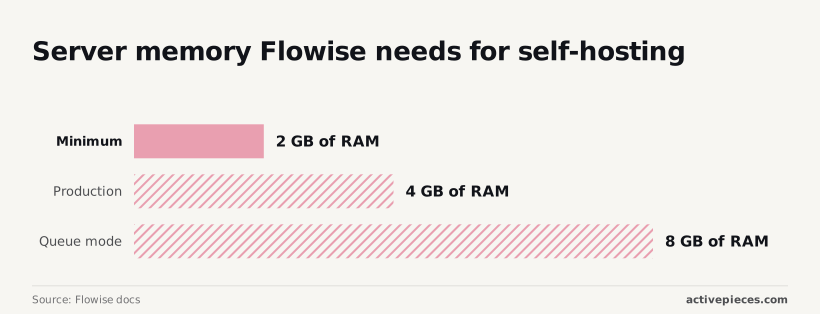
**8 GB of RAM per server is the starting point** in Flowise's [production guidance](https://docs.flowiseai.com/configuration/running-in-production). Production wants 8 GB per server, so budget accordingly for anything customers touch.
Queue mode, which adds workers for concurrent runs, also starts from 8 GB per server and worker.
Flowise is Apache 2.0 licensed. n8n is self-hostable under its Sustainable Use License, which restricts some commercial resale, so have legal read it before you embed n8n in a product.
On n8n's cloud plans, which meter by workflow execution, cost climbs with run volume, though a long multi-step run counts once.
Self-hosted Flowise has no per-run fee. Your costs are the servers above plus model tokens, so a heavy month raises the infrastructure and token bill rather than a platform invoice.
## The verdict on Flowise vs n8n by situation
For For most business teams, n8n fits, because the spend you just priced usually buys automation across apps with an AI step inside it. Flowise fits when the main job is prototyping and tuning a standalone RAG chatbot or agent.
The table shows which tool matches each situation and what has to be true for that pick to hold, so check the condition before you commit.
| Situation | Pick | Condition it holds under |
|---|---|---|
| Cross-app business automation | n8n | The agent is one step in a process that touches your CRM, inbox, or ticketing system |
| Approval-gated actions | n8n | A person must sign off before the workflow writes, sends, or spends |
| Standalone RAG chatbot | Flowise | The product is the chatbot itself, not a process around it |
| Prompt and retrieval tuning | Flowise | You iterate on chunking, retrievers, and prompts more often than on integrations |
| Using both | Both | Agent quality and business process each need their own owner |
| Governed AI automation across apps and data | Activepieces | You need agents and fixed-rule automations in one workflow, with 741 integrations, an MIT-licensed core, and unlimited flows on every plan, including free |
### Choose n8n when
If your agent's value shows up in a downstream system, such as a qualified lead routed, a refund approved or a record updated, the hard problem is the apps and approvals around the model.
A weaker prompt inside a well-governed workflow usually moves pipeline further than a brilliant agent nobody trusts to act.
Where a human must decide, such as refunds above a threshold or outbound messages to key accounts, the workflow should pause for that person. Rules should handle everything else.
A weaker prompt inside a well-governed workflow usually moves pipeline further than a brilliant agent nobody trusts to act.
The agent's reasoning is the problem. If you're comparing retrieval strategies, adjusting how documents are split, or testing prompts against real questions, a builder organized around the agent's components shortens each experiment.
This is the right shape for a support or knowledge chatbot that other teams will consume as a finished service.
### When to use Flowise and n8n together
Build and tune the agent in Flowise, then call it from an n8n workflow that handles triggers, data in other apps, and approvals. Each tool then owns the part it was built for.
The cost is two systems to host and monitor, so it pays off only when the agent and the process each have enough complexity to justify separate ownership.
## Activepieces for agents that act across business apps
If you want to avoid owning two systems, Activepieces runs its AI agent step inside the same flow that touches your business apps, and it's an open source, MIT-licensed core across 741 integrations.

That removes the host-and-monitor burden of a split stack, but it gives up depth on one side.
### Where it fits the same criteria
Activepieces calls its integrations "pieces," and a connected piece is an agent tool from the moment it exists: the same action runs as a step in a flow and as a tool on the per-project MCP server that Claude, ChatGPT, [Cursor](https://www.activepieces.com/pieces/cursor) or your own agent can call.
Nothing is exported or wired twice.
The catalogue is **741 integrations on an MIT-licensed core**, counted from packages/integrations/community in the open source repo, where the action a flow runs is the same one the MCP server exposes as a tool; the Integrations Framework and MCP Server documentation describe both sides.
MoneyGram, Moneypenny, Alan and FundingSocieties run it in production, and **roughly 60% of those integrations are community-contributed**, so most teams can likely connect to their essential services without writing custom integrations.
The full list is on the [pieces page](https://www.activepieces.com/pieces), where your CRM, ticketing and finance tools are either listed or not.
The four criteria, applied one at a time:
- For apps the agent can act in, the AI agent step draws on integrations coverage, so it can act wherever an integration exists. Confirm your CRM, ticketing and finance tools are listed. A missing integration means custom work.
- For approval, a flow can pause for a person's decision before a consequential step. Put that pause ahead of any write, refund or send, so the agent proposes and a human commits.
- For self-hosting, the code is open source, so you can run it on your own infrastructure. Regulated data then stays inside your boundary.
- For pricing as runs grow, the $20 Plus plan covers 10,000 runs. Count your expected monthly runs first, because an agent flow with many steps can eat that allowance faster than the trigger count suggests.
Run against the same four criteria, Activepieces comes out as one flow rather than two products joined by a callback: place an Agent step next to a deterministic step, open the run trace, and the whole execution is logged as one run.
The free plan on Activepieces Cloud has unlimited flows and 1,000 credits a month, with no card needed: https://cloud.activepieces.com/sign-up.
### Where it does not fit
Flowise is the better choice when your hard problem is the agent's reasoning, and Activepieces isn't built for that job. That covers retrieval tuning, multi-agent orchestration and inspecting how the agent reached an answer.
Flowise is Apache 2.0 licensed, and a team that needs that depth gets it there.
n8n's own comparison page credits Flowise with 100+ AI-specific tools and vector databases, so that depth is the reason to choose it.
If you need the widest catalogue of mature app nodes, the same page claims 1,000+ for n8n. That's a vendor's claim, so check it against your own app list. For a large, branching business process, n8n is the stronger default.

Activepieces is the better choice for teams that want their AI agents to act across business apps without owning and monitoring a second system, judged on how little wiring it takes to turn an integration into an agent tool.
Because the same piece action that runs in a flow is the one exposed as a tool on the MCP server, nothing is exported or built twice, and the 741 MIT-licensed integrations are usable by agents from the moment they are connected.
A team that needs more depth on the agent side than a flow-based step provides may weigh that trade-off differently, but for agents that work across CRM, ticketing and finance tools, one system is the simpler one to run.
## One-week test plan for Flowise vs n8n
Treat the default as a hypothesis and spend one week testing it on your own job, with your own apps and your own approver, before you commit budget to either platform. The week runs in five steps:
1. Write the one job the agent must do.
2. List the apps it touches and the approval step.
3. Run the job on each tool's free or self-hosted option.
4. Estimate monthly runs against each billing unit.
5. Re-check both pricing pages before you decide.
Day one takes the first two steps, midweek takes the third, and Friday takes the last two, which means day one and Friday are the heaviest work days, with a lighter midweek point.
### Day one: define the job and the approval point
Write the job as one sentence with a measurable outcome, such as "qualify an inbound lead, draft a reply, and log it in the CRM." Then mark which decisions a rule can make and which need a person.
Routing by territory is a rule. Approving a discount or an outbound message to a key account is judgment.
The approval point is where the two tools differ most in practice, so decide it now, not after you build.
### Midweek: build the same job in both
Run Flowise self-hosted, and n8n either self-hosted or on its free trial. Build the identical job in each, with the same model, the same prompt, and the same test records.
Then watch two things. Does the agent reason correctly on messy input? And how much work does it take to connect each app and pause for the approver?
If the reasoning is where you struggle, that points toward Flowise. If the app connections and the approval pause take the effort, that points toward n8n.
### Friday: price it at your real run volume
Estimate how many times the job fires in a month from your own pipeline data, not from a vendor's example. Then read each pricing page for what counts as one billable unit.
n8n's cloud plans meter workflow executions. For Flowise, use whichever unit its page names.
Multiply by your busiest month, because a multi-step agent that loops can consume more units than a simple count of leads suggests.
Pricing pages change, so re-read them on the day you decide. Then choose the tool whose build felt lighter and whose bill you can forecast.
## Frequently asked questions
Each answer below can be checked against the vendor's own pricing or docs page, and these five questions are the ones the comparison leaves open.
Yes. Flowise's core is open source, so you can run it on your own server without a license fee.
You still pay for the server and for every call to the model provider, so the real cost of a busy agent is token spend, not software.
Some enterprise features sit under a separate commercial license, so check the repository's license notes before you plan around them.
### Can n8n build AI agents without code?
Largely, yes. n8n has an AI Agent node on its visual canvas where you pick a chat model, attach memory, and connect tools such as other n8n nodes. Code is optional, though expressions and the occasional code node appear once data needs reshaping.
A non-developer can assemble a working agent, but whoever maintains it will eventually meet a data-mapping problem.
Can Flowise and n8n be used together? Yes. Flowise publishes each flow as an API endpoint, and n8n can call it with its HTTP Request node.
That splits the work along the article's dividing line: Flowise holds the agent's reasoning, and n8n handles the triggers, app connections, and approval steps around it. The cost is two systems to host, monitor, and secure instead of one.
Does n8n charge per step or per workflow run? Per workflow run. On n8n's cloud plans, one execution counts as one run no matter how many nodes fire inside it.
A long workflow with many steps therefore doesn't cost more than a short one, which makes the bill easier to forecast from trigger volume alone. Self-hosting changes this, because you pay for infrastructure rather than executions.
### Which is easier for a non-developer to start with?
It depends on the first task. If the task is moving data between business apps with an approval along the way, n8n's app nodes will feel familiar.
If the task is tuning how an agent retrieves documents and answers, Flowise puts those choices on the canvas, but you need to understand concepts like vector stores and prompts. Build one real task in each before committing.
## Related reading
- [Building Powerful AI Workflows: Clarifai 🤝 Activepieces](https://www.activepieces.com/blog/building-powerful-ai-workflows-clarifai-activepieces)
- [Building Sovereign AI Agents on Private Infrastructure](https://www.activepieces.com/blog/building-sovereign-ai-agents-on-private-infrastructure)
- [Stop building agents on platforms that can't debug them](https://www.activepieces.com/blog/stop-building-agents-on-platforms-that-can-t-debug-them)
## References
- [Teradata](https://www.teradata.com/insights/white-papers/why-agentic-ai-stalls-enterprise)
- [Flowise docs](https://docs.flowiseai.com/configuration/running-in-production)
- [WorkflowMath](https://workflowmath.com/)