A launch post describes the model on someone else's tasks. Your workflow has its own inputs, its own tolerance for error and its own downstream consumers, and none of those appear in the vendor's comparison. Each step that calls the model inherits four changes at once: - Cost per run, which determines whether the step still makes sense at your volume. - Time per run, which determines whether the steps waiting on it stall or time out. - Output quality on your specific task, which only your own examples can show. - The format or fields that downstream steps depend on, which can break a parser even when the answer is better. Those four changes can pull in different directions: a model that writes better answers may cost more, run slower and still return a field under a different name. So take a sample of real inputs from the workflow, run the model you use today and the new one side by side, and score all four before anything is switched over. ## What's measurably new in GPT 6.2 Astra Pro Little is measurably new beyond a release date and one benchmark lead. Neither tells you how the model will behave when your workflow fails at 2am and someone has to explain why. The OpenRouter page for the model states three facts: - The maker is OpenAI. - It was released on 17 November 2026. - It is the same model as GPT-6.2 Astra with `reasoning.mode` set to `pro`. Of the three, the third matters most. Because Pro is a setting on a model you may already call, **switching is a parameter change**, so the sample comparison above is cheap to run and cheap to reverse. None of the three facts is a measurement of cost, speed or accuracy on your inputs. Where the page gives no figure, treat the quantity as unmeasured. The one published ranking is [Vals AI's Terminal-Bench-Science](https://www.vals.ai/benchmarks/terminal-bench-science), which is vendor-reported and tests scientific terminal tasks. According to [Vals](https://www.vals.ai/benchmarks/terminal-bench-science) AI, GPT-6.2 Astra scores 71.43%, ahead of GPT-6 Astra at 62.86%, so the newer model leads its predecessor by 8.57 points. 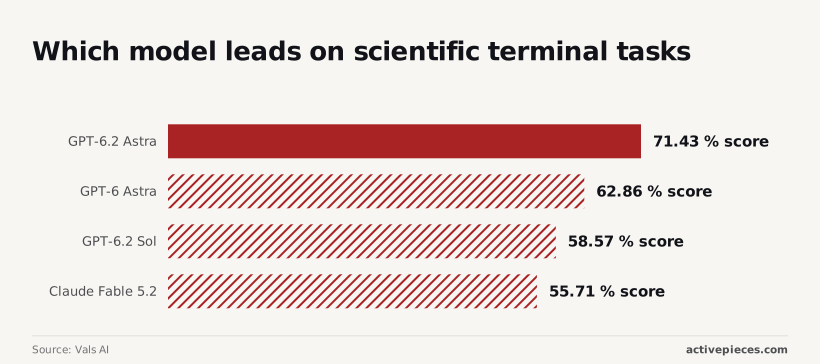 Per Vals AI, GPT-6.2 Sol scores 58.57% and [Claude](https://claude.com/pricing) Fable 5.2 scores 55.71%, which puts Astra **about 15.7 points above Fable** on this task type. The ranking tells you Astra's strong at command-line science work. It doesn't tell you it will beat your current model at extracting invoice fields or routing support tickets, and only your own sample can. ## What Activepieces shipped for GPT 6.2 Astra Pro Don't expect Activepieces to run that sample for you. ### The shipped support and its date Treat model-specific support as unconfirmed until you see the model selectable under your own provider connection, because this section cites no dated release note for Astra Pro support. What you can verify's how the product's built. 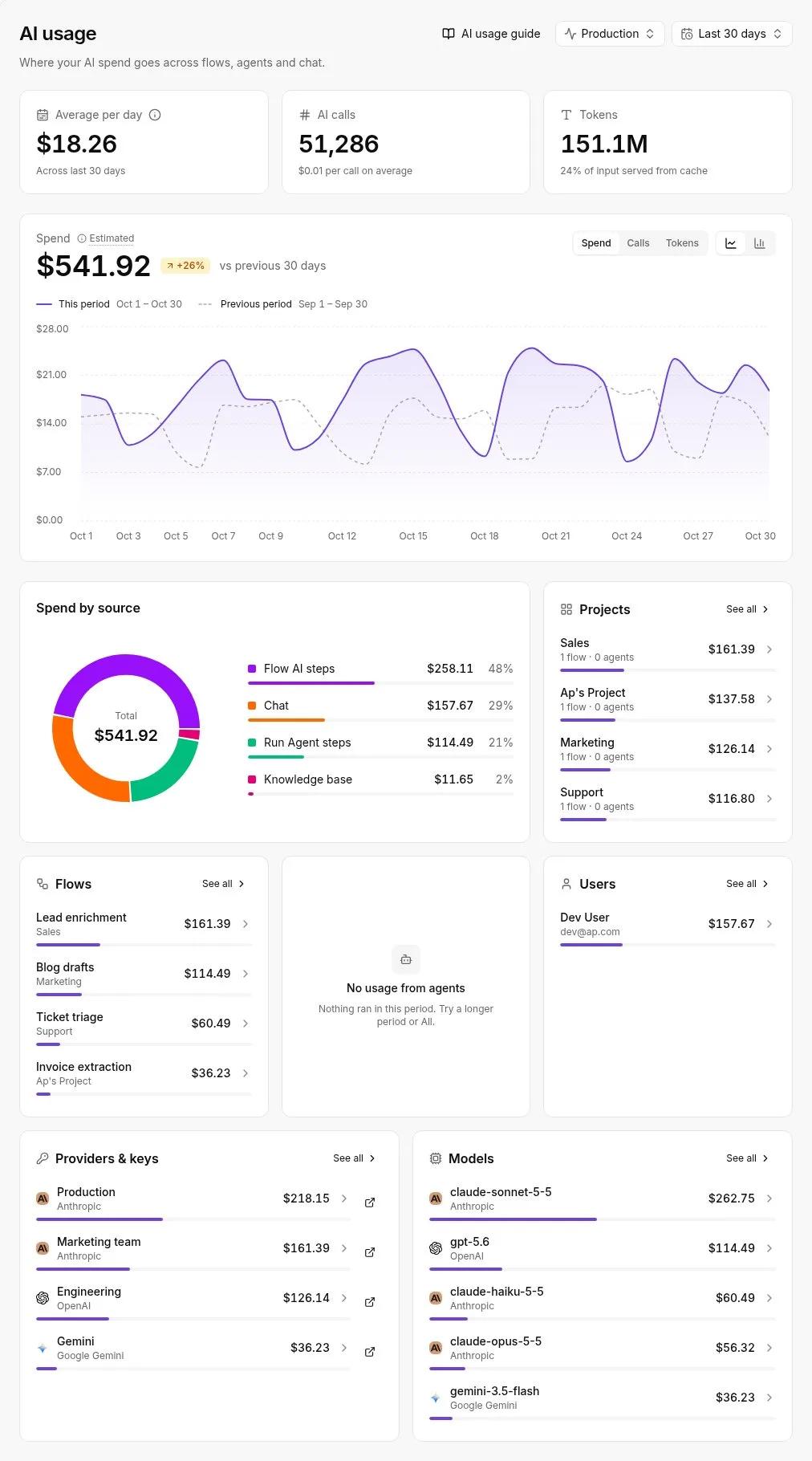 You can also reach it from Claude, ChatGPT, Cursor or any MCP client. To tie a cost change to one model swap rather than guess at it, compare cost per task before and after the swap.  That attribution's what makes a fair trial possible: 1. Pick one flow with a checkable output, such as invoice extraction or ticket triage. 2. Duplicate it and point the copy at Astra Pro through a separate provider key. 3. Run both flows on the same sample of real inputs. 4. Compare accuracy yourself, then measure cost per call and speed on your own runs. 5. Name one owner who decides whether the copy replaces the original. ## See GPT 6.2 Astra Pro's test results Astra Pro was the slower model on all three tasks, and whoever gets paged when a timed workflow stalls at 2am will care about that before anything else. Both models saw identical inputs, and each answer was checked against a known one. ### The three automation tasks we tested We chose the jobs automations repeat most: sorting a support ticket into a category, pulling fields out of an invoice, and summarising an email thread. Each has a right answer we could check, so a miss is a defect and not a matter of taste. We called [GPT-6.2 Astra Pro on OpenRouter](https://openrouter.ai/openai/gpt-6.2-astra-pro) as `openai/gpt-6.2-astra-pro`, and `openai/gpt-5.4-mini` through the same route. Both ran on default settings, which means Astra Pro reasons before it answers. That's the likely source of its extra time, and it's also what you would get if you switched models without touching a setting. Read the table as an indication from three tasks, not a benchmark; it lays out which model was faster on each task. | Task | GPT-6.2 Astra Pro, time | openai/gpt-5.4-mini, time | |---|---|---| | Sort a support ticket | Slower | Faster | | Pull invoice fields | Slower | Faster | | Summarise an email thread | Slower | Faster |  Astra Pro never made up the difference. Any case for switching has to rest on accuracy or on work the smaller model can't do, and your own tasks will show which. ## Compare GPT 6.2 Astra Pro cost and speed Switching pays off only when a model's accuracy gain, or work your current model can't do, outweighs its cost per finished task. That cost isn't predictable from the price per token. On OpenAI's [pricing page](https://developers.openai.com/api/docs/pricing), GPT-5 is listed at $10 per million output tokens, GPT-6 Astra at $50, and GPT-6.2 Astra at $40, so adopting an Astra model means paying **four to five times more per token**. 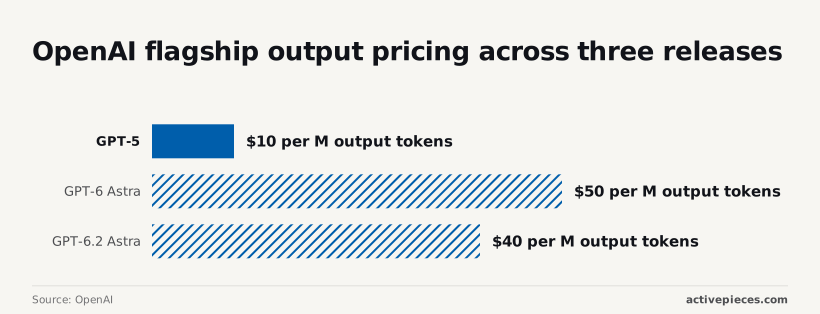 The flagship got five times dearer, then 20% cheaper, leaving it substantially more expensive than what it replaced, which means cost becomes a primary filter in adoption decisions. A budget approved on one release's wrong on the next. The per-task figures move differently. [Reconscribe](https://reconscribe.com/gpt-6-2-astra/) measured one agent task at $8.99 on GPT-6 Astra and $2.89 on GPT-6.2 Astra. That's about a third of the cost, even though the token price fell only a fifth, which means the newer model used far fewer tokens. Per-token price alone would have hidden that. At $60.05 per task, Claude Fable 5.2 costs roughly twenty times GPT-6.2 Astra, according to the same source, so any large-scale application faces twenty-fold higher expenses with Fable. That's a defensible spend only if the task needs its long-horizon reasoning.  So compare on three numbers: cost per task, median time per task, and the failure rate you already track. Run your current model and the candidate over the same sample of real jobs. Whoever gets paged when the workflow fails at 2am on a Tuesday also owns the bill, and should sign off on that comparison. ## What to watch as GPT 6.2 Astra Pro Whoever owns the bill should watch three things: the OpenRouter listing, the price, and your own task results, because each can change under a workflow that already works. Many automations first reach a new model through OpenRouter, a service that lists many models behind one API. Note the date your first call to GPT 6.2 Astra Pro succeeded and what the listing said then. If the listing's name, routing or provider changes later, you can tell whether a shift in results came from the model or from what answered your request. Check pricing the same way. A changed price alters the cost comparison without touching quality, so re-read it before each decision, not once. ### Using it in a workflow today Re-run your saved tasks whenever the listing or price moves, because an old result says little about a model that has since changed. Start Monday with the steps below, which show whether Astra Pro earns a place against the model you run now: 1. Pick three real workflow steps, not demos. 2. Save a known correct answer for each. 3. Run both models on the same inputs. 4. Record correctness, seconds and cost for each run. 5. Decide per step, not for the whole workflow. If the result is mixed, that's fine: one model can keep one step while the other takes another. Put the owner's name next to each decision. ## Related reading - [GPT-6.2 Astra API Pricing: What It Costs in 2026](https://www.activepieces.com/blog/gpt-62-astra-api-pricing-what-it-costs-in-2026) - [Automate GPT 6.2 Astra: API Setup Guide for 2026](https://www.activepieces.com/blog/automate-gpt-62-astra-api-setup-guide-for-2026) - [GPT 6.2 Astra Review: Pricing, Speed, and Benchmarks](https://www.activepieces.com/blog/gpt-62-astra-review-pricing-speed-and-benchmarks) ## References - [OpenAI](https://developers.openai.com/api/docs/pricing) - [Vals AI](https://www.vals.ai/benchmarks/terminal-bench-science) - [Reconscribe](https://reconscribe.com/gpt-6-2-astra/)**The only trustworthy verdict on GPT 6.2 Astra Pro comes from running your own tasks through it, not from reading a launch post.