You lack the administrative access to verify that the provider has purged data from internal logs or weights. ### Why SOC2 compliance isn't enough for customer voice data SOC2 Type II reports confirm that a provider has defined processes in place, but they don't guarantee the specific data isolation required for high-stakes banking transactions. Multiple clients' data can be processed on shared GPU clusters even if a provider is SOC2 compliant. This introduces the risk of side-channel attacks where one tenant might infer the data patterns of another. ### The hidden cost of API-based data leakage risks factory Every external API endpoint acts as a potential egress point for sensitive metadata that falls outside the scope of standard encryption-at-rest policies. Metadata surrounding a voice call (such as timestamps, IP addresses, and duration) is often stored in debugging logs to improve service reliability. This creates a persistent trail of metadata that your security team can't audit.  ## Open-source vs proprietary AI model costs Per-token billing creates a "**success tax**" that self-hosting open-weights models eliminates. This allows you to scale call volumes without a linear increase in operational expenditure. ### AI model pricing tiers compared Open-source deployments maintain a flat cost profile based on hardware utilization, whereas proprietary models typically implement an asymmetric pricing structure that penalizes long-form reasoning. | Model | Input Cost | Output Cost | | :--- | :--- | :--- | | GPT-4o (OpenAI) | $2.50 | $10.00 | | Llama 3.1 70B (Meta) | $0.88 | $0.88 | | Mixtral 8x22B (Mistral) | $1.20 | $1.20 | **Proprietary models price output tokens up to four times higher than input tokens, as shown in this comparison.** By switching to a model like Llama 3.1, you can stabilize the budget because the cost per token is uniform regardless of whether the model is reading or writing. ### Llama 3.1 vs Claude 3.5 ROI comparison Investing in the infrastructure for the Llama 3.1 70B model yields a return on investment faster than a subscription to Claude 3.5. You depreciate the upfront hardware costs over time. Millions of voice-to-text inferences daily will offset the capital expenditure for H100 GPU clusters within months through the absence of API bills. Furthermore, owning the weights means the model version never reaches a forced "end-of-life" date. ### Why token volume dictates the hosting strategy High-frequency call centers eventually reach a "crossover point" where the cost of cloud-based inference exceeds the cost of maintaining a private Kubernetes cluster. Latency overhead from the public internet begins to degrade the natural flow of voice interaction at mid-range volumes, making the "cloud tax" harder to defend. At enterprise scale, migrating to self-hosted Llama or Mixtral becomes a mandatory fiscal optimization. ## Cutting AI voice latency for call centers Self-hosting Large Language Models (LLMs) allows you to bypass the public internet. This reduces the total response time to under 200 milliseconds so that the AI can interrupt or respond without the awkward pauses that signal a machine is processing. ### Reducing round-trip delay in voice AI Deploying a model like Llama 3 on a private cluster eliminates the variable delay of the "round-trip" to a third-party data center. This ensures the system hits a [target latency of 200ms](https://llmping.app/leaderboard/) so the caller perceives a fluid, human-like cadence.  By moving the weights to local NVIDIA H100 GPUs, your engineering team gains direct control over the execution stack. The time from the end of a customer’s sentence to the start of the AI’s synthesized speech stays below the threshold where humans begin to feel social discomfort. ### Why P99 latency spikes break the customer experience Unpredictable P99 latency (the slowest 1% of requests) causes cloud-based models to suffer from catastrophic "hangs" during critical banking transactions, meaning users may experience frustrating delays at the most sensitive moments of their financial activity. 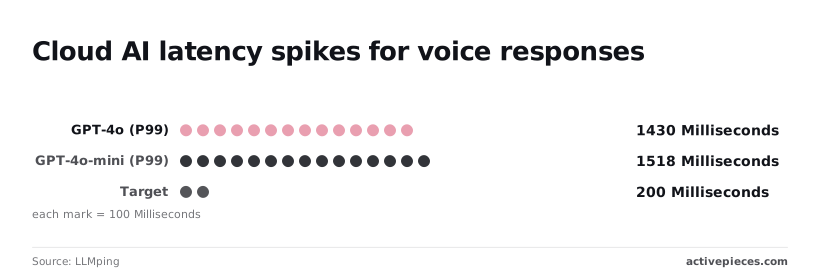 According to data from LLMping, the P99 latency for GPT-4o reaches 1430 milliseconds. One out of every hundred customers waits nearly a second and a half for a response. The smaller GPT-4o-mini performs even worse under load, with a P99 of 1518 milliseconds. These tail-end delays represent hundreds of frustrated callers per hour in a high-density center. ### Fine-tuning for banking-specific terminology and dialects Local hosting enables the use of Low-Rank Adaptation (LoRA). This is a technique for efficiently updating specific layers of a model to train the system on regional accents and internal product codes without leaking proprietary data to a vendor. Training on local audio ensures the system correctly identifies "chequing" versus "savings" in thick regional accents. Fine-tuning on internal manuals allows the model to recognize specific alphanumeric loan identifiers, so the agent doesn't hallucinate. ## Activepieces secures the connection between banking cores and local AI Self-hosting Activepieces, an open-source workflow engine, allows you to orchestrate data flows between your core systems and local LLMs within a hardened perimeter. Every credential the platform touches can be routed to your own secret manager instead of an external database, ensuring no vendor ever holds the keys to your core infrastructure. By inspecting the self-hosted instance, you can verify that sensitive connection secrets for your banking apps are stored only where you authorize them. ### Automating customer identity verification workflows Activepieces automates the multi-step handshake of caller verification by triggering local scripts the moment a voice gateway captures a customer’s ID number. Because the workflow engine resides on the same subnet as the core banking system, it can query the database and pass the result to a local Large Language Model (LLM) using internal IP addresses. > [!NOTE] > Screenshot of Activepieces flow builder showing the "new flavor created" trigger ### Routing call transcripts to private vector databases The platform manages the ingestion of real-time transcripts by funneling them directly into a private instance of Qdrant or Milvus. These are vector databases used to store and retrieve high-dimensional data for AI context. You maintain a complete audit trail of the conversation without relying on external logging services by using the Activepieces "HTTP" integration to send data to a local endpoint. ### Building custom 'integrations' for legacy banking mainframes Your engineers can extend the platform by writing custom TypeScript integrations that wrap around the specific protocols used by legacy mainframes. Custom Node.js packages handle ISO 8583, the global standard for financial transaction messaging. Local webhooks translate SOAP responses from the mainframe into the JSON format required by modern LLMs. ## Migration plan for self-hosted AI Core banking systems rely on a 90-day hardware procurement and testing roadmap. This moves you from cloud-based prototypes to a production-ready, self-hosted environment. ### Audit your current third-party AI data exposure Mapping the flow of Personally Identifiable Information (PII) reveals exactly which external vendors currently ingest customer voice prints or account numbers. By documenting every API call to external Large Language Model (LLM) providers, your security team identifies the specific points where data sovereignty is currently forfeited. ### Benchmark Llama 3 against your current call center scripts Running the Llama 3 open-weights model against historical call transcripts determines if a self-hosted model can match the intent-recognition accuracy of proprietary cloud models. Your engineers use these benchmarks to calculate the required model quantization. If the local model maintains accuracy while reducing round-trip latency, the business case for migrating is technically validated. ### Establish a 90-day hardware procurement and testing roadmap A structured roadmap synchronizes the arrival of long-lead-time silicon with the preparation of data center facilities to avoid idling expensive assets. | Component | Specification | Purpose | | :--- | :--- | :--- | | GPU Node | 8x H100 HGX, 8.4 kW draw | Providing the parallel processing power needed for concurrent LLM inference streams. | | Power/Cooling | 90 kW total load, PUE 1.3 | Ensuring the rack remains within operational temperature limits to prevent hardware failure. | | Network | 400GbE InfiniBand | Eliminating data bottlenecks between nodes to achieve the sub-second latency required for natural speech. | Securing these components allows your platform team to begin stress-testing the internal network fabric. ## Frequently asked questions about self-hosted banking AI? ### Can self-hosted models match GPT-4 performance in banking? Self-hosted large language models (LLMs) can match or exceed the performance of generalized models like OpenAI’s GPT-4 when fine-tuned on your specific internal transcripts and product documentation. This domain-specific training means the model understands the precise terminology of a local mortgage product or a specific fraud alert workflow. A general model often relies on broad probabilities that lead to generic, unhelpful responses for a caller. ### What are the minimum hardware specs for a bank call center AI? The minimum hardware requirement is determined by the specific parameter count of the chosen model and the desired concurrent call volume. This necessitates dedicated GPU clusters with enough VRAM to hold the entire model weights in memory. High-bandwidth memory GPUs prevent the processing bottlenecks that occur when data must travel between the system RAM and the processor. This travel is the primary cause of high latency in voice interactions. RDMA-capable networking allows GPUs to communicate across the rack without involving the CPU. Remote Direct Memory Access reduces the time to first token so the AI doesn't leave the customer in silence. NVMe storage arrays ensure that logging and session state persistence don't slow down the inference engine, keeping the entire stack responsive under heavy load. ### Do open-source model licenses allow for commercial banking use? Most modern open-weights models use permissive licenses, such as Apache 2.0 or the Llama Community License. These explicitly permit commercial use provided you don't exceed specific monthly active user thresholds that would trigger a custom negotiation. This legal clarity allows your compliance teams to approve deployments without the risk of a sudden software audit or retroactive licensing fees that often plague proprietary enterprise contracts. ### How does self-hosting impact AI hallucination rates? Self-hosting reduces hallucination rates by allowing for a "closed-loop" Retrieval-Augmented Generation (RAG) architecture where the model is strictly constrained to your own verified databases. Because the inference engine sits behind the same firewall as the core banking system, it can verify account statuses in real-time. It doesn't have to guess a plausible-sounding answer based on outdated training data. ## Related reading - [How to Deploy Workflow Automation in Large Companies](https://www.activepieces.com/blog/workflow-automation-for-large-companies) ## References - [Hakaru](https://hakaru.io/tools/llm-cost-comparison) - [LLMping](https://llmping.app/leaderboard/)You can't prove to a regulator exactly where a specific customer’s biometric voiceprint resides after the API call finishes.