# Hume AI Pricing: Free Tier, Plans and Costs (2026)
By Dario Espinoza-Blum · 2026-11-11 · Source: https://www.activepieces.com/blog/hume-ai-pricing-free-tier-plans-and-costs-2026
---
Hume has a free tier, paid subscription tiers and pay-as-you-go rates, but **no single monthly price**, because each of its products is metered in a different unit.
Your bill depends on which product you build on, whether you wire it straight into your app or route its output through a workflow tool like [Activepieces](https://www.activepieces.com).
Hume bills three products, each with its own meter:
## Hume AI pricing by product and meters
- Empathic Voice Interface (EVI) meters per conversation minute.
- Octave text-to-speech meters per character.
- Expression Measurement meters per input.
### Hume AI EVI pricing per conversation minute
You pay for the minutes a conversation runs. EVI is the live, two-way voice conversation product: it listens, decides what to say and speaks back.
Cost follows how long people talk, not how many people use the app, so a handful of users in long sessions can cost more than a crowd making quick requests.
**You pay for the length of the script**, not the length of the audio. Octave turns text you send into spoken audio, and the meter counts characters, or credits that stand in for them.

A voice agent that gives long, wordy answers costs more than one that keeps replies short.
Check how Hume defines one input before you estimate. Expression Measurement reads emotion and expression from audio, video, images or text you submit for analysis, and you pay per input.
## Every current Hume AI plan in one table
Once you know what counts as one input, read the table below. It lines every plan on Hume's pricing page up against the limits that will stop you first, not just the headline price.

"Not stated" means I found no published figure, and you should ask Hume before building on a guess. The monthly prices and included minutes for the paid tiers are the figures I could cross-check against the overage rates quoted below.
Confirm them on the live page, because plans change.
| Plan | Price | Included minutes | Characters | Overage | Concurrency | Voice limits | Commercial use | Support |
|---|---|---|---|---|---|---|---|---|
| Free | $0 a month | not stated | not stated | none published | 1 connection | 15 requests per minute | not stated | not stated |
| Creator | $14 a month | 200 | not stated | $0.07 a minute | not stated | not stated | not stated | not stated |
| Pro | $70 a month | 1,200 | not stated | $0.06 a minute | not stated | not stated | not stated | not stated |
| Scale | $200 a month | 5,000 | not stated | not stated | not stated | not stated | not stated | not stated |
| Enterprise | Quote only | Custom | Custom | Negotiated | not stated | not stated | Contract terms | not stated |
**Use the free tier to test, not to launch.** Its published allowance and its commercial-use terms are the two things to confirm before you show it to a customer.
### Self-serve paid tiers
You can buy Creator, Pro and Scale by card without talking to anyone.
Compare them on the unit you actually consume, whether that's conversation minutes, characters or analysis inputs, and on concurrency, which caps how many users can talk to your app at the same moment.
Nothing on the page lets you price Enterprise, because it is quote-only. Ask for the rate on each product in its own unit, the overage terms, and any commercial-use language in writing, because the quote replaces the public limits.
### Hume AI subscription versus overage break-even point
Take the voice agent and compare Creator with Pro. Creator costs $14 and covers 200 minutes, then charges $0.07 for each extra one. Pro costs $70 and covers 1,200 minutes.
Creator reaches $70 at 1,000 minutes: $14 plus 800 extra minutes at $0.07. Above 1,000 minutes a month, Pro is cheaper. At 1,200 minutes Creator would cost $84 against Pro's $70.
Below 1,000, Creator wins, and at 500 minutes it costs $35 against Pro's flat $70.
That break-even holds only for conversation minutes. A text-to-speech build hits a character cap first, so rerun the sum in characters before you trust it.
## Hume AI pricing at different unit volumes
A 100,000-minute month on Hume's empathic voice interface (EVI) **lands between $6,000 and $7,000**, because overage runs $60 to $70 per 1,000 minutes.
### Hume AI voice agent cost at three volumes
According to [Pass Index](https://pass.io/index/hume-ai/evi-3), Creator overage is $0.07 a minute and Pro is $0.06. Side by side:
| Minutes | Creator | Pro |
|---|---|---|
| 1,000 | $70 | $60 |
| 10,000 | $700 | $600 |
| 100,000 | $7,000 | $6,000 |
At 100,000 minutes, volume is what you pay for, and the plan's included minutes matter much less, though Pro still comes out cheaper than Creator. [AI Central Resources](https://www.aicentralresources.com/compare/hume-ai-vs-inworld-ai) lists Pro with 1,200 included minutes, leaving 98,800 billed as overage at 100,000.
Scale includes 5,000, leaving 95,000. Pro's allowance is worth about $72 at $0.06 a minute, which is a rounding error against a $6,000 bill.

### Hume AI text-to-speech cost per character volume
You can't reuse the voice-agent table here, because text-to-speech is metered in characters, not minutes. I have no confirmed per-character rate to put against 1,000, 10,000 or 100,000 characters, so I won't guess one.
On the voice agent, Pro beats Creator at every volume tested. It saves $10 at 1,000 minutes and $1,000 at 100,000.
Scale's extra 3,800 included minutes over Pro only pays off if its quoted rate is at or below Pro's.
## Hume AI limits that force a plan upgrade
You will rarely hit minutes first:
- You have one concurrent connection on Free
- You have 15 requests per minute
- You have 5,000 characters per utterance
- You have a 30-minute inactivity timeout

While the first caller is talking, a second is refused, because **Free allows one concurrent connection**. That's fine for a demo and breaks a public phone line.
The cap of 15 requests per minute means a burst faster than one every four seconds gets throttled, so a batch job needs pacing or a higher tier.
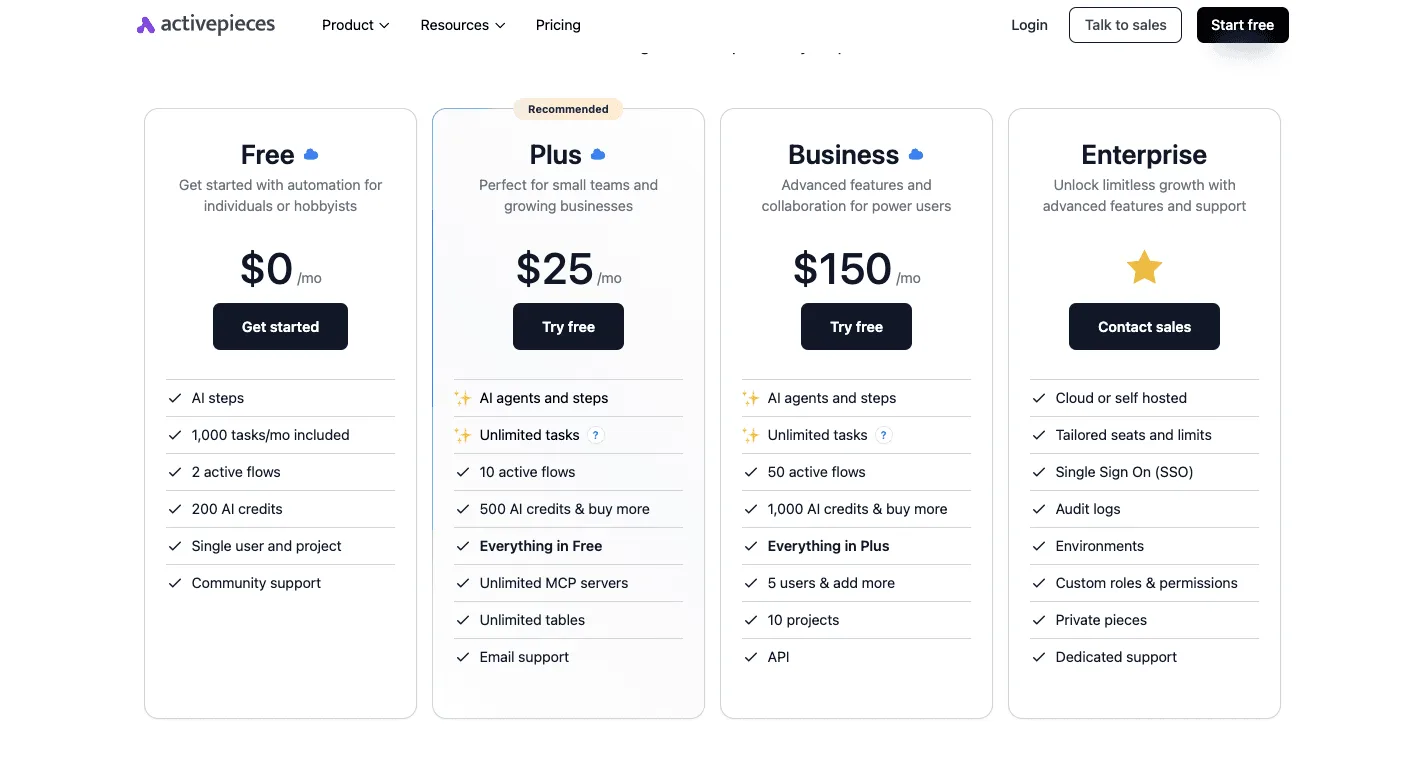
Pacing that batch job means a retry with a wait in it, and Activepieces meters the run rather than the steps inside it: 1 credit per flow run, so the ten-step flow with the retry costs the same as the two-step workaround without it.
Zapier's pricing page counts per task, which bills you again for every step you add and so taxes the habit of splitting work into smaller, more reliable integrations.
The free plan includes 1,000 credits a month, and MoneyGram, Moneypenny, Alan and FundingSocieties run it in production. None of this changes Hume's bill, which still arrives in characters.
### Languages, voices and latency
Past 5,000 characters, a single utterance has to be split before sending, so budget for that code. The 30-minute inactivity timeout closes an idle session, which means a kiosk or support widget has to reconnect without the user noticing.
I have no confirmed language, voice-count or latency limits to quote, so check those on the plan page before committing.
### Costs outside Hume's invoice
One slice of a voice-agent minute is Hume's charge. The [HireFinn calculator](https://www.hirefinn.ai/tools/voice-ai-cost-calculator) puts text to speech at 25.8% of cost per minute and speech to text at 20%, which means text-to-speech is the costlier component.

Prompt tokens to the language model take 16.7%, and generated tokens only 2.1%, so most of your costs come from what you send, not what you get back.
Those four add up to 64.6%, so more than a third of the minute goes to other line items.
Prompt tokens to the language model take 16.7%, and generated tokens only 2.1%, so most of your costs come from what you send, not what you get back.
Hume's EVI (its conversational voice product) runs on a language model that's not priced in the figures here, and telephony is unpriced too. Until you have quotes for both, any per-minute total you give your client is an estimate that can only go up.
## Hume AI against ElevenLabs, OpenAI Realtime and Cartesia
Hume is cheaper than these three only after you convert every vendor into the same unit, and until then no ranking is honest, because each one counts something different. The table shows what each vendor bills for, so you know what to convert before comparing.
| Vendor | Unit billed | What 10,000 of that unit means for you |
|---|---|---|
| Hume | Voice-conversation minutes, text-to-speech characters, or expression-analysis inputs, depending on product | Three separate meters, so price the one product you are building on |
| ElevenLabs | Characters of generated speech, drawn from a monthly allowance | A script's length sets the bill, not how long it plays |
| OpenAI Realtime | Audio tokens in and out | You must estimate tokens per minute of talk before you have a per-minute figure |
| Cartesia | Characters of generated speech | Comparable to ElevenLabs, but check how each counts a character |
I'm not printing entry prices, free tiers, concurrency caps, language counts or check dates here. I haven't confirmed them against each vendor's own page, and a price that was true last quarter is the kind of number that wrecks a quote.
Here's what follows from the units. A voice agent that talks for ten minutes uses ten minutes on Hume's conversation meter and a few thousand characters on a character-metered vendor. On OpenAI it uses a token count that you can't know until you test.
Then check the caps. The plan that looks cheapest on price can be the first one you outgrow if you hit its concurrency limit before its usage limit.
## Calling the Hume API from a workflow
When you call Hume's text-to-speech from a workflow tool such as Zapier or n8n, an ordinary HTTP step does the job, and that's where you'll find out which cap you actually hit.
One request and one reply is exactly what an HTTP step does, and that is all text-to-speech needs. Set it up in this order:
1. Store your API key as a secret in the workflow tool, not in the step itself. A key pasted into a step is visible to anyone who can open the workflow, and a leaked key spends your plan's allowance for someone else.
2. Add the key header Hume's documentation specifies to the HTTP step, filled from that secret.
3. POST your text-to-speech request, with the text and the voice you want in the body.
4. Retry on a 429 response, which means "too many requests," and wait longer between each attempt. Without that, a busy hour turns into silently dropped audio.
5. Log how many characters each run sent.
Because an HTTP step sends one message and takes one reply, it can't hold an EVI conversation, which runs over a WebSocket, a connection that stays open while audio flows both ways.
Put the EVI connection in a small script or service, and let the workflow start it or receive its results.
## Measuring usage before choosing your plan
Spend one week measuring each product in its own unit, then choose the plan from what you measured.
1. Reopen the pricing page and write down the date. Plans and rates change. Without a dated note, you can't tell later whether your bill moved because you used more or because the price did.
2. Run a one-week pilot on the free tier. Record voice-conversation minutes, text-to-speech characters and expression-analysis inputs separately. One week of real traffic shows you which meter runs fastest, and that meter decides your plan.
3. Check the limits for the product you actually use. Look at concurrency, voices, languages and commercial-use terms, not only the quota.
4. Set a usage alert before you launch. Point it at the meter that ran fastest in the pilot.
5. Compare subscription and pay-as-you-go at your break-even point. That's the monthly usage where the flat plan costs the same as paying per unit. Below it, pay-as-you-go is cheaper. Above it, the subscription is. Use your pilot numbers, scaled to a month, to see which side you are on.
## What Activepieces does about this
Hume's three meters leave you needing a record of which one you are running up, and the pilot week is where Activepieces helps.
Build the text-to-speech call as a flow with an HTTP step, a retry on 429 and a final step that writes characters sent to a sheet or database.
At 1 credit per run, the free plan's 1,000 credits a month covers that pilot without adding a second meter to your bill.
The core is open source under the MIT licence, so you can self-host the flow and see what each run does. MoneyGram, Moneypenny, Alan and FundingSocieties run it in production.
EVI still needs your own WebSocket service. The flow can start that service and collect its results.
## Frequently asked questions
### Free use and unused minutes
Wherever your calls come from, these are the billing questions to settle before you commit, because a wrong guess shows up on the invoice rather than in testing.
Is Hume AI free to use? You can try it without paying, but a free allowance is for testing, not for running a product.
Treat it as a way to measure how many minutes, characters or inputs your build really uses. Then check what the allowance covers on your account today, since the limits can change.
Does Hume AI charge for unused minutes at month end? Assume yes, and assume unused allowance doesn't roll over unless your plan terms say so. If you pay for a bundle and use half, you have paid for the other half.
Read the plan terms for a rollover clause before sizing up, and size to your typical month, not your best one.
### Commercial use and the language model
Can I use Hume AI output in a commercial product? That depends on your plan's terms, not on the technology. Read the terms for your tier before launch.
If your product is customer-facing and the wording is unclear, ask Hume in writing.
Does the Hume AI price include the language model? Don't assume it does. A voice conversation involves a language model that writes the replies, and that model may be billed separately from the voice minutes, depending on which one you choose.
Look for it as its own line on the invoice, and add it to your estimate before you compare plans.
### Runaway sessions
How do I stop a runaway voice session from costing money? Put the limits in your own code, because a session left open keeps metering. The usual controls:
- A maximum session length that ends the call on its own.
- A hang-up after a stretch of silence.
- A spending limit or usage alert in your account, if your plan offers one.
- A cap on how many sessions your workflow can start at once.
## Related reading
- [Claude Sonnet 5.5 API Pricing for Developers (2026)](https://www.activepieces.com/blog/claude-sonnet-55-api-pricing-for-developers-2026)
- [Best Tools for Citizen Developers in 2026](https://www.activepieces.com/blog/tools-for-citizen-developers-in-2024)
- [Google Docs API Rate Limits for Developers (2026)](https://www.activepieces.com/blog/google-docs-api-rate-limits-for-developers-2026)
## References
- [HireFinn](https://www.hirefinn.ai/tools/voice-ai-cost-calculator)
- [Pass Index](https://pass.io/index/hume-ai/evi-3)
- [AI Central Resources](https://www.aicentralresources.com/compare/hume-ai-vs-inworld-ai)