# Is Activepieces Free? Automation Plans and Limits
By Lin Rodriguez · 2026-10-23 · Source: https://www.activepieces.com/blog/is-activepieces-free-automation-plans-and-limits
---
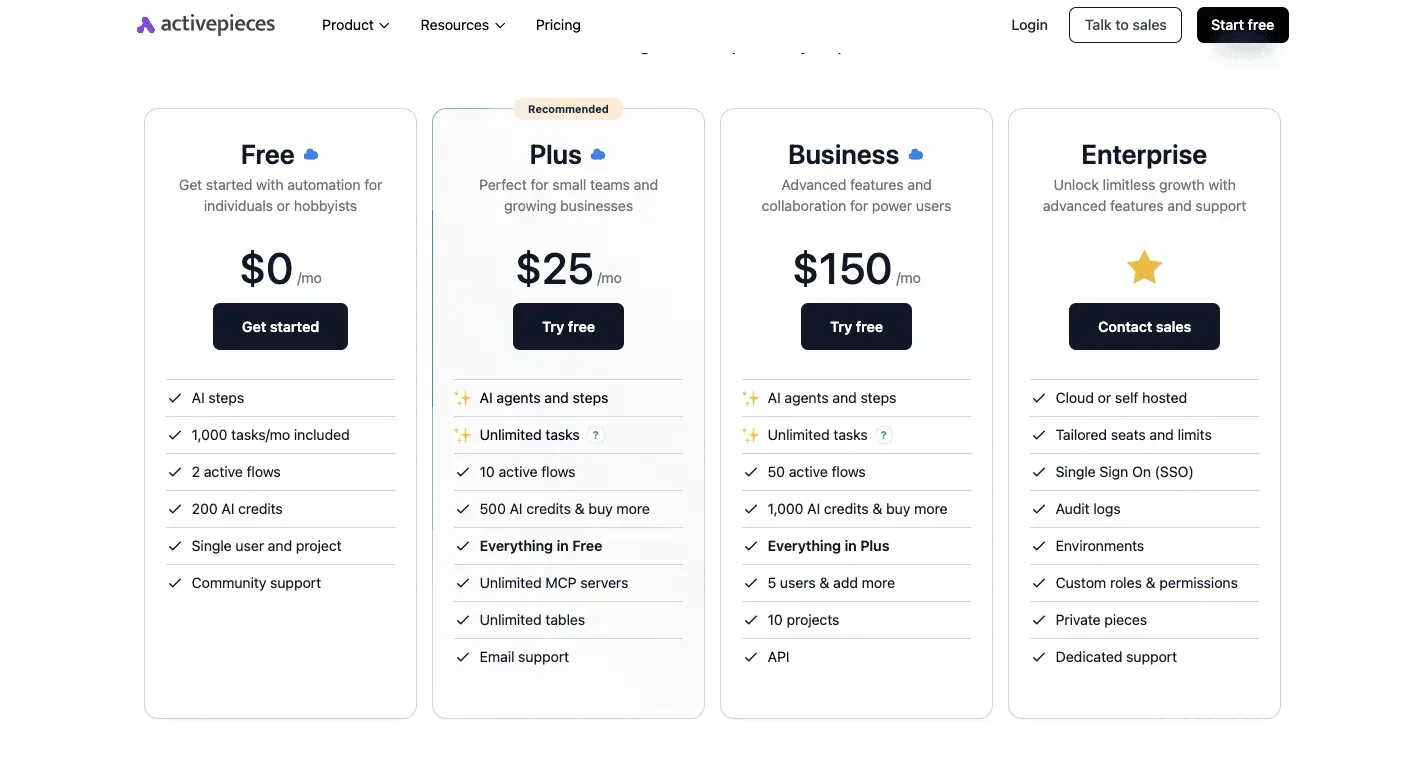
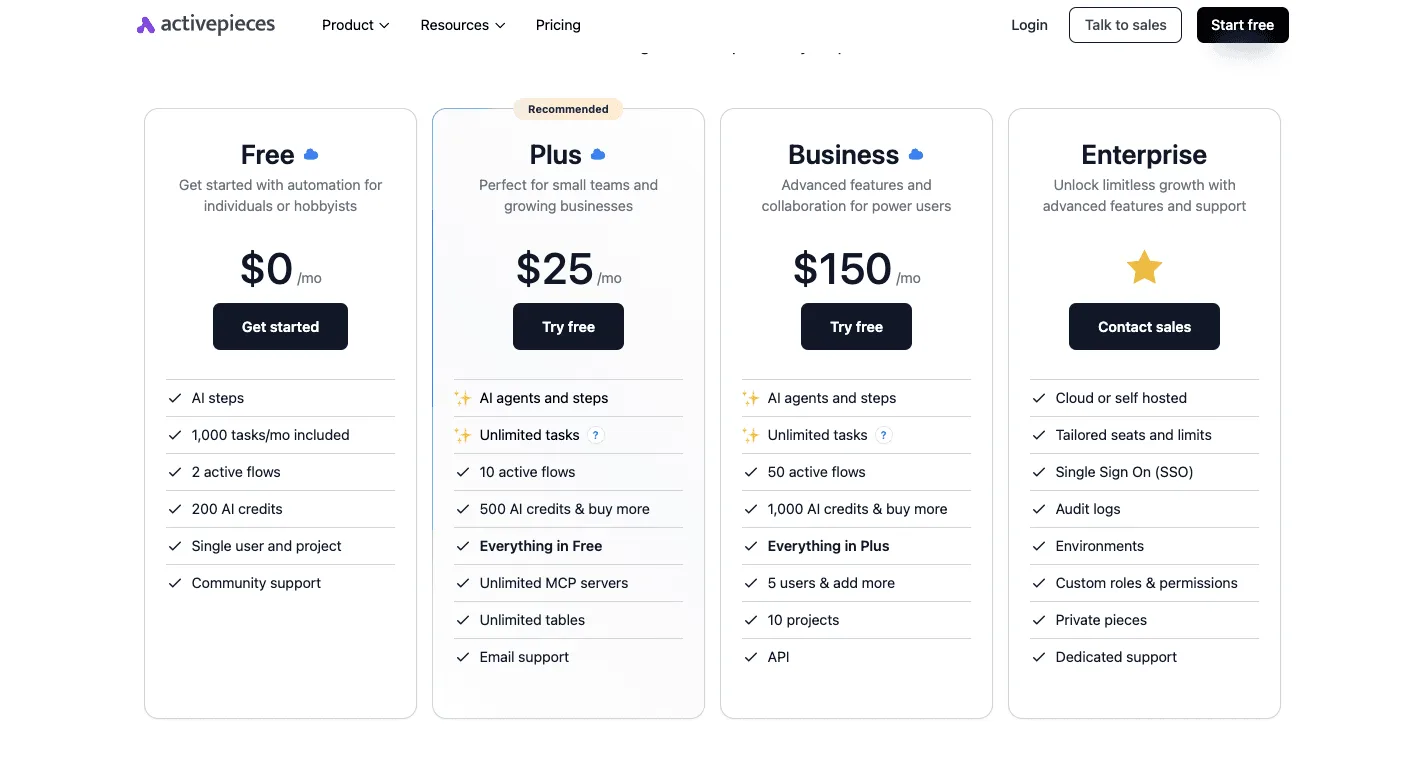
According to [Activepieces](https://www.activepieces.com/pricing) [Community](https://community.activepieces.com/t/concern-question-about-ai-credit-consumption/12370), Activepieces costs $0 on the hosted Free plan, which gives you 1,000 credits a month, and the first paid step is $20 a month. Past that, the real question is which kind of free you're looking at.
Activepieces is an open source, MIT-licensed AI automation platform with 744 integrations, and you connect apps and AI steps into automations that run on triggers.
Free is $0 with 1,000 credits a month, per Community, enough to prove one or two workflows work, not to run a team on them, so you're upgrading to a paid tier the moment you need team capacity.
Per Activepieces, Plus is $20 a month with 10,000 credits, which suits one person whose volume has outgrown Free.
According to [5minsystems](https://www.5minsystems.com/guides/activepieces-pricing-for-small-business-2026), Team is $200 a month with 50,000 credits, 25 users and SSO, so it's the first plan that covers a shared workspace with single sign-on.
Credits beyond your plan cost $0.007 each, so overage is a predictable line item, not a forced jump to the next tier.
### Free plan versus Community Edition
Both are free, but they solve different problems. Credits cap the hosted Free plan at 1,000 a month, and Activepieces runs it for you.
The Community Edition is the MIT-licensed core, so the software costs nothing, but you run it and your own servers set the ceiling.
| | Hosted Free plan | Self-hosted Community Edition |
|---|---|---|
| Price | $0 | No licence fee; you pay for your servers |
| What limits you | 1,000 credits a month | Your own servers |
| Who runs it | Activepieces | You |
| SSO included | No | No |
Neither row includes SSO, so a team that needs it moves to Team or talks to sales. Community Edition is enough for a technical owner who wants control and will handle upgrades and uptime. It's not enough once you need SSO or vendor support.
Plans and figures here date from October 2026. Self-serve plans are on the [pricing page](https://www.activepieces.com/pricing).
## What each Activepieces plan includes for a team rollout
If you want a price you can read on that page, only three rows below show one.
So anyone requiring single sign-on has one option on that page.
Sales quotes the other three.
Look at where the paid line falls in the table: SSO and a user cap first appear at Team, and everything past Team is a conversation, not a checkout.
| Plan | Price per month | Monthly credits | Users | SSO | Deployment | Support |
|---|---|---|---|---|---|---|
| Free | $0 | 1,000 | See pricing page | No | Cloud | Community forum |
| Plus | $20 | 10,000 | See pricing page | No | Cloud | See pricing page |
| Team | $200 | 50,000 | 25 | Yes | Cloud | See pricing page |
| Ultimate | Quote | Quote | Quote | Quote | Quote | Quote |
| Self-hosted enterprise | Quote | Quote | Quote | Quote | Your infrastructure | Quote |
| Embed | From $36k a year | Quote | Quote | Quote | Quote | Quote |
At $36k a year, Embed works out to $3,000 a month, so it only makes sense if you're putting automation inside a product you sell.
### How credits are counted and what overage costs
Every time an AI step runs, it spends credits, and the model tier decides the rate. On the Free plan's 1,000 credits, a Fast model gets [500 AI steps a month, a Smart model 100, and a Frontier model 50](https://community.activepieces.com/t/concern-question-about-ai-credit-consumption/12370).


That means one Frontier-model step costs as much as ten Fast ones. A workflow that calls a top model on every record can drain the free allowance in an afternoon.
Everything outside the AI steps is metered by the run: a flow run is 1 credit whether it has two steps or ten, so complexity never multiplies your per-run costs.
Beyond the included credits, usage costs $0.007 a credit. At that rate, a Frontier step past your limit costs about $0.14, and a Fast step about $0.014. Overage is cheap for light spillover and expensive if a Frontier step runs thousands of times.

### What drives a sales quote
When you ask what Ultimate, self-hosted enterprise and Embed cost, the answer is that none has a public price. Four things set the number: how many users you need, how many credits you expect to burn, where it deploys, and what support you require.
Start with the [pricing page](https://www.activepieces.com/pricing) for the three self-serve plans. For self-hosted enterprise, SSO beyond Team, Ultimate or Embed, use the [sales form](https://www.activepieces.com/sales).
## Open source license and permissions
### What the free licence covers
You can self-host, read and modify the Community Edition for free, but the enterprise features sit under a separate commercial licence, and that licence is what sales quotes.
In practice you can run the core on your own server, fork it and change it without paying anyone. You still pay for the server, the database, the upgrades and whoever gets paged when it breaks. For a bootstrapped team that's often the real cost.
### What it leaves out
What the free licence doesn't give you is the enterprise layer. SSO beyond what the Team plan offers, the managed controls larger organisations ask for, and vendor support all belong to the commercial side.
If your security review needs those, the Community Edition is not a cheaper route to them.
## Usage-based pricing and the options around it
Every automation platform has to charge for the same scarce thing, which is work done on your behalf, but they disagree on what counts as one unit of work.
The unit matters more than the headline price, because it decides whether adding a step or an AI call makes your bill grow.
### Why free comes in two kinds
Vendors give software away in two different ways, and they fund each differently. A hosted free tier is a marketing cost: the vendor pays for your usage, so it sets the meter low enough to stay cheap.
An open source release hands you the code instead, and the vendor earns elsewhere, usually from people who want it operated or certified for them.
That second pattern is called open core: a free engine plus a commercial layer for what larger organisations buy, such as single sign-on, audit logs, role controls and support contracts.
A solo builder rarely needs those and a security reviewer always asks for them, which is why the line lands in much the same place across the industry.
### Metering by task, run or credit
Task-based billing, which Zapier uses, charges for each action, so a ten-step process costs more than a two-step one. Execution-based tools such as n8n count a whole workflow run once, which is close to the flow-run credit described above.
Make sits between the two, counting operations module by module.
Credit systems add AI on top by pricing model calls separately from ordinary steps. Whichever tools you compare, convert the price into your own monthly runs, steps and AI calls before trusting it.
Seat-based pricing is the other common shape, charging for people rather than work. A small team running heavy automation usually prefers seats, while a large team with light use prefers a meter.
### What a team needs beyond the meter
Whatever the pricing unit, a team's requirements split into capacity and governance. Capacity is how many runs, steps and AI calls you need each month.
Governance is who can log in, how identity is managed, who can see stored credentials, and who answers when a flow fails.
Most vendors price the two separately. Capacity grows along the meter, while governance arrives in steps: shared logins first, then single sign-on, audit logs and role controls, then a support contract.
That is why the paid line tends to fall at users, SSO and support rather than at anything the automation itself can do.
A quick test works on any tool. Ask whether five colleagues can sign in under company identity, whether you can see who changed a flow, and who you call when it breaks.
If the honest answers are no, no and nobody, a free tier or a free open source release is fine for a pilot, and neither is a team setup.
### Self-hosting trades the meter for operations work
The other way out of a meter is to run the engine yourself. n8n publishes its source under a fair-code licence that restricts some commercial uses, Windmill and Node-RED can be self-hosted, and the Activepieces core is MIT.
In every case the work moves from a vendor to you, and that means queues, databases, secrets and upgrades.
## Free is all teams need
If you never want to pay, the best argument is that self-hosting carries no credit meter.
A small server at $4.50 to $24 a month could run a whole team's automation, with the Free plan as a fallback, meaning your infrastructure budget needn't scale with your team.
### The case for never paying
For a small server (2 vCPU, 4 GB), you pay [$4.50 on Hetzner and $24 on DigitalOcean](https://ossalt.com/guides/total-cost-self-hosting-servers-time-maintenance), two hosting providers at opposite ends of the price range, which means your provider selection matters more to cost than your specs do.
| Server size | Hetzner | DigitalOcean |
|---|---|---|
| Small, 2 vCPU / 4 GB | $4.50 | $24 |
| Medium, 4 vCPU / 8 GB | $7 | $48 |
| Large, 6 vCPU / 16 GB | $14 | $96 |

Even the large server at $96 a month on DigitalOcean costs less than the $200 Team plan, and at $14 on Hetzner it costs about a fifteenth of it, making self-hosting cheaper than any commercial subscription tier.
### Where the case breaks
Look at what the table prices: the machine, not the person who keeps it running. Someone has to apply patches, watch disk and memory, test upgrades before they break a live flow, and answer when the server is down at 2 a.m.
An hour or two of that a month, billed at a founder's or engineer's real rate, can cost more than the $7 medium server did; your maintenance time exceeds your hardware cost.
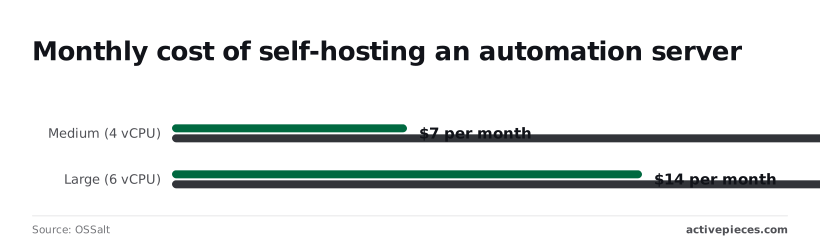
The cheap line on the table is where the cost starts, not where it ends.
Even with a perfect server, two gaps remain. **The free Community Edition has no SSO, so a team that needs single sign-on for security review has to pay or go without.**
If you stay on the hosted Free plan instead, its 1,000 monthly credits disappear fast once a few workflows run on a schedule.
Free is enough for one technical owner running a few internal flows. It stops being enough when more people, uptime promises or SSO enter the picture.
## Mistakes people make when budgeting for Activepieces
Once a team outgrows the free options, six budgeting errors come up, and each one comes down to a published figure.
- Open source doesn't mean every feature is included, because paid capabilities sit outside the free Community Edition.
- The 1,000 free credits a month run out faster than the number suggests.
- SSO needs the Team plan at $200 a month or higher.
- **Embed starts at $36k a year**, so it's not a team plan.
- Self-hosting moves server, backup and upgrade costs onto your own bill.
- **SOC 2 is in progress, not certified**.
### Underestimating credit use
Per [Activepieces Community](https://community.activepieces.com/t/concern-question-about-ai-credit-consumption/12370), AI steps are metered by model tier. A Fast step costs 2 credits, so the 1,000 free credits cover 500 of them.
A Smart step costs 10, which leaves 100 steps. A Frontier step costs 20, which leaves just 50 before the cap.
Beyond your plan, credits cost $0.007 each. A Frontier step runs about $0.14 and a Smart step about $0.07.
### Picking the wrong tier for SSO or embedding
For $200 a month, Team gives you 25 users, 50,000 credits and SSO, so you're limited to 25 people before you must upgrade.
Embed is a different product: it lets you build automation into your own software for customers, and it starts at $36k a year, so you can't evaluate it without committing serious budget.
The SOC 2 programme is in progress, which is not a certificate. If your security review requires the report today, do not put it in the budget as done.
## Choosing between Free, Team, self-hosting and sales
Use Free or the Community Edition to evaluate and run small automations, Plus when you need more credits, Team when you need 25 users and SSO. Go to sales for self-hosted enterprise, SSO beyond Team, Ultimate or Embed.
### Match the plan to credits and deployment
If you host the software yourself and need paid support, SSO beyond Team, or a licence that covers a larger organization, the price stops being a list price.
When one technical person owns the automations and nobody needs audit-grade access control, the free Community Edition is enough. Once you must answer to a security reviewer, you are paying for the maintenance and the controls, not the software.
On Monday, work through these in order:
Once you must answer to a security reviewer, you are paying for the maintenance and the controls, not the software.
1. List your top workflows, the five or ten that would break something if they stopped.
2. Estimate the runs per month for each, and the steps in each run.
3. Add the AI steps, because they consume credits on top of ordinary steps, so a workflow that looks cheap can dominate your total.
4. Compare your total with 1,000, 10,000 and 50,000. Under 1,000 you can stay on Free. Between that and 10,000 you are a Plus buyer. Up to 50,000 you are looking at Team. Above it, you are paying per-credit overage or negotiating.
5. If you land on a self-serve tier, go to the [pricing page](https://www.activepieces.com/pricing). If you need self-hosted enterprise, SSO beyond Team, Ultimate or Embed, fill in the [sales form](https://www.activepieces.com/sales) and bring your step 4 total with you.
## Frequently asked questions
### Cost and licensing
Is the Activepieces Community Edition free forever? The Community Edition is the MIT-licensed core, so the code you download is yours to run for as long as you want.
Can I use Activepieces commercially without paying? Generally yes, within limits. The Community Edition core is MIT-licensed, and the Free plan is capped at 1,000 credits a month and 5 users rather than reserved for hobbyists.
Read the licence file for the version you deploy, and ask sales if you resell or embed the product.
### Sign-up, credits and compliance
Does the Free plan require a credit card? Free is a $0 plan, but I can't confirm the sign-up flow from here, so check it before you assume either way.
What happens when I run out of credits? You hit the cap that defines the plan, and the fix is an upgrade. Paid plans bill extra credits individually, so a busy month costs more instead of stopping your flows.
Is Activepieces SOC 2 certified? No. The SOC 2 programme is in progress, and it isn't a certification you can cite yet. If a security questionnaire requires it today, say so up front and ask sales what documentation they can provide in the meantime.
## Related reading
- [Monday.com Pricing 2026: Plans, Costs & Automation Limits](https://www.activepieces.com/blog/monday-com-pricing-2026-plans-costs-automation-limits)
- [Spotify Web API Free? Access Modes, Scopes, Limits](https://www.activepieces.com/blog/spotify-web-api-free-access-modes-scopes-limits)
- [Cursor AI Pricing 2026: Free Plan Limits and Features](https://www.activepieces.com/blog/cursor-ai-pricing-2026-free-plan-limits-and-features)
## References
- [Activepieces Community](https://community.activepieces.com/t/concern-question-about-ai-credit-consumption/12370)
- [OSSalt](https://ossalt.com/guides/total-cost-self-hosting-servers-time-maintenance)