Any older comparison that quotes the old hosted Cloud's plan limits describes a product you can't buy, and you should discard it. You can't model the IBM route in advance, because it publishes no price, billing unit or limits. Expect to get a number only by talking to sales. Ask for the billing unit in writing first (per seat, per run or per deployment), because that one answer decides whether your volume makes the quote cheap or ruinous. ## What Langflow costs at three realistic usage levels If you self-host Langflow, **your floor is $24 to $32.75 a month** for a 2 vCPU, 4 GB server, and model calls decide everything above it. A [DigitalOcean Droplet](https://deploys.run/) costs $24, so a prototype's fixed cost is roughly a lunch. At $25.15, DigitalOcean's App Platform costs $1.15 more and buys managed deploys, so deployment becomes a vendor responsibility. Railway is $32.75, $8.75 above the Droplet, which only pays off if you value its tooling.  Replace my per-run model costs with your own token counts, because they are assumptions, not measurements. The table prices three volumes on those hosts. | Scenario | Langflow | VM cost | LLM spend (per run × runs) | Monthly total | Assumptions | |---|---|---|---|---|---| | Solo prototype | $0 | $24 | $0.01 × 300 = $3 | $27 | Short single-model flow | | Team agent | $0 | $25.15 | $0.02 × 3,000 = $60 | $85.15 | Retrieval plus tool calls | | Production agent | $0 | $32.75 | $0.02 × 30,000 = $600 | $632.75 | Same flow; one host holds up | At $27 a month, **the server is 89% of the bill**. Optimizing prompts here saves pennies, so spend your effort on shipping. 70% of the $85.15 total is model spend. Host choice now barely matters, because the $8.75 gap between Droplet and Railway is smaller than the model cost of 450 runs. ### Production agent at high volume Multiply the runs by ten and the model line goes up tenfold, to $600, while the server rises by a few dollars. The host is about 5% of the bill, so a cheaper model per run saves far more than a cheaper server. ## Hidden costs and limits Langflow users run into Beyond the plan price, a Langflow deployment adds five cost lines, and the model bill is the one that can move the $600 above by a factor of a hundred, which means model costs will likely dominate your budget. The list below separates what the documentation states from what you have to price yourself: - A separate LLM bill from your model provider - A separate vector database bill - Hosting and ops time, where the docs give 2 vCPU/2 GB as the minimum and 4 vCPU/8 GB as the recommended size - Access control, which you own once you self-host - Upgrades, which cost your time on every release 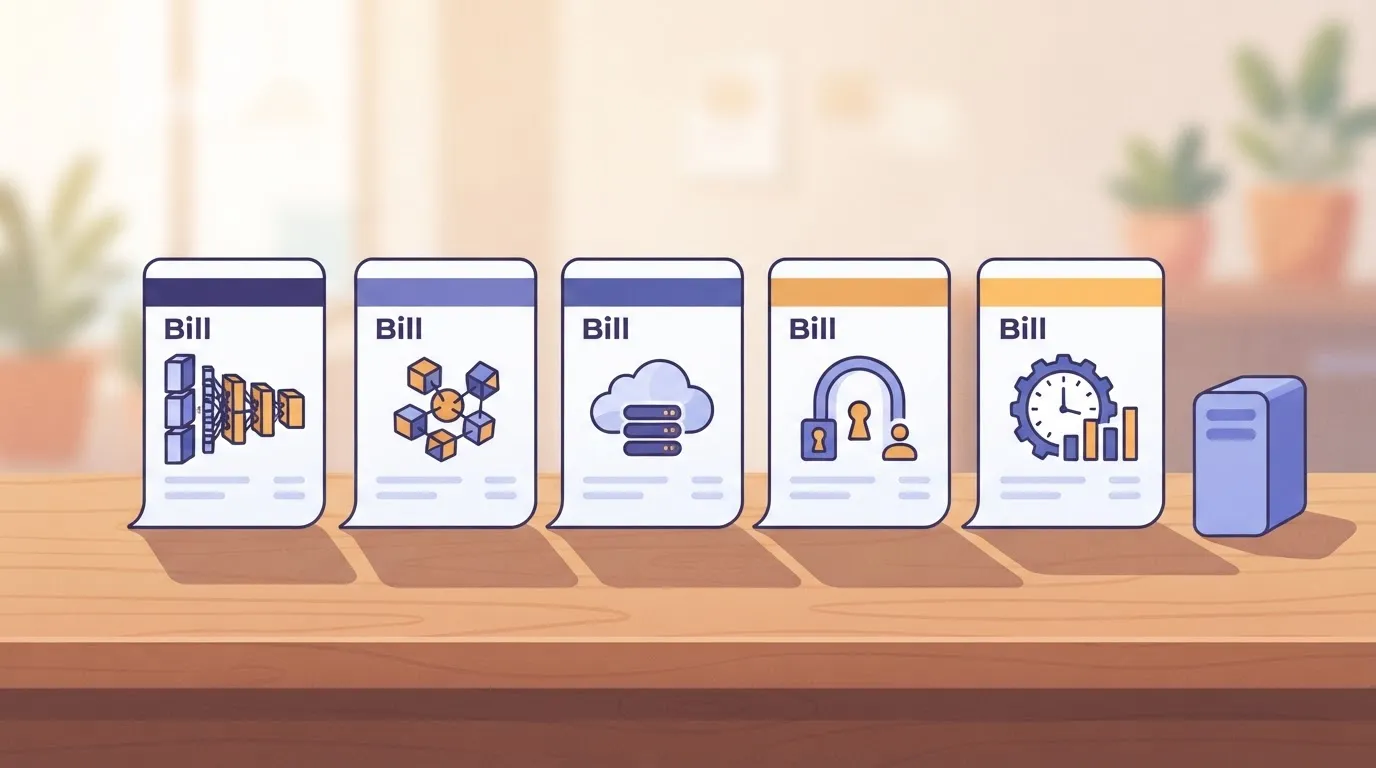 Of the five lines, just the host sizing is a documented figure. The rest are costs by construction, not quoted prices, and I cite no user reports for them. Output tokens cost five times input everywhere. On [TokenCalculator](https://tokencalculator.net/pricing/): - Haiku 5.5 and GPT-6 Luna run $0.1–0.5 per million tokens, so a chatty flow stays cheap - Sonnet 5.5 and GPT-6.1 Sol run $2–10, twenty times that - Opus 5.5 runs $4–20 - Fable 5.1 runs $10–50, a hundredfold gap from Luna More than the plan tier, **model choice decides the bill**. The vector store is billed separately and grows with the vectors you keep. Budget for the recommended 4 vCPU/8 GB, which quadruples memory; the 2 vCPU/2 GB minimum fits a small virtual machine, so production realistically requires the higher tier. Upgrades are hours of regression-testing flows, and I would pin a version until you have done that. viz type=groupedbars title="What input and output tokens cost on current models" unit="$ per million tokens" source="TokenCalculator - https://tokencalculator.net/pricing/" cols="Input,Output"0 out up to Check whether a human-approval pause is built in or something you assemble. If you assemble it, that's build time. Do the same for each app your agent must act in, and count a missing connector as a cost. ## Langflow against Flowise, Dify, n8n and Activepieces When the hard part is the model pipeline itself, Langflow wins. The other four win when the agent must act across many business apps and pause for a human first. That connector gap is a line item, as the last section showed. The table below sets all five on the four things that decide a business agent. Cells are my reading of each vendor's public pages and docs, so confirm the row you plan to buy against the check date. | Platform | Apps the agent acts in | Human approval | Self-hosting and licence | Pricing scaling with runs | Check date | |---|---|---|---|---|---| | Langflow | Model, vector store and tool components; business apps often need custom components or MCP | Designed into the flow; no dedicated approval step I could point to | Self-host, open source | Software free; hosting and model calls scale with runs | 2026-10-17 | | Flowise | Tool and integration nodes in agent flows | Human-in-the-loop option in agent flows | Self-host, open source | Hosted plans by usage; self-hosted cost is infrastructure plus model calls | 2026-10-17 | | Dify | Built-in tools and plugins | Review steps in workflows; check your version | Self-host, source-available under a modified Apache licence with conditions | Hosted tiers by usage; self-hosted cost is infrastructure plus model calls | 2026-10-17 | | n8n | Large library of app nodes plus an AI agent node | Wait and send-and-wait steps | Self-host under a fair-code licence, not an OSI open source one | Hosted plans count workflow executions | 2026-10-17 | | Activepieces | Pieces library; the AI agent step works across those integrations | Wait-for-approval step in flows | Self-host, MIT community edition; some enterprise features licensed separately | Hosted plans count runs; self-hosted cost is infrastructure plus model calls | 2026-10-17 | Pick Langflow if your team iterates on retrieval, prompts and model choice, because its visual flows expose those integrations. Self-hosting keeps the software line at zero, so your bill is hosting plus tokens, which you can meter per run yourself. The cost is that every missing app action becomes custom work. ### When another agent platform beats Langflow If the agent writes to a CRM, a ticketing tool or a spreadsheet, the platforms built on integration libraries save you that custom work. Activepieces applies this directly: its AI agent step reuses the same [pieces](https://www.activepieces.com/pieces) as ordinary flows, all 741 of them sitting in the packages/integrations/community folder of its GitHub repository, whose core is MIT-licensed, and a wait-for-approval step can sit before the risky action. Activepieces' pricing page lists 1 credit per flow run however many steps the flow holds, so a ten-step flow costs what its two-step workaround did, while Zapier's pricing page meters per task and Make's per module. 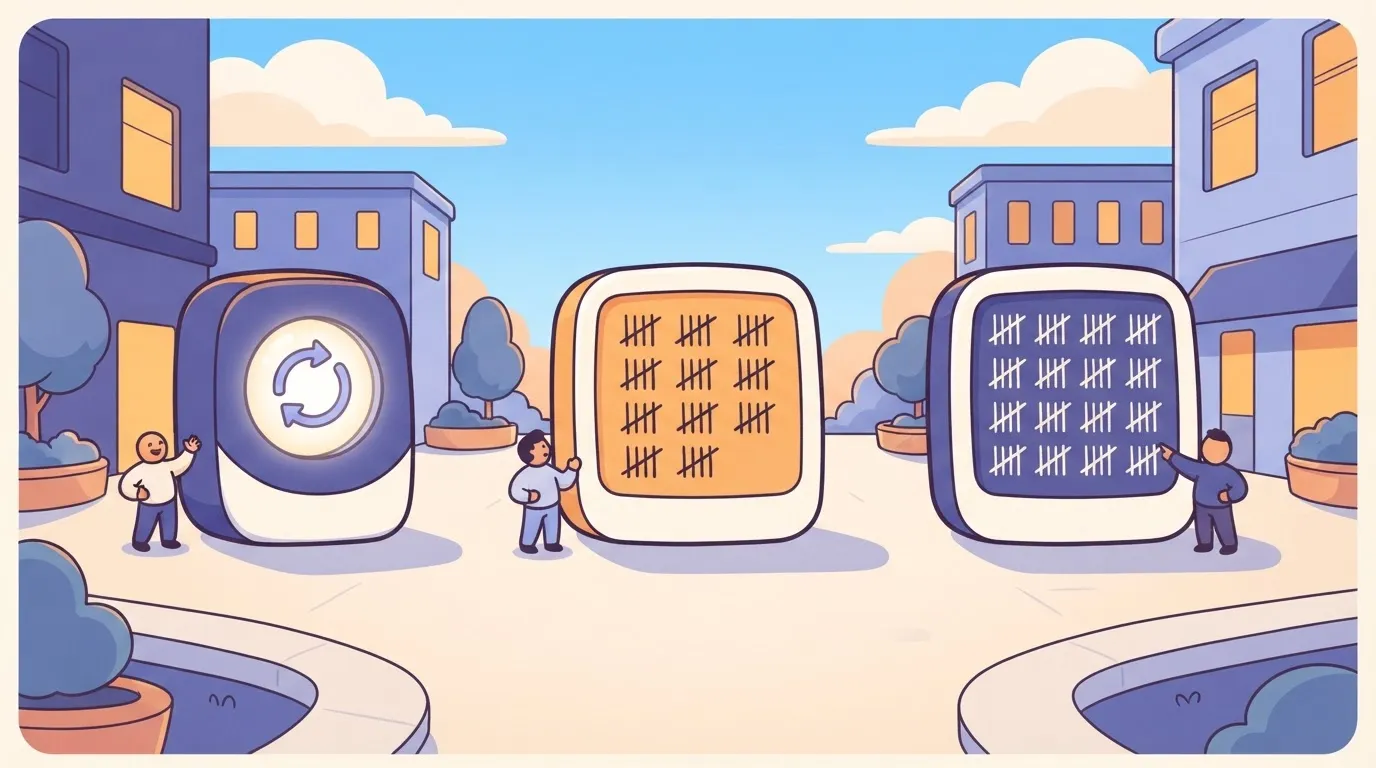 The run is the meter, which means splitting work into smaller, safer steps never raises the bill. You can try it free at https://cloud.activepieces.com/sign-up. Choose n8n if you accept its licence terms, and Flowise or Dify if chat-style apps are the product. ## Activepieces for agents that act across business apps Choose Activepieces, an open source automation platform, if the agent's job is to act inside business apps rather than hold a conversation. Its AI agent step works across the same 741 [integrations](https://www.activepieces.com/pieces) as every other step, and it has human approval and self-hosting under an MIT-licensed core. The workflow below shows what that looks like. A new lead arrives from HubSpot, a customer-relationship tool, and an AI agent step qualifies it. A condition then routes qualified leads into Salesforce and a Slack notification, while the rest enter a nurture loop that ends in a Gmail message. 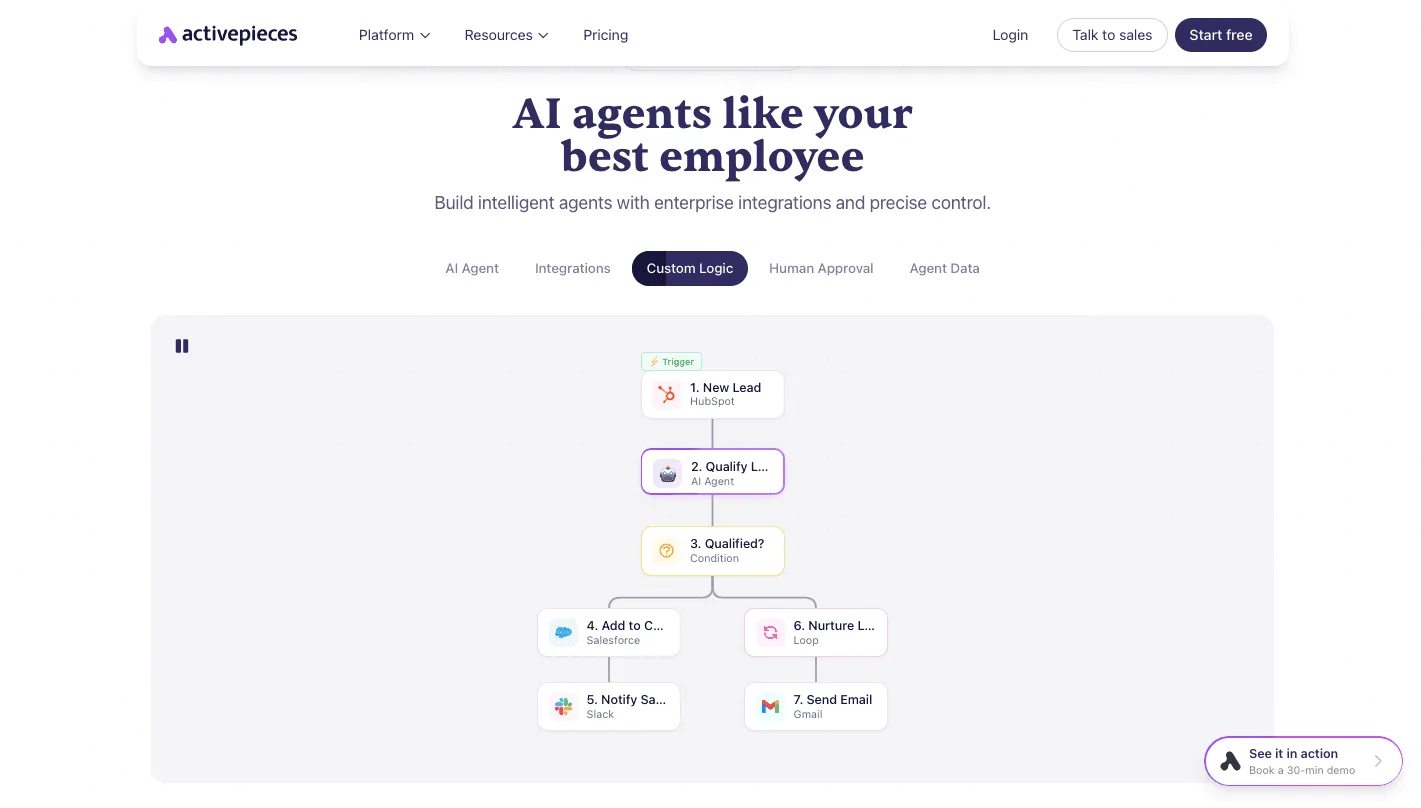 Just one of the seven steps is a model call, making the build primarily integration and orchestration work. The model bill therefore tracks lead volume, while the other six are ordinary integration steps. That makes the cost per run easy to estimate before you commit. ### Approval, self-hosting and pricing Two features matter for business use. A human approval step lets you pause before the agent writes to a CRM or sends an email, so a bad qualification costs you a review rather than a wrong record. If you self-host, your lead data and credentials stay on infrastructure you control, but you then pay for the servers and the upkeep yourself, which is the cost the sticker price hides. On pricing, Activepieces publishes its plans, with Plus at $20 a month and Team at $200, and only Ultimate going through sales, so you can price a run without a sales call. Do that against your own run volume, and count model calls separately from platform charges. When the agent's reasoning is the product, Langflow is the better tool. Its visual builder suits retrieval pipelines, custom Python components and step-by-step inspection of prompt chains. Activepieces earns its place when the hard part is getting the agent to act in the right apps, and with 741 integrations, roughly 60% of them community-contributed, that is the part it has already covered, with a person able to stop the agent. You can try it free, with 1,000 credits a month, unlimited flows and up to 5 users, at https://cloud.activepieces.com/sign-up, which means small teams can explore all capabilities. ## A first-week plan for choosing a Langflow plan Spend the first week pricing Langflow against your own run volume before you commit to any plan. The five steps below take you from a guess to a number you can defend, so you can justify the spend to leadership. 1. Estimate monthly runs and the model calls inside each run. 2. Run a prototype self-hosted, at no software cost. 3. Price one real workflow using low, expected and high run scenarios. 4. Recheck the pricing page before you buy. 5. Set a spend alert on your model API account. Until it is multiplied by your volume, a plan's sticker price says nothing, so steps one and three decide the outcome. Prototype here first, because self-hosting costs nothing in licence fees. It's not free to operate, though. You still pay for the server, for whoever patches it, and for every model call your flows make. Log those calls during the prototype so step three uses measured counts, not guesses. Choose a hosted tier and you trade your maintenance time for limits on usage, seats or features. Read what each tier caps and compare it with your expected scenario, then your high one. 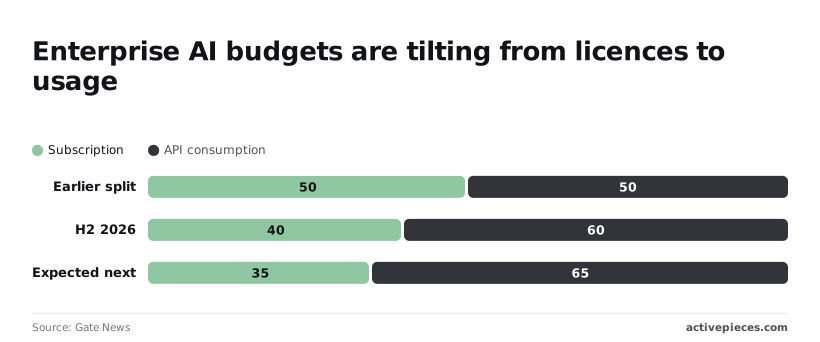 When the top tier says "contact sales," you can't price it yourself, and that's a cost in itself. Bring your scenario table to the call so the quote answers your numbers, not theirs. **Whatever tier you land on, set the model API spend alert first: model usage bills separately from the platform and is the line most likely to grow unnoticed.** ## Frequently asked questions The answers below are the ones that most often move your total once you price a real workload, and each points to where you can verify it. Is Langflow free to use commercially? Generally yes: the core project is open source, and its license file in the Langflow GitHub repository is the authority on commercial terms. Read it before you build a product on it, because the license, not this article, binds you. Hosted plans and support contracts are separate purchases. Does Langflow charge per run or per flow? The open source software itself meters neither. Any per-run cost comes from what a run consumes: compute, storage, and model tokens. If a hosted offering bills differently, its pricing page is the source, and you should read it against your own run volume. ### Self-hosting, model calls and price changes Can I self-host Langflow without paying anything? You can run it without a software fee, but not without a bill. You still pay for the server, the database, backups, and the engineer's time to patch and monitor it. For the supported deployment paths, see the installation docs; the hardware you need depends on your flows, so size it from a trial run of your own. Does Langflow include the cost of OpenAI or Anthropic calls? No. Langflow connects to model providers using your own API keys, so OpenAI or Anthropic bills you directly for tokens. That line item usually outgrows hosting as runs climb, so choosing a cheaper model for simple steps is the most effective cost lever. Each provider's pricing page gives the current rates. How often does Langflow change its pricing? There's no published schedule, so don't assume stability. Check the vendor's current pricing page and release notes before committing, and re-check at each renewal. A cost model built on a quoted rate is only as good as the date you read it. ## Related reading - [Top 6 AI Agents for Finance Teams in 2026](https://www.activepieces.com/blog/ai-agents-for-finance) - [AI Agents for Legal Teams: What’s Possible Now](https://www.activepieces.com/blog/ai-agents-for-legal) - [AI Agents for Sales: What Teams Are Using Today](https://www.activepieces.com/blog/ai-agents-for-sales) ## References - [Deploys.run](https://deploys.run/) - [TokenCalculator](https://tokencalculator.net/pricing/) - [Gate News](https://www.gate.com/news/detail/enterprise-ai-spending-shifts-from-seat-licenses-to-api-consumption-40-to-23697657)Put a zero on the license line and the bill moves rather than disappears.