Before committing, read the list below for what the plan fee doesn't cover and where each claim comes from. The "not stated" entries are budget gaps you must close yourself. - Retry and debug credits: every failed or corrected prompt spends credits like a good one (source: not stated). - Cloud 20 and AI 4 monthly credits: the allowances for backend and AI features are small (source: not stated). - Top-up at $0.30: the price of running past your allowance (source: not stated). - Rollover and reset rules: whether unused credits survive the month (source: not stated). - External database or auth: any service you connect is billed by its own vendor (source: not stated). You must price each of these lines before you can quote a cost per working feature. When a prompt breaks the app and a second one repairs it, that is two prompts, not one. Count the repair when you compute credits per feature, or your estimate will run low on every build that needs a fix. ### Charges outside the plan fee When an app has a chatbot, the 4 AI credits drain fast, and you pay at the $0.30 top-up rate for the rest. Those 20 Cloud and 4 AI monthly credits cover backend and AI usage separately from build credits. Multiply your expected overrun by that rate before you call a plan cheap. Count security as a cost too. [Steelsuit](https://steelsuit.com/blog/lovable-security/) found that roughly one in ten **sampled Lovable apps leaked user data**. Budget a review pass before launch, because a leak costs far more than the credits spent building the app. 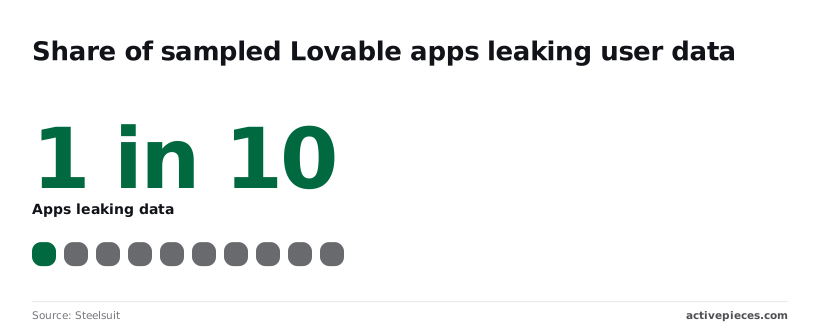 Before you add a collaborator, check seat counts, private project allowances and custom domain limits on the pricing page. None is stated in the figures I have, and a missing seat can force a plan upgrade. Neither are rollover and reset rules stated here. If unused credits expire at the reset, a slow month buys you nothing, so spend your credits on planned features. An external database or auth service adds its own vendor bill, also not stated, so price it separately. ## Lovable Against Bolt, v0 and Replit on Price Not cheapest on every line, but competitive with Bolt.new, Vercel v0 and Replit Agent: that is where Lovable sits, and the metering model separates them more than the monthly fee does. Like the database, each rival adds its own cost behind the headline, so compare them the same way. I print no dollar amounts because they move often and a stale one misleads, so confirm each against the vendor's page before budgeting. To compare the four on the five lines that decide the bill, read Table 1; the takeaway is that the columns differ in kind, not just in number. Checked against vendor pricing pages on 1 November 2026. | | Entry paid price | Metering model | Team seat cost | Free tier limit | At allowance end | |---|---|---|---|---|---| | Lovable | Flat monthly subscription | Credits per prompt action | Workspace plan, shared credit pool | Small credit grant | Prompting pauses until reset or top-up | | Bolt.new | Flat monthly subscription | Tokens consumed | Per seat | Daily and monthly token cap | Wait for reset or buy tokens | | Vercel v0 | Flat monthly subscription | Credits tied to usage | Per seat | Small monthly credit grant | Wait for reset or buy credits | | Replit Agent | Flat monthly subscription | Usage-based, scaled to effort | Per seat | Limited trial usage | Charges continue beyond included credits | All four charge a flat monthly fee at entry, so that line barely separates them. The free tiers do: each is a trial, not a working budget. A small grant that one vague prompt can burn means you learn the tool's habits, not your cost per feature. ### Lovable credit metering and overage versus rivals Of the four, Lovable's credits are the easiest to count, because you can log credits spent per working feature. Token and effort-based metering, as in Bolt.new and Replit Agent, tie cost to how much the model reads and writes.  That's harder to predict, and a large codebase costs more per prompt. Replit's overage is the one that can surprise you, since work continues and the bill grows. Lovable stops instead, which **caps spend but stalls the project mid-month**. ### Team pricing Under per-seat plans the fee multiplies by headcount, and each person's prompting habits still drain the allowance. Lovable's shared pool avoids that multiplication, but one careless prompter can empty it for everyone. Where per-seat pricing is the rival's model, Lovable may come out cheaper for a small group. For a solo builder with disciplined prompts, any of the four could win. ## Cutting Credit Burn With Rules and Activepieces To keep prompting disciplined, follow four rules, and let Activepieces, an automation tool with an MIT-licensed core, take over the logic that should never have been a prompt. The metric is credits divided by working features, so every retry and every rebuilt screen lands in the numerator. Read across the table for what each rule replaces, the spend it avoids, and what the prompt that enforces it looks like. The takeaway is that each rule costs one short message and prevents a chain of long ones. | Rule | What it replaces | Credit cost avoided | Example prompt cost | |---|---|---|---| | Credit budget | Open-ended sessions with no stopping point | The slow drain of "just one more tweak" | One sentence stating the credits this feature may use | | Retry cap | Re-asking the same failed request with small rewording | Paying repeatedly for the same wrong answer | One line: stop after two failed attempts and report why | | Plan before build | Building straight from a vague idea | Rebuilding screens after the structure turns out wrong | A planning request that returns an outline, with no code changes | | Move recurring logic to a workflow | Prompting the app to hand-code notifications, syncs and approvals | Re-prompting and debugging that logic every time it changes | One prompt that adds a webhook call, with the logic built elsewhere | Only the fourth rule is architectural, and it's where Activepieces, which MoneyGram, Moneypenny, Alan and FundingSocieties run, comes in; the first three are habits. ### Offload app tasks to external workflows Through a webhook, a Lovable app can call an Activepieces workflow, and that workflow can reach any of Activepieces' 746 integrations, roughly 60% of them community-contributed. The app sends an event, and the workflow does the rest: send the notification, sync a record to another system, route an approval to a person. The logic lives in a visual flow you edit directly, so changing who gets notified no longer means spending credits on a prompt and a regression check. What saves the credits is the division of labour. Lovable's credits go to what only Lovable does, which is the interface and the app's behaviour. Recurring plumbing, which changes often and has no screen, goes where editing it doesn't draw on the allowance. Be precise about the limit. Activepieces doesn't change Lovable's pricing or the size of your allowance, and its own meter is separate: the Plus plan is $20 a month for 10,000 credits. 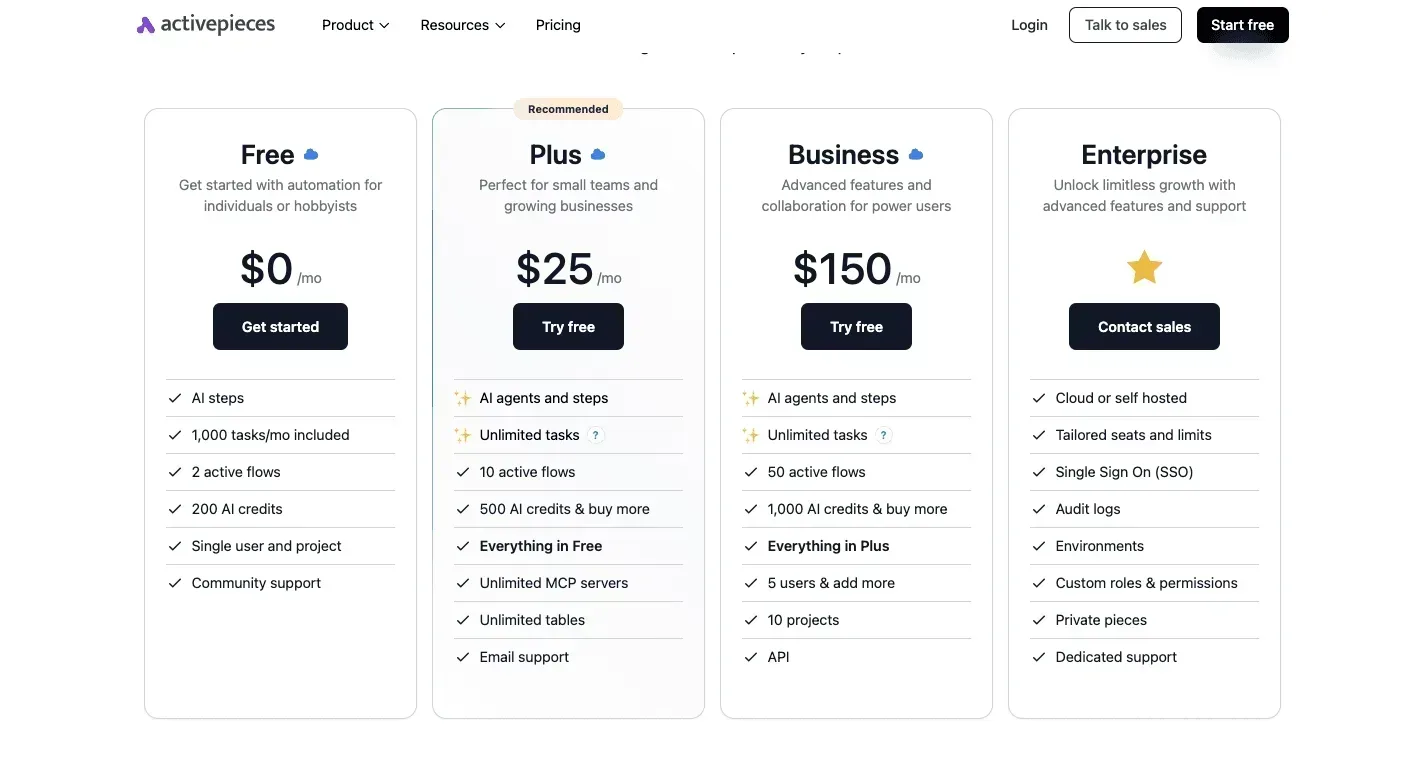 It lowers how fast you consume that allowance by removing a category of prompts. The workflow side is priced on [Activepieces' pricing page](https://www.activepieces.com/pricing) at 1 credit per flow run, whatever the number of steps, where Zapier's pricing page bills per task and Make's bills per module, so a notify-sync-approve flow costs one credit per event, and the Free plan includes 1,000 credits a month with unlimited flows. ## What to check before committing to Lovable Before any card is entered, do six steps in this order in one sitting. The list below puts the spending decision last and the evidence first, so take from it that the plan comes out of your feature count rather than the reverse. 1. Recheck the pricing page for the current plans and credit allowances. 2. Count the features you expect to build this month. 3. Pick the plan whose allowance covers that count with room to spare. 4. Set a credit budget and a checkpoint at mid-month. 5. **Ship one real feature on the Free plan**. 6. Log the credits that feature consumed, and every one after it. 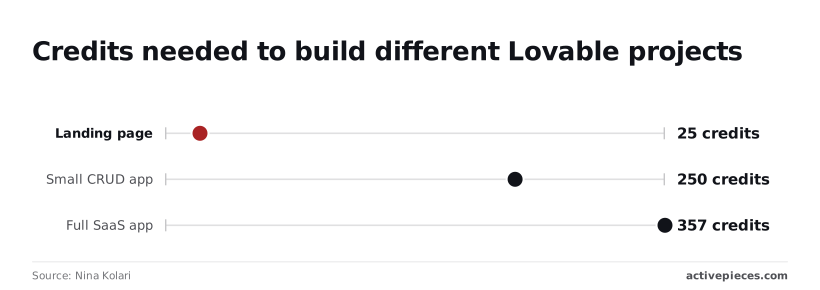 Steps one through four are the paperwork. Steps five and six are the test that tells you whether the paperwork was honest. Read the pricing page itself, today, rather than trusting an article or a screenshot, including this one. Allowances change, and a plan description you remember from last quarter is a guess. If any tier makes you book a call to learn what you get, treat the missing number as a cost. Then count features, not seats. Write down the screens, integrations and workflows you actually intend to ship, and choose the smallest plan whose allowance plausibly covers them. A solo builder with a long feature list can need a bigger plan than a team of five with a short one, because credits are consumed by prompts, not by people. ### Set a budget and a checkpoint Turn the allowance into a per-feature ceiling: divide it by your feature count and keep a reserve for rework. That ceiling is your budget, and it's only useful if you compare against it midway. Put the checkpoint in your calendar for the middle of the month. If you have spent more than half the allowance and finished fewer than half the features, tighten your prompts or cut scope while there's still time to choose. Before committing, build one real feature on Free, not a demo, and record what it cost. Keep that log going afterward. The first entry gives you a starting estimate, and the later ones show whether your prompting is getting cheaper or merely busier. ## Frequently asked questions ### Is Lovable free to use? Yes, there's a free plan, but it limits how many credits you can spend per day, so it works for testing an idea rather than shipping one. Run your first feature through it and note how many prompts it took. That's your cost-per-feature baseline before you pay anything. If a simple feature eats most of a day's free allowance, a paid plan won't stretch much further unless your prompting improves. Lovable's pricing page states the current free limits, and they change, so read it on the day you decide. ### Do unused Lovable credits roll over? Don't budget as if they do. Rollover terms are the kind of detail that gets revised, and the safe model is that each billing cycle gives you an allowance you either spend or lose. If you plan on a carried-over balance and the terms say otherwise, the shortfall lands in the final week of the month, when you are most likely to be mid-build. Check the plan details on Lovable's pricing page and record the date you checked. A cost log that says "rollover confirmed on this date" is worth more than a memory of it. ### Can I downgrade or cancel Lovable mid-month? From your account's billing settings you can change plans, but what happens to credits you have already paid for in the current cycle is governed by Lovable's terms. Read those before switching, because the cheapest-looking moment to downgrade may be the one where you forfeit credits you paid for. If you're cutting costs, finish the work that the current allowance already covers, then change the plan at renewal. Lovable's billing documentation is the authority here, not a forum thread from last spring. ### Does Lovable charge extra for hosting or a custom domain? Publishing to an address Lovable provides is part of using the product. A custom domain is where you should expect a paid plan to matter, and the domain name itself is bought separately from a registrar, so that cost never appears on Lovable's invoice. After you stop prompting, a finished app can keep costing credits, because backend and AI features inside it can also draw on their own usage allowance. Add those lines to your per-feature estimate, and confirm each against Lovable's pricing and documentation pages when you subscribe. ## Related reading - [Best Lovable Alternatives: 5 AI App Builders for 2026](https://www.activepieces.com/blog/best-lovable-alternatives-5-ai-app-builders-for-2026) - [Augment Code Pricing 2026: Plans, Credits & Costs](https://www.activepieces.com/blog/augment-code-pricing-2026-plans-credits-costs) - [Replit Pricing 2026: Plans, Credits and Real Cost](https://www.activepieces.com/blog/replit-pricing-2026-plans-credits-and-real-cost) ## References - [TechCrunch](https://techcrunch.com/2026/09/24/lovables-annualized-revenue-crosses-600m-as-vibe-coding-takes-off/) - [Nina Kolari](https://ninakolari.com/blog/how-many-lovable-credits-to-build-a-saas-app/) - [Steelsuit](https://steelsuit.com/blog/lovable-security/)**Whichever is cheaper per working feature wins, not whichever has the lower headline fee.