That means a model reaches a workflow only when someone deliberately enables it, and that person is the one to name before launch. ## Which MiniMax H3 Image Plan Fits You Match the plan to whoever answers when image generation fails, because that person holds the account. I could confirm no published plan or price for MiniMax H3 Image on minimax.io as of 2026-11-12. The four situations below show what each reader can verify and where the catch sits. - A solo user: **plan and price not published**. The catch is that you're also the person paged at 2am, with no second owner. - A team of five: plan and price not published. The catch is that shared credentials leave no record of who enabled the model. - A team of 25 needing SSO or admin controls: plan, price and SSO availability not published. The catch is that you can't assume central administration exists until the maker confirms it. - Heavy API volume: rate and limits not published. The catch is that you can't budget or size retries without a stated rate. Until the maker publishes figures, treat every row as a question to put to MiniMax before launch. A release date isn't published in the pages I could rely on, so I don't give one. MiniMax is the maker, and your change log should record the day your team first enabled the model. I read the maker's own pages at minimax.io on 2026-11-12, and everything here comes from them. The facts below stick to what the maker documents, so you know what you're taking on. **Nobody operates this model by hand**; it's a call your workflow makes. A trigger fires, the step sends a prompt, an image comes back, and the next step files or publishes it. Because it runs unattended, a failed call produces a gap where an image should be. Decide before launch who watches that step. ### How to get MiniMax H3 Image API access MiniMax documents API access, so the route below needs no manual tooling: 1. Create a MiniMax API account. 2. Generate an API key. 3. Choose the H3 Image model name. 4. Send the request from the workflow step. 5. Store the returned image.  When the key leaks or expires, steps one and two are what put the account and key under a named owner. Step five matters because returned images are not guaranteed to stay retrievable, so your own storage is the record. The maker's pages decide the exact model name and request format. ### Self-hosting MiniMax H3 Image open weights The API is not the only way in. MiniMax calls H3 Image "open-weight," which means the model's weights can be downloaded. You can host them on your own machines, or use a third-party host that serves them for you. That route changes who carries the work. You run and monitor the infrastructure, so a stalled job or a crashed server is yours to catch, not MiniMax's. It does not apply to a copy you run yourself, and a third-party host will set its own price.  Check two things on MiniMax's pages before you commit: the licence terms, which decide whether your use is allowed, and the hardware the model needs. We have not confirmed either. The Mac mini timings reported further down come from this route, a local run on the reporter's own machine, so treat them as an example of self-hosting and not as what the hosted API will deliver.  ## What MiniMax Says Is New in H3 Image The only claims about H3 Image we will carry are the ones MiniMax makes on its own pages. This draft holds no confirmed figures from them, so it reports none. Someone will build a timeout or a retry rule around each of these: speed, output size, sampling steps, reference-image limits and any "faster than before" claim. Until a figure is confirmed against the maker's page, treat it as not published. A guessed timeout is what pages whoever owns the workflow at 2am. We ran no benchmarks of our own and don't substitute ours for theirs. We haven't confirmed the release date here, so we don't state one. MiniMax is the maker, and the maker's pages are the authority on it. Record it yourself when you read the page, because it tells you which version your integration was tested against. Each specification should carry three things: - the maker's exact statement - a link to the page that makes it - the date you checked Without the link and the date, nobody can tell later whether a changed behavior is the model or the documentation. Name an owner for rechecking those pages, since a spec you can't trace has no one answerable for it. ## What Activepieces Has Shipped for MiniMax H3 Image We haven't run H3 Image ourselves, and what Activepieces, whose core is MIT-licensed, has shipped is MiniMax as a selectable AI provider, not an H3 Image feature by name. Whoever is paged when an image step fails should know that gap exists. ### What shipped and when On 2026-08-24, per [Activepieces](https://github.com/activepieces/activepieces/pull/14987), the product added MiniMax alongside xAI, DeepSeek, Z.ai, Qwen and Moonshot AI as AI providers, all speaking the OpenAI wire format. That date is your reference point: any claim that H3 Image works in Activepieces should trace to this change, pull request 14987 in the open source repository, or to something later. The change doesn't name H3 Image, so confirm the model identifier against MiniMax's own pages. ### Connecting it in a workflow today Because MiniMax speaks the OpenAI wire format, you add it as a provider with an API key, and if H3 Image ever needs a connector the catalogue lacks, you don't wait on a vendor release: roughly 60% of the 747 integrations in the open source monorepo came from the community, and Activepieces lets you generate one with AI and add it privately to your own instance. The panel below lists each configured provider with its status, models and project access, and MiniMax appears under "Also available". Anthropic, Google Gemini and OpenAI are already set up there.  Scope the MiniMax key to the one project that needs it, record who created it, and test a single image call before any workflow depends on it, because the per-provider project access is the audit hook. 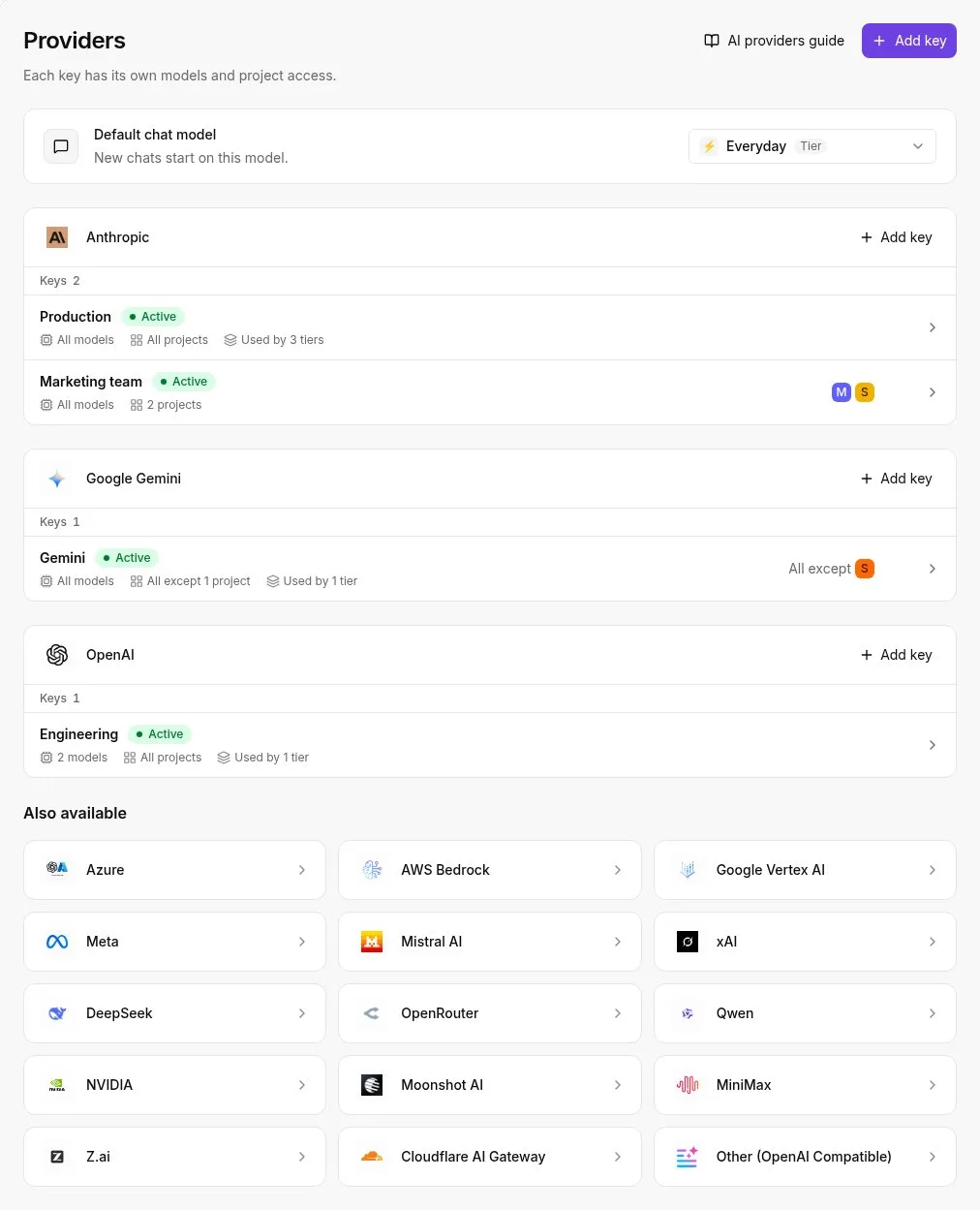 ## Cost and Speed Against today's Image Options Make that test call at 4K, because **H3 Image costs $0.10 per image** there, **roughly three times the price** of GPT Image 2.5 or FLUX 3 Klein, according to [Okaypic](https://okaypic.com/compare/ai-image-api-pricing). MiniMax's blog frames H3-Image as bringing 4K image generation into the "10-second era", so measure latency yourself. | Model | Price per image (4K) | Published speed | Access method | Check date | |---|---|---|---|---| | MiniMax H3 Image | — | not published | API | 2026-11-12 | | FLUX 3 Klein | $0.036 | not published | API | 2026-11-12 | | GPT Image 2.5 | $0.03 | not published | API | 2026-11-12 | | Nano Banana Pro | $0.24 | not published | API | 2026-11-12 | _Prices and plan limits checked against [minimax.io](https://minimax.io) and [github.com](https://github.com/activepieces/activepieces/pull/14987) on November 12, 2026._  At 1,000 images, GPT Image 2.5 costs $30 and FLUX 3 Klein $36. We have no timings of our own. The only ones come from an outside local run on a Mac mini, reported by [TokenPost](https://www.tokenpost.com/news/technology/54746). Someone must own the job that is still running at 2am.  ## What to watch and do in H3 Image Name one owner and trial H3 Image in a single low-risk workflow. Keep minimax.io's pricing page, docs and changelog open as the sources that tell you when your assumptions have expired. The owner is the person paged when the job stalls overnight, so pick them before you pick the workflow. Nothing runs unattended until a cap and a reviewer exist, because the steps below are ordered that way: 1. Pick one low-risk workflow, such as internal draft visuals, where a bad image costs a re-run and nobody outside the team sees it. 2. Add the MiniMax provider or node in your automation tool, and record who holds the API key. 3. Set a spend cap before the first call, so a looping job hits a ceiling instead of a surprise invoice. 4. Run ten test images, enough to show how often output misses the brief without a large bill. 5. Review every image by hand and log the misses, because that log is your evidence for or against widening use. 6. Check the pricing page, docs and changelog on minimax.io, and note the date you checked. Anything they change later is a reason to re-run step 4. ## Frequently asked questions Is MiniMax H3 Image available through an API? Yes. MiniMax's own pages describe it as reachable through an API call, so an automation can request images without a person in the loop. Our findings don't cover whether the hosted API is open in every country, so confirm that for your region before you build on it. Does my automation platform support MiniMax H3 Image? We haven't confirmed a dedicated integration for it, though MiniMax has been a selectable AI provider since 2026-08-24. Check the integration catalogue for a current MiniMax entry. If there's none, the API route above is the fallback, and whoever builds the flow should be named as its owner, because a custom call has no vendor-maintained piece behind it. Has any automation platform tested MiniMax H3 Image? We have no record of a test, so we make no claim about results; the only thing we can point to is pull request 14987, which added MiniMax as a provider on 2026-08-24 and doesn't name H3 Image. Treat any output quality or reliability as unverified until your team has run a sample of real requests and kept the results. Where do I check current MiniMax H3 Image pricing? Use MiniMax's own pricing and model pages, not a third-party summary. We have no confirmed figures to quote here, and prices change. Read the current rate on the day you set your budget, and record the date next to the number. ## Related reading - [MiniMax API Pricing in 2026 and What Each Model Costs](https://www.activepieces.com/blog/minimax-api-pricing-in-2026-and-what-each-model-costs) - [MiniMax M3.1 Flash Pricing & Specs: 2026 Test Results](https://www.activepieces.com/blog/minimax-m31-flash-pricing-specs-2026-test-results) - [Should You Self-Host MiniMax M3.1 Flash or Use the API?](https://www.activepieces.com/blog/should-you-self-host-minimax-m3-1-flash-or-use-the-api) ## References - [Okaypic](https://okaypic.com/compare/ai-image-api-pricing) - [TokenPost](https://www.tokenpost.com/news/technology/54746)Before wiring it in, the question that matters is who owns it when it breaks.