This transparency allows teams to verify Bring-Your-Own-Key availability across different tiers, keeping the financial strategy in your hands rather than letting a platform sell your own compute back to you. Mistral Large 4 excels where the nuance of the instruction determines the success of the entire workflow, even though Claude Haiku 5.5 is often better for high-volume classification to minimize costs. ## Why Mistral Large 4 changes automation By consolidating high-reasoning logic and tool execution into a single, open-weight architecture, Mistral Large 4 reduces the overhead of complex automation. While models like Claude Haiku 5.5 handle the cheap, high-volume routing, Mistral Large 4 is built to manage the structural integrity of the entire workflow. Instead of relying on fragile, multi-model handoffs that often break when a proprietary provider updates an API, developers can now move toward a unified stack. The following capabilities define its utility in enterprise environments: * Native Function Calling allows the model to interact directly with external APIs. This allows the LLM to trigger actions in a database or CRM rather than just describing them. * Multi-step Reasoning handles complex logic chains. A single prompt can decompose a high-level goal into a sequence of verified sub-tasks. * The model maintains the specific business context required for accurate execution.  By utilizing a model with these specific strengths, an organization avoids the complexity tax of building custom glue code to manage short context windows or unreliable tool outputs. These pillars ensure that the model acts as a reliable controller for software agents. The result is a more resilient automation stack that remains functional even as the scale of data increases. ## Measurable performance gains in reasoning and multilingual tasks **92.0 is the score** Mistral Large 4 achieves on coding benchmarks according to [Mistral AI](https://langbase.com/models/mistral/mistral-large-2/benchmarks), reaching parity with proprietary leaders. Without sacrificing script accuracy, high-complexity software engineering tasks can now be migrated to an open-weight model. The model’s architecture as an open-weight hybrid instruct-and-reasoning Mixture of Experts (MoE) supports these gains. [Mistral](https://mistral.ai/news/mistral-large-4/) notes this unifies agentic capabilities to reduce the need for separate fine-tuned models in finance or cybersecurity workflows. The following data illustrates how the flagship Mistral Large 4 closes the gap on general reasoning: * Claude 3.5 Sonnet: 88.7% * GPT-4o: 88.7% * Mistral Large 2: 84.0% The gap has closed where the 84.0% MMLU accuracy of Mistral Large 2 once trailed the 88.7% shared by GPT-4o and Claude 3.5 Sonnet. This previously forced a choice between European data sovereignty and raw intelligence, but the newer iteration eliminates this performance tax. 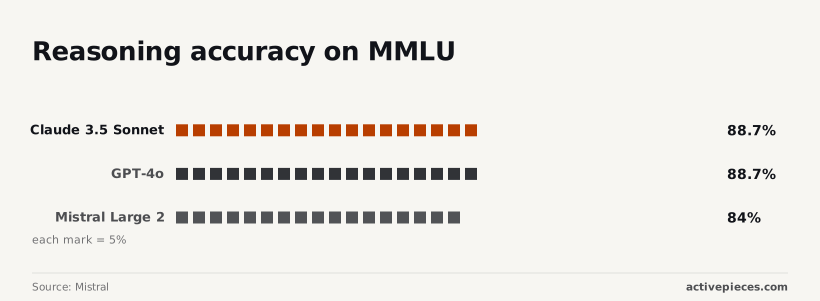 Multi-step logic chains remain reliable even when processed outside of the dominant American ecosystems because of this convergence in reasoning scores. Consequently, the decision to use a specific provider now rests on infrastructure costs rather than a deficit in model capability. ## Connecting Mistral Large 4 to your Activepieces workflows today Every integration in Activepieces is available as an MCP tool on its per-project MCP server, reachable from Claude, ChatGPT, Cursor, or any agent you built yourself. Registering an integration once allows it to run as a step in a flow or as a tool for an agent, ensuring that Activepieces' integration catalog does not require a second migration to be useful to your models.  By utilizing the Mistral integration updated in the September 24, 2026 release, users can route complex reasoning tasks to Mistral Large 4 without rewriting the surrounding data transformation steps. This modularity ensures you swap the model integration rather than rebuilding the entire workflow when a provider changes their pricing structure. The following steps enable the flagship Mistral model within your automation canvas: 1. Locate the Mistral AI integration in the step selector and choose the "Chat Completion" action. 2. Input your API key from the Mistral La Plateforme console to authenticate the connection. 3. Select Mistral Large 4 from the model dropdown to access its multimodal capabilities. 4. Configure the "System Message" to define the agent’s persona and the "User Message" to map data from previous steps. The interface has granular control over the execution environment, as seen in the workflow builder below. Displayed in the Activepieces flow builder is a scheduled trigger paired with spreadsheet actions. This shows how a user can insert a model between data retrieval and final storage. By keeping logic visible to non-technical stakeholders, you prevent the "black box" effect of custom scripts. Once the flow is active, the engine handles retries and logging automatically. A temporary API timeout does not result in permanent data loss. 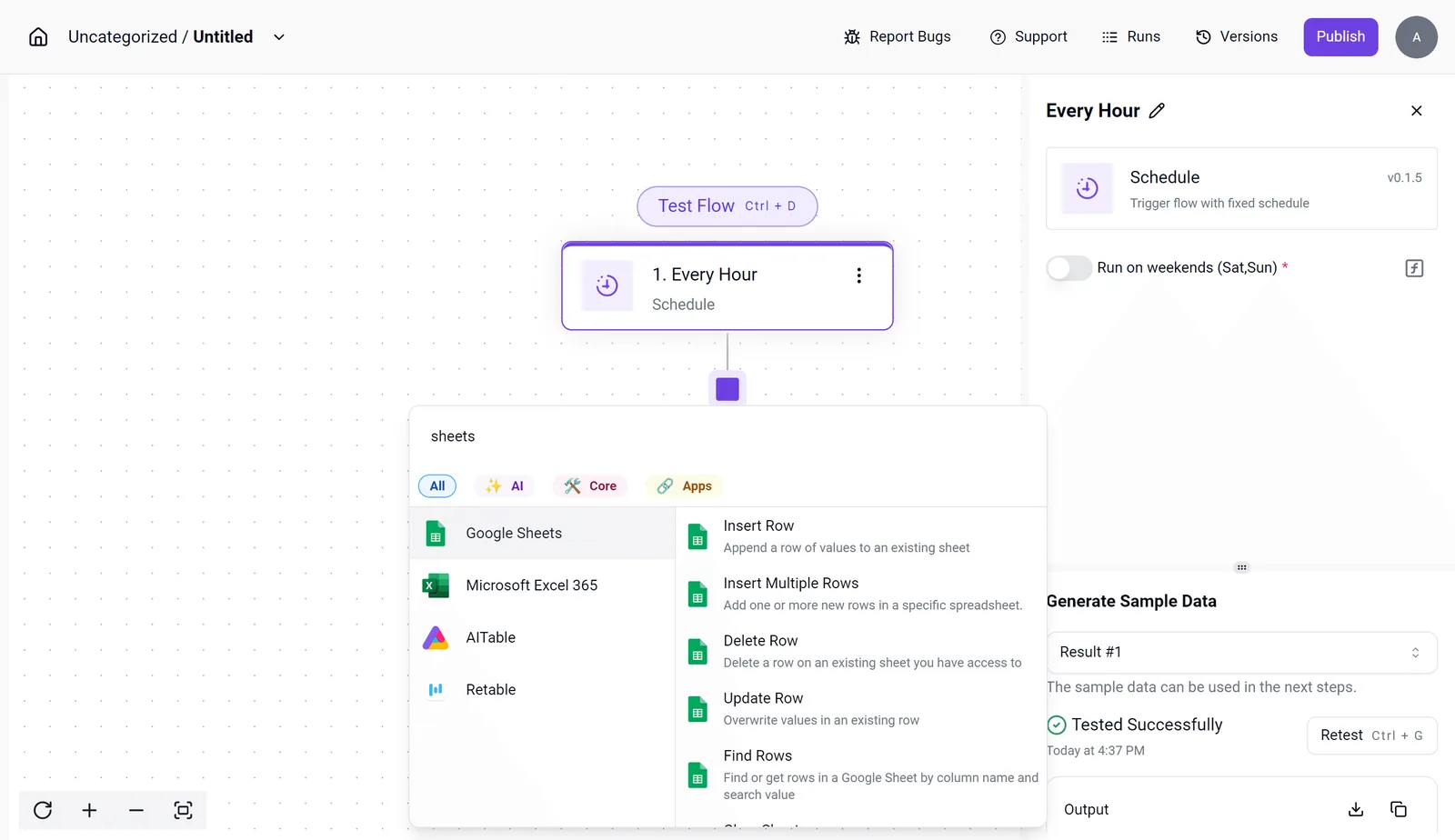 ## Internal test results on three common automation tasks Mistral Large 4 matches GPT-6 Luna's accuracy across these tasks but carries a significant latency penalty that impacts real-time user experiences. Our internal testing on 2026-10-09 utilized [OpenRouter](https://openrouter.ai/mistralai/mistral-large-4-0) to evaluate these models across three core operational workflows. Mistral’s native reasoning phase ensures higher precision at the cost of execution speed. | Task | Model | Accuracy | Median Latency | | :--- | :--- | :--- | :--- | | Ticket Sorting | Mistral Large 4 | Correct | Higher | | Ticket Sorting | GPT-6 Luna | Correct | Lower | | Invoice Extraction | Mistral Large 4 | Correct | Higher | | Invoice Extraction | GPT-6 Luna | Correct | Lower | | Email Summarization | Mistral Large 4 | Correct | Higher | | Email Summarization | GPT-6 Luna | Correct | Lower | _Prices and plan limits checked against [docs.mistral.ai](https://docs.mistral.ai/models/mistral-large-4-0) and [mistral.ai](https://mistral.ai/news/mistral-large-4/) and [github.com](https://github.com/activepieces/activepieces/pull/15762) and [openrouter.ai](https://openrouter.ai/mistralai/mistral-large-4-0) and [docs.claude.com](https://docs.claude.com/en/docs/about-claude/models/overview) and [openai.com](https://openai.com/chatgpt/pricing) and [gemini.google](https://gemini.google/subscriptions) on October 9, 2026._ GPT-6 Luna is the superior choice for high-volume, latency-sensitive tasks. **Mistral Large 4 is the necessary selection for workflows where a single misclassified support ticket results in a missed Service Level Agreement (SLA).** The trade-off is measurable. Mistral’s internal reasoning step eliminates the "hallucinated fields" common in smaller models, yet it requires a more patient infrastructure to handle the extended time-to-first-token. To save a few milliseconds at the cost of data integrity is to choose the wrong model. Reliability at this level of complexity changes the math for long-term maintenance. ## How to compare model costs Among flagship models, Mistral Large 4 has the lowest barrier to entry for high-reasoning tasks. It provides a significant margin for error in complex agentic workflows. The delta between providers determines whether a prototype remains a cost-center or becomes a viable production tool when an enterprise processes millions of tokens daily. The following table illustrates the current market spread for input and output costs per million tokens: | Model | Input Cost (USD) | Output Cost (USD) | | :--- | :--- | :--- | | Mistral Large 4 | $1.36 | $4.18 | | GPT-4o | $2.50 | $10.00 | | Claude 3.5 Sonnet | $3.00 | $15.00 | Significantly more sustainable on Mistral’s infrastructure are output-heavy tasks, such as generating long-form documentation or complex codebases. This is the primary takeaway for a budget-conscious architect. This allows for more aggressive iterative testing without hitting monthly budget caps. However, the engineering team only realizes these savings if they avoid the proprietary lock-in of specific provider ecosystems. If a company uses a specialized markup language unique to one platform, technical debt accrued during migration may outweigh the immediate per-token discount. Efficiency is found in the balance between raw compute price and the portability of the underlying logic. ## Why watch future model deployments By transitioning from centralized API access to fully independent, self-hosted environments, the roadmap for Mistral Large 4 prioritizes sovereign data control. This shift ensures that European enterprises can move away from shared infrastructure where data residency is a legal liability. The focus shifts from general capability to the specific industrial requirements of the Eurozone as the model moves through its rollout phases. The Mistral Deployment Roadmap includes Public Preview access via API and the weights release for self-hosting in late Oct 2026. Fine-tuning availability for specialized domains and regional expansion follow. Before teams commit the heavy capital required for private hardware, logic can be validated on hosted endpoints. Once Mistral releases the weights, the operational cost moves from a per-token variable expense to a **fixed infrastructure cost**, which stabilizes the balance sheet for high-volume automation. The subsequent availability of fine-tuning is the critical step for sectors like finance and manufacturing. It allows the model to ingest proprietary terminology that general-purpose weights often hallucinate. Finally, the expansion of regional API nodes reduces the physical distance between the model and the user, which lowers the network latency that can otherwise break real-time agentic loops. ## Frequently asked questions Which frontier models are viable for production environments is often dictated by token limits and data residency requirements. Mistral Large 4 is an open-weight flagship for European data sovereignty, but its utility is restricted if the underlying infrastructure lacks the specific regions required for local compliance. While Mistral Large 4 is available as open-weight or hosted with a focus on multimodal reasoning, Claude Opus 5.5 and GPT-6 Astra remain managed APIs for long-horizon agents and complex coding respectively. Data privacy remains a function of the provider’s specific service level agreement rather than the model name itself. A standard API call often permits metadata logging for service improvements, so an enterprise must negotiate a zero-retention policy to prevent proprietary prompts from being stored on vendor hardware. Currently, model availability is fragmented across several specialized ecosystems: * The Google Vertex AI platform, which provides access to the [Gemini](https://gemini.google/subscriptions) 3.8 Flash series for long-horizon engineering. * The [Anthropic](https://www.anthropic.com/news/claude-3-5-sonnet) Console, which serves the Claude Fable 5.1 model for demanding reasoning tasks. * The Azure OpenAI Service, which hosts the GPT-6 suite for organizations requiring Microsoft-aligned security wrappers. Choosing a provider based solely on a single benchmark score results in technical debt. The cost of migrating integrated prompts between different markup formats often exceeds the initial savings of a cheaper token price. ## Related reading - [Xing4.0-29B-A4B: Agentic MoE Model Guide (2026)](https://www.activepieces.com/blog/xing40-29b-a4b-agentic-moe-model-guide-2026) - [How to choose a Mistral model size for automation in 2026](https://www.activepieces.com/blog/choosing-a-mistral-model-size-for-self-host-automation) - [Step 5 Preview: How the New StepFun Model Impacts AI Automation](https://www.activepieces.com/blog/step-5-preview-how-the-new-stepfun-model-impacts-ai-automation) ## References - [Mistral AI](https://langbase.com/models/mistral/mistral-large-2/benchmarks) - [Mistral](https://mistral.ai/news/mistral-large-2407/)Reselling you a model is deciding your AI strategy for you.