## What's measurably new in Voxtral 3 Voxtral 3 has five models, reachable through its API. Those gaps are small, so your recordings will decide more than the benchmark does.  ### Capabilities Mistral states Pick either Small Transcribe 3 or Mini Transcribe 3 and you get transcription and diarization (labelling who spoke). On the launch evaluation reported by [BenchLM](https://benchlm.ai/voice-benchmarks/voxtral-3-launch-evaluation), the error rate with a specified language runs 4 to 4.5 percent, which is about **one word in twenty-five wrong at best**. Attribution is therefore the weak point, and Small and Mini are nearly indistinguishable there. 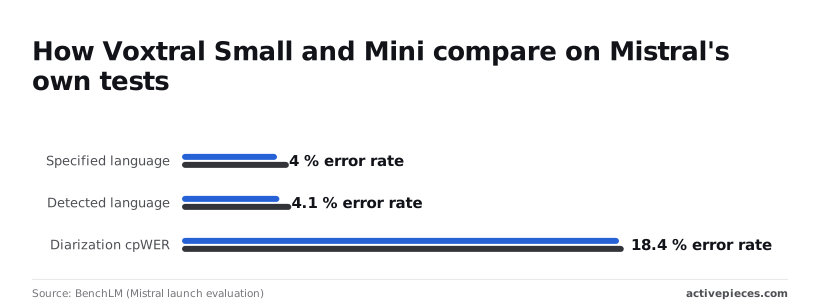 You could self-host the earlier Voxtral releases, because they shipped open weights: [9to5ai](https://9to5ai.tech/voxtral-3-mistral-speech-tts-voice-agents) counts two in 2025 and one more, Realtime 4B. **Mistral says Voxtral 3 can be deployed on your own infrastructure**, so you can self-host, though the weights and licence terms aren't stated on the page. Blank cells in the table are figures neither source gives, so cost and speed remain unknown. The table below sets what Mistral states against the original announcement. | | Voxtral 3 per Mistral | Original Voxtral announcement | Source | |---|---|---|---| | Capabilities | Transcription, diarization, realtime, TTS | | [9to5ai](https://9to5ai.tech/voxtral-3-mistral-speech-tts-voice-agents) | | Stated figures | 4–4.5% specified-language error | | [BenchLM](https://benchlm.ai/voice-benchmarks/voxtral-3-launch-evaluation) | | Access | API or self-deployment, 5 models | 2 open-weight models | [9to5ai](https://9to5ai.tech/voxtral-3-mistral-speech-tts-voice-agents) | | Limits | | | | _Prices and plan limits checked against [mistral.ai](https://mistral.ai/news/voxtral-3) and [docs.mistral.ai](https://docs.mistral.ai/studio/audio/overview) and [mistral.ai](https://mistral.ai/news/voxtral) and [github.com](https://github.com/activepieces/activepieces/pull/15762) and [docs.claude.com](https://docs.claude.com/en/docs/about-claude/models/overview) and [claude.com](https://claude.com/pricing) and [openai.com](https://openai.com/chatgpt/pricing) and [gemini.google](https://gemini.google/subscriptions) on October 25, 2026._ Price per audio minute is published, so you can estimate what you will pay. ## Connecting Voxtral 3 to a workflow in Activepieces today In [Activepieces](https://www.activepieces.com/pieces/mistral-ai), every connector is an agent tool, and the Mistral AI integration's audio transcription action shows what that means here: it is defined once, as a flow step and as a tool schema on the project's MCP server. Claude, ChatGPT, Cursor or an agent you built yourself can call the very action you trialled in a flow, so there is no second catalog to populate and no export step. 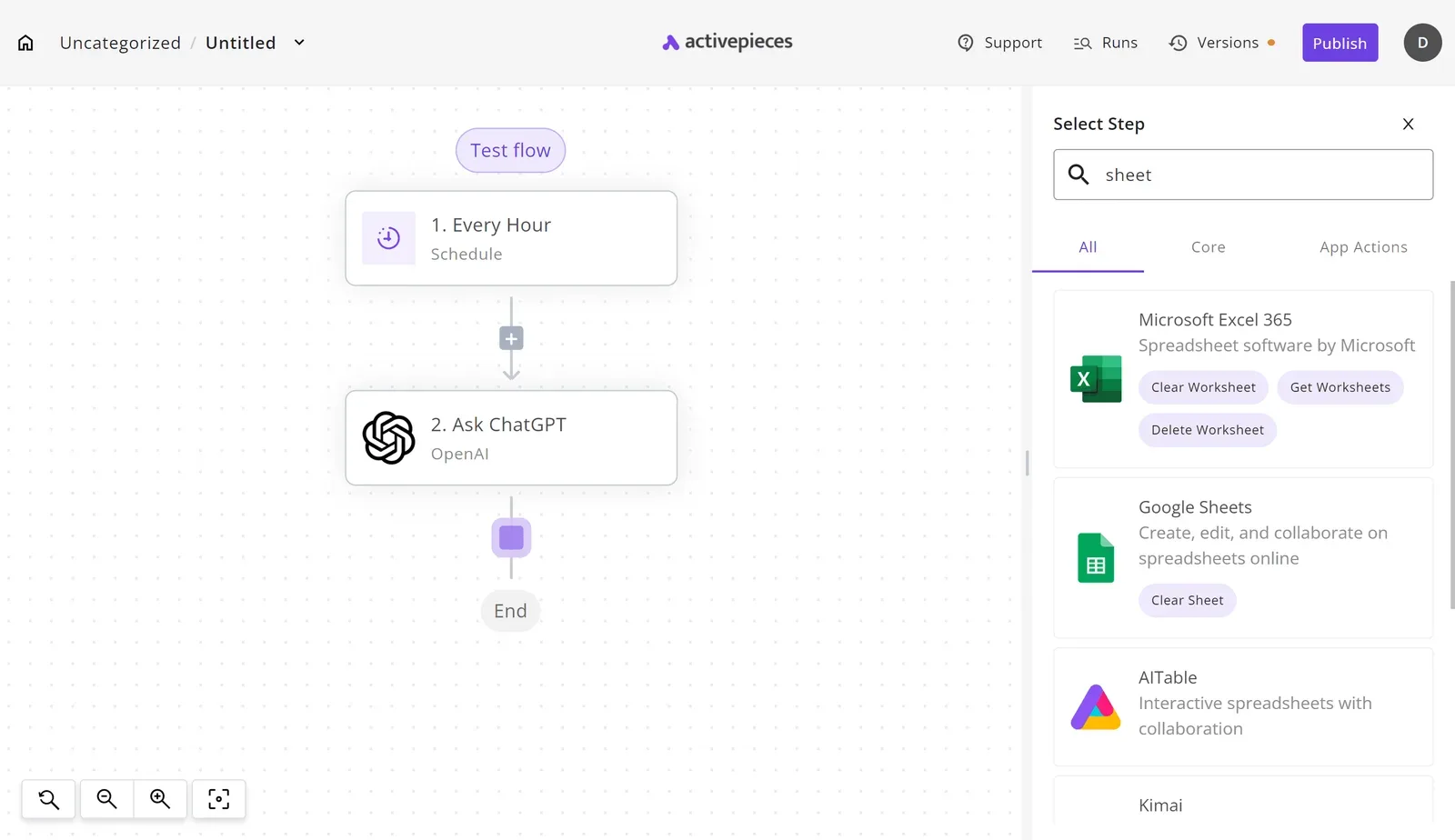 The same action sits in packages/integrations in the open source repo, alongside the other integrations, for both uses. We haven't run Voxtral 3 through it. That means the price and latency rows stay empty until you fill them with your own audio. ### New actions and schemas for Mistral On 2026-09-24, a pull request on [Activepieces' GitHub repository](https://github.com/activepieces/activepieces/pull/15762) added 42 agent-facing actions and output schemas to the Mistral AI integration. The list includes chat completion, Codestral code completion, audio transcription, speech generation, moderation and model retrieval. Transcription is therefore a named action, not something you assemble from a generic HTTP call. We read the pull request description; we didn't check which Voxtral models the transcription action lists, so confirm that in the action's model field before you build around it. Build and test in this order, one step at a time: 1. Trigger on a new recording, for example a file landing in cloud storage or a call-recording webhook. 2. Fetch the audio file, so the next step receives the file itself and not only a link. 3. Add the Mistral transcription action and select the Voxtral model you are trialling. 4. Parse the text output, keeping only the fields the destination needs. 5. Post the result to your CRM, ticket queue or message channel. Run a handful of real recordings and open each step's run output. The per-step input and output is where you'll see whether a failure came from the fetch, the transcription or the parse. If the integration doesn't expose a Voxtral 3 option or a parameter you need, call Mistral's API with Activepieces' HTTP step, using the same position in the flow. Check the parameters against Mistral's own documentation, since we haven't verified them. ## Compare Voxtral 3's cost and speed $0.0035 to $0.08 per minute of audio is the published range, which fixes the span but not your bill, meaning you still cannot know what you will actually pay. The same documentation check applies to the prices below. ### Published price per unit of audio At the rates [Apex Logic](https://www.apex-logic.net/news/voxtral-3-pricing-api-guide-2026) lists, Mini transcribe is $0.0035 per minute and Small transcribe $0.004, bringing hourly transcription to roughly 21 to 24 cents. At those rates, 1,000 hours a month would cost about $210 on Mini and $240 on Small. Realtime transcribe is $0.008, so live captioning costs roughly twice the batch rate. $0.04 per minute on Small 4 and $0.08 on large are the voice-agent tiers, so large costs twice as much per minute. Every price here rests on Mistral's own announcement page, checked on 2026-10-25, and it gives sub-500ms latency for the realtime service. We have nothing published for your current transcription service, so we can't rank Voxtral 3 against what you run today. **Mistral states sub-500ms latency** for its Voxtral realtime transcription service. Any speed comparison is therefore unverified, and the figures above are a third party's listing, not a measurement. 1. Pull 50 to 100 recordings from last month, including the noisy ones. 2. Send the same files to Voxtral 3 and your current service. 3. Log wall-clock time per file and the billed minutes. 4. Multiply billed minutes by your monthly volume. ## What to watch after the Voxtral 3 launch Watch three first-party pages (Mistral's model listing, its pricing page and the docs changelog). Only they can replace a third party's figures with Mistral's own, and any limit change will show up there first. On the model list, Voxtral Mini Transcribe 3 is described as transcription with diarization, Voxtral Small Transcribe 3 as the flagship transcription tier, and Voxtral Mini Transcribe Realtime 3 as the live option. That tells you which variant to test against which job: batch call recordings go to the first two, live captioning to the third. Re-read these descriptions at each changelog entry, since wording is where a capability gets added or narrowed. Confirm on the model page which variant is offered through Mistral's hosted API and whether any is offered as downloadable weights. That decides whether your recordings leave your infrastructure, which matters more for customer calls than for public webinars. We haven't seen a published maximum file length or upload size from Mistral that we can verify. Confirm those yourself before moving production audio, then run this: 1. Pick 20 real recordings, including your worst audio. 2. Confirm file length and size limits against each file. 3. Run all 20 through your current model and Voxtral 3. 4. Record cost per task and time for each run. 5. Compare transcript errors on names, numbers and speaker labels. 6. Decide per workload, not globally. Budget only from the cost and time columns of step four. Treat anything else as a listing until your own traces confirm it. ## Frequently asked questions For the release date, go to Mistral's own model page and changelog; we haven't independently verified it. For planning, treat the model as new: check those pages for the date and any revisions before you rely on a behavior you saw in a demo. ### Where can I use Voxtral 3 in an automation? Through the access routes Mistral documents, which start with its own API. Call the model from an HTTP step in your automation tool, or from a code step. Pricing sits on Mistral's pricing page, and per-model details are in its documentation. Any other route is a third-party listing until your own traces show a call going through and returning a transcript. Activepieces lists a Mistral AI integration, and a pull request dated 2026-09-24 added agent-facing actions to it, including a Transcribe Audio action. The rule here is the same as everywhere else: a listed integration is a claim, and a run from your own account is the evidence. ### Has Voxtral 3 been tested against other transcription models? No. We haven't run it, so we have no accuracy, speed or cost comparison to report. Anything Mistral publishes on those points is the maker's claim. To settle it for your workload, run the same recordings through the model you use now and through Voxtral 3, then compare the raw outputs and the invoice line. Mistral announces changes on its changelog and model pages, so check them before you rerun a comparison. ## Related reading - [Gemini Agent: What Google Launched, Pricing and Limits](https://www.activepieces.com/blog/gemini-agent-what-google-launched-pricing-and-limits) - [SAP Business One AI Assistant: Edit Automations](https://www.activepieces.com/blog/sap-business-one-ai-assistant-edit-automations) - [Asana Automations: A Quick Guide for Modern Teams](https://www.activepieces.com/blog/asana-automations) ## References - [BenchLM (Mistral launch evaluation)](https://benchlm.ai/voice-benchmarks/voxtral-3-launch-evaluation) - [9to5ai](https://9to5ai.tech/voxtral-3-mistral-speech-tts-voice-agents) - [Apex Logic](https://www.apex-logic.net/news/voxtral-3-pricing-api-guide-2026)If the transcript is wrong, every later step inherits the error silently.