# Mitra MCP: What It Is and How to Use It (2026)
By Winston Bracewell · 2026-11-12 · Source: https://www.activepieces.com/blog/mitra-mcp-what-it-is-and-how-to-use-it-2026
---
Mitra released Mitra MCP, and as of 2026-11-12 it's **brand new**. Its only public description is the page at getmitra.com/mcp.
## Mitra MCP launched: who released it and when
**Nothing here has been field-tested, so treat every claim below as the maker's own.** [Activepieces](https://www.activepieces.com), an MIT-licensed core with 747 integrations, only matters to this story as a place where the question of reaching it comes up.
### What Mitra says about Mitra MCP's release
Only the maker has documented this release. Mitra, the company behind getmitra.com, released a product named Mitra MCP, and its own page is the only place the release is described. There's no independent review, no third-party write-up and no deployment history to check it against.

Whatever capability you read on that page is **a statement of intent, not an observed result**. Plan around it that way.
Five launch facts are confirmed, and that is all. The maker is Mitra, the product is Mitra MCP, we read the page on 2026-11-12, the source is getmitra.com/mcp, and the status is new and not yet field-tested.
Very little is established, so everything past these facts needs your own testing before it goes near a production workflow.
If you read the page later, any difference between your copy and ours is a change to the product or its documentation, not an error in the facts above. The date matters for that reason: the page can change after we read it.
Re-check the source before you act on it. The next section covers what the page describes and what a workflow can do with it today.
## How Mitra MCP helps automation teams
As far as a workflow can reach it today, Mitra MCP matters to an automation team, and as of 2026-11-12 that means general building blocks, not a native connector.
### Where an MCP server fits in an automation stack
When an agent or workflow engine needs to act on an app, it calls an MCP server. The table shows that the three earlier launches each arrived inside a platform teams already run, while **Mitra MCP has no such home yet**.

| Offering | Launch date | How a workflow reaches it |
|---|---|---|
| Zapier MCP | Apr 4, 2025 | Natively, as an MCP server exposing Zapier actions |
| Make MCP server | May 16, 2025 | Natively, as an MCP server exposing Make scenarios |
| Copilot Studio MCP GA | May 29, 2025 | Natively, from agents built in Copilot Studio |
| Mitra MCP | — | No native step; a generic HTTP request or a custom MCP client |
| Activepieces | — | — |
_Prices and plan limits checked against [getmitra.com](https://getmitra.com/mcp) on November 12, 2026._
So reaching Mitra is plumbing you build and maintain yourself.
The official TypeScript SDK's monthly npm downloads, [per Gravity](https://gravity.fast/data/mcp-adoption-statistics/data.csv), grew from 50,249,918 in Jan 2026 to 71,656,771 in Feb, 141,911,796 in Mar, 140,092,905 in Apr, 153,164,130 in May and 165,176,305 in Jun.
That growth makes the SDK a stable base for custom clients, though downloads count installs, not servers in production use.
Ask how it authenticates. In [MCPtrove's](https://mcptrove.com/research/mcp-authentication-statistics) 520-server directory, 245 listings need no credential, 222 use an API key and only 53 use OAuth.

Most servers a workflow meets therefore hand you a static key to store and rotate, or no access control at all. If Mitra falls in either group, your workflow tool's secret store becomes the whole control.
## What's measurably new per Mitra's page
If your workflow tool's secret store is the whole control, the only claims worth storing a credential for are the ones the maker states itself. Per [Mitra's MCP page](https://getmitra.com/mcp) (read 2026-11-12), Mitra has an MCP connector for making and answering calls.
One sentence is all the page gives for capability: "Connect Mitra to your AI app to **make and answer calls from your number**." That covers outbound and inbound calls, made from your own number.

It doesn't name other features. Anything beyond calling, such as transcripts, call routing or voicemail handling, isn't claimed there, so don't plan around it.
### How to get it and what it costs
You reach it at `https://getmitra.com/mcp`, where the page presents an MCP server. Model Context Protocol is the standard that lets AI apps call outside tools, and the page carries the line "Put your Mitra to work today."
That address is the access method as stated.
There is no mention of a native module for any automation platform, and no price, so this section records none.
Picture a flow that chains Claude, a spreadsheet update, ChatGPT and Perplexity, each step writing back to the sheet. That is the general building block you would have to rely on.
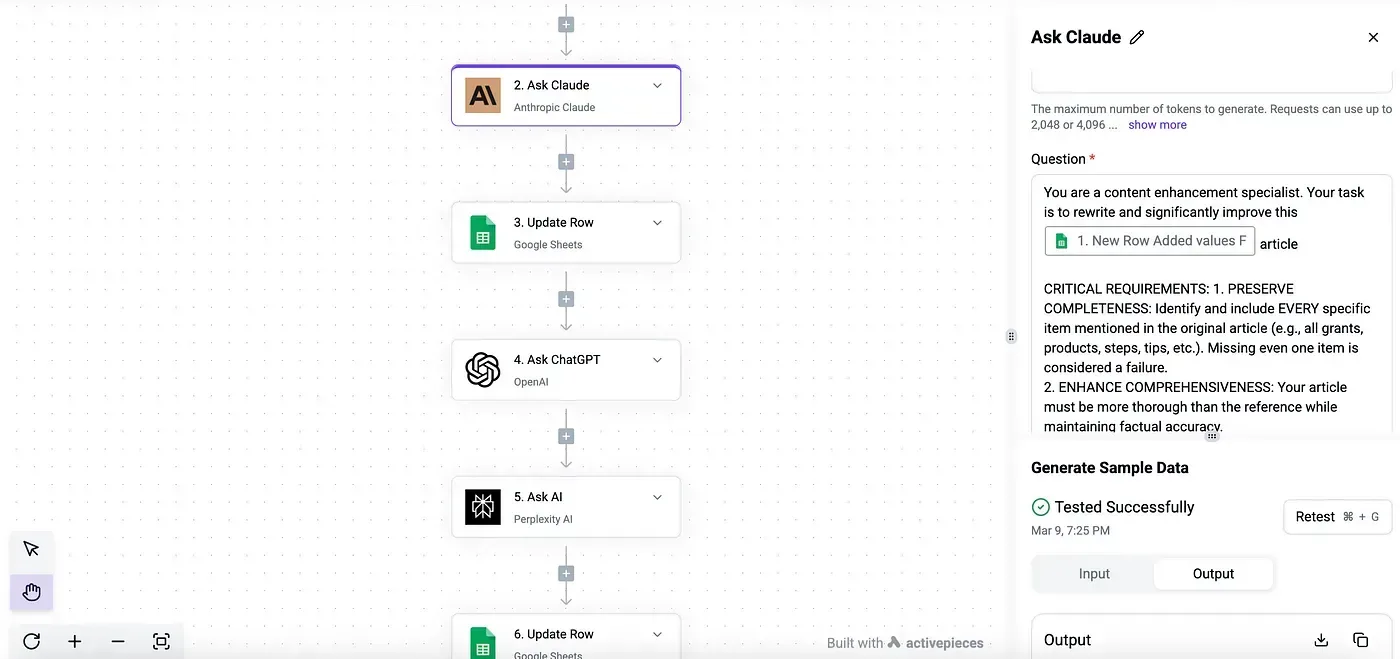
If the page implies any route, it is a step that can call an outside service. It doesn't describe a ready-made workflow integration.
You won't find benchmarks on the page, so the maker hasn't measured call quality, latency or reliability.
The scraped text also doesn't describe authentication or how the service authorises a call, which matters because that's what your secret store would be guarding. Treat every one of these gaps as an open question for the vendor.
## How to connect Mitra MCP in a workflow today with Activepieces
Activepieces has no Mitra integration, and its repository and catalog, read on 2026-11-12, show no pull request to link.
What it does have is a model where every connector is an agent tool: connect one of its 747 integrations once and it is both a step in a flow and a tool on the per-project MCP server, so Claude, ChatGPT, Cursor or an agent you built can call it with nothing to export and nothing to wire a second time.
The `packages/pieces` directory in the open source repo shows it, since the action a flow runs is the same one the MCP server exposes.
If a Mitra integration appears later, an agent gets calling from your number without a second catalog to re-integrate, which would otherwise be a second migration.
Until then, Mitra MCP is reachable only through general steps, which we list simplest first. We haven't run Mitra MCP against any of them, so each first check below is untested.
### Connect Mitra MCP with an HTTP request step
Add the built-in HTTP integration and point it at the Mitra MCP endpoint with whatever credential the vendor issues. Store that credential in a connection, not in the step's header field, so it doesn't sit in plain view in the flow definition.
You will have to hand-write the request body, because the step knows nothing about the protocol. First check: send one request and confirm the response isn't an authentication error. That proves the endpoint is reachable from your Activepieces instance, and nothing more.
A run is 1 credit however many steps it has, so the test fits easily inside the free plan's 1,000 credits a month.
### Connect Mitra MCP with an AI step
This works only if Mitra publishes an OpenAI-compatible endpoint, which we haven't confirmed.
Activepieces lets you bring your own AI keys from the $20-a-month Plus plan up, which puts model cost on your provider bill, but a key is not a protocol and MCP is a different one, so don't assume the match.
First check: call the provider's model-listing route from the provider settings. If it returns nothing usable, stop here and take option 3.
### Option 3: connect it as an MCP server
Register Mitra MCP as an MCP server so a flow's agent can call its tools.
This is the closest fit to what Mitra MCP is, and the one that depends most on how your Activepieces version handles outside servers: Activepieces documents its own per-project MCP server, which exposes its 747 integrations as tools, meaning you have comprehensive built-in functionality, but consuming someone else's server is the opposite direction.
First check: list the server's tools and compare them with the vendor's documentation. A tool you can't see is a tool the agent can't call.
Whichever you pick, the vendor's answers on the gaps above decide what you can safely automate.
A tool you can't see is a tool the agent can't call.
## How Mitra's cost and speed compare today
Where a price is published, we can compare on price, and on nothing else. We make no speed or per-task cost claim, because we haven't run any measurements of our own.
### What Mitra MCP's published pricing shows
Using only published list prices, the table sets Mitra MCP beside two tiers of n8n, a workflow automation tool. It shows that one side of the comparison is empty, so read it as a gap, not a verdict.
| | Published price | Published speed | Our measurement |
|---|---|---|---|
| Mitra MCP | No figure cited | No figure cited | None |
| n8n Starter | $24/mo monthly, $20 annual | No figure cited | None |
| n8n Business | $960/mo monthly, $800 annual | No figure cited | None |
Commit to the year and the annual Starter rate saves $4 a month, but a team still evaluating should pay monthly.
At $960 monthly, Business costs forty times Starter, which means the tier jump needs a specific feature behind it, not general growth.
With **no Mitra MCP price to set against either**, nothing here ranks the three on cost, and no speed figure exists to rank them on speed.
Run the same workflow through each option and record the following:
1. Wall-clock time from trigger to completed action, over enough runs to see the spread, not a single result.
2. Failure and retry counts, since a retried run costs time and, on metered plans, money.
3. Cost per completed task, calculated from your actual bill, not the list price.
4. Which admin settings you had to change to get the run working, so the setup effort is on the record.
Until those four are logged, any claim about Mitra MCP's cost or speed is the maker's, not ours.
## What to watch next with Mitra MCP
After 2026-11-12, watch three places: the maker's page, the public registries, and your workflow tool's catalog. Until one of them changes, Mitra MCP is **reachable only through general building blocks**, and nothing here predicts what the maker will do.
### Signals to check on the maker's page
Start at getmitra.com/mcp and record the pricing and capability text as it reads today. Without a saved copy, a quiet edit looks like it was always there, and you can't tell a real change from a rewording.
Any published benchmark should be compared against the four items we asked you to log, not taken on its own.
Check registries second, since their sizes differ enough that one absence proves little. [The MCP Registry Observatory](https://mcptoplist.com/observatory) counts 120,434 listed servers on Glama, 62,013 in the official registry, 22,110 on PulseMCP and 14,871 on Smithery.
Because Glama lists about eight times as many as Smithery, a server missing from Smithery may simply be outside its narrower scope.
Check all four, because any single registry can lag.
Next comes the checklist you can run in one sitting.
- Compare getmitra.com/mcp against your saved copy for changed pricing or capabilities, and note any published benchmark.
- Search all four registries by name, and log the date and result of each search.
Look in the Activepieces catalog and in `packages/pieces/community`, where its 747 integrations are counted, for a Mitra integration or an open pull request, meaning if Mitra isn't in either place, it hasn't been integrated into Activepieces.
If any of the three changes, re-read your integration plan. If none does, the general-purpose route remains the only one you have.
## Related reading
- [Zendesk Native AI vs AI Agents for Support (2026)](https://www.activepieces.com/blog/zendesk-native-ai-vs-ai-agents-for-support-2026)
- [Customer Support Workflow Templates: Examples (2026)](https://www.activepieces.com/blog/customer-support-workflow-templates-examples-2026)
- [AI Agent Builder for Customer Support Teams](https://www.activepieces.com/blog/ai-agent-builder-for-customer-support-teams)
## References
- [MCPtrove](https://mcptrove.com/research/mcp-authentication-statistics)
- [MCP Registry Observatory](https://mcptoplist.com/observatory)
- [Gravity](https://gravity.fast/data/mcp-adoption-statistics/data.csv)