# Muse Spark Open: Benchmarks and Cost (2026 Guide)
By Ossian Kettunen · 2026-10-15 · Source: https://www.activepieces.com/blog/muse-spark-open-benchmarks-and-cost-2026-guide
---
Muse Spark Open is Meta's new open-weight, natively multimodal model for coding and agentic work. It's listed on Meta's blog, Hugging Face and OpenRouter as of 2026-10-15.
Muse Spark Open is an open-weight AI model from Meta that natively handles text and images, built for coding and agentic tasks, with downloadable weights that teams can run themselves or reach through hosted services such as OpenRouter.
It's trained for agentic coding workflows, so judge it on multi-step tool tasks, not chat. [Activepieces](https://www.activepieces.com) counts 741 integrations in its open source monorepo, and none is confirmed for this model, so teams call it through a plain HTTP request.
Treat it as new and unproven, because it was only released on October 15, 2026. [Meta's research blog](https://research.meta.ai/blog/muse-spark-open) announces it, and the [Hugging Face card](https://huggingface.co/meta-models/Muse-Spark-Open-816B-A42B) credits Meta Superintelligence Labs.
Meta's earlier [Muse Spark 1.3 post](https://research.meta.ai/blog/introducing-muse-spark-1-3) only listed an open weights release as roadmap, so expect little community testing yet.
You can test through an API today without owning any hardware, because the weights sit on Hugging Face and [OpenRouter](https://openrouter.ai/meta/muse-spark-open) lists a hosted endpoint.
| Field | Value | Source page |
|---|---|---|
| Maker | Meta | OpenRouter, Hugging Face card |
| Model name | Muse Spark Open | Meta blog, OpenRouter |
| Parameters | 816B total, 42B active | Meta blog, Hugging Face card |
| Context | 1M tokens | Meta blog, Hugging Face card |
_Prices and plan limits checked against [research.meta.ai](https://research.meta.ai/blog/introducing-muse-spark-1-3) and [openrouter.ai](https://openrouter.ai/meta/muse-spark-open) and [research.meta.ai](https://research.meta.ai/blog/muse-spark-open) and [huggingface.co](https://huggingface.co/meta-models/Muse-Spark-Open-816B-A42B) and [openrouter.ai](https://openrouter.ai/meta/muse-spark-open) on October 15, 2026._
Because only 42B parameters are active per token, per-token compute should sit nearer a mid-sized model, while self-hosting still means storing all 816B. A 1M-token window lets a whole repository or long ticket history fit in one prompt, which is where the cost question starts.
## What value Muse Spark Open brings to teams
### One more model for the AI step
Think of Muse Spark Open as one more model that can fill the AI step in a workflow you already run. The only real question is whether it costs less or answers faster than the model sitting there now.
The workflow below shows why the swap is cheap to try: the trigger and the send-to-app step stay fixed, and only the middle slot changes between your current model and Muse Spark Open.

`{{illustration}}`
Because nothing else in the flow moves, a trial costs you one changed step, not a rebuild. What it can't give you is a track record.
### Muse Spark Open versus established LLM providers
74.6% of developers had used Anthropic in the past year and 74.3% had used OpenAI, according to the [Stack Overflow Developer Survey 2026](https://survey.stackoverflow.co/2026/technology/data/llm), which means both platforms have achieved near-identical adoption rates. Most teams already have a model from one of them.
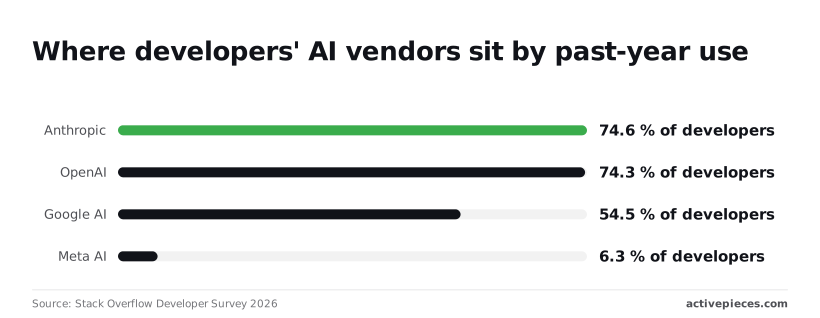
Google AI reached 54.5%. **Meta AI reached 6.3%**, which means far fewer people have shared prompts, failure cases or rate-limit warnings for Meta models, and your own test counts for more.
Before committing, check the release date on Meta's own model page. Meta released Muse Spark Open, and a recently released model has had little time to show how it behaves on real tickets, invoices or long threads.
### What "Open" means for access
The "Open" in the name points to downloadable weights, so read the license terms before using it on client work.
For hosted access, any workflow tool that can send an HTTP request can call a model API, so the AI step needs only an endpoint, a key and a mapped prompt field.

## What's measurably new in Muse Spark Open
Whether you can point your existing HTTP step at it today depends on a few stated specs. Dated 15 October 2026, they are:
- 816 billion total parameters with 42 billion active per token, so you are routing to a large mixture-style model whose per-token compute is closer to a mid-sized one. That's why a speed and cost test is worth running.
- A context window of 1,048,576 tokens, so whole document batches can go in one call, though you pay for every token you send.
- Multimodal input, so scanned forms or screenshots can enter the same prompt field as text.
- Open weights on Hugging Face, so you can self-host if hosted terms stop suiting you.
- Access through OpenRouter, so the endpoint-and-key setup above works without a Meta account.
Read the license text before putting the model inside a client deliverable. "Open weights" describes what you can download, not what you may resell or run commercially.
OpenRouter is the quickest route. Listed prices can change and your cost depends on your prompt lengths. Take the current rate from that page and multiply it against your real traffic.
Treat Meta's improvement claims as the vendor's own. None of them tells you whether this model beats the one you already run on your prompts, so run a small side-by-side test and treat the result as an indication, not a verdict.
## Connect Muse Spark Open in a workflow today
To run your side-by-side test you need a way to call the model, so you reach it through general building blocks. Three routes, simplest first:
1. An HTTP request step to OpenRouter with the model `meta/muse-spark-open`.
2. An AI step pointed at an OpenAI-compatible provider.
3. An MCP server.
With option 1, the HTTP request step, send a POST to OpenRouter, an API gateway that exposes many models behind one endpoint, and set the model field to `meta/muse-spark-open`.
You control the exact payload, so your test prompts go through unchanged. The cost is that you parse the response JSON yourself.
With option 2, an AI step with an OpenAI-compatible provider, your platform's AI step needs to accept a custom base URL and API key. Point it at an OpenAI-compatible endpoint and enter the same model name.
You get the platform's normal prompt and output handling, but check that the step lets you override the model name. Some only offer a fixed dropdown, which rules this route out.

Option 3 is an MCP server. MCP (Model Context Protocol) lets an agent call tools through a server.
Use this route only if you want the model sitting inside an agent that also uses other tools. For a plain cost-and-speed comparison it adds moving parts without adding information.
Reselling you a model amounts to choosing your AI step for you, at a price you never got to test Muse Spark Open against.
Activepieces has no Muse Spark Open integration, yet it runs whichever model you picked on your own provider key, so the spend sits on your provider account at your rate.
MoneyGram, Moneypenny, Alan and FundingSocieties run it that way, and the pricing page lists Bring-Your-Own-Key availability by tier, which you can set against a reseller's per-task charge.
Whichever route you pick, map the model's text field, not the whole response object, into the next step: the Slack message body, the ticket description, the spreadsheet cell. A wrong field mapping will make a good model look bad.
## How Muse Spark Open performed on automation tasks
It took about 18 times longer and cost about 17 times more per task, and Muse Spark Open got all three tasks right where GPT-5.4 mini got two, yet one additional correct task costs seventeen to eighteen times more resources, so that single extra correct answer would need to be operationally critical to justify the order-of-magnitude cost increase.
Muse Spark Open ran on default settings, which reason before answering, and that likely accounts for much of the delay.
**3 of 3 tasks came back correct** from Muse Spark Open, with a median of 14.8 seconds and $0.0024 per task, making perfect accuracy a premium offering with substantial latency and cost penalties, which is too slow for most real-time systems and too expensive for cost-sensitive applications.
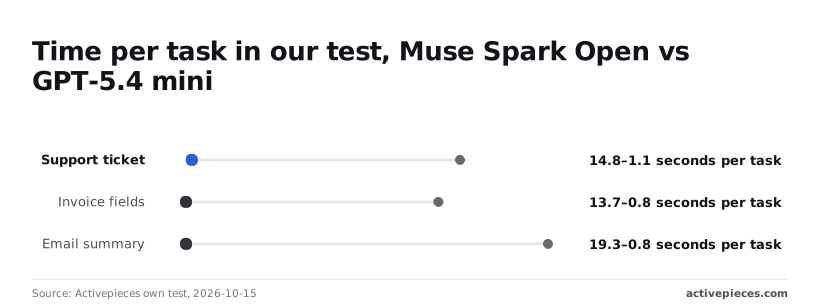
In that test, openai/gpt-5.4-mini, an older model, got 2 of 3 with a median of 0.8 seconds and $0.000138 per task. Current small models such as GPT-6 Luna or Claude Haiku 5.5 were not measured.
Sorting a support ticket took 14.8 seconds against 1.1. Pulling invoice fields took 13.7 against 0.8, and summarising an email thread took 19.3 against 0.8.
A flow that waits on the model before its next step will feel those 13 to 19 seconds on every run.
**Three tasks is a signal, not a verdict.** **One extra miss would erase the accuracy gap**, so test your own inputs before switching.
Meta released Muse Spark Open on October 15, 2026.
Three tasks is a signal, not a verdict. One extra miss would erase the accuracy gap, so test your own inputs before switching.
We reached the model through its OpenRouter page, listed as meta/muse-spark-open. That's the listing to check for current pricing before you budget.
## How Muse Spark Open's cost and speed compare
Muse Spark Open lists at $1.25 per million input and $4.25 per million output tokens, second-cheapest of the four models compared on output, and our test measured 14.8 seconds and $0.0024 per task.
[Utilix's comparison](https://www.utilix.tech/blog/claude-haiku-4-5-gpt-5-4-mini-gemini-3-8-flash-compared) puts Gemini 3.8 Flash lowest at $3.75, so **Muse Spark Open doesn't win on price**. GPT-5.4 mini lists at $4.50, which means Muse Spark Open saves $0.25 per million output tokens.
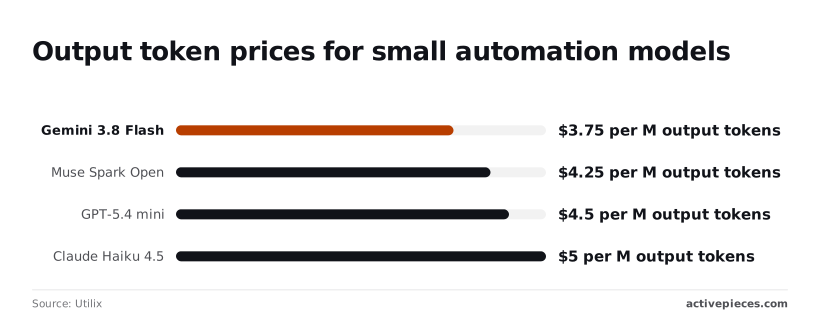
In that comparison, the older Claude Haiku 4.5 listed highest at $5.00, a $0.75 premium over Gemini 3.8 Flash; Claude Haiku 5.5 is Anthropic's current fast model and was not priced there. For a flow that emits short outputs, those gaps are pennies.
Read the table below for what's missing. It sets Muse Spark Open against the two OpenAI models on listed prices, with our own columns beside them, and most measured cells for the OpenAI models are empty, so it ranks little on speed or per-task cost.
| Model | Listed input / output per 1M | Our median seconds | Our cost per task |
|---|---|---|---|
| Muse Spark Open | $1.25 / $4.25 | 14.8 | $0.0024 |
| GPT-5.4 mini | $0.75 / $4.50 | not measured | not measured |
| GPT-5.4 nano | $0.20 / not measured | not measured | not measured |
A listed price is only half the bill, because a model that rambles or retries can cost more than a pricier one that answers once.
Run your own flow's real prompts through Muse Spark Open and your current model, then compare seconds and cost per completed task.
## What to watch next with Muse Spark Open
Once your own test numbers exist, they only stay useful if the listings, prices, and model files behind them stay the same, so repeat four checks on a schedule.
- OpenRouter provider listings and prices
- Hugging Face model card edits
- Meta blog updates
- A re-run of your own tasks before switching a live workflow
When a price or provider changes, a cost win can quietly disappear, and a card edit can change what you assumed about the model.
The last check matters most, because your test result describes the model as it behaved on your prompts that day. The two paragraphs below say where each source lives.
For the release date and any later announcements, Meta's own blog is the source, since Meta released Muse Spark Open. Read the post itself rather than a reseller's summary.
If Meta revises the post, the change tells you whether the behavior you tested still matches what the maker describes.
For licence terms, usage notes, and edits, go to the model card on Hugging Face, where the weights sit. Hosted access is listed on OpenRouter, which shows which providers serve the model and what each charges.
Providers come and go, so a route you tested last week may not be the cheapest or fastest one now. Re-check the listing before you compare it against your current model, and test again through the provider you plan to use.
## What Activepieces does about this
Activepieces is the workflow tool we build.
It has no Muse Spark Open integration, so the HTTP request step and the AI step with a custom provider are the routes to use. Both leave the trigger and the send-to-app step where they are. Only the middle slot changes.
The code is open. The monorepo counts 741 integrations, and the community edition is MIT-licensed, so you can read how a step sends its request and how the response gets mapped before you put a new model into a live flow.

You can also self-host it, which keeps your test prompts and the invoices or tickets inside them on infrastructure you control.
Model spend stays on your own provider account. You bring your own key, so an OpenRouter charge for `meta/muse-spark-open` is billed at the rate on that listing, with no per-task markup from us.
The pricing page lists Bring-Your-Own-Key availability by tier, so check it for the plan you'd use. That also makes the comparison honest: your current model and the new one run through the same flow, on the same inputs, billed by their providers.
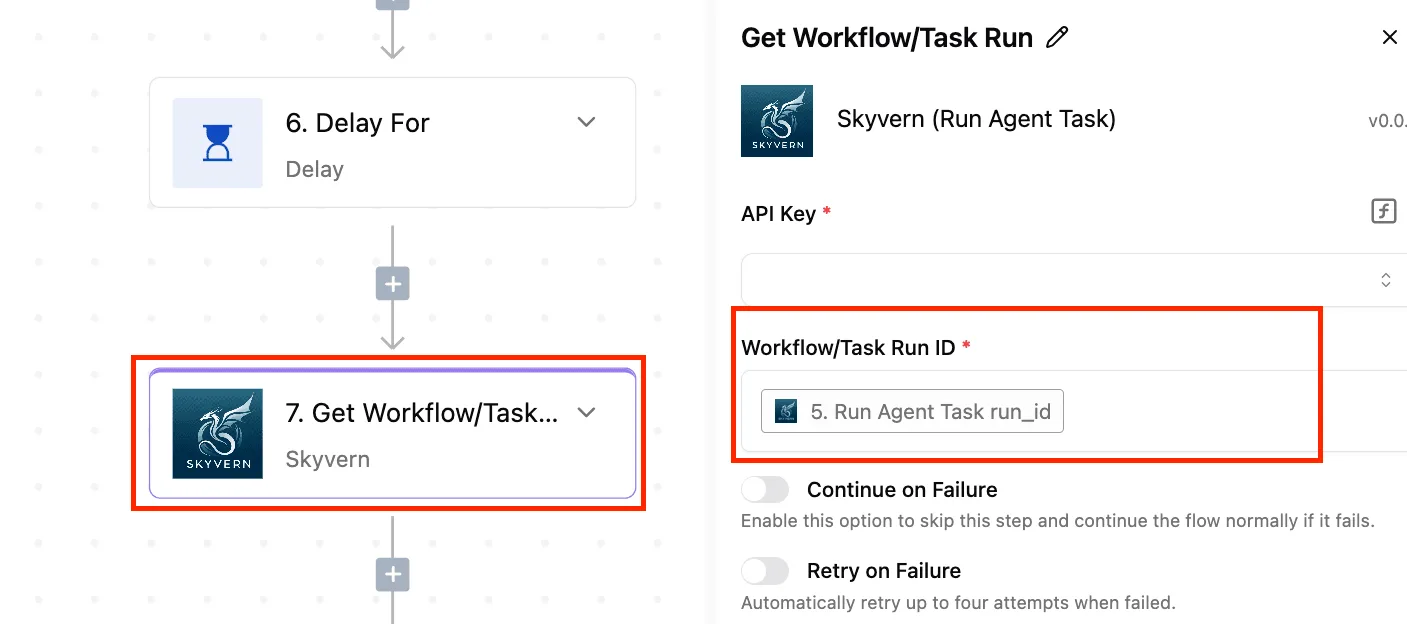
A practical way to start is to duplicate the flow you already run and change only the model step in the copy. Send the same real inputs through both, then compare seconds and cost per completed task from each run's history.
Treat the result as an indication, as the article says. If the gap holds on your own prompts, switch the live flow. If it doesn't, you've spent one changed step finding out.
## Frequently asked questions
Is Muse Spark Open free to use? We can't confirm that it's. Whether you pay depends on the provider you call it through, so read that provider's pricing for the model before you build a flow around it.
Cost is the very thing you're testing, so don't assume it's zero.
Can I download and self-host Muse Spark Open? Yes, the weights are downloadable from Hugging Face in BF16 and NVFP4 versions under the Muse Model License.
Open can mean published weights, a permissive license, or just wider access. Check the listing for a weights download and read the license terms before you plan any self-hosting.
Does Activepieces support Muse Spark Open natively? We haven't confirmed a native integration for it among the 741 integrations counted in its open source monorepo, so potential users would need to build custom integration.
It still works through the general building blocks, but you map the request body and response fields yourself.
Should I replace my current model with it? Not on the strength of a small test alone. A small test indicates whether cost and speed are worth pursuing, and it can't prove they hold at your volume.
Run the same real inputs through both models, compare cost and latency on your own tasks, and switch only if the gap holds up.
## Related reading
- [Vellum vs Open Source Automation for AI Workflows](https://www.activepieces.com/blog/vellum-vs-open-source-automation-for-ai-workflows)
- [Muse Wonder (2026 Guide)](https://www.activepieces.com/blog/muse-wonder-2026-guide)
- [Muse Wonder API Pricing: Rates per Million Tokens](https://www.activepieces.com/blog/muse-wonder-api-pricing-for-every-tier-and-workload)
## References
- [Utilix](https://www.utilix.tech/blog/claude-haiku-4-5-gpt-5-4-mini-gemini-3-8-flash-compared)
- [Activepieces own test, 2026-10-15](https://openrouter.ai/meta/muse-spark-open)
- [Stack Overflow Developer Survey 2026](https://survey.stackoverflow.co/2026/technology/data/llm)