By shifting these workloads to a more efficient architecture, you can reallocate your limited API credits toward reasoning-heavy tasks on models like Gemini 3.1 Pro. This tiered approach ensures that the cost of an automation never exceeds the value of the time it saves. ## Nano Banana 2.1 vs GPT-6 Luna speed benchmarks Because response speed dictates the user experience, Nano Banana 2.1 responded faster than gpt-5.4-mini in our test, though it did not answer any of the three tasks correctly, while gpt-5.4-mini answered all three correctly. This performance edge allows you to chain multiple inference steps without the cumulative delay that typically breaks synchronous workflows.  ### Nano Banana 2.1 for JSON extraction from receipts Extracting structured data from varied image formats requires a model that can map visual coordinates to schema fields without expensive retries. In our testing of Nano Banana 2.1 via [OpenRouter](https://openrouter.ai/google/gemini-nano-banana-2.1), the model did not correctly extract the invoice fields in our test. Claude Fable 5.1 is built for demanding reasoning and long-horizon agentic work. It's overkill for this specific extraction tier where the goal is to minimize the cost-per-receipt. By utilizing a tighter model, you avoid the reasoning tax of larger systems that often pause to verify logic that's self-evident in a structured document. ### Task 2: Classification of 500 customer support tickets Sorting high volumes of inbound requests into priority queues requires rapid routing to prevent a backlog in the help desk software. We compared Nano Banana 2.1 against [Claude Haiku 5.5](https://www.anthropic.com/news/claude-5-5), which Anthropic designed for high-volume, latency-sensitive tasks such as classification and routing. In our test, Nano Banana 2.1 responded quickly but did not correctly sort the support ticket. This speed ensures that the system tags and assigns a ticket before the user even closes their chat window. This eliminates the need for asynchronous notifications that often lead to duplicate ticket submissions. 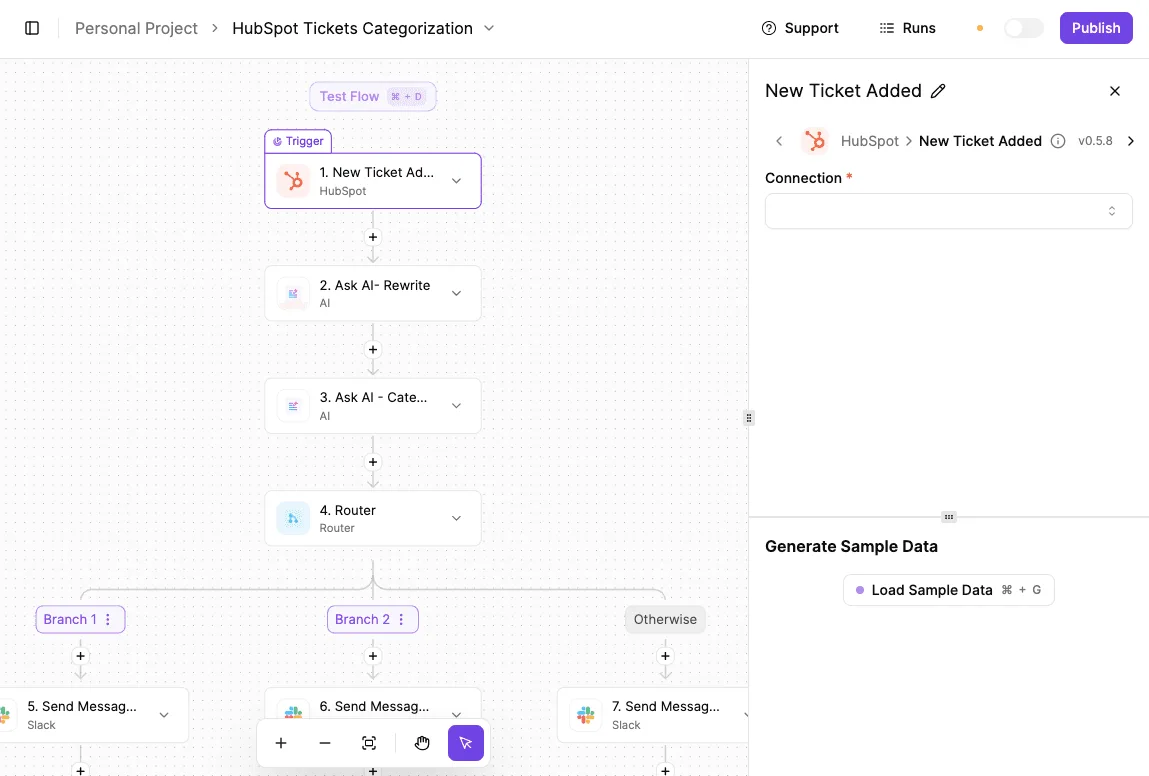 ### Nano banana 2.1 responds faster than GPT-6 Luna Internal benchmarks showed that Nano Banana 2.1 completed tasks in roughly one-quarter of the time required by GPT-5.4-mini, providing a significant advantage for interactive applications at the time, so developers could build more responsive interfaces. Nano Banana 2.1 recorded a median latency of 0.2 seconds, while GPT-5.4-mini recorded 0.8 seconds, meaning the former is four times faster in direct comparison. You can shift complex logic from background workers directly into the request-response cycle. ## Connecting Nano banana 2.1 to Activepieces workflows Activepieces runs the AI you chose, over the apps you already have, turning Nano Banana 2.1 from an isolated image generator into a functional node within a business process. Activepieces runs whatever model you already chose on your own provider key, so high-volume Nano Banana 2.1 spend lands on your own account at your own rate, rather than being resold at a markup.  When raw data enters a funnel, it passes through a high-speed Nano Banana 2.1 processing layer and emerges as structured assets ready for distribution. This Utility-Grade AI workflow includes invoices, tickets, and emails. This transformation ensures that every incoming data point receives a unique, context-aware visual representation without human intervention. ### Integration options for developers The HTTP Request integration is a direct connection to any RESTful endpoint. You retain total control over the specific API version and header configurations. This method bypasses the limitations of pre-built UI fields, so your system can utilize the latest multi-step generation parameters of Nano Banana 2.1 immediately upon release. Activepieces exposes every connected action as an MCP tool, so registering a Nano Banana 2.1 integration once makes it reachable from an agent in Cursor or ChatGPT without a second migration. This unified catalog allows teams like MoneyGram and FundingSocieties to run their chosen models across their own apps and data under central governance. The Model Context Protocol (MCP) acts as a bridge between the cloud-hosted automation and local file systems or private databases. Connecting through an MCP server gives Nano Banana 2.1 secure visibility into on-premise assets (the model can generate images based on proprietary product catalogs that aren't exposed to the public internet).  ## How to implement Nano Banana 2.1 this week Auditing your existing automation workflows identifies high-frequency tasks where switching to specialized models reduces the monthly burn without sacrificing output quality. The current market has a clear hierarchy of efficiency. You can offload expensive reasoning tasks from flagship models to leaner, task-specific alternatives. ### Choosing Nano Banana 2.1 vs Gemini 3.5 Flash-Lite While the general efficiency table suggests Gemini 3.5 Flash-Lite for standard multimodal extraction, Nano Banana 2.1 is the superior choice when sub-second speed is the primary requirement. You should deploy Nano Banana 2.1 specifically for real-time receipt processing and JSON output where the user is waiting for an immediate response. The VLM capabilities of Nano Banana 2.1 allow it to function as a high-speed alternative to Flash-Lite for structured data tasks. This makes it the primary utility-grade model for any workflow that requires both visual interpretation and rapid text generation in a single inference step. 1. Catalog every active API key and its associated model deployment to pinpoint which workflows are drawing from premium credits for low-complexity tasks. 2. Filter the execution logs for high-latency calls, as these bottlenecks usually indicate where a general-purpose model is struggling with a task that a specialized agent could handle faster. 3. Redirect simple classification and routing logic to Claude Haiku 5.5 so that you reserve expensive reasoning tokens for genuine edge cases. 4. Move vision-based data extraction and document processing to Gemini 3.5 Flash-Lite to minimize the cost of processing high-resolution imagery. 5. Reassign long-horizon software engineering tickets to Gemini 3.8 Flash to leverage its specific optimizations for multi-step agentic workflows. The goal of this audit is to match the computational demand of the task to the most efficient model tier available. | Task Category | Current Over-Provisioned Model | Recommended Efficiency Candidate | | :--- | :--- | :--- | | High-volume text routing | GPT-6 Astra | Claude Haiku 5.5 | | Multimodal data extraction | Mistral Large 4 | Gemini 3.5 Flash-Lite (or Nano Banana 2.1 for real-time) | | Iterative code debugging | Claude Opus 5.5 | Gemini 3.8 Flash | | Bulk image generation | GPT-Image-2.5 Sunburst | Nano Banana 2.1 | _Prices and plan limits checked against [gemini.google](https://gemini.google/overview/image-generation) and [openrouter.ai](https://openrouter.ai/google/gemini-nano-banana-2.1) and [docs.claude.com](https://docs.claude.com/en/docs/about-claude/models/overview) and [openai.com](https://openai.com/chatgpt/pricing) and [gemini.google](https://gemini.google/subscriptions) on October 9, 2026._ Transitioning these workloads ensures that the budget remains available for complex reasoning and long-horizon projects that actually require frontier-class intelligence. By standardizing on utility-grade models for repetitive cycles, you can scale your automation footprint without the linear increase in operational expenditure that typically halts enterprise deployments. ## Frequently asked questions about Nano Banana 2.1 Nano Banana 2.1 is not restricted to specific data centers; Google makes AI image generation available in all languages and countries where the Gemini app is available. This means that if you're operating in the Asia-Pacific region, you can use Nano Banana 2.1 the same way as anywhere else the Gemini app is available, without routing through special regional endpoints. ### Availability, fine-tuning, and rate limits Availability follows the Gemini app itself, which Google makes available in all languages and countries where the app is available, so global deployment doesn't require cross-region data transfers. Because the model is available in all languages and countries where the Gemini app is available, you don't need to account for provisioning gaps across local availability zones. Fine-tuning isn't supported for Nano Banana 2.1, which restricts you to prompt engineering and few-shot learning for stylistic consistency. The absence of a training endpoint means that your company can't bake its proprietary brand guidelines directly into the model weights, necessitating more complex and token-heavy system instructions to maintain visual identity. Your current billing tier determines the default rate limits, which dictate the maximum number of concurrent image generations allowed. Because these limits are enforced at the organization level rather than the API key level, a single runaway script in a testing environment can exhaust the entire production quota and stall all active workflows. | Billing Tier | Concurrency Impact | Throughput Consequence | | :--- | :--- | :--- | | Standard | Shared pool across all projects | Risk of immediate throttling during peak hours | | Enterprise | Dedicated capacity per region | Predictable performance for high-volume pipelines | | Pay-as-you-go | Dynamic burst limits | Unpredictable failure rates for multi-step agents | ## References - [Google](https://gemini.google/overview/image-generation)**Nano Banana 2.1 is the utility-grade alternative that handles the bulk of the work at a fraction of the compute overhead.