If you run Sonar inside an [Activepieces](https://www.activepieces.com) flow, the run costs 1 credit however many steps it has, but every Sonar call inside it is still one billable request on Perplexity's side, so loops multiply the fee directly. Perplexity's consumer subscriptions are priced per seat for the app. They don't fund API calls, which draw on a separate API balance. Budget the two independently. ## What 1,000 searches cost on each Sonar model At 500 input and 400 output tokens, the per-request fee and the context setting decide the cost of a Sonar search. The token charge on a reply that short is the smaller part of the bill. 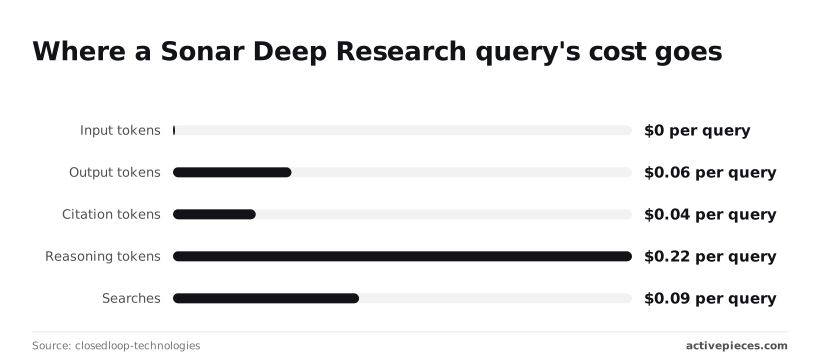 The arithmetic is the same for every model: cost per search is the request fee for the chosen context level, plus 500 times the input rate, plus 400 times the output rate. Read the request-fee segment first: it changes with the context setting, not with how long your answers are. ### Sonar API cost for 1,000 searches a month Most teams won't notice what the model choice does to the bill at this volume. Run the formula once per model and multiply by 1,000, and the totals differ mainly by which context level you left switched on. A small team should set context to the lowest level that still returns usable citations. Picking the cheapest model matters less here than not leaving High as the default. ### Sonar API cost for 50,000 searches a month Multiply the same per-search cost by 50,000 and every habit becomes a line item. A request fee that looked like rounding at 1,000 searches now dominates the invoice, and the gap between context levels turns into a gap between budgets. **Trimming replies helps less than lowering context**, since token cost grows only with answer length. Moving from Sonar to Sonar Pro at the same context level raises the bill by a visible multiple. This volume is where you should test whether the cheaper model answers well enough. ### Sonar Deep Research pricing breaks per-search estimates Once you reach Deep Research, the per-search formula stops holding, because one query triggers many internal searches and a long chain of reasoning. Perplexity bills those reasoning tokens on top of input and output, so a 500-in, 400-out assumption understates the real token count by a wide margin. You can't budget Deep Research from a table of request fees. Run a sample of real queries, read the usage fields on each response, and price from what was actually metered. ## Sonar API costs and limits that inflate bills Five things move a Sonar bill past the list price. They are the search-context setting, reasoning and citation tokens, Deep Research's extra charge lines, usage-tier rate limits, and how prepaid credits and failed requests are handled. The catches below pair every cost with its fix, so you can check your own configuration against them. ### Search context setting Sonar charges a **per-request fee on top of tokens**, and that fee changes with the search-context level. A higher level pulls in more retrieved material and lifts the fee on every call. If your queries are simple lookups, leaving the setting high means paying the larger fee thousands of times for context nobody reads. Set it to the lowest level at which your sample answers stay acceptable, and raise it only for the query types that fail. ### Reasoning and citation tokens A short answer can cost far more than its length suggests, because reasoning models bill the tokens they spend thinking, and these are separate from the answer you see. Some models also meter citation tokens as their own line. The fix is to route plain factual queries to a non-reasoning model and keep reasoning models for questions that need them. Deep Research goes further: it adds a charge for the search queries it runs, so one request produces several lines. Cap how often your code calls it, and never use it as a default. Your tier depends on how much you have spent on the account, and limits rise in tiers. A new account can hit throttling before any bill looks large. Check your tier in the dashboard before launch, and add queueing and backoff so retries don't pile up as duplicate requests. ### Credits, top-ups and failed requests If the balance runs out, your service stops, because Sonar is prepaid. Automatic top-ups prevent that, but they will also refill after a runaway loop. Set a top-up ceiling and a balance alert.  Whether failed requests bill isn't clearly documented, which makes it an undocumented item. Test it yourself: send a deliberately malformed call, then compare the balance before and after. ## Sonar versus Tavily, Exa and OpenAI search pricing The same malformed-call test works on any rival, and it matters because these four vendors meter different units, so a "search" isn't the same purchase at each. The table below, checked on 2026-10-24, shows what each one meters and what it hands back. Take from it that none of the four is like for like. | Service | Price per 1,000 searches | Answer or raw results | LLM tokens billed separately | Free tier | |---|---|---|---|---| | Sonar | Request fee that moves with the search-context setting | Answer with citations | Yes | None that we confirmed | | Tavily | Credit-based; a basic search uses one credit | Raw results, optional short answer | Yes, for whatever model reads the results | 1,000 credits/month | | Exa | $4 to $12, depending on search type | Raw results | Yes | None that we confirmed | | OpenAI web search | Per tool call | Answer from the model | Yes | None that we confirmed | Exa shows the spread inside one vendor. According to [Mux](https://getmux.io/guides/exa-pricing-explained), instant search costs $4 per 1,000 requests, fast and auto cost $7, and deep costs $12, meaning search sophistication directly multiplies per-request cost. 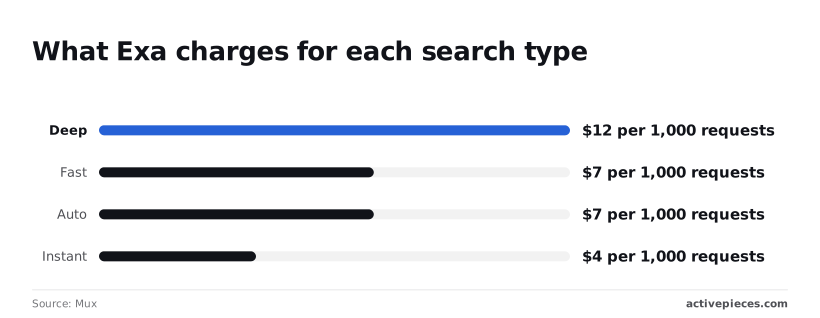 Deep is therefore three times the price of instant. Sonar wins when you want a finished, cited answer from one call and don't want to build a reading step. Tavily wins for prototypes, since 1,000 free credits a month covers testing without a card. Exa wins when you want raw results and can pick the cheap tier. OpenAI's tool suits you if the model is already OpenAI's and you want one invoice. Whatever the answer length, Perplexity charges a request fee per call. Token cost accrues per word read and written. Sonar and OpenAI web search charge both, so a short question on a high context setting still carries the full request fee. Tavily and Exa return raw results, which means a second bill: the model that reads those results charges tokens on every page you feed it. Comparing only the headline search price leaves that second bill out, and it can be larger than the first. If your test call drains a balance, look at the API console, not the subscription page. A consumer Pro or Max subscription is a separate account from an API balance, and paying for one doesn't fund calls made with an API key. ## Run Sonar from Activepieces with a spend ceiling On Activepieces the run is the meter, not the steps inside it: a flow with a cache check, a run cap and a Low-context Sonar call is 1 credit, exactly what a bare two-step call costs. 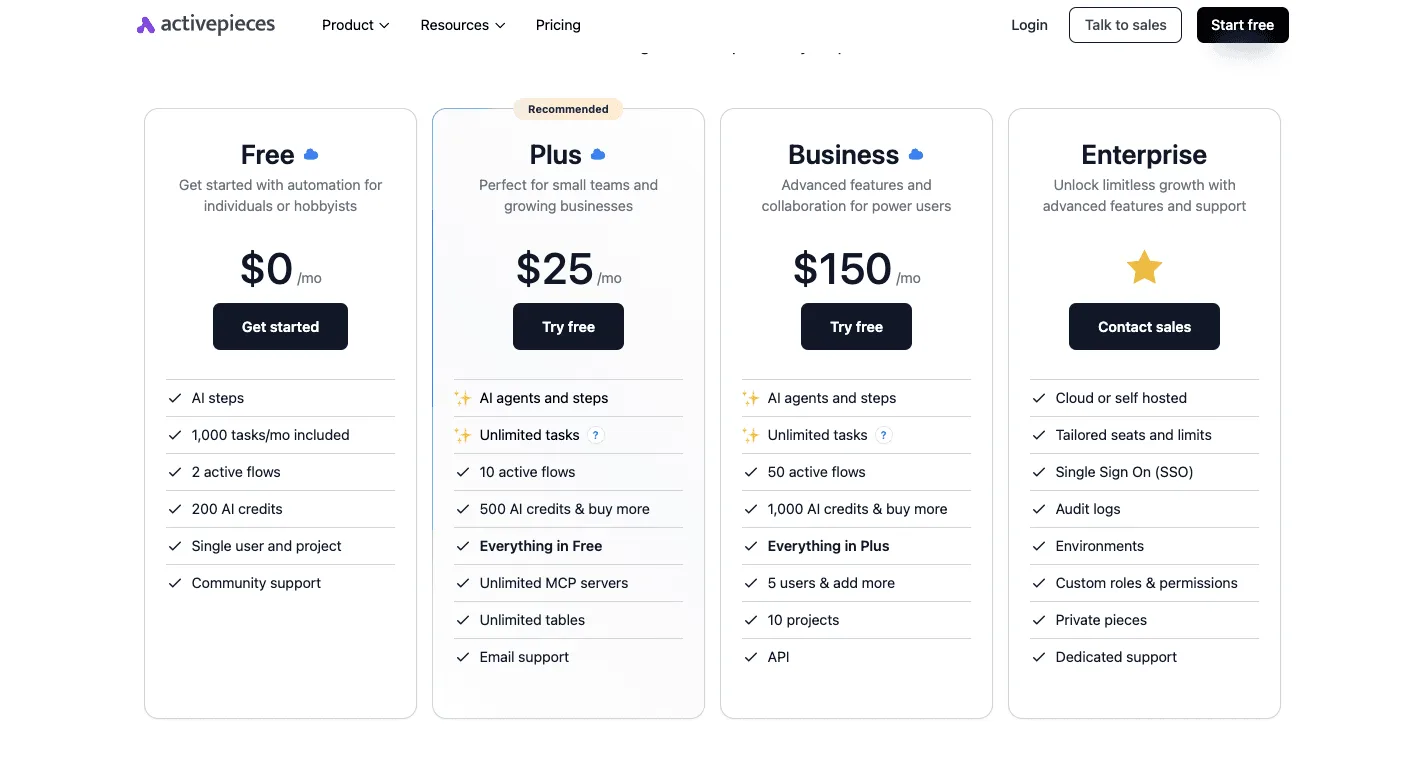 Zapier bills per task and Make per module, so on their pricing pages every added step is added cost, which punishes the habit of splitting work into smaller, safer stages. Here that split is free, and the per-request fee and model price stay where Perplexity set them. Budgeting the fixed fee and the token charge separately only helps if something limits how many times each one fires. ### When a workflow tool is worth it Activepieces is an MIT-licensed automation platform with 744 integrations, so you probably won't need to wait for connector support: you build a flow from a trigger and a chain of steps, and it runs them without you. The metered unit on Perplexity's side is still the request, plus tokens. A run is 1 credit however many steps it has, and the free plan includes 1,000 credits a month with unlimited flows. That is a separate meter from Perplexity's, and it doesn't discount a single Sonar call.  That makes it a fit for recurring research: a morning brief on a set of competitors, or enrichment of new records with a short web-sourced summary. In both cases the same questions come back again and again, and a repeated question is a repeated per-request fee. A flow can catch that. For a one-off call, skip it. If you're running a query by hand or testing a prompt, a direct API call costs the same and takes less setup. A workflow tool pays off only when repetition is the problem. ### Sonar API spend caps and response caching The flow below is the smallest version that puts a ceiling on spend. The diagram shows where each control sits, and the point to take from it is that **the cache check comes before the paid call**, so a repeat query never reaches Perplexity. 1. Schedule trigger starts the run at a fixed interval. 2. Check the cache for the query; if an answer is stored, use it and end the run. 3. Call the Perplexity API at Low search-context size, with max tokens set. 4. Store the answer against the query for the next check. 5. Stop when the daily run cap is reached.  Each step maps to a cost lever from earlier. Low context trims the context-dependent part of the per-request fee. Max tokens bounds the output you pay for, so a verbose answer can't inflate one request. The cache turns a repeated question into a free lookup. The run cap sets a worst case: the daily maximum is the cap multiplied by your worst-case cost per request, a number you can write down before the month starts. Some controls live outside the product. Perplexity lets you set a spending limit on the account side, and you can pick a cheaper model for routine briefs, keeping a heavier one for the few queries that need it. Treat those as a second layer, because the flow's cap only counts runs it started. What follows is the comparison: how this bounded setup compares with leaving the calls uncapped. ## Frequently asked questions ### Is there a free Perplexity Sonar API tier? Not one we can confirm, so budget as if every call is metered. The API is billed per request and per token against account credit, and each search carries both a per-request fee and token charges from the first call. Check the billing page for any promotional credit before you rely on it, because a trial credit isn't a free tier and runs out at the same per-search rate. ### Does Perplexity charge for failed or empty searches? Whether failed requests are billed isn't clearly documented, and a request that completes with a thin or unhelpful answer is billed. The per-request fee and the tokens used both count, so a weak result costs the same as a good one. Validate your queries on a small batch before you run a large job, and treat a poor answer as spent money. ### Is Sonar API pricing the same as a Perplexity Pro subscription? No. A Pro subscription is a separate consumer product, and the API is billed on usage whatever plan you hold. The per-search cost still comes from the same three levers: the per-request fee, the search-context setting and the model. Compare any subscription perk against your actual call volume rather than assuming it covers production traffic. ### How do I set a monthly spend limit on the Sonar API? The surest cap is the credit balance itself. Fund the account with an amount you can afford to lose and leave automatic top-up switched off, so the balance stops the spend. Add limits in your own code too: set a ceiling on output tokens, keep the search-context setting at its lowest acceptable level, and count calls per day. Confirm what your dashboard offers, since its controls may differ from what is described here. ### Does Sonar cost more than a model plus a search API? It depends on how many tokens a typical answer uses. Sonar folds search and generation into one call, so you pay one per-request fee plus tokens. A separate setup pays a per-query search fee, then model tokens for the retrieved text you feed in. Long, context-heavy answers tend to favor the bundle, while short lookups can favor a cheap model paired with a lean search API. Price your own average query both ways before you commit. ## Related reading - [Perplexity API Pricing in 2026: Models & Costs](https://www.activepieces.com/blog/perplexity-api-pricing-in-2026-models-costs) - [Gemini 4 Argon API Pricing: Tokens and Search (2026)](https://www.activepieces.com/blog/gemini-4-argon-api-pricing-tokens-and-search-2026) - [DeepSeek Search and Fetch API: Pricing and Reliability](https://www.activepieces.com/blog/deepseek-search-and-fetch-api-pricing-and-reliability) ## References - [Mux](https://getmux.io/guides/exa-pricing-explained) - [Perplexity docs](https://perplexity.mintlify.app/docs/sonar/models/sonar-pro) - [closedloop-technologies](https://github.com/closedloop-technologies/awesome-deep-researchers/blob/main/COSTS.md)However short the answer, every API call carries one request fee.