# Poe Integration: How Points and Plan Costs Work (2026)
By Leah Goldberg · 2026-11-12 · Source: https://www.activepieces.com/blog/poe-integration-how-points-and-plan-costs-work-2026
---
Start with Premium at $19.99 a month if you're testing the API alone (or wiring it into a workflow tool like [Activepieces](https://www.activepieces.com) to see how it behaves), and move up only when your points run out before the month does.
**Every plan sells points at the same rate**, so a bigger plan buys more capacity, not a discount.
Poe integration is the practice of connecting Poe's AI models to your own app or workflow, most often by calling the Poe API with a key from your account, so that each request draws on your plan's points and rate limits.
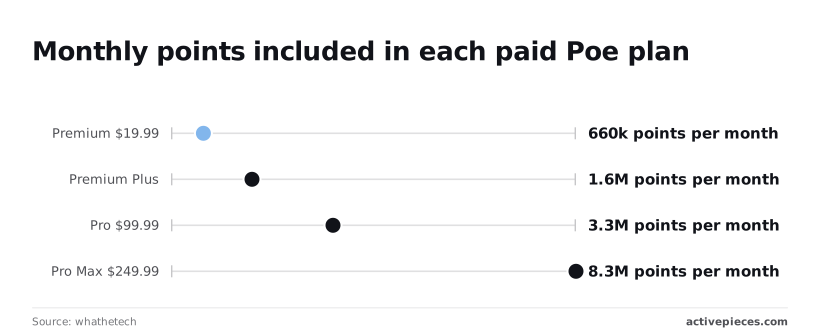
If you want to see where each plan tops out, the table below, from [whathetech](https://whathetech.net/ai-compare/tools/poe) (checked 12 November 2026), shows each plan's monthly points and the signal to move up.
## Which Poe plan fits you
| Plan | Monthly Price | Monthly Points | Upgrade Trigger |
|---|---|---|---|
| Premium | $19.99 | 660,000 | Points gone before month-end |
| Premium Plus | $49.99 | 1,650,000 | Shared key drains the pool mid-month |
| Pro | $99.99 | 3,300,000 | Many users or automated runs on one key |
| Pro Max | $249.99 | 8,250,000 | Sustained volume past the Pro pool |
Because the price per point is flat, the right plan is whichever one your realistic usage fits inside, and the sections below put numbers on that.
**660,000 points a month** is what Premium gives you for $19.99, which averages about 22,000 a day. That's enough to build and test one integration, and a single runaway loop can burn through it.

The catch is that API calls and chat draw from the same pool, so your own chatting shrinks your testing budget.
Split five ways, Premium Plus's 1,650,000 points at $49.99 come to 330,000 each, versus 132,000 each on Premium, meaning each member receives substantially more from Plus. It fits five people best.
The catch is the shared pool: one person's batch job can leave four teammates throttled for the rest of the month.
If you have 25 people, Pro Max at $249.99 gives 8,250,000 points, or 330,000 each, matching the five-person Premium Plus ratio. Pro at $99.99 stretches the same 25 people to 132,000 each.

The source table covers points only, not admin controls or SSO, so confirm those on poe.com before you pick a plan for compliance reasons.
### Heavy usage or high API volume
2.5 times the points costs 2.5 times the price here: Pro at $99.99 buys 3,300,000 points, and Pro Max at $249.99 buys 8,250,000.
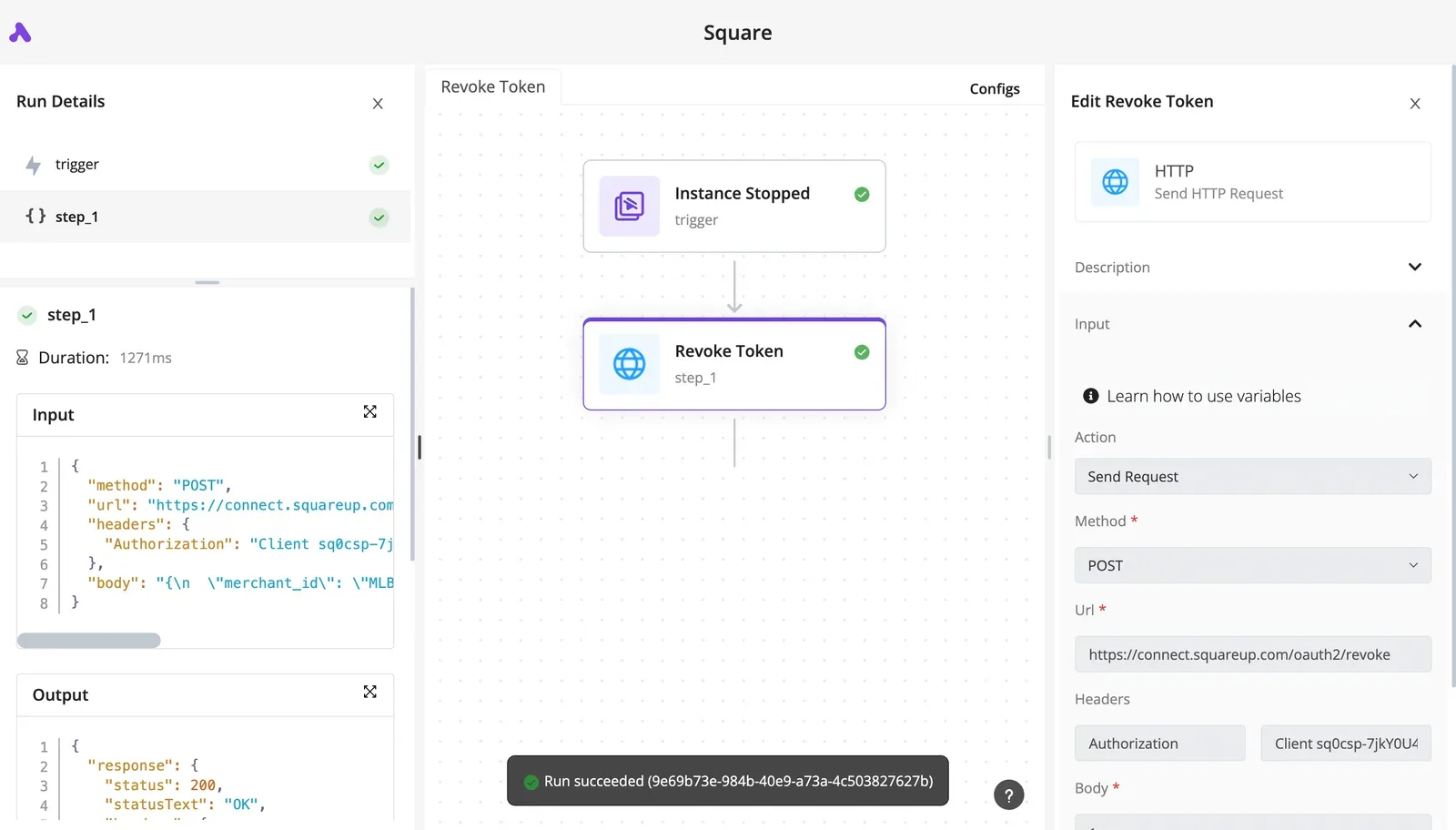
If your volume is steady and large, no plan lifts the ceiling, so [Activepieces](https://www.activepieces.com) can sit between your trigger and Poe and pace the calls, and a run there costs 1 credit however many steps it has, so the pauses add nothing.
That keeps you inside the pool instead of burning it in bursts.
## Which Poe connection direction fits you
Two things count as a Poe integration. Either Poe's models run inside your own app or workflow, or your own code runs inside Poe. The direction of the call decides everything else.
Before you write any code, sort out which side sends the request, because that determines what you build, who hosts it, and where the errors land. It's the same split that separates an inbox rule you write from a forwarding address someone else controls.
In the left diagram below, your app sends a request to the Poe API; in the right, Poe sends a webhook to a server you run.
Take away that the arrow points opposite ways, so the failure you debug in one case is on a different machine in the other.
Before you pick, know that each route comes with its own limits, covered next.
### Poe API: your app calls Poe
You create a key in your Poe account, put it in your app, and send requests. Your app's the caller and Poe's the service answering.
You need the key and a place to make HTTP calls, which can be a script, a backend, or a workflow tool with a request step.
When a loop retries on failure, it can drain the pool and trip the limit at the same moment, and that's the billing catch people miss. Every call draws on your plan's points and is subject to your plan's rate limits.
Nothing in the integration changes that.
Build in backoff before you build anything else. This route fits you if you want Poe's models inside something you already run.
### Server bots: Poe calls your app
Here the direction flips. You run a server, register it as a bot, and Poe sends requests to it when someone talks to that bot.
You need a publicly reachable endpoint, code that accepts Poe's requests and returns a reply, and a way to keep that server up.
You pay for your hosting and for any outside services your bot calls, and keeping them up is your problem, separate from the points a Poe user spends.
This route fits you if you want your own logic, data, or model to be available to people inside Poe. If your goal is to use Poe's models in your app, it's the wrong tool and adds a server to maintain for nothing.
Don't assume a third route exists. The API path doesn't come with a ready-made trigger-and-action connector, so for no-code tools you're supplying the HTTP request and the key yourself.
Nor does a key lift your plan's limits. If you hit a ceiling, the fix is pacing your calls or changing your plan, not finding a different door.
## Poe API setup in five working stages
Before a key does anything, your Poe plan has to be active and have points available, so check that first and the five actions below go quickly.
Follow the list below in order, from account to first response, and note that only the last step proves anything.
1. Open Poe Settings.
2. Navigate to the API tab.
3. Click "Create Key".
4. Copy and save the secret.
5. Test in Terminal.
Four steps in, all you have is a credential, so the onboarding process is far from finished. Step 5 tells you whether the credential, the plan and the endpoint agree with each other, and the stages below explain what each one needs.
When the balance is empty, the integration looks broken, because every call spends points from your account. Open your account's usage view before you generate anything.
If the balance is empty or the plan's lapsed, the key will be created fine and then fail on every request. Fix that now and you skip the most common "it worked yesterday" ticket.
Create the key from Settings, on the API tab. Poe shows the secret when you create it, so copy it straight into a secrets manager or an environment variable.
Don't paste it into a script, a shared doc or a chat thread. If it leaks, anyone holding it spends your points, so revoke it and create a new one.
### Send your first Poe API chat request
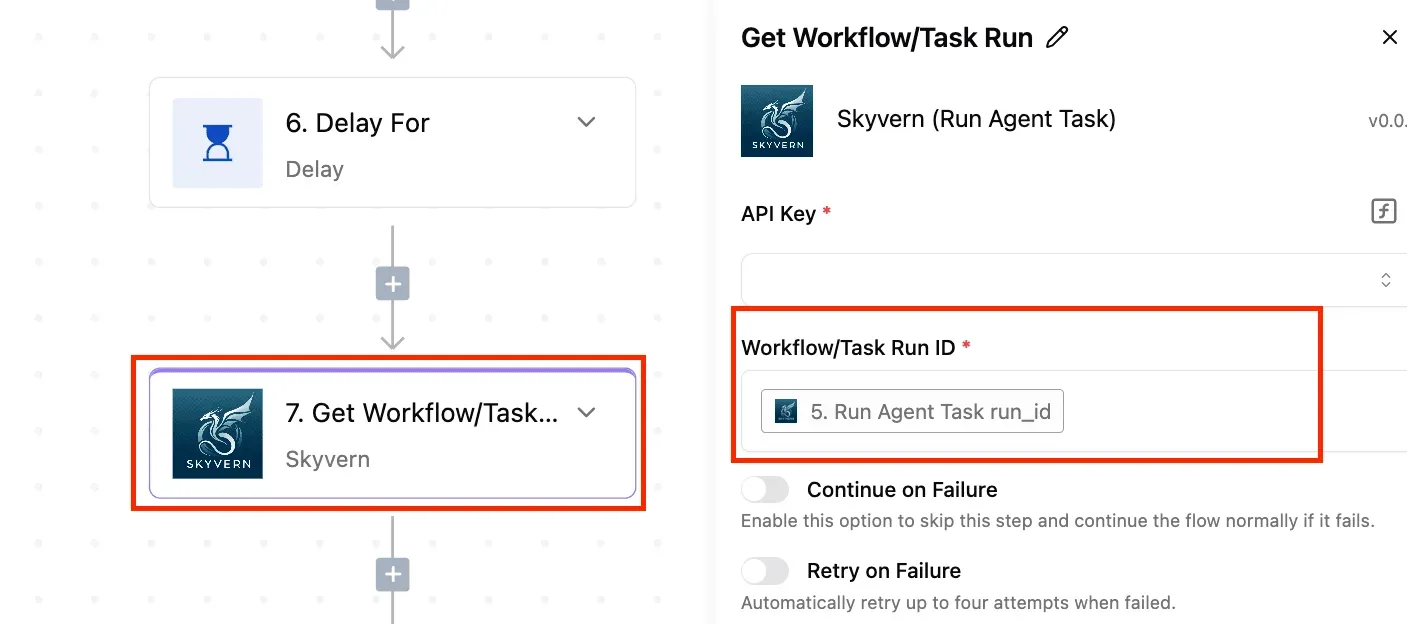
Send a plain chat request to `https://api.poe.com/v1/chat/completions` with the header `Authorization: Bearer YOUR_KEY` and a JSON body that has a model and a messages array.
The model field takes the bot's handle exactly as it appears on its Poe page, so copy it rather than retyping it.
Run it from a terminal with curl first. If it fails there, no library is hiding the cause, and the error text will point to a bad key, a wrong handle or a rate limit.
### Use an OpenAI-compatible client with Poe
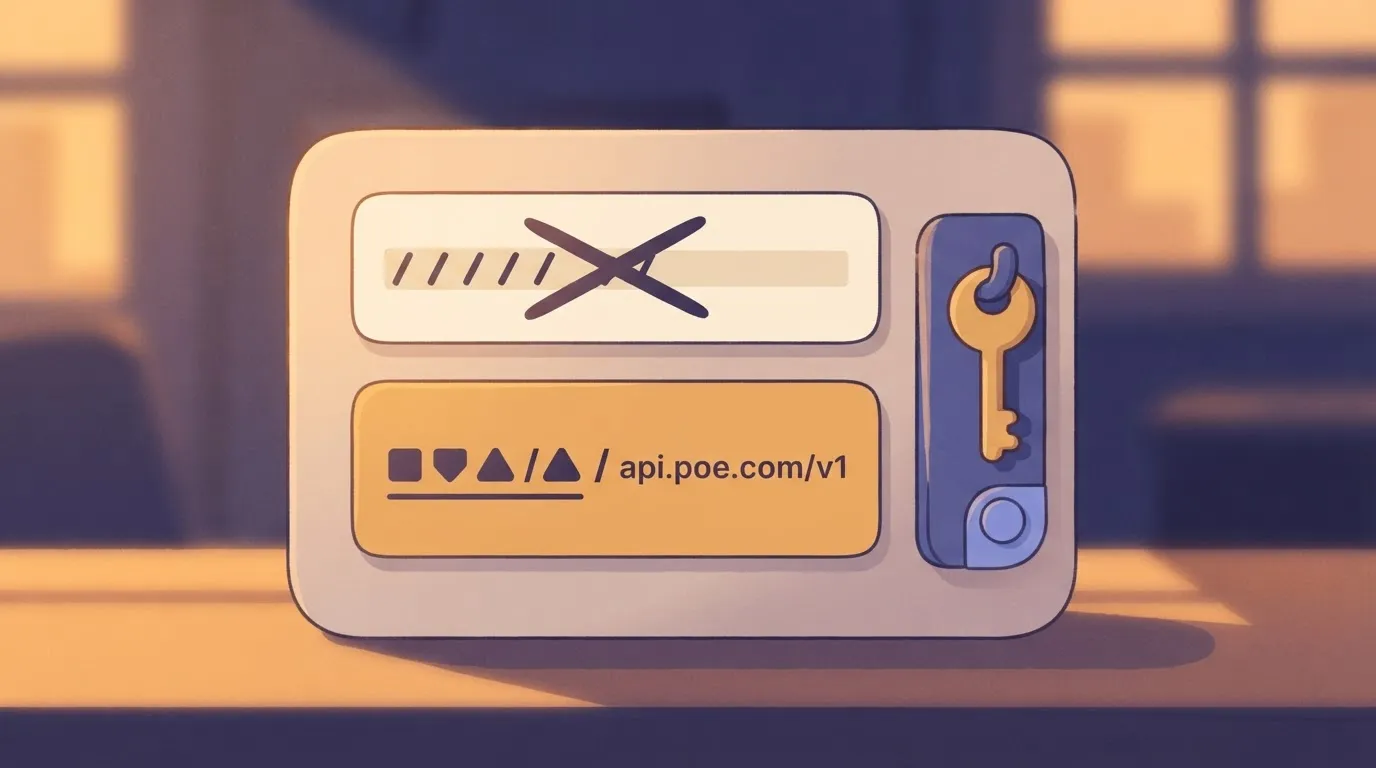
If your app already uses an OpenAI-compatible client library, you rarely need new code. Set the base URL to `https://api.poe.com/v1`, pass your Poe key where the OpenAI key went, and change the model string to a Poe bot handle.
Your request and response handling stays the same.
Once the client draws on Poe points and Poe's rate limits, retries that were harmless before can drain your balance quickly. Add a pause between retries before you turn on any automation.
## Poe integration limits and errors with fixes
Check the budget before you debug the request, because most Poe API failures come from your points balance and rate limits, not from your code.
**Retrying a failed call without a pause is exactly how a small limit error turns into a blocked workflow, and every retry also spends points.**
### Rate limits and points budgets
**Every call draws from the same points balance** as your chat usage, so an automation can quietly drain the budget you wanted for manual work.
**Retrying a failed call without a pause is exactly how a small limit error turns into a blocked workflow, and every retry also spends points.
Per [Whizi](https://whizi.io/resources/is-poe-ai-worth-it/), one standard message costs 600 points on GPT-5.5, 497 on Claude Opus 4.7, 234 on Claude Sonnet 5 and 200 on Gemini 3.5 Flash.
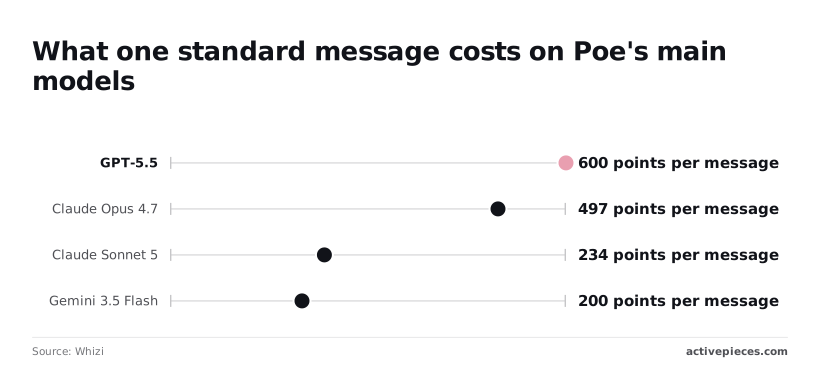
In Whizi's figures, a loop that ran on GPT-5.5 **burned points three times as fast** as the same loop on Gemini 3.5 Flash, so put the cheapest model that does the job in your first draft.
Expect output to be the expensive side, since input and output are priced differently.
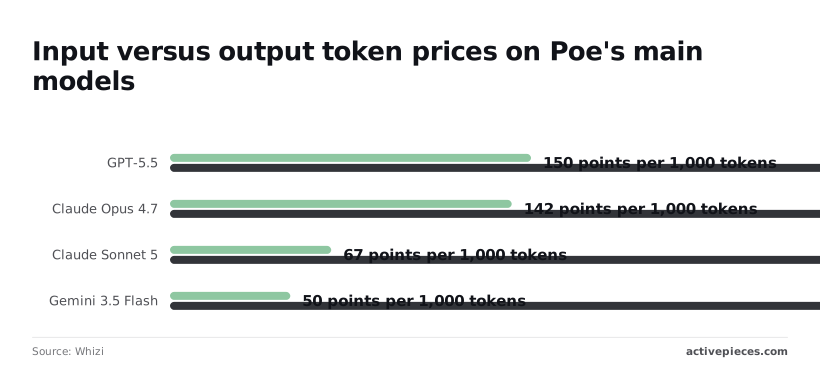
[Whizi](https://whizi.io/resources/is-poe-ai-worth-it/) lists GPT-5.5 at 150 to 900 points per 1,000 tokens, Claude Opus 4.7 at 142 to 709, Claude Sonnet 5 at 67 to 334 and Gemini 3.5 Flash at 50 to 300.
On all four, **output costs about six times input**, so a verbose prompt is cheap, while a long reply is what empties the balance. Cap response length in your request.
The API has a rate limit of 500 requests per minute, and you can track your usage with the `X-RateLimit-Remaining` response header.
### Poe API error codes, causes and fixes
Start at the code in your logs and work across; the table maps the four codes you will meet most often to their usual cause and the quickest repair.
| Error Code | Likely Cause | Immediate Fix |
|---|---|---|
| 401 | Invalid Key | Copy the key again from your Poe account, check for trailing spaces, and confirm it is sent in the authorization header. |
| 402 | Low Points | Check your balance, top up or wait for your allowance to refresh, and switch to a cheaper model meanwhile. |
| 429 | Rate Limit | Stop sending, wait, then retry with a growing delay between attempts. |
| 504 | Timeout | Shorten the prompt or the maximum output, then retry once after a pause. |
When the model name is wrong, the request is rejected before any points are spent, which is a separate failure with its own symptom.
Poe's exact status code for it is unverified here, so compare your model string against the bot name in Poe itself. Fix 401 and 402 first, **because retrying them never helps**.
### Poe API settings that affect cost
You can move your bill with three settings without touching your code. Model choice is the big one, given the 3x gap above, which means it outweighs every other variable in the value equation. Maximum output length caps the expensive side of every call.
At Whizi's GPT-5.5 rate, three automatic retries on a failing call would have cost 1,800 points for one answer you never receive, which is why retry count multiplies everything. Set retries low and keep the pause between them.
## Run Poe calls from a workflow with Activepieces
When you want Poe called from a workflow, Activepieces, an automation tool with an MIT-licensed core and 747 integrations counted in its public repository, can do it through its HTTP step, with your key held as a secret and retries on a 429 capped where you set them.

That cap matters because a workflow that retries blindly spends points on answers you never receive.
### When a workflow tool is worth it
Start from the trigger. If the call should fire when a support email lands in a labeled Gmail folder, a form is submitted, or a ticket changes status, someone has to own the glue between that event and Poe. You have four realistic options.
If you write custom code, you get full control, but you also own hosting, error handling and key storage.
A bare HTTP request from whatever system already fires the event works if that system can set headers and retry sensibly, and many can't. Zapier, a hosted automation service, and n8n, a self-hostable workflow builder, both do this job as well.
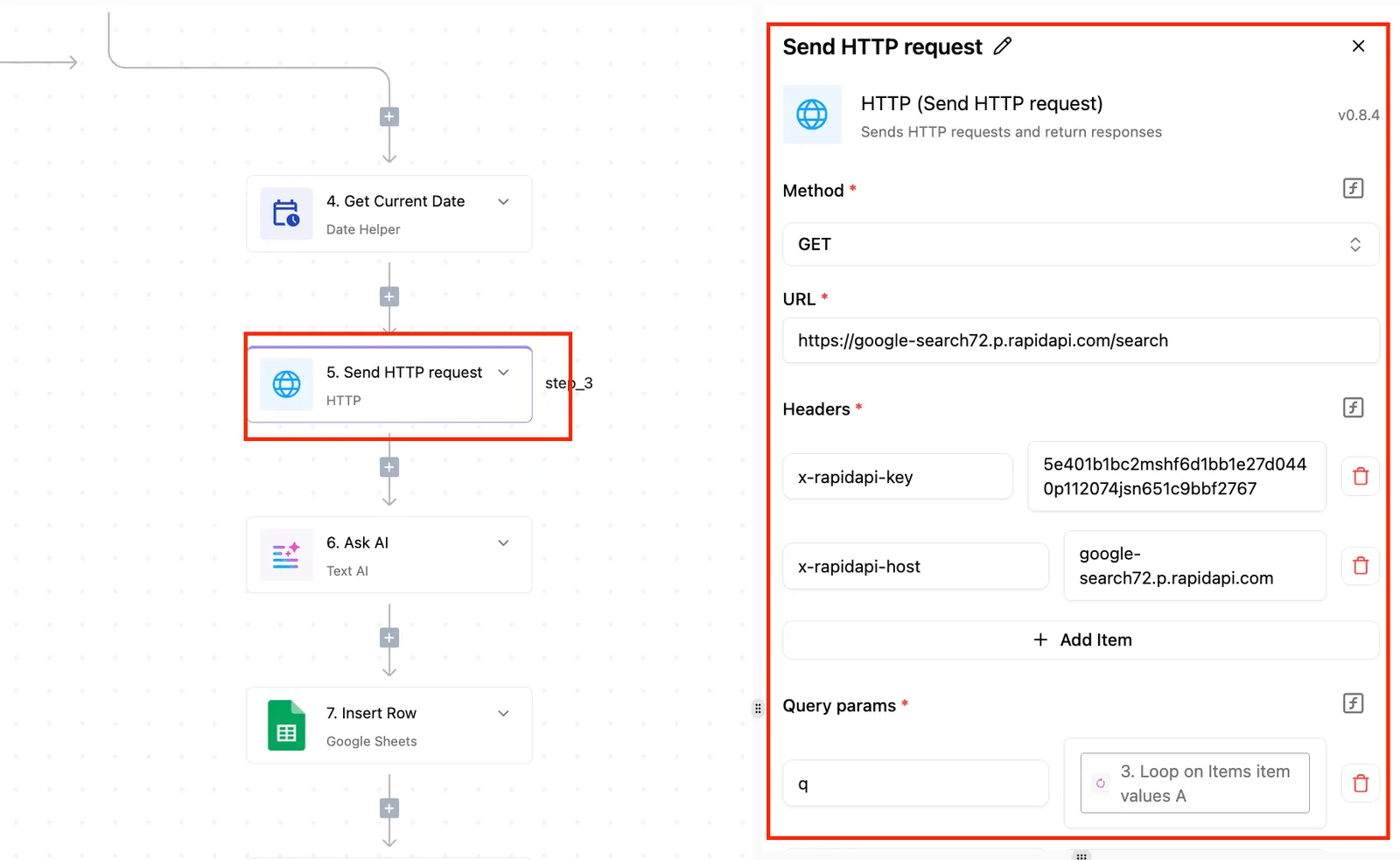
Where you want the trigger, the Poe call and the failure handling visible in one flow, Activepieces earns its place. That means the person who gets paged can see which step burned points.
If one script in one place makes the call, you probably don't need it.
### Build the Poe HTTP request steps
Build it in this order:
1. Pick the trigger that matches your business event, such as a new email, a new row or an incoming webhook.
2. Add the HTTP step and set the method to POST. Point it at Poe's OpenAI-compatible chat completions endpoint, `https://api.poe.com/v1/chat/completions`.
3. Store your Poe API key as a secret or connection rather than pasting it into the step, then reference it in an Authorization header as a Bearer token. Anyone who can view the flow's steps then can't read the key. Credentials are held centrally, so the Poe key sits in one governed place, and secret managers are part of the enterprise governance feature set together with SCIM, custom RBAC, SSO/SAML and audit logs.
4. In the JSON body, set the model to the bot name exactly as Poe lists it, and map the message content from the trigger's data.
5. Handle a 429 response on its own path. Add a delay step, then one retry, then stop and notify a person. Don't let the flow loop.
Step 5 is where this connects to your points. A 429 means you hit your plan's rate limit, and hammering the endpoint again immediately just repeats the failure.
Keep the pause long enough for the limit to clear and the retry count low, so a bad hour costs you a few wasted calls instead of a drained balance.
Before you switch the flow on, send one test event and check the response body, not just the status. A successful call that returns an error message in the body will otherwise flow downstream as if it were an answer.
## Frequently asked questions
### Does Poe have an official API I can use for free?
Yes, Poe publishes an official API, but "free" only goes as far as your plan's points.
On a free account you hit the ceiling sooner than on a paid one, because every call draws on the allowance attached to your account.
I haven't verified the exact free allowance, so read it off your account's usage page before you build anything that depends on it.
### Can I use Poe in apps like Cursor or Open WebUI?
Usually, if the app lets you set a custom base URL and API key. Poe exposes an OpenAI-compatible endpoint, so any tool with those two fields can talk to it.
I haven't tested every app, so treat a given app's support as unverified until a single test message returns a real answer.
Watch the model name: use the bot name exactly as Poe lists it, not the name the app suggests.
### Why does my Poe API key fail in my app but not elsewhere?
Most of the time the key is fine and something around it is wrong. Check these first:
1. The key has a stray space or line break from copy-paste.
2. The app is still pointed at another provider's base URL.
3. The model name doesn't match a bot Poe serves.
4. Your points are spent or your per-minute limit is exhausted.
Of these, the last is the most common and the easiest to misread.
The comparison below puts Poe's requests-per-minute ceiling next to the entry tiers of three other providers. It sits well above Gemini's free tier but far below OpenAI's Build tier, so an app built for a generous limit will stall on Poe first.
Because the limit is per minute, a burst from an automation can fail while a single manual test passes. Add a retry with a short delay, and log the status code so a rate limit isn't mistaken for a bad key.
### Does API usage use the same points as chatting on Poe?
Yes. API calls and chat messages come out of the same points balance on your account. A busy workflow can therefore leave you short when you open the chat window, and the reverse is true too.
Since cost per call varies by model, a heavier model drains the balance faster than a light one.
### Can I publish my own bot on Poe and earn from it?
Yes, Poe lets creators publish their own bots, and it has a creator program with monetization options. Eligibility rules and payout terms are unverified here, and they're the part most likely to change. Read the creator documentation before you plan revenue around it.
## Related reading
- [Looking for the Best BPM Workflow Tool? Try These Top 8 Picks](https://www.activepieces.com/blog/best-bpm-workflow-tool)
- [AI Agent vs Workflow: When to Use Each (2026 Guide)](https://www.activepieces.com/blog/ai-agent-vs-workflow-when-to-use-each-2026-guide)
- [AI Agent Workflow Examples: 7 Templates to Copy (2026)](https://www.activepieces.com/blog/ai-agent-workflow-examples-7-templates-to-copy-2026)
## References
- [whathetech](https://whathetech.net/ai-compare/tools/poe)
- [Whizi](https://whizi.io/resources/is-poe-ai-worth-it/)