The following table illustrates how platform selection and budget directly constrain the minimum possible latency for automated tasks. | Platform | Plan Tier | Minimum Polling Interval | | :--- | :--- | :--- | | Zapier | Free | 15 minutes | | Zapier | Professional | 1 minute | | Make | Core | 1 minute | | Pipedream | Basic | 1 minute | | Activepieces | Free | — | High-frequency polling consumes task quotas faster if the workflow involves filtering out noise. ### Rate limits in shared cloud environments API providers enforce strict pagination and rate limits to protect their infrastructure. These limits restrict how much data a single poll can retrieve before the connection drops. Even if an automation triggers frequently, it's still bound by the "MaxResults" parameter of the source system. A high-volume sync will fall behind if the incoming data rate exceeds the per-request limit. Up to 2,000 records per request are allowed by [Salesforce](https://support.atlassian.com/jira/kb/how-to-use-the-maxresults-api-parameter-for-jira-issue-search-rest-api/), so a massive migration can proceed with fewer API calls. [Shopify](https://support.atlassian.com/jira/kb/how-to-use-the-maxresults-api-parameter-for-jira-issue-search-rest-api/) limits requests to 250 records, which requires more frequent polling to keep high-volume stores synchronized. 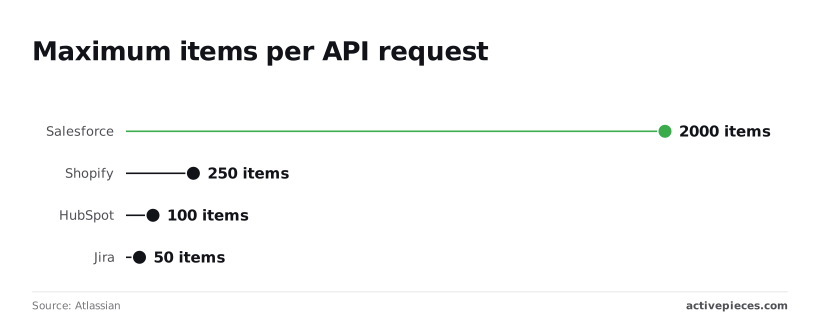 ### Webhook advantages Batches are restricted to 100 records by [HubSpot](https://support.atlassian.com/jira/kb/how-to-use-the-maxresults-api-parameter-for-jira-issue-search-rest-api/), increasing the risk of a backlog during peak marketing events. [Jira](https://support.atlassian.com/jira/kb/how-to-use-the-maxresults-api-parameter-for-jira-issue-search-rest-api/) caps results at 50 records, so you must poll more aggressively to maintain an accurate dashboard. Webhooks shift the architectural burden from the automation tool to the source application. They send data the instant an event occurs rather than waiting for a scheduled check. This "push" model eliminates the 1-minute or 15-minute wait entirely. A "New Order" notification reaches the warehouse the second the customer clicks purchase. Only when there is actual work to do does the automation platform wake up. Webhooks remove the "polling tax" of empty checks, though they require the source system to support outbound HTTP requests.  ## How Activepieces manages polling intervals and rate limits Activepieces provides a central control plane to govern how frequently an automation platform queries external systems, offering unlimited flows on every plan to ensure that architectural complexity never drives up the subscription cost. This prevents the silent budget creep of unnecessary API calls, as the pricing page confirms every flow run consumes just one credit regardless of internal complexity. By decoupling the trigger frequency from the execution logic, the platform allows you to match the polling rate to the actual volatility of the data source. ### Configuring custom polling schedules for legacy APIs Activepieces allows you to define specific execution windows when integrating with older databases or internal tools that lack push notifications, using an MIT-licensed core that can be self-hosted to keep sensitive polling traffic within your own firewall. This helps avoid exhausting API quotas. The interface provides a visual configuration for the Schedule trigger. Here, you can dictate not just the frequency, but also the specific days of the week the automation is active. The following view demonstrates this control within the flow builder. The modal has category tabs: All, AI, Core, and Apps. On the right side, a settings panel shows the Schedule trigger configuration with a "Run on weekends" toggle, and below that a "Generate Sample Data" section showing a successful test result.] 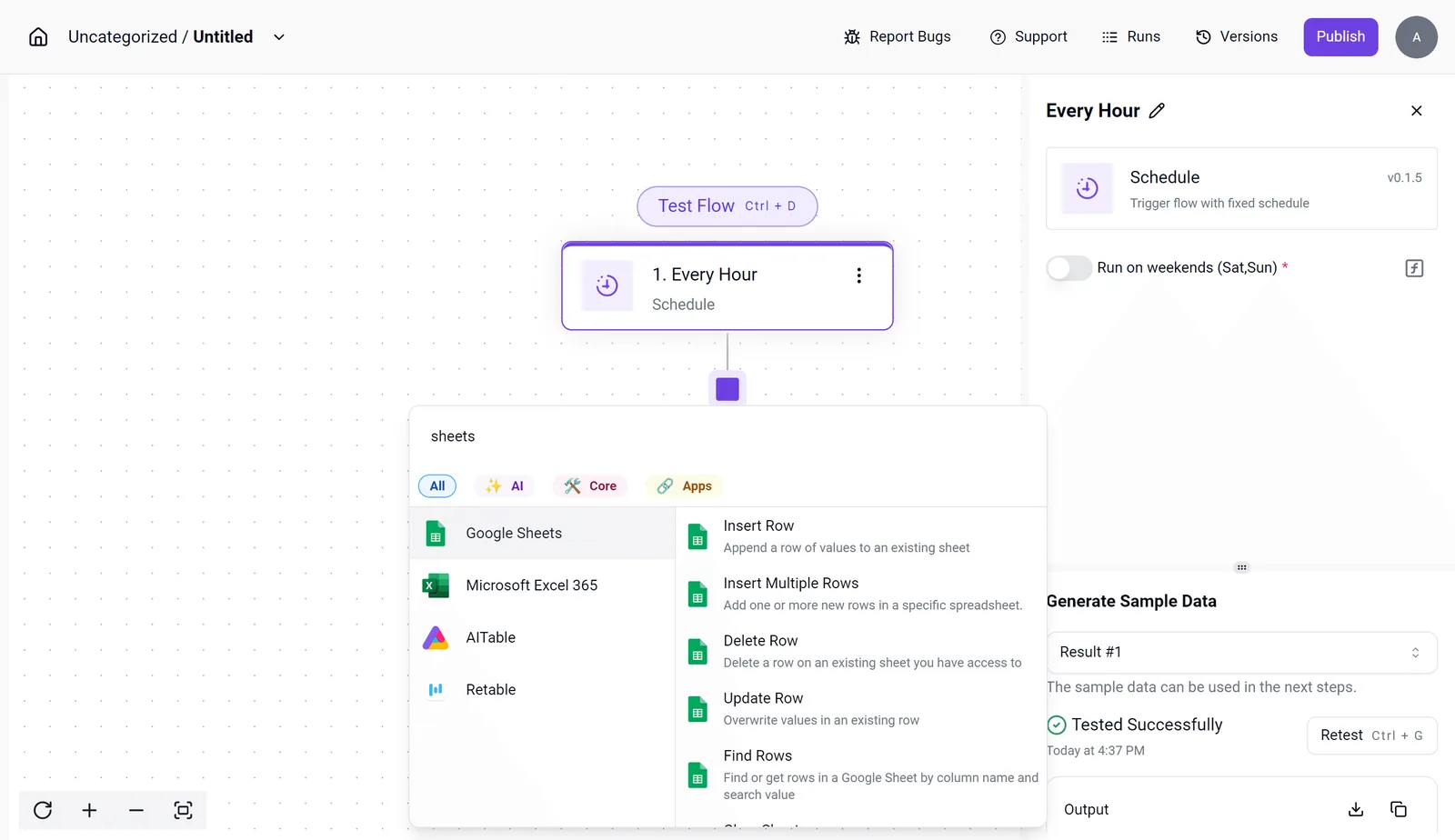 This configuration ensures that a workflow querying a Google Sheet for new rows doesn't consume resources during hours when the office is closed. By restricting these checks to business hours, you reduce your total step count. It also lowers the risk of being throttled by the target service. ### Switching to webhooks for zero-latency automation For modern services like GitHub or Stripe, Activepieces offers native webhook listeners that eliminate the need for polling entirely, contributing to a library of 733 integrations that prioritize event-driven triggers, which means users can automate complex workflows without worrying about missing critical updates. 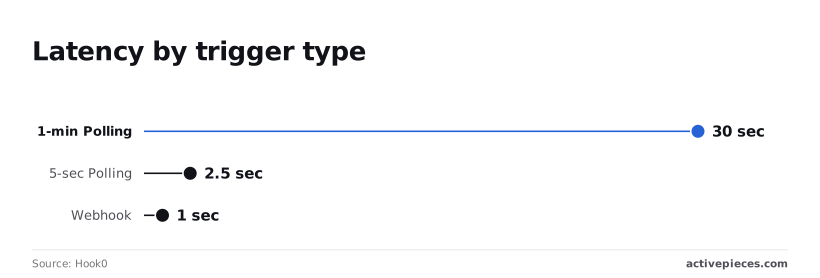 This architectural shift moves the burden of monitoring from the automation platform to the source system. The source only sends data when a specific event occurs. Because the flow remains dormant until a payload is received, you avoid the "polling tax" of empty runs. It also achieves near-instant data synchronization. ### Using built-in 'Delay' and 'Retry' logic to survive API outages Activepieces mitigates the risk of intermittent connection failures by providing granular retry policies and delay steps within the flow itself, which run in the air-gapped build exactly as they do in the managed cloud.  The run is the meter, not the steps inside it, meaning a complex ten-step recovery sequence costs exactly the same as a basic two-step flow. This ensures that building resilient, multi-stage error handling doesn't inflate the bill, as the pricing page confirms every flow run consumes just one credit regardless of internal complexity. A buffer is created that protects data integrity. It doesn't require manual intervention from you to restart stalled processes. ## Optimizing the payload to reduce total API calls Efficiency in data synchronization depends on maximizing the density of each request rather than increasing the cadence of the checks themselves. Moving from a mindset of constant pings to strategic fetches allows your system to handle larger bursts of activity without triggering protective throttling mechanisms.The gap between standard and high-frequency polling is rarely a technical limitation. It's almost always a monetization strategy that increases the cost of time-sensitive data.
### Identifying 'High-Volume, Low-Value' polling workflows High-volume flows are characterized by frequent requests to endpoints that rarely yield new information. This creates a significant gap between the cost of the check and the value of the result. > 98.5% Wasted (No New Data); 1.5% Productive (New Lead Found) Fundamentally, this data demonstrates that the standard polling model is inefficient. Nearly every request is a sunk cost that provides zero operational utility. Consequently, you must audit your logs to identify which triggers have a high failure-to-success ratio before these silent costs scale alongside your business. ### Calculating your API budget against trigger frequency A sustainable API budget requires balancing the desired freshness of data against the hard caps imposed by service providers. These include the CRM platform Salesforce or the ERP system SAP. If a workflow polls every minute, it consumes over forty thousand calls per month. Daily limits of a standard API license can be quickly exhausted by this volume. This leads to service blackouts for other critical business functions. Calculating this budget involves determining the maximum allowable delay for a specific business process, such as a lead follow-up. It also requires identifying the total daily API call limit provided by the vendor's current subscription tier. Finally, allocate a specific percentage of that limit to polling so that enough headroom remains for manual searches and bulk exports. ### Batching requests to stay under the rate limit Batching transforms a series of individual pings into a single, comprehensive request that retrieves multiple records at once. This drastically reduces the number of round-trips to the server. By configuring a middleware or an integration tool to fetch all records updated since the last timestamp in one go, your system maintains high throughput. It stays well below the rate-limiting thresholds that typically penalize high-frequency pings. This approach is particularly effective for high-velocity environments where dozens of events may occur within a single polling interval. Instead of triggering fifty separate workflows for fifty new rows in a Google Sheet, a batched request processes the entire delta as one unit. ## Frequently asked questions about polling triggers ### Can I force a polling trigger to run faster than the platform limit? Platform-enforced polling intervals are hard constraints designed to protect the infrastructure of the automation provider. You can't bypass these limits through configuration alone. Attempting to circumvent these frequencies by nesting multiple "wait" steps or recursive loops typically results in a suspended account. This happens for violating fair-use policies, which cuts off all business-critical workflows without warning. If the native refresh rate of a tool is insufficient for a specific operational requirement, the only viable path is to migrate that specific integration. This could be to a developer-hosted script or a platform that supports real-time webhooks. ### Does every API call by a polling trigger count toward my bill? Most automation platforms charge based on the number of times a workflow is successfully triggered. The underlying API calls made to check for new data often consume the rate limits of the connected service. If a workflow polls a CRM every minute to see if a deal has closed, it may exhaust the daily API quota of that CRM before noon. Other integrated tools are prevented from accessing customer data. It creates a hidden operational cost where the "free" check for updates eventually forces a mid-month upgrade to a more expensive tier of the third-party software. ### What is the difference between long polling and short polling? The primary distinction lies in how long the connection remains open, which dictates how much overhead is generated by the server. Short polling sends a request and expects an immediate response, even if no new data exists, which creates constant, repetitive traffic. Long polling keeps the request open until the server has new information or a timeout occurs. This reduces the total number of headers exchanged and lowers the burden on the network. ### How do I know if an app supports webhooks instead of polling? Verification requires auditing the "API Reference" or "Developer Documentation" of the specific software to see if it lists a "Webhooks" or "Subscriptions" endpoint. If the documentation only mentions "GET" methods for retrieving lists of items, the application is likely limited to polling. A delay between an event occurring and the automation starting must be accepted. A definitive sign of webhook support is the presence of a configuration screen within the app’s settings that asks for a "Payload URL." This is the destination for data the moment a change is recorded. ## Related reading - [Webhooks vs Polling: When to Use Each (2026 Guide)](https://www.activepieces.com/blog/how-webhook-triggers-detect-and-send-real-time-data) - [10 Top API Integration Platforms for 2026](https://www.activepieces.com/blog/10-top-api-integration-platforms-for-2025) - [Top 5 Integration Platforms For 2026 And Beyond](https://www.activepieces.com/blog/top-5-integration-platforms-for-2025) ## References - [Hook0](https://documentation.hook0.com/explanation/webhook-vs-polling) - [WittyCoder](https://wittycoder.in/courses/chat-system/websockets-vs-polling) - [Atlassian](https://support.atlassian.com/jira/kb/how-to-use-the-maxresults-api-parameter-for-jira-issue-search-rest-api/)Efficiency in data synchronization depends on maximizing the density of each request rather than increasing the cadence of the checks themselves.