# Postmark Pricing: Plans, Costs by Volume (2026 Guide)
By Petra Vlk · 2026-10-20 · Source: https://www.activepieces.com/blog/postmark-pricing-plans-costs-by-volume-2026-guide
---
## Explore Postmark pricing by plan and volume
### Postmark pricing summary for transactional email
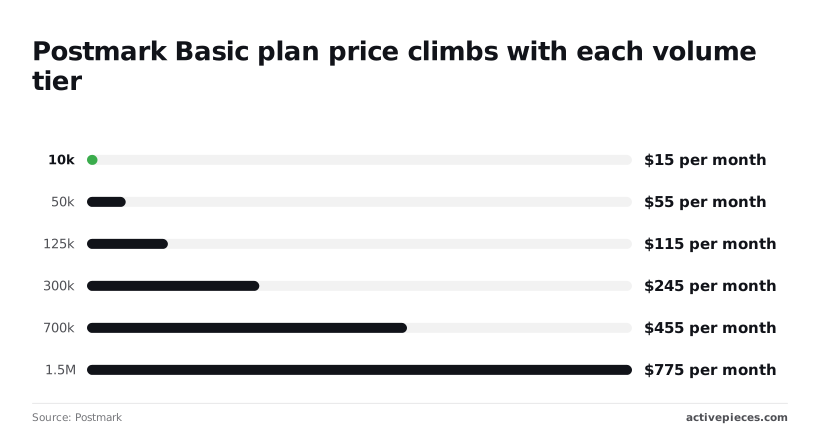
Postmark's Basic plan costs [$15 a month for 10,000 emails](https://postmarkapp.com/pricing.txt) and $775 a month for 1.5 million.
You buy volume in fixed steps, whether you send from an app or from a workflow tool like [Activepieces](https://www.activepieces.com), and the price per thousand falls from $1.50 at the bottom to about $0.52 at the top.

Postmark pricing is the tiered, monthly subscription model under which Postmark, an email delivery service built for transactional mail, charges for sending volume bought in fixed steps, with the cost per thousand emails falling as the plan size grows.
Five times the volume costs 3.7 times as much, and that first step is the sharpest.
Per [Postmarkapp](https://postmarkapp.com/pricing.txt), at 50,000 emails the price is $55 a month. After that the discounts shrink: 125,000 emails is $115 a month, and 300,000 is $245.
**Doubling your volume never halves your bill**.
### What Postmark is and how it bills
Postmark's a transactional email service. It sends the password resets, receipts and alerts that one user's action triggers, not newsletters.
Billing's a monthly subscription tied to a volume tier. A spike past your tier's therefore a billing event, so find out what your tier does when you cross it before launch day.
Upstream of Postmark, [Activepieces](https://www.activepieces.com) allows unlimited flows on every plan, including free, and its credits meter AI usage, so building the ten-step flow that screens out duplicate sends before they reach Postmark, rather than the two-step version, doesn't eat into a flow allowance.
MoneyGram, Moneypenny, Alan and FundingSocieties run Activepieces.
At 700,000 emails the price is $455 a month, about $0.65 per thousand. At 1.5 million it's $775. **Volume's the only lever that cheapens each email**, which is why a sender who needs bulk rather than deliverability should price a rival first.
### Plan table checked on the stated date
Read the last column as the real price of growth: it drops with each tier, but by less each time.
The table lists every Basic volume tier as published on Postmark's pricing page on 20 October 2026, with the cost per thousand emails worked out from each price.
| Basic tier (emails/month) | Monthly price | Cost per 1,000 emails |
|---|---|---|
| 10,000 | $15 | $1.50 |
| 50,000 | $55 | $1.10 |
| 125,000 | $115 | $0.92 |
| 300,000 | $245 | $0.82 |
| 700,000 | $455 | $0.65 |
| 1,500,000 | $775 | $0.52 |
Compare your monthly volume with these rows, then check the same volume against a cheaper sender's price before you commit.
## What Postmark charges at major volumes
Set the cost per 1,000 emails against a cheaper sender's rate. It falls as you climb Postmark's Basic price ladder, and the bill at each of those three volumes follows that ladder.
The dollar figures below are as published on Postmark's pricing page.
It shows the effective cost per 1,000 emails at each volume, drawn from the verified tiers and overage rates. What follows explains how to read the shape.
### A small SaaS sending 10,000 a month
At 10,000 emails you sit near the bottom of the ladder. The effective rate per 1,000 is highest there, because a flat tier price is spread over the fewest messages.
If you send a few password resets and receipts, you pay the most per email here and also the least in total.
Because the premium matters least in absolute terms, the question is whether inbox placement on those messages justifies it.
### Postmark cost at 100,000 emails a month
At 100,000 the same ladder gives you a lower effective rate, but only if your volume lands inside a tier.
Sending just past a tier's included count means overage rates apply to the extra emails, and the effective cost per 1,000 can creep back up.
Check where in the tier your real month falls, including your busiest one, not the average. A launch week that crosses the line changes the bill.
### A high-volume sender at 500,000
Yet it's still the point where a bulk-oriented sender is most likely to undercut Postmark by the widest margin in total dollars.
Multiply a small difference per 1,000 by hundreds of thousands and it becomes a large monthly difference. Price a rival at exactly this volume before you commit.
## Hidden costs and limits Postmark users hit
Don't read the headline per-email rate as the bill, because add-ons, retention, stream rules and overage handling all change it. Overage rates are published, but the add-ons and retention costs vary, so check them before budgeting.
### Postmark dedicated IP pricing and eligibility
You pay extra for a dedicated IP, since it's an add-on and not part of the plan, and Postmark gates it by sending volume.
Low-volume senders don't qualify, which matters because a dedicated address you can't keep warm can hurt your reputation rather than help it.
Check the current price and the volume threshold on Postmark's pricing page before you budget for one. The same applies to the other optional extras, including DMARC monitoring, which Postmark bills per domain, so every extra sending domain adds to it.
### Postmark message history and retention costs
If a customer disputes a receipt email after the window closes, you can't pull the delivery record to answer them. Message history is kept for a default window, and longer retention is a paid extra.

If you need that record for support or compliance, price the extended retention into the comparison with a rival. I haven't confirmed the current retention rates, so verify them rather than trusting any third-party summary.
### Broadcast versus transactional streams
Postmark separates transactional mail from broadcast mail into message streams, and the two are held to different standards. Transactional's the stream the premium buys.
Marketing-style sends belong on the broadcast stream, and pushing bulk mail through the transactional one is the quickest way to invite a review.
If your volume is mostly newsletters or promotions, you're paying transactional prices for mail that didn't need them. Also confirm how Postmark bills CC and BCC recipients, since each may count as a separate message and quietly inflate a send count.
### Postmark overage charges and account review
Read the overage terms before launch, not after the first spike. Whether Postmark bills a spike at an overage rate or throttles it is a contract detail I couldn't confirm, and the difference decides whether a busy day costs money or loses mail.
Postmark also reviews accounts, particularly new ones and those with high bounce or spam-complaint rates. A review can pause sending, so ask support in writing how long one usually takes before you move production traffic.
## Postmark premium pricing compared to alternatives
Start with price per email, where the case is strongest. Amazon SES charges $0.10 per 1,000, so 100,000 messages a month cost $10.
Every other provider has to justify its premium against that figure. The review wait above is part of that bargain, since cheap senders often leave more of the setup to you.
### Cost per 1,000 emails across five providers
Read this table for the gap between SES and everyone else, then check whether the extras in the last column replace work you'd otherwise do yourself.
It shows what each provider charges to start, what 100,000 emails a month costs per 1,000, whether a free tier exists, and what comes bundled.
On 20 October 2026 the SES figure was checked. I haven't quoted the other vendors' prices, because plans change often. Read their pricing pages on the day you decide.
| Provider | Entry paid price | Cost per 1,000 at 100,000 a month | Free tier | Bundled extras |
|---|---|---|---|---|
| Postmark | Monthly plan, priced above bulk senders | Highest of the five | Small free plan for testing | Separate streams for transactional and broadcast mail, searchable message history |
| Amazon SES | Pay as you go, no plan | $0.10 | Check AWS terms for your account | Sending only; you assemble the rest |
| SendGrid | Tiered monthly plans | Varies by tier | Check current terms | Marketing campaign tools, templates |
| Mailgun | Tiered monthly plans | Varies by tier | Limited free plan | Address validation, inbound routing |
| Resend | Tiered monthly plans | Varies by tier | Free plan for small senders | Developer-focused API, React-based templates |
**Only SES publishes a single flat rate** that fits in one cell. The others charge by tier, so your real cost depends on where 100,000 lands in their bands.
### Hidden work in cheaper Postmark alternatives
Whatever the sticker price, a cheaper sender moves work onto your side. With SES you build your own bounce handling, suppression lists and delivery dashboards, so the saving is partly paid in engineering hours.

With SendGrid and Mailgun, check whether transactional and marketing mail share sending infrastructure, because a bad campaign can then drag down your password resets. Before committing, ask each vendor in writing which of these it handles and what review or pause policies apply.
## Why Postmark's reliability premium matters most
Once the vendors have answered in writing, the premium comes down to one test: **Postmark's worth paying for when a lost message costs you something.** About one in six legitimate commercial emails never reaches an inbox.
Postmark's worth paying for when a lost message costs you something.
Start from 100% of emails sent, as Validity's figures, [via Sales.co](https://sales.co/research/email-deliverability-statistics.csv), do, so the percentages that follow represent the actual fate of every message you send.
Of those, 6.7% land in the spam folder and 9.8% go missing or are blocked, leaving 83.5% in the inbox, meaning roughly one in every six emails fails to reach its intended destination.

For a password reset, that missing 16.5% is a locked-out user opening a support ticket, tying up your support team with preventable account lockouts.
### Where Postmark's higher price pays off
[Mailtrap](https://mailtrap.io/blog/transactional-email-services/) ran identical free-tier shared-IP tests. **Postmark reached 83.3% inbox placement**, Amazon SES 77.1%, [Mailgun](https://www.mailgun.com/pricing/) 71.4% and SendGrid 61.1%. **That puts Postmark 22.2 points ahead of SendGrid**, so on those results nearly two in five of SendGrid's test messages missed the inbox.

That gap is what the per-email premium buys. It matters most where a person is waiting on the message: receipts, resets, login codes and alerts.
### When Postmark pricing stops making sense
If most of your volume is newsletters or promotions, a missed message costs little and you're paying transactional rates for bulk traffic.
SES finished only 6.2 points behind Postmark at 77.1%, so for mail nobody's waiting on, a cheaper sender can be the better buy. These were shared-IP free-tier tests, so your own sending reputation can move every number.
Before you decide, do three things on Monday:
1. Count last month's sends by type, not just the total. A single monthly figure hides which mail the premium would cover.
2. Split transactional mail from marketing mail. Only the first group needs the highest placement.
3. Price two rivals at your real volume. Ask each for overage rates, free-tier caps and what happens if an account is paused, and keep the written answers next to the Postmark quote.
## Run this in Activepieces: Postmark bounce alerts
Since your own sending reputation moves every one of those numbers, the practical safeguard is a flow that tells you the moment a hard bounce or spam complaint lands. The four steps below build it:
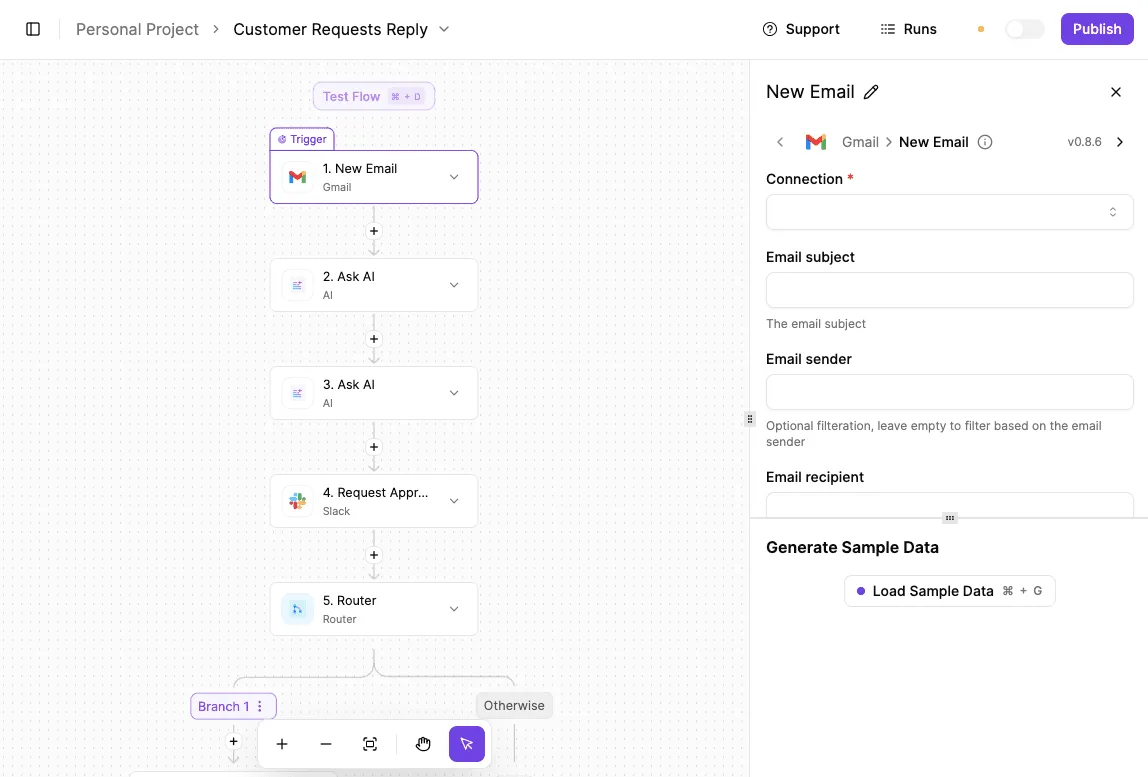
1. Add a webhook trigger in Activepieces and paste its URL into Postmark's bounce and spam-complaint webhook settings, so each event starts a run.
2. Continue only when the payload's bounce type is a hard bounce. Soft bounces, which often clear on retry, stop here and don't page anyone.
3. Send a Slack message or an email with the address, the bounce reason and the time.
4. Append the address to a Google Sheet, so your team has a suppression list to check before the next send.
Because Postmark's called through the webhook rather than a dedicated step, check the payload field names against a real test event before you trust the filter.
Once the filter passes the right events, the sheet becomes your running record of which addresses are hurting your reputation.
The free plan on Activepieces Cloud costs $0 and includes 1,000 credits a month, with unlimited flows and up to 5 users. Credits meter AI usage, and this four-step flow has no AI step.
## Frequently asked questions
What the pricing page makes you hunt for is answered below, and each answer ends with something to confirm in your own account before you commit money.
Does Postmark have a free plan? Only for testing. Postmark has a small free allowance, not a free tier you can run production mail on.
Use it to check that your templates render and your authentication records pass. Then price the paid plan against your real monthly volume, because the free allowance tells you nothing about that cost.
### Does Postmark charge for unused emails at month end?
Treat the monthly volume as a purchase, not a credit. Plans are sold in monthly tiers, so you pay for the tier whether you fill it or not.
Don't assume unused sends carry over, and read the current billing terms before you buy a tier sized for your busiest month. If your volume is spiky, you'll pay for the peak all year.
Can Postmark send marketing newsletters? Yes, but through a separate broadcast stream, not the transactional one. Postmark keeps the two apart on purpose, so a promotional send can't damage the reputation of your password resets.
If newsletters are most of your volume, you're paying a transactional premium for bulk mail, and a bulk-oriented sender will almost certainly cost less.
### How long does Postmark keep sent message history?
If support or compliance asks you to prove what was sent to a customer last quarter, a short window means you can't answer. Postmark keeps message history for a limited default window, and a longer window is a paid extra.
Export what you need to your own storage on a schedule, and check the current retention setting before you rely on it.
Is Postmark cheaper than SendGrid or Mailgun? Not per email. Both of those senders are built for volume, and their per-message cost usually undercuts Postmark's.
The premium buys you transactional deliverability and a cleaner separation of mail types.
Get a quote from each at your actual volume, and ask each about overage rates and dedicated IP eligibility, because those two lines decide the real bill.
## Related reading
- [Comparing SendGrid Alternatives for Transactional Email](https://www.activepieces.com/blog/comparing-sendgrid-alternatives-for-transactional-email)
## References
- [Validity via Sales.co](https://sales.co/research/email-deliverability-statistics.csv)
- [Mailtrap](https://mailtrap.io/blog/transactional-email-services/)
- [Postmark](https://postmarkapp.com/pricing.txt)