Further along, the same series reaches $0.52 in 2025 Q1, about 75 times below the start, then rises to $0.96 in 2025 Q3. Prices can climb, so a budget built on last quarter's rate is a guess. With the unit price this low, **the overrun comes from the multipliers**: - Output tokens are priced above input tokens. - A long-context surcharge may apply, which I haven't confirmed for Qwen3.8 Flash Next. - Retries after rate limits repeat paid calls. - Free quota expires. - No hard spending cap is set by default, which I have also not confirmed for this model. I haven't tied any of these to a dated vendor document here, so check each against Qwen's own pricing page before relying on it. Reading a long email costs less than returning a long answer, because output costs more per token than input. If reasoning mode adds hidden tokens, you pay for text nobody reads. 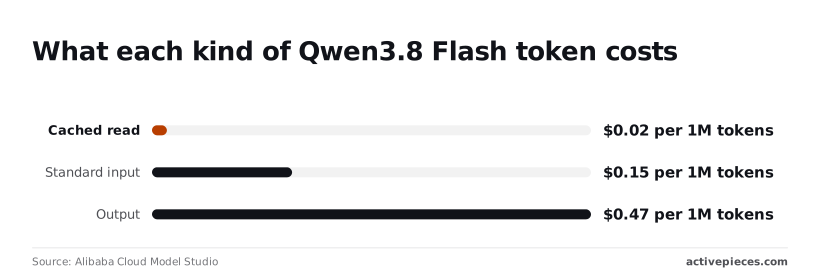 When a rate-limit error is followed by an immediate retry, the attempt's billed again. Without backoff and a retry ceiling, one stalled step can multiply its own cost. While the free allowance lasts, testing looks cheap. When it lapses, the same volume costs the full rate, so cost per run jumps overnight. If no cap exists, nothing stops a loop. **You find out from the invoice, so set the limit yourself before the first run.** ## Closest Alternatives Priced Against Qwen3.8 Flash Next At $0.15 per million input tokens and $0.47 per million output, Qwen3.8 Flash is priced as follows, per [Pricepertoken](https://pricepertoken.com/pricing-page/model/qwen-qwen3.8-flash). That's the lowest output rate among its Flash-tier rivals, but not the lowest bill on every step. ### Price and limits side by side You're billed by the token, separately for what you send and what comes back. | Model | Input (per million) | Output (per million) | Against Qwen | |---|---|---|---| | Qwen3.8 Flash | $0.15 | $0.47 | Baseline | | DeepSeek V4.1 Flash | $0.13 | $0.54 | Cheaper to read, dearer to write | | Claude Haiku 5.5 | $0.10 | $0.50 | Beats Qwen on input by a third | | GPT-6 Luna | Check OpenAI's pricing page | Check OpenAI's pricing page | OpenAI's efficient, cost-sensitive option | | Gemini 3.8 Flash | $0.75 | $3.75 | Five times Qwen's input rate, nearly eight times its output rate | 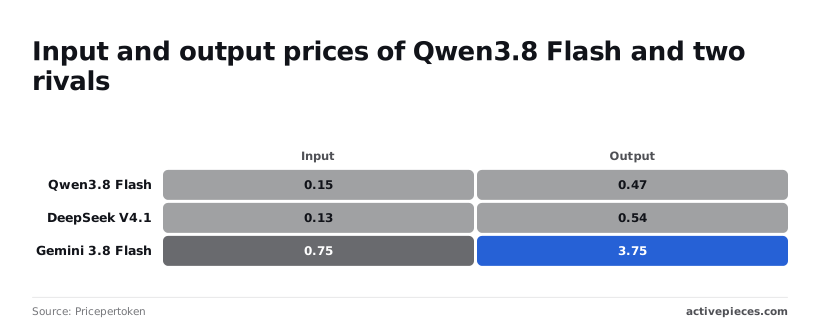 ### What 1,000 classification runs cost Take a classification step that sends 500 tokens and returns 50. Across 1,000 runs that's 500,000 input tokens and 50,000 output tokens. On Qwen that comes to about $0.10. DeepSeek lands at about $0.09, because the step's input-heavy and its cheaper input rate outweighs its dearer output. Gemini 3.8 Flash comes to about $0.56 for the same work, which provides a pricing baseline for direct comparison. It prices the same 1,000 runs on Qwen3.8 Flash, DeepSeek V4.1 Flash, GPT-6 Luna and a cheaper Qwen sibling, making total cost measurable across vendors. At 1,000 runs, those cents decide nothing, so performance and quality become the deciding factors instead. They start to matter at a million, where a $0.01 gap per thousand runs becomes $10. ### Where Qwen wins and where it doesn't **When the output's long, Qwen wins**. Drafting a reply or summarising a thread shifts the bill toward output tokens, where its $0.47 rate's the lowest on the list. It loses on short labelling, where input dominates and Haiku 5.5 or DeepSeek undercut it. Only where the step needs its extra capability does Gemini 3.8 Flash make sense, and the price of that is a bill several times larger. ## Model Routing and Spend Checks in Activepieces The larger model only runs where a step has earned it, and in Activepieces that routing sits on your own provider key, so the model spend lands on your provider account at your own rate; MoneyGram, Moneypenny, Alan and FundingSocieties run Activepieces in production. The provider's own limits catch whatever the workflow misses. ### Spending Rules for Qwen3.8 Flash Next Automation Steps Every automated step now answers to five rules. Classification and triage go to the cheapest model that gets them right. Drafting, where tone and length matter, goes to a larger one. The workflow caps retries at two, so a failing step stops instead of re-billing the same prompt indefinitely. A daily token ceiling bounds the worst day. An alert fires before that ceiling is reached, not when it's hit. Each rule targets one of the leaks named earlier: unmetered output, unbounded retries, and no cap. None of them depends on a model's per-token price being low. They depend on someone having decided, per step, what the step is allowed to cost. ### Routing each step to the cheaper model In Activepieces, a Router step sends a run down one of several branches depending on a condition you set, and each branch can call a different model. The free plan's 1,000 credits a month and unlimited flows are enough to test the routing before it carries real tickets. Look at the canvas below for the shape: a Router at step 5 with two conditional branches and an Otherwise branch. The first two branches lead to separate agent steps for invoice payment work (steps 6 and 7).  Read it as a pricing decision. The condition on each branch is where you decide which tickets or emails are simple enough for a small model and which need a larger one. The Otherwise branch matters most: it catches everything your conditions didn't anticipate. Point it at the cheap path, or at a human, rather than letting unclassified input default to the expensive model. Set the retry cap at the step too, on the steps that call a model, so a malformed response costs two attempts at most. ### Provider-Side Spend Caps for Qwen3.8 Flash Next API Don't rely on the workflow tool alone, and don't let it be the last line of defence. Most model providers let you set a monthly spend limit and a budget alert on the account or project that holds your API key. Set both. The alert should sit below the limit, so you hear about a runaway step while there's still budget left. Use a separate key for each workflow, with its own limit. A looping flow then exhausts its own allowance and stops, instead of draining the budget shared with everything else. This works with any tool, and it still holds if a routing condition is written wrong. ## Six Qwen3.8 Flash Next Pricing Checks Before Production Done in this order, six checks keep a wrong assumption about Qwen3.8 Flash Next from reaching your invoice. Each one catches a different way the bill drifts from the price list: 1. Reread the pricing page and write down the date you read it, so you know which prices your estimate used. 2. Count tokens, input and output separately, in ten real samples. 3. Multiply by your expected volume of runs, including retries. 4. **Set a budget alert and a rate ceiling**. 5. Force a loop to fail on purpose. 6. Put a monthly recheck on the calendar. ### Estimate tokens from ten real samples Pull ten actual inputs, such as emails or tickets, not a tidy example you wrote. Run each through the step and record the tokens in and the tokens out. Output's the metered unit that surprises people, since the model decides its length, not you. Take the longest sample as well as the average, because a long outlier shows what a bad day costs. Multiply by your monthly runs, then add a margin for retries, since every retry is billed as a fresh request. ### Setting Budget Alerts and Rate Limits Before Launch You want both a budget alert and a rate ceiling: the alert tells you spend's climbing, and the ceiling limits how fast it can. An alert alone arrives after the money has gone. Then break a loop deliberately: make a step return an error and watch what your automation does. If it retries without a limit, you've found the missing cap in a test and not on an invoice. Set a maximum retry count and a maximum output length on every step. Because prices and tier names change, the date you wrote down in step one tells you how stale your estimate is. Once a month, reread the page, compare it with your note, and rerun your ten samples if anything moved. ## Frequently asked questions These are the questions the cost arithmetic above leaves open. Each answer names the page that settles it, because a price you read from memory is a price you may be paying wrongly. ### Does Qwen3.8 Flash Next have a free tier? Treat any free quota as a trial allowance, not a budget line. Whether it expires, and whether it resets, is stated in the quota terms on the maker's pricing page. A flow built on free usage will start billing the day the allowance lapses, so read those terms before you size a workload around it. ### Is the Qwen API cheaper through a third-party provider? Sometimes, but compare the input rate and the output rate separately, since output is usually the larger line. A reseller may also set its own rate limits and retry behaviour, and failed calls that are retried are billed work. Check each provider's own pricing page rather than a comparison site. ### Are cached input tokens billed at a lower rate? Look for a separate cached-input line on the pricing page. If it's there, repeated prompt prefixes, such as a long fixed instruction block, cost less on every run after the first. If the page shows no such line, assume every input token bills at the full rate and price your steps that way. ### Can I set a hard spending limit on the Qwen API? Don't assume one exists. A budget alert tells you after money is spent; a cap stops the spending. Check the billing console for a setting that blocks requests at a limit. If you find only alerts, enforce the cap yourself by counting tokens per run and halting the flow when a ceiling is reached. ### How often does Qwen API pricing change? Often enough that a number copied into a spreadsheet goes stale. Record the price and the date you read it, pin the exact model version in your flow, and recheck the pricing page at the start of each billing cycle. If a new release makes a cheaper model good enough for your simplest steps, that changes your routing as well as your bill. ## Related reading - [Qwen3.8 Flash Next (2026 Guide)](https://www.activepieces.com/blog/qwen38-flash-next-2026-guide) - [Qwen3.8 Flash Next Launch: Specs, Benchmarks, and License](https://www.activepieces.com/blog/qwen38-flash-next-launch-specs-benchmarks-and-license) - [DeepSeek V4.1 Flash API: Pricing, Specs & Features (2026)](https://www.activepieces.com/blog/deepseek-v4-1-flash-api-pricing-docs-2026) ## References - [Pricepertoken](https://pricepertoken.com/pricing-page/model/qwen-qwen3.8-flash) - [Alibaba Cloud Model Studio](https://help.aliyun.com/en/model-studio/model-pricing) - [LLM Calculator](https://llmcalculator.net/llm-pricing-history)Even as the price per token fell, the bill grew, because the quantities around it, such as output length, retries and expiring free allowances, went unmetered.