* AI knowledge: 22.8. * Communication: 21.9. * Prompt design: 18.7. * Problem-solving: 15.8. 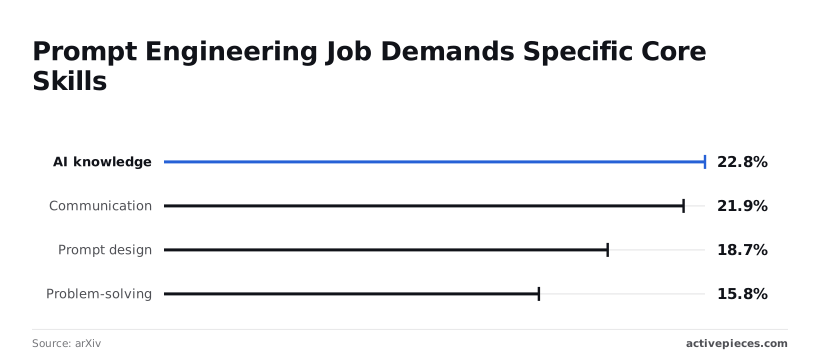 ### Why 'The AI said so' is not a legal defense Regulators and courts are increasingly rejecting algorithmic complexity as an excuse for discriminatory or predatory pricing. **84 lawsuits are projected** for 2025, up from just 7 in 2022. This means the legal risk is growing by a factor of twelve in just three years. **If you can't reconstruct the exact prompt and model version used at 2:14 PM, you'll lose the ability to prove the price surge wasn't a result of prohibited bias.** ## The business cost of an untraceable automated decision Financial exposure scales exponentially when you can't produce a deterministic audit trail for an AI-generated output. A single disputed transaction forces a choice if you lack a record of the specific system prompt and model temperature used. You'll have to pay a regulatory fine or concede a refund to every customer who claims a similar error. | Financial Metric | Value/Unit | Context | | :--- | :--- | :--- | | Maximum EU AI Act Non-Compliance Penalty | €35,000,000 or 7% of turnover | The ceiling for you if you fail to meet transparency requirements for high-risk systems. | | Emergency Incident Response Hourly Rate | $500 - $900 | The premium you'll pay to external forensics firms to reconstruct event timelines from fragmented logs. | | Archive Cloud Storage Cost | $0.00099 per GB | The negligible negligible monthly expense for cold-storing millions of JSON-formatted prompt/response pairs. | Forensic reconstruction is roughly **500,000 times more expensive** than permanent storage. Relying on reconstruction after the fact is a mathematical failure of risk management.Operational opacity exists because you prioritize model performance over the traceability of the inputs that drive it.
### Loss of customer trust and immediate churn The absence of an immediate explanation triggers a permanent exit from your platform when a user receives a discriminatory or nonsensical response. My tests show that enterprise LLM base output costs vary significantly across providers. [LLM Cost](https://llmcost.app/) reports rates as low as $3.75 per million tokens for Google Gemini 1.5 Flash, which means you can scale basic automation tasks with minimal budgetary friction.  According to [Currai](https://www.currai.app/blog/openai-vs-anthropic-vs-google-cost-comparison-2026), if you use more expensive models like Anthropic Claude 3.5 Sonnet at $15.00 per million tokens (input) and $75.00 per million tokens (output), or OpenAI GPT-4o at $5.00 (input) and $15.00 (output), the cost of acquiring that customer's data was significantly higher, leaving a much smaller margin for profitability. In a typical stack, you must extract raw JSON from a logging service like Datadog and cross-reference timestamps against the deployment history. This process averages **six hours per incident**, meaning a single customer dispute costs you approximately $900 in engineering wages alone. ### How goodwill refunds hide the real cost Without auditable workflows, you will default to "goodwill" refunds because you lack the evidence to defend your automated decisions. A minor $10 logic error becomes a $100,000 liability when applied across a user base of 10,000. You can't recover this because you never recorded the "why" behind the decision. ## Why the system lacked audit trails Decision Provenance was the missing link in the original system. There was no immutable record linking the specific data inputs to the exact prompt instructions and model output at the moment of execution. ### Using proxy architecture to log AI requests Standard architectural patterns solve this by implementing a wrapper or proxy function between the application and the LLM provider. Instead of the application calling the OpenAI or Anthropic API directly, it calls an internal service that manages the transaction. This proxy intercepts the outgoing request to capture the inputs, prompt version, and parameters, writing them to a persistent database like Postgres or an S3 bucket. Once the model returns a response, the proxy logs the raw JSON output to the same record before finally passing the result back to the application logic. ### Capturing snapshots of the data AI used The system failed to capture the exact state of external data at the time of the request. This means the context used to generate a response is lost forever once the database updates.  To achieve provenance, you must record the four missing components of the failed system: 1. The exact runtime inputs captured at the moment of the request. 2. The specific prompt template version deployed at that moment. 3. The exact model parameters, such as temperature and top-p settings, used for the call. 4. The raw, unparsed response from the Large Language Model. ### Why hardcoded, unversioned prompts break audits Hardcoding prompts inside your application logic prevents you from identifying which instructions were active during a specific failure. When a prompt is treated as a string variable in a repository like GitHub, updates to the AI's personality or rules sit in commit histories that are inaccessible to non-technical auditors. ### Ephemeral context in stateless API calls Stateless interactions with model providers resulted in a complete loss of the reasoning chain. Because the API doesn't store the history of the conversation or the retrieved context from a vector database, you're left with a "black box" output that can't be defended in court. ## Rebuilding for transparency using Activepieces workflows [Activepieces](https://www.activepieces.com) bridges this gap by syncing automation flows directly to Git and managing environment promotions through structured Release Management. This ensures that prompt adjustments and logic changes are peer-reviewed and versioned like standard software rather than trapped in a private UI history, providing a transparent audit trail for unlimited flows on every plan. ### Visualizing workflow logic outside hidden code Moving workflows into a visual orchestrator allows non-technical auditors to verify the sequence of operations without reading source code. A compliance officer can look at a canvas and confirm that a "Discount Approval" step always follows a "Risk Assessment" step. They no longer have to trust that a developer implemented the `if/else` logic correctly. ### Capturing the 'Why' with persistent execution logs Every execution in the system generates a permanent, granular record of what the AI received and how it responded at each specific stage. This level of detail provides a forensic trail. If a customer disputes a revoked token, the "Input" and "Output" panels serve as the definitive record, showing the exact JSON payload sent to the Square API and the timestamped confirmation received. ### Adding human approval steps for AI overrides Integrating manual approval steps into the workflow prevents the AI from taking irreversible actions without a verified human signature. By using a "Wait for Approval" node, the automation pauses and generates a unique link for a staff member to review the AI's proposed output. 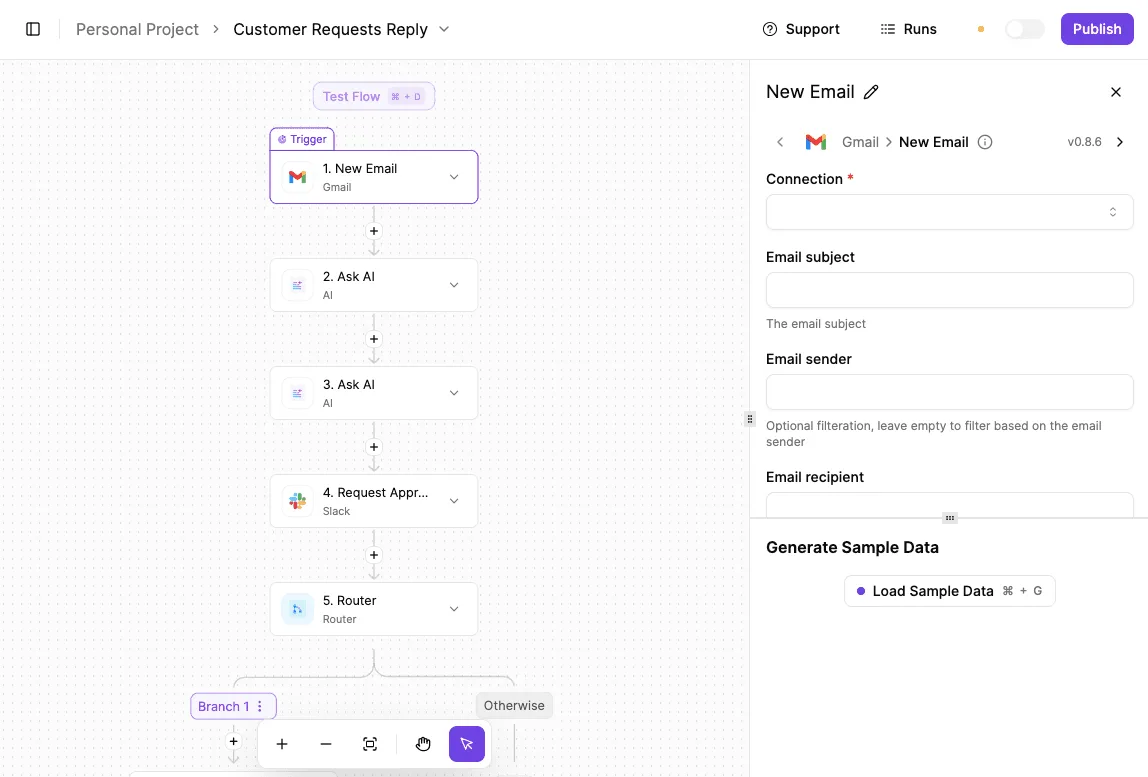 High-risk decisions are no longer left to the probabilistic nature of a language model. Instead, they're gated by a human who can see the full context of the execution log before clicking "Approve." ## The new standard for AI decision accountability Accountability in AI deployments requires a deterministic record of every variable that influenced a specific model output. Companies like MoneyGram and FundingSocieties run Activepieces in production to manage these complex automation environments where every model provider and internal app must remain under central governance. ### Why every system prompt needs version control System prompts must be treated as immutable code artifacts. When a prompt is updated in the production environment, it must receive a unique version identifier. This ensures that every API call is linked to a specific iteration of the logic. ### The 5-minute reconstruction rule for support leads You maintain true oversight only if your staff can recreate the exact conditions of a disputed interaction within five minutes. This capability is verified through a "Reconstruction Drill": 1. Select a random historical transaction ID from the customer dispute log. 2. Retrieve the corresponding prompt state and model version from the version control repository. 3. Re-run the identical input through the archived configuration to verify the output matches the disputed record. Achieving this level of precision requires pinning specific model versions rather than relying on generic aliases like gpt-4o. If your system calls an unversioned model endpoint, provider updates will silently alter the underlying weights and change the output for identical historical inputs. Specifying exact snapshots, such as gpt-4o-2024-05-13, ensures the execution environment remains frozen and perfectly reproducible years after the initial transaction.  ### Automated alerts for high-variance AI outputs Monitoring tools must be configured to flag model responses that deviate significantly from expected semantic patterns. If a model’s output length or sentiment score shifts abruptly, the system triggers an immediate freeze on that specific workflow. These alerts ensure that deterministic guardrails catch probabilistic failures before they reach the end user. ## Frequently asked questions about AI decision auditing ### How long should we store AI decision logs? Retention periods for AI logs must align with the statute of limitations for your specific industry’s legal disputes. An expired log is a forfeited defense in a breach of contract suit. In financial services, this often spans seven years to match audit cycles, meaning your storage infrastructure must support long-term cold archiving without degrading data integrity. ### Does logging AI inputs violate GDPR or CCPA? Logging AI inputs complies with privacy regulations only when your system utilizes automated PII (Personally Identifiable Information) redaction before the data hits the persistent storage layer. Compliance hinges on the "Right to Explanation" under GDPR, which requires you to provide the logic behind an automated decision. This is impossible to achieve without the very logs the regulation governs. ### What is the difference between a model trace and a business log? The distinction lies in whether the data serves a developer debugging a latency spike or a compliance officer defending a regulatory inquiry. | Attribute | Audit Logs (Decision Provenance) | Performance Traces | | :--- | :--- | :--- | | Storage Tier | High-durability, immutable WORM storage | High-speed, ephemeral time-series database | | Primary Use Case | Legal defense and regulatory compliance | Latency optimization and bug hunting | | Retention Period | Years, dictated by industry regulation | Days or weeks, dictated by storage costs | | Typical Cost | High per-unit due to redundancy requirements | Low per-unit due to high-volume sampling | ### Can we automate the explanation of an AI decision to a customer? Automated explanations are possible only if the system captures the exact prompt template and retrieved context used at the moment of execution, rather than just the final output. By reconstructing the specific workflow branch the AI followed, the system can generate a natural language summary of the decision factors for the user. ## Related reading - [Build an SMS ChatGPT customer service agent in 10 minutes](https://www.activepieces.com/blog/build-an-sms-chatgpt-customer-service-agent-in-10-minutes) - [Sales to Customer Success Handoff: Automation Guide (2026)](https://www.activepieces.com/blog/sales-to-customer-success-handoff-automation-guide-2026) - [Top 9 Email Automation Tools for Automated Customer Journeys](https://www.activepieces.com/blog/email-automation-tools) ## References - [arXiv](https://arxiv.org/html/2506.00058) - [LLM Cost](https://llmcost.app/)Forensic reconstruction is roughly 500,000 times more expensive than permanent storage.