The sections after this one show how to turn those three variables into your own monthly figure. Mind the word "preview": Ripple 65B Preview is a pre-release language model from Ripple, offered through an API under preview terms. Preview terms usually mean limits can change, and sometimes the price can too.  Treat every number on the pricing page as valid for the day you read it, not for the quarter you're budgeting. ### Every plan in one table To price a workload you need five columns: price and billing unit, inclusions, rate limits and quotas, free allowance, and preview caveats. Of everything I checked, only Ripple 65B Preview could be confirmed by name, and every one of those five fields for it is "not stated" rather than a guess. Fill any gaps from the vendor's pricing page before you budget. When every field reads "not stated", that is itself a finding. A preview **with no published limits can throttle you** at a threshold you only discover through an error message. Read the rest of this article with that in mind, and treat any unstated field as a question to settle before you commit spend. ### How the Ripple 65B pricing was checked I prepared this page on 16 November 2026. I compared the pricing information available to me against the plan columns above. I left a field as "not stated" wherever I couldn't confirm it. I didn't infer anything from other vendors' models or from what previews usually look like. You can recheck cheaply. Open Ripple's pricing page beside this article and fill each unstated field as you find it. Then log your own usage for a day, and if you build the counter in [Activepieces](https://www.activepieces.com), a ten-step counter costs the same as a two-step one: 1 credit per flow run, where Zapier bills per task and Make per module, so splitting the work into smaller steps never raises the meter. A day of real counts will show you which unit Ripple actually bills you in. ## What Ripple 65B Preview Costs at Realistic Usage Price one coding-agent session first: it costs [$0.23 with no caching and $0.11 with 80% of input cached](https://www.eesel.ai/blog/ripple-65b-pricing), so your monthly bill is sessions multiplied by that figure, plus a retry buffer. 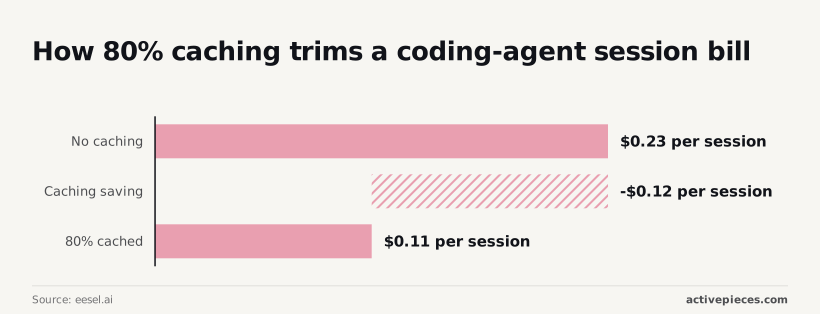 Caching saves $0.12 per session, which is more than half the uncached price, so the aggregate savings grow substantially with session volume. You need three inputs: requests per month, average tokens in and out, and the billing unit your day of counts showed. Keep the usage dashboard open and screenshot the counts, because that's your evidence if an invoice disagrees. 1. Count requests per month from your own logs. 2. Multiply by average input tokens and average output tokens per request. 3. Apply the unit price from the vendor's pricing table for your billing unit. 4. Subtract the free preview allowance the pricing page lists, if any. 5. Add a retries buffer, since failed calls usually still count toward the meter. ### Worked examples To skip steps 2 and 3, the examples below use the per-session figures, and they assume 30 days a month, meaning actual months will generate different results than these 30-day figures. At ten sessions a day you run 300 a month. Priced at $0.23 uncached, that's 300 × 0.23 = $69. Caching barely matters here, so a prototype team can leave it off and save the setup time. Go to a hundred sessions a day and that is 3,000 a month. Uncached, that's 3,000 × 0.23 = $690. With 80% caching it's 3,000 × 0.11 = $330, so **caching is worth $360 a month** and worth switching on before launch.  A thousand sessions a day is 30,000 a month. Cached, that's 30,000 × 0.11 = $3,300. Add a 10% retries buffer and the figure is $3,630. Uncached, the same traffic would be 30,000 × 0.23 = $6,900, so a missing cache setting would cost you $3,270 more each month. Read the chart that follows, which plots the monthly bill against daily request volume, for the point where the cached and uncached lines pull apart. That gap is what you pay for not configuring caching. ## Identify hidden costs and Ripple 65B limits You can only learn the limits, caps, overage, preview risk, retries and support from Ripple's documentation, and the headline price leaves all of them out. Anything the docs don't state is a question to put to Ripple in writing before you commit. Read the gap between the cached and uncached lines as the cost of one omission. What follows is the rest of what the price doesn't say. I haven't confirmed any of it, so each point is something to find on the pricing page or ask Ripple. - On rate and concurrency limits, ask what the request and token ceilings per minute are, and whether excess calls queue or fail. - On context and output caps, ask whether the output cap is lower than the context window, and whether a truncated reply still bills in full. - On overage behaviour, ask whether service stops or billing continues when you pass a preview quota. - On preview status, ask whether Ripple can change pricing, limits or the model itself without notice. - On retry costs, ask whether failed and timed-out calls are billed. - On support, ask whether it's included during the preview or sold separately. Find the limit before you size a workload. A ceiling that rejects excess calls means your batch job fails partway through. One that queues them means it finishes late. Ask which applies, and whether limits are per key, per project or per organisation. If they are per organisation, a colleague's test run can starve your production traffic. ### Preview-status risk When a model carries a preview label, terms can usually move. Ask whether Ripple commits to notice before it changes price or limits, and what happens to your integration when the preview ends. If the answer is "nothing is promised," budget for a rewrite.  Ask what happens at the quota edge: a hard stop, throttling or silent billing. Then ask whether a call that errors or times out is charged. If it is, your retry logic is a cost line, and a loop with no back-off can spend money while returning nothing. Check whether support, logging, fine-tuning access or data retention carry separate charges. If the pricing page is silent, treat that as a question, not as a "free." ## How Ripple 65B Preview compares to alternatives Compare Ripple against hosted coding-capable APIs you could switch to this week, and price each one from its own page. A page that stays silent on price also stays silent on whether a rival undercuts it. ### Which alternatives are genuinely comparable Comparable means a hosted model API, billed per use, that handles the same coding and agent work. [DeepSeek V4.1 Flash scores 90.6 on Terminal-Bench 2.1](https://www.inferama.com/en/benchmarks/terminal-bench-21), a 0-100 scale, which puts a cheap, fast model at the top of this set. Just behind it, the earlier GPT-5.6 Sol scored 88.8 and GPT-5.6 Luna 84.7 on this benchmark; OpenAI's current equivalents are GPT-6.1 Sol and GPT-6 Luna, which aren't scored here. Reflection Beam (80.1), Meta Muse Spark (76.4) and Gemini 3.1 Pro (70.7) trail. 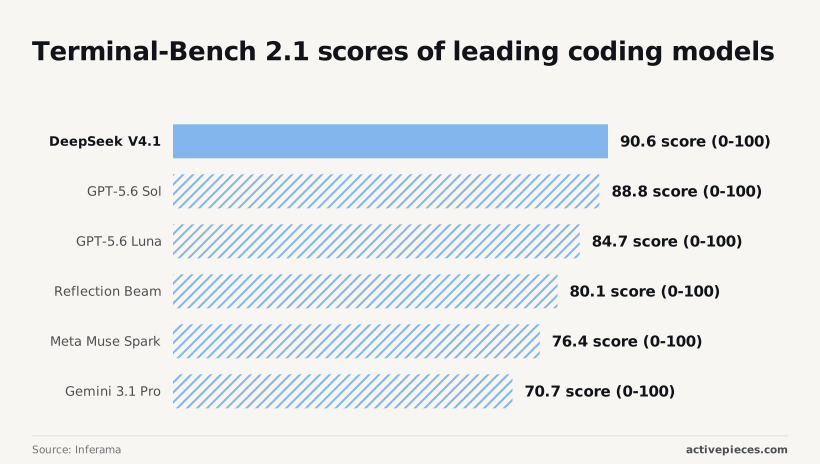 Each gap is the capability you give up if a cheaper bill pulls you down the list. ### Side-by-side at the same usage Since the table covers only what the figures I hold can support, pull unit price, free allowance, rate limits and overage terms for each row from its maker's pricing page, then run them through your own volume. | Model | Terminal-Bench 2.1 | What it means | |---|---|---| | DeepSeek V4.1 Flash | 90.6 | Highest score listed; the first price to check | | GPT-5.6 Sol (earlier model; current is GPT-6.1 Sol) | 88.8 | Scored within two points of the leader | | GPT-5.6 Luna (earlier model; current is GPT-6 Luna) | 84.7 | Scored a step down; Luna is the cheaper tier | | Gemini 3.1 Pro | 70.7 | Lowest score here; it must win on price or ecosystem | Of the rows here, Ripple alone is marked Preview. Its limits can change under you, and none of the others carry that caveat in this comparison. ### When to stay on Ripple and when to switch Switch if a higher-scoring alternative costs less at your volume, because then **Ripple is dearer and weaker at once**. That's a real possibility given DeepSeek V4.1 Flash's score, and any "Flash" tier is built to be cheap. Stay if Ripple's preview terms leave your bill lower once overage rules are applied, or if you need what it does that the benchmark doesn't measure. Even then, keep a second provider's price in your spreadsheet, since a preview can end without notice and the exit costs far more to plan after the notice arrives. ## Set a Ripple Spend Alert and Monday Checklist **Set a hard budget cap with your provider, note the date on Ripple's pricing page, and put a recheck on the calendar.** A cap you set now still works after the preview terms change, which a spreadsheet alone can't promise. Each step does one job: the date tells you which terms your figure rests on, the cap limits the damage if those terms move, and the calendar entry keeps both from going stale. 1. Open the pricing page and read the last-updated date. Write it beside your cost figure in the spreadsheet, so you can say which version of the terms your estimate was built on. 2. Set a budget cap in your provider's billing settings, at the monthly figure you worked out earlier. If the provider offers only a notification threshold and no hard stop, take the threshold, and treat it as a warning rather than a limit, because overage keeps billing after the email goes out. 3. Put a recheck on the calendar, recurring, with a link to the pricing page in the invite. A preview can change its limits quietly, and the first you hear of it shouldn't be an invoice. That covers the manual part. What follows automates the checking, and you can skip it without losing the protection above. ### Build optional daily spend alert If you already run an automation tool, a daily check takes little to build, and it only works if Ripple's documentation publishes a usage endpoint. Look for one before you start. If there's none, stay with the invoice and the cap. 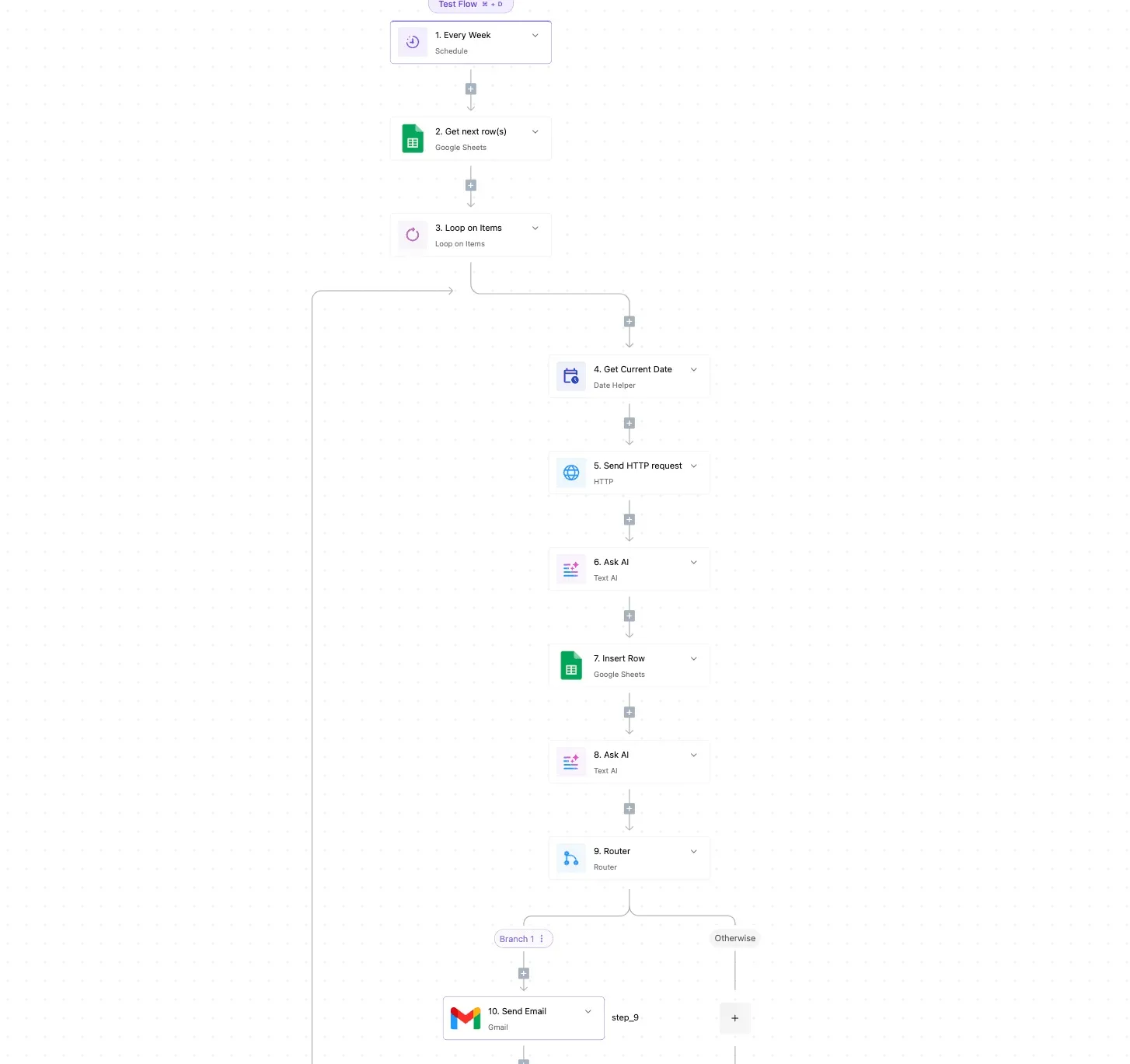 1. Add a schedule trigger that fires once a day, early enough that someone reads the result while it still matters. 2. Add an HTTP step that calls the usage endpoint with your API key, and map the spend field from the response. 3. Add a branch that compares that spend with your monthly budget, and let the alert path run only when spend passes the share of budget you chose. 4. Send the alert to Slack, the channel your team already reads, or to email, with the spend figure in the message itself. Test it once with the threshold set low so you see the alert arrive. An alert you haven't seen fire is the same as no alert. ## What Activepieces does about this The problem in this article is that a bill depends on a billing unit you have to discover, and on limits and overage rules that the headline price leaves out. Activepieces can't tell you what Ripple charges. What it can do is make the meter you build yourself easy to predict. An Activepieces flow run costs 1 credit however many steps it contains, so a ten-step counter costs the same as a two-step one.  Zapier bills per task and Make per module, so on those tools splitting a job into smaller steps raises the meter. Here that cost stays flat. That matters most for the twenty-minute exercise this article recommends. A day of logged usage only tells you which unit Ripple bills if your own logging doesn't distort the count. A flat per-run price keeps that logging out of your budget, and the schedule, HTTP and branch steps in the optional alert section are enough to log requests and compare spend with your cap. On the licence, the core of Activepieces is open source under the MIT licence, and you can self-host it. For a spend alert that watches a preview-priced API, self-hosting means the checker doesn't add a per-run charge of its own, and you can read exactly what each step does. I haven't confirmed that Ripple publishes a usage endpoint, and the alert only works if it does. If it doesn't, the invoice and the budget cap remain your protection. Treat this as a way to watch a bill you have already worked out, not as a way to lower it. The figure still comes from your own request counts, the vendor's pricing page and the overage terms you get in writing. ## Frequently asked questions ### Cost and pricing changes Verify each answer below the same way you verified your alert. Look at what Ripple's pricing page and docs actually say today, not what this article remembers. Is Ripple 65B Preview free to use? Not by default, and "free" is the word to distrust. Look for whether the pricing page lists a **free allowance or only a free trial period**, because those end differently: an allowance runs out quietly, while a trial ends on a date. Read what happens at the edge, not the headline. Will preview pricing change at general availability? Assume it can. Preview terms usually reserve the right to change rates, and nothing here says Ripple has promised otherwise. If your budget only works at today's rate, you have a plan that depends on a clause you haven't read. Find the preview terms and look for the word "change." ### Production use and bill protection Can I use it in production under preview terms? Only if the terms say so, and many preview terms limit support, availability commitments, or both. If an outage at 2 a.m. would cost you money, check whether the preview terms promise anyone will answer. The test is that simple. A model you can call isn't the same as a service you can rely on. How do I stop an unexpected bill? Set a spending cap or budget alert in the account console if one exists, then trigger it deliberately with a small test so you know it fires. If the console offers alerts but no hard cap, that's a notification and not a brake, and the overage rules decide what happens after the notification is ignored. ### Discounts Does Ripple offer committed-use discounts? Check the pricing page for a commitment tier, and if there isn't one, ask sales in writing. A discount only helps if you know your volume, and preview limits make that volume hard to predict. Don't commit before you have a measured month of real usage to commit against. ## Related reading - [Ripple 65B Preview: Pricing, Speed, and Test Results](https://www.activepieces.com/blog/ripple-65b-preview-pricing-speed-and-test-results) - [Ripple 65B Preview MCP: What It Is (2026 Guide)](https://www.activepieces.com/blog/ripple-65b-preview-mcp-what-it-is-2026-guide) - [CrewAI Pricing for 2026 and What Your Workload Costs](https://www.activepieces.com/blog/crewai-pricing-for-2026-and-what-your-workload-costs) ## References - [Inferama](https://www.inferama.com/en/benchmarks/terminal-bench-21) - [eesel.ai](https://www.eesel.ai/blog/ripple-65b-pricing)Until you know what a unit is, a price quoted per unit tells you nothing.