# Rippling Pricing 2026: What Each Module Costs
By Femi Adegoke · 2026-11-03 · Source: https://www.activepieces.com/blog/rippling-pricing-2026-what-each-module-costs
---
## Rippling pricing and what each plan costs
### Direct answer and the date it was checked
Add up every module you switch on, multiply by headcount, and add any platform minimum: that is your bill, because Rippling charges per employee per month, module by module. I drafted this section on 2026-11-03 and it carries only the published entry figures.
Rippling's real cost per employee is the sum of the per-employee monthly prices of every module you activate, multiplied by your headcount, plus any platform minimum and add-ons, rather than the single entry price listed for the base platform.

**Stack a module and every employee costs again**. Rippling meters the employee record, while [Activepieces](https://www.activepieces.com) meters use: its free plan allows up to 5 users and unlimited flows, and credits are only spent when something runs, so you avoid paying for idle workflows.
### Every current plan in one table
Read the table below as a checklist of lines to price: it lists the modules Rippling sells, what each covers and what it meters on.
Then read the amounts for each line from the live pricing page on the day you buy. Where a line isn't published, treat it as quote-only until a sales rep confirms it in writing.
| Module | What it covers | Metered per | Where the amount comes from |
|---|---|---|---|
| HR platform | Employee records, onboarding, org data | Employee per month | Live pricing page, or a quote |
| Payroll | Pay runs, tax filing, deductions | Employee per month | Live pricing page, or a quote |
| IT | Device and app management, access control | Employee per month | Live pricing page, or a quote |
| Spend | Cards, expenses, reimbursements | Employee per month, plus usage terms | Live pricing page, or a quote |
What the table doesn't show is your total. That needs three inputs: your headcount, the modules you'll actually use, and whether a platform minimum or add-on applies at your size.
A small team can pay more per head than a large one if a minimum dominates the bill.
## Per-employee cost at 10, 50 and 200 employees
Change the headcount and the effective per-employee price shifts. Rippling meters the employee per month, and the bill is that rate times headcount plus any base fee.
Read the table below as a method: it sets out the arithmetic at three sizes. The core-only column shows what a minimum or base fee does to a small team, and the stack column shows each added module multiplying across everyone on payroll.
| Headcount | Core-only monthly | Core-only annual | Effective per-employee price | Stack with payroll, benefits, IT and devices |
|---|---|---|---|---|
| 10 | Base fee + 10 × core rate | Monthly × 12 | Monthly total ÷ 10 | Each module's rate × 10, plus base fee; quote-only items unknown |
| 50 | Base fee + 50 × core rate | Monthly × 12 | Monthly total ÷ 50 | Each module's rate × 50, plus base fee; quote-only items unknown |
| 200 | Base fee + 200 × core rate | Monthly × 12 | Monthly total ÷ 200 | Quote-only; unknown |

Each paragraph below covers one row.
With a fixed base fee spread over only ten people, the effective price per head sits well above the listed rate. Any platform minimum matters most here, because you pay it whether or not you use every seat.
At fifty employees the base fee spreads thin, and the effective price approaches the listed rate for core-only. The stack is different: payroll, benefits, IT and devices each add a separate monthly charge across fifty people.

At two hundred employees, pricing for a full stack is quote-only, so you have no figure until a sales rep supplies one. Don't extrapolate from the smaller rows.
Ask for the per-module rates, any minimum and every add-on in writing, then multiply by your own headcount.
## Hidden costs and limits buyers hit after signing
Read only the headline rate and you will miss several charges that show up in a quote: add-on modules, a one-time implementation fee, contract terms, and caps on usage and features. Each one raises the total beyond headcount times price.
Switch on a product and it adds its own line, because Rippling bills by module. Payroll, benefits, IT and device management each carry their own rate.
### Rippling implementation fees, contract terms and minimums
On top of subscription cost, setup is a one-time fee. [The People Stack](https://www.thepeoplestack.co/post/how-much-does-a-rippling-implementation-cost-in-2026) reports lowest quoted fees of $2,000 for a light project, $12,000 for mid-complexity, $30,000 for complex and $75,000 for enterprise, which means **implementation is a five-figure expense for most deployments**.
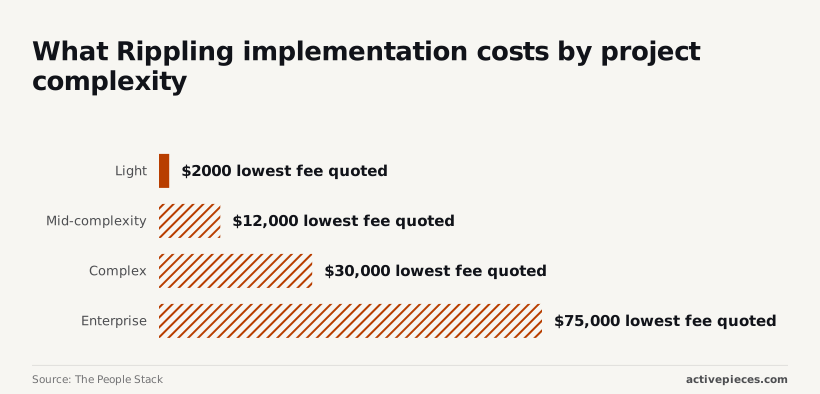
What pushes a project up a tier is multi-entity payroll, custom approvals and data migration. As a sanity check, a common rule of thumb puts implementation at 5-15% of annual fees, so a quote far outside that range deserves questions.
Ask for the contract term and any platform minimum in the same document. A multi-year term locks in the module list you chose on day one.
Check three things before signing: whether Rippling charges payroll runs individually, which API access comes with your plan, and which support level your plan includes.
I found no published figure for per-run charges, API tier pricing or support-tier pricing. Treat each as an open line item. Get a number in writing for every one, or assume the quote will add it later.

## Rippling against Gusto, Deel, Justworks and BambooHR
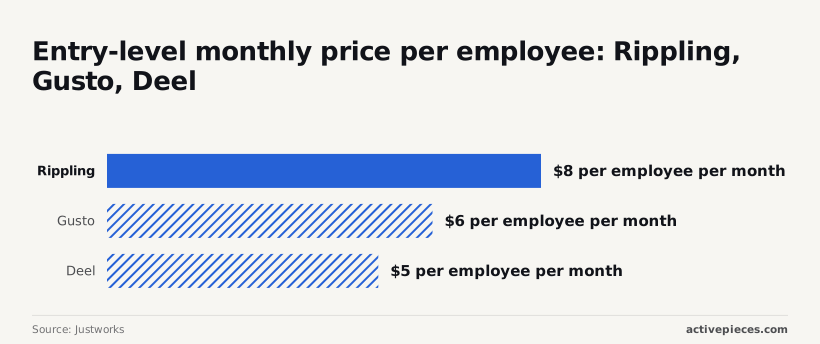
At 100 people the entry gap to Deel is **$300 a month, or $3,600 a year**, before you add any module, making the annual gap material enough to sway some buyers toward Deel on cost alone.
### Comparison table on price, model and inclusions
Open Gusto's own page and it confirms Rippling at $8 and Deel at $5, and puts Justworks at $8, so Rippling and Justworks compete on functionality and service depth rather than price. Those are entry prices.
The table shows what sits around them: Gusto and Justworks add a flat monthly base, so Gusto's 100 people cost $649 ($49 + $6 × 100) and Justworks' cost $850 ($50 + $8 × 100).
| Vendor | Starting price | Listed or quoted | PEO or software | Global coverage |
|---|---|---|---|---|
| Rippling | $8 per employee per month | Entry listed, total quoted by modules | Software | Global payroll sold as a further module |
| Gusto | $49 base + $6 per employee | Listed | Software | US-focused |
| Deel | $5 per employee (HR) | Listed for HR, other products priced separately | Software | Built for international hiring |
| Justworks | $50 base + $8 per employee | Listed | PEO | US-focused |
| BambooHR | Quote only | Quoted | Software | Mainly US |
Compare the right-hand columns before the price column, because they decide what the first number leaves out.
### When a cheaper Rippling alternative makes more sense
If your team is US-only, under about 50, and needs payroll and basic HR, Gusto suits: at 25 people it costs $199 a month, and no module sits on top.
Justworks fits if you want a PEO to carry compliance and benefits administration, and its $8 buys that service rather than software alone. Deel fits when the hiring is international and the $5 HR tier is the entry point to a wider setup.
Stacking pays when you'd otherwise run three tools for HR, IT and payroll and reconcile them by hand. If you need two or more modules on one employee record, price that combined list.
A $3,600 gap a year is small against a spreadsheet job someone does every pay cycle.
## Getting a Rippling quote that matches your needs
**The quote, not the pricing page, is what you'll actually pay, so get it in writing against your own headcount and module list.** A small yearly gap is easy to absorb; an unpriced add-on or a renewal uplift you never asked about isn't.
Bring the inputs below as a fixed list rather than a rough description, because each one changes how many of those units Rippling bills you for. The unit is the employee, per module, per month.
The steps, in order:
1. Assemble your headcount, counting full-time employees and contractors separately, since the two are often priced differently.
2. List every US state where you have employees, because multi-state payroll and tax filing can carry their own charges.
3. List every country where you hire or pay people, and say whether each is an employee or a contractor arrangement.
4. Write out the modules you want on day one and the ones you expect to add within a year.
5. Send that list by email before the call, so the rep prices your situation and not a generic one.
Once the list is in, ask for these in writing:
1. What's the platform minimum, and does it apply if your headcount falls?
2. How much can the price rise at renewal, and is that capped in the contract?
3. What does each add-on cost, priced per employee per month, and which ones sit outside the module bundle?
4. What are the exit terms: notice period, data export, and any charge for leaving mid-term?
5. Compare the answers line by line against the listed prices, module by module.
When the quote adds a line beyond the page, that line is the gap between the entry fee and your real cost.
## Activepieces for the gaps around Rippling
If you want to carry data out of Rippling to the other systems your team uses, Activepieces is an open source, MIT-licensed AI automation platform that moves it across its 746 integrations.
It won't lower Rippling's bill or stand in for payroll, so treat it as a way to close hand-off gaps cheaply.
Before you build anything, find out how your plan counts runs or steps, because a hiring-heavy quarter fires far more of them than a quiet one.
The unit to ask about is the run: each time a workflow fires, a trigger and its steps execute once.
Activepieces meters that unit in credits, not seats: a run is 1 credit however many steps it has, flows are unlimited on every plan, and the free plan includes 1,000 credits a month.
Its published pricing runs from there to $20 a month for 10,000 credits on Plus and $200 a month for 50,000 credits and 25 users on Team, with $0.007 a credit beyond the allowance, making any excess usage negligible in cost.

A hiring-heavy quarter therefore costs credits rather than headcount, and Alan and FundingSocieties run production automation on it.
The credit tiers and unlimited flows above are the ones printed on the Activepieces pricing page, and the 746 integrations are counted straight from the open source monorepo on GitHub, whose core carries an MIT licence, meaning the platform is community-reviewed, modifiable, and forkable under permissive terms.
Whether Rippling has a ready-made connector among those 746 integrations, roughly 60% of them community-contributed, is something to check in the catalogue directly, leaving most integrations without dedicated vendor support.
If it doesn't, a webhook or a generic HTTP request step can receive or fetch the data instead.
### Tasks worth automating around an HRIS
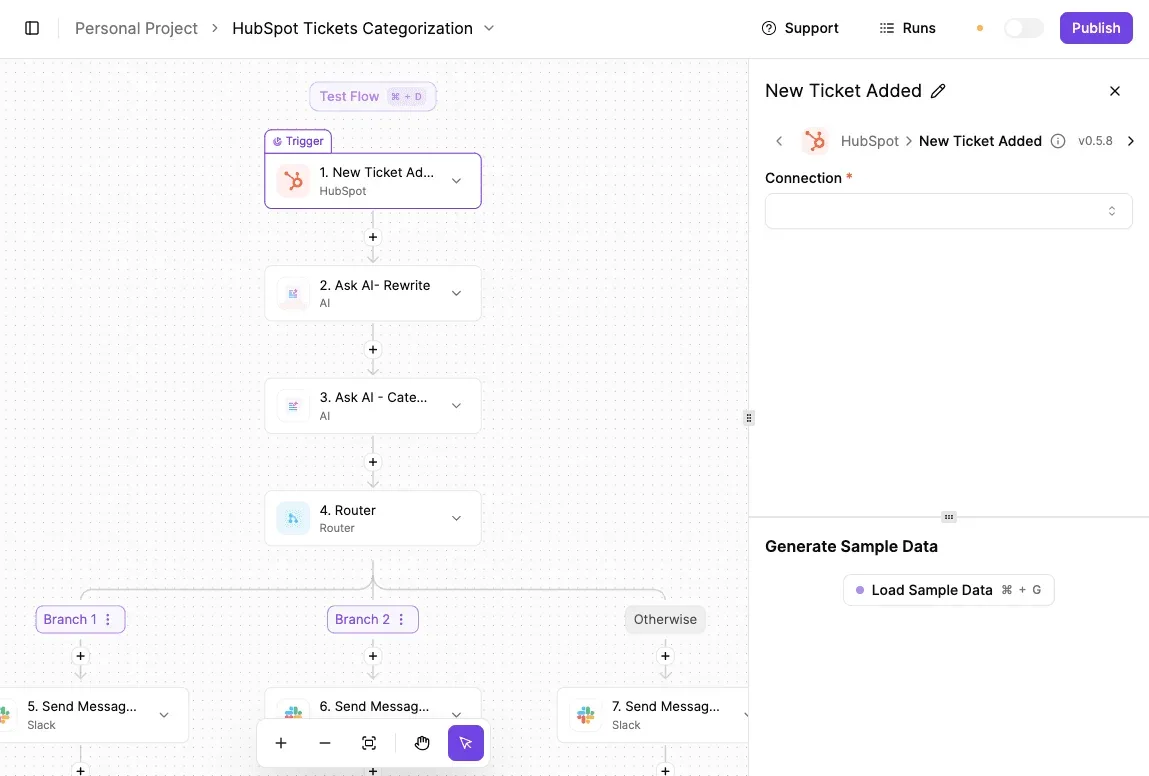
In the screenshot below you can see the shape of a typical build.
It's a workflow called "HubSpot Tickets Categorization": a HubSpot trigger fires on each new ticket, two AI steps rewrite and categorize it, and a router splits it into branches with an "Otherwise" path.
Three message steps post the result to Slack.
Swap the trigger for a new-hire event from your HRIS and the same skeleton applies: one event in, a decision in the middle, notifications out.

For the small jobs that sit between modules you pay for, that pattern suits:
- Posting a new hire's onboarding checklist to a Slack channel.
- Opening a Jira ticket so IT provisions a laptop before day one.
- Writing headcount rows to a spreadsheet for finance to read.
Skip another paid module and the cost you're trying to avoid is the manual copy-paste each of these saves.
### What to check before relying on it
Test the trigger with real sample data first, since a workflow that reads the wrong field will quietly notify the wrong people. Confirm how failed runs are reported and retried, so a missed hire doesn't go unnoticed.
Check who owns each connection's credentials, because a departed employee's login can silently break the flow.
Finally, keep payroll, benefits, and compliance inside Rippling; automation here moves information, and it shouldn't decide pay.
## A Monday checklist for pricing Rippling properly
Price Rippling by fixing the metered unit first, which is each paid person per module, and then multiplying by your own counts, not by the vendor's example company.
Run these five steps in order, because each one feeds the next. The first three are prep work you can finish alone, and the last two make the vendor commit to a number and protect you after signing.
1. List the modules you need, and separate them from the ones you merely like the look of. Each module is its own line on the bill, so an unneeded module is a recurring charge for nothing.
2. Count headcount fully: employees, contractors, and staff in other countries. Different worker types can be billed differently, so a count that leaves out contractors or international hires will understate the total.
3. Re-check the live pricing page the day you plan to call. Published prices change, and a screenshot from a comparison article may already be stale.
4. Request a written quote that itemizes every module, the platform minimum, and each add-on. A verbal figure can't be audited later, and the minimum is the line most likely to surprise a small team.
5. Set a renewal reminder on your calendar well ahead of the contract end date. Auto-renewal is where **a negotiated rate quietly becomes list price**.
### Reviewing your Rippling quote before you sign
Rebuild the quote in a spreadsheet from your own module list and headcount, then compare line by line. Any line you can't trace to a module you chose is a question for the rep.
Auto-renewal is where a negotiated rate quietly becomes list price.
Also ask what happens to the per-person rate when you add a module or hire past your current count. Your cost at the next stage of growth matters more than today's figure, and the reminder from step five is when you get to renegotiate it.
## Frequently asked questions
Ask each of these in writing before you sign, because several get their final answer in your contract rather than on the pricing page.
### Free trial or demo
Does Rippling offer a free trial or demo? Rippling offers a sales-led demo, and a self-serve free trial isn't something to count on.
Because the quote is built from your headcount and module list, the demo is where you should get that quote, so arrive with both written down.
### Minimum monthly fee
Does Rippling charge a minimum monthly fee? Rippling applies a platform minimum, and it shows up in your quote rather than in the headline per-employee price. At a small headcount, the minimum can make your effective per-employee cost higher than the listed rate.
Ask for the minimum stated separately, and ask whether it changes when you add modules.
### Rippling versus Gusto
Is Rippling cheaper than Gusto? It depends on how many modules you need, and neither headline price answers it.
Gusto's published pricing suits a payroll-first setup. Rippling's base price covers less than the full platform, so every module you add moves it further from that comparison.
Price both vendors against the same list of functions and the same headcount, then compare the totals.
### Contractors and pricing
Do contractors count as employees for pricing? Not necessarily, since contractors are often metered differently from employees. Ask whether they are billed at a separate rate, whether that rate is per contractor or per payment, and whether they count toward the platform minimum.
If you pay many contractors, this line can matter more than the employee rate.
### Can I cancel Rippling modules mid-contract?
Treat the term as fixed unless the contract says otherwise. Dropping a module is usually something you negotiate at renewal, not mid-term.
Ask before signing whether you can remove modules at renewal and whether the minimum stays in place if you do. Also confirm whether billing is monthly or annual, since that decides how much you owe once you commit.
## Related reading
- [Employee Onboarding Workflow Template: Free Options](https://www.activepieces.com/blog/employee-onboarding-workflow-template-free-options)
- [Employee Onboarding Automation: What HR Automates First](https://www.activepieces.com/blog/employee-onboarding-automation-what-hr-automates-first)
- [Easing AI Fears: Addressing Enterprise Employee Concerns](https://www.activepieces.com/blog/easing-ai-fears)
## References
- [Justworks](https://www.justworks.com/pricing)
- [The People Stack](https://www.thepeoplestack.co/post/how-much-does-a-rippling-implementation-cost-in-2026)
- [Gusto](https://gusto.com/product/pricing)