*Constructed scenario: 4,000 Hindi and Tamil calls, planned bill against actual bill after the 02:10 retry loop, in rupees.* Because the retried block is a repeat of work already paid for, it buys nothing. The fix is two checks, not a cheaper rate: a hard cap on attempts per call, and a spend alert that wakes someone well before 07:00. ## Why Sarvam AI bills exceed pricing Only the first and fifth of six multipliers are directly caught by the attempt cap and spend alert above, because all six stack on top of the list price. Read it top to bottom: every cause multiplies the one before it, so none can be budgeted alone. Sitting between this sentence and the next, the chart covers six causes: - Retries billed as new calls, which inflate the request count. - Output priced above input, which inflates the output-token line. - Indic token inflation, which inflates both token lines. - Audio billed by duration, which inflates the audio-seconds line. - 429-triggered retries, which inflate the request count a second time. - Plan limits, which inflate the cost of the tier you move to. When a job fails and reruns, it pays for the same work twice, with output tokens often the costly half, because a retry is a new call. A 429 (too many requests) response makes it worse: naive retry loops fire again at once, hit the limit again, and repeat. Count attempts, not calls, when you forecast. Put the same meaning in Devanagari, Tamil or another Indic script and it usually splits into more tokens than the English text. The same sentence therefore costs more, and because output costs more than input, a verbose Hindi reply is where the premium lands. Measure tokens on your real text, not on English samples. Trim silence before upload, or your cost per useful minute will exceed the listed rate, because duration billing charges for silence, hold music and dead air as readily as for words. If your workload fits one tier, it may still throttle on another, since rate and quota ceilings vary by plan. Throttling feeds the retry loop above, and the fix, an upgrade, changes your fixed cost. Check your plan's limits against your peak hour, not your daily average. ## Compare Sarvam AI against alternatives Once your peak hour fits a plan's limits, price decides, and Sarvam AI's Bulbul v3 text-to-speech sits mid-table: cheaper than both ElevenLabs tiers, dearer than Azure, Google and Polly. ### Price for the same 4,000 recordings Start with the cost of one thousand characters, since speech output is billed per character. Multiply by your real character count, retries included, because a failed call you resend is billed twice. | Provider and voice | USD per 1M characters | INR per 1M characters | |---|---|---| | ElevenLabs v4 | 80.00 | ₹7,509 | | ElevenLabs Turbo | 40.00 | ₹3,754 | | Sarvam Bulbul v3 | 31.96 | ₹2,999 | | Azure Neural | 14.11 | ₹1,324 | | Google WaveNet | 4.00 | ₹375 | | Polly Generative | 4.00 | ₹375 |  **Twenty-fold is the spread in the table**, from $4 to $80, so the voice you pick moves the bill more than any retry habit. Bulbul v3 costs 60% less than ElevenLabs v4 and 20% less than ElevenLabs Turbo. Don't let a free tier pick your vendor, because it only lowers the first month. A rate limit can break a launch day. Whichever vendor you choose, read its limit as requests per minute and compare it with your busiest hour, then leave headroom for retries, which arrive exactly when the system is already struggling. ### When Sarvam AI alternatives cost less On plain English or text-heavy speech, Google WaveNet and Polly Generative each charge $4 per million characters, so neither has a cost advantage. That's roughly one-eighth of Bulbul v3, or ₹375 against ₹2,999. At $14.11, Azure Neural costs 44% of Sarvam AI's price, making it substantially cheaper. If your audio doesn't need Indic voices, **Sarvam AI loses on price to all three**. Whether the gap matters depends on volume. At a few thousand characters a month it's pocket change, and at hundreds of millions it's a line item worth a second look. ## Fix the overrun with Activepieces If a small workflow logs every Sarvam AI call, totals the day's spend, alerts at 50% and 80% of budget, and pauses the job at the cap, a runaway loop stops itself instead of showing up on next month's invoice.  Sarvam AI's prices stay exactly as listed; this only limits how much of them you can consume. Do the generic fixes first, because they work without any extra tool: - Set whatever usage or rate limit the provider's dashboard allows, so the vendor refuses work past a ceiling you chose. - Cap retries in code, so one failing request can't quietly become many billed ones. - Turn on budget alerts wherever the account offers them, so a person hears about drift before the invoice. - Keep a daily total of your own, because the provider's figure arrives after the spending and yours arrives with it. Because each covers a gap the others leave, no single rule is enough. Provider limits are coarse, retry caps do nothing about legitimate volume, and alerts alone only inform. ### Configure spending alerts and pause automation To follow the fourth rule without writing a service, use Activepieces, an open-source AI automation platform that lets you wire the log, the total and the stop. Starting at a trigger, the flow below calls Sarvam AI through an HTTP step, and adds the call's cost to a daily-total step. It then branches into a 50% alert, an 80% alert and a pause step at the cap.  The retry limit of 3 sits on the HTTP step, so a failing call is billed at most a few times, not indefinitely. The job that hammered Sarvam at 02:10 was an agent-shaped script with a key and nobody answerable for it: code has no tenant, no role and no audit trail of its own. Activepieces treats agents as actors too, giving each its own least-privilege access, alongside custom RBAC, SSO and SCIM for people and control over which apps a team may connect. Every tool call it makes is logged separately with its own input and output, which means a retry loop shows up as 40 distinct calls rather than one opaque result. MoneyGram, Moneypenny, Alan and FundingSocieties run it in production. The two alert branches matter for different reasons. The 50% message is a planning signal, telling you whether the day's volume matches the budget you built from the price table. The 80% message is a warning that gives someone time to act before the pause fires. Once the screenshot's flow is running, the remaining work is calibration. Set the cap from your real monthly budget divided across days, then review the alert history to see whether the thresholds fire too early or too late. ## Budget your Sarvam AI API workload Once the cap and alerts exist, four steps before launch and one review after it keep the pricing table from being your only source of truth. Do them in this order, because each step feeds the next. Read the list below as the pre-launch sequence: the estimate comes before the cap, and the cap comes before any real volume, so the limit is sized to a number you can defend. 1. Re-check Sarvam AI's pricing page each quarter and write down the date you looked. A price with no date is a guess, and you won't know whether a surprise came from a change or from your own usage. 2. Estimate the workload with 2x retry headroom, which means you won't exhaust capacity when requests fail and retry. Multiply your expected units by two, since timeouts, malformed inputs and reruns all bill like successful calls. If the doubled figure is unaffordable, you have learned that before paying for it. 3. Set a hard cap and alerts at 50% and 80% of it, so you respond before you hit the ceiling. The alerts give you time to react; the cap is what actually stops spend. 4. Test on ten files first. Ten is small enough to cost almost nothing and large enough to expose a bad file type, an oversized input or a retry loop. Only after those four should the full workload start. ### Review Sarvam AI API costs in week one Review week one against the estimate, line by line. Compare actual units with expected units, then compare retries with the headroom you assumed. 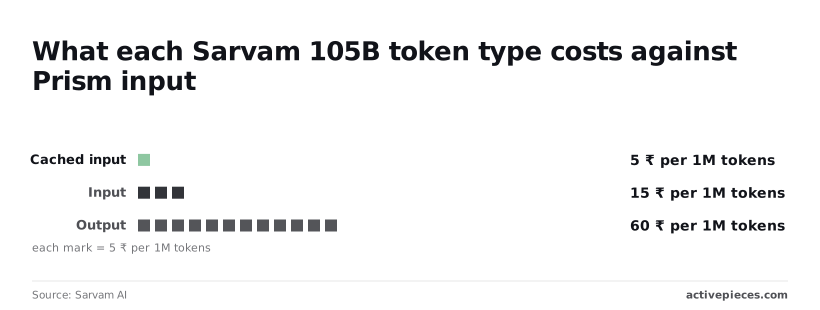 If real usage sits well under the doubled figure, lower the estimate. If it sits near it, the retries are the problem to fix, not the cap. Record what you find next to the pricing-page date from step one. Together they tell you which assumption moved: the price, the volume or the failure rate. Each one has a different fix, and a bill that only shows a total can't tell you which. ## Frequently asked questions Does Sarvam AI have a free tier for its API? Credits run out, so a prototype that works on them tells you little about a bill at volume. Read the current amounts on Sarvam AI's pricing page, checked 9 November 2026. ### Does Sarvam AI charge for failed API requests? Budget as if a retry costs the same as the first call, because Sarvam AI's pages don't give me a confirmed answer. If a request fails after the work is done, it may still be billed, and a retry loop then multiplies spend without producing more output. Cap retries in your own code, and compare your invoice with your request logs for a week before trusting any assumption. How often does Sarvam AI change its API prices? There's no published schedule, and the pricing page shows only the current rates. Model versions are priced separately, so moving from one Bulbul text-to-speech version to the next can change your cost per character even if nothing else changes. Pin the model version in your config and re-read the page whenever you upgrade. ### Can I get a spend cap on a Sarvam AI account? I couldn't confirm a hard account-level cap in Sarvam AI's documentation, so don't assume one exists. Until you see one in your dashboard, build the limit yourself. Count usage per day in your own service, alert at a fraction of the monthly budget, and stop calls when the ceiling is hit. A cap you control is also one you can test. ### Is Sarvam AI cheaper than OpenAI for Hindi? It depends on the workload, and the list prices alone can't settle it. Sarvam AI prices in rupees and OpenAI in dollars, so the rupee's exchange rate moves the dollar side of the comparison while leaving Sarvam AI's unchanged. Token counts for Hindi also differ by model. Run the same sample of real documents through both, record tokens and cost, and compare the per-run totals, not the rate cards. ## Related reading - [Best Data Automation Tools of 2026 for Analytics Teams](https://www.activepieces.com/blog/best-data-automation-tools-of-2026-for-analytics-teams) - [Reverse Logistics Automation Tools for Operations Teams](https://www.activepieces.com/blog/reverse-logistics-automation-tools-for-operations-teams) - [Top 3 Banking Automation Software Tools for Finance Teams](https://www.activepieces.com/blog/top-3-business-automation-tools-for-banks) ## References - [Sarvam AI](https://www.sarvam.ai/token-factory/pricing) - [Sarvam](https://www.sarvam.ai/api-pricing)**A loop with no ceiling therefore has no ceiling on cost either.