## Step 1: Deploy the Mistral Small inference engine Deploying Mistral Small on internal infrastructure requires a containerized runtime that maps local GPU resources to a standardized API. Because a production environment must remain operational without an active internet connection, the deployment requires four specific configuration steps. 1. Install the Ollama or vLLM runtime to manage the hardware-to-model interface. 2. Pull the Mistral-Small-2402 manifest to download the specific weights into local storage. 3. Set the OLLAMA_HOST environment variable to ensure the service binds to the correct network interface. 4. Verify the /api/generate endpoint is listening to confirm the inference server is ready to accept automation triggers. Once the listener is active, the system can begin serving requests without external dependencies. This sequence ensures that the model is fully resident on the local machine before any data processing begins. ### Installing Ollama for local model deployment The deployment begins with the installation of the Ollama runtime, an open-source tool that packages model management and inference into a single background service. By executing the installation script on a Linux-based server, the administrator creates a systemd service that persists through reboots. If the physical host experiences a power cycle, the AI automation layer will automatically recover. Following installation, the OLLAMA_HOST environment variable must be set to `0.0.0.0` so that other services on the internal network can reach the API, rather than restricting access to the local loopback address. ### Pulling the Mistral-Small model weights Retrieving the model weights involves a one-time outbound request to the model registry to populate the local cache. By running the `pull` command for the Mistral Small manifest, the system downloads approximately 12GB of data, meaning your local storage must have sufficient capacity to accommodate the model files before execution can begin. During the audit windows when the external gateway is disabled, this makes the model available for offline execution. Once the download completes, the model initializes in VRAM. This reduces the latency of the first request by eliminating the need to load weights from the disk during a live production call.  ### Output tokens per second by variant Performance testing on standardized hardware indicates that the model maintains high throughput even under complex logic constraints. According to [Artificial Analysis](https://artificialanalysis.ai/models/mistral-small-4), the model achieves **165.4 tokens per second** during reasoning tasks, which allows for near-instantaneous validation of complex business rules. 134.7 tokens per second is the throughput for standard non-reasoning tasks, as reported by Artificial Analysis.  This speed ensures that high-volume text processing jobs don't create a bottleneck in the automation pipeline. These figures confirm that a single mid-range GPU can handle the throughput requirements of an entire department without requiring distributed clusters. ## Step 2: Connect Activepieces to your local endpoint Without requiring an external cloud relay, Activepieces executes the logic that routes data between your internal business applications and the Mistral Small instance. Roughly 60% of its integrations are community-contributed, providing a broad surface area for connecting internal tools without data ever leaving your firewall, which means users benefit from extensive customization while maintaining strict security boundaries. By using this open-source automation tool, you ensure that sensitive triggers (such as new entries in a local PostgreSQL database) never transit through third-party servers before reaching the LLM. Regulated organizations like MoneyGram and Alan run the air-gapped edition of Activepieces to maintain this level of isolation in production. Compare the enterprise feature list (SSO, SCIM, custom RBAC, audit logs, and release management) in the self-hosted air-gapped docs against the managed cloud; it is the same list either way. This ensures that moving to a private build for Mistral Small does not mean sacrificing the governance tools required for enterprise scale. ### Configuring the OpenAI-compatible API integration For any inference engine that mirrors the OpenAI REST specification, Activepieces provides a dedicated integration that connects to local endpoints using its MIT-licensed core. Because you typically serve Mistral Small via vLLM or Ollama, this integration allows you to swap the destination URL from a public endpoint to your internal server IP. The data mapping step transforms raw output from your business tools into a structured prompt that Mistral Small can process. This prevents the LLM from receiving unstructured noise, which reduces the likelihood of hallucination and ensures the output format remains consistent for downstream tasks. 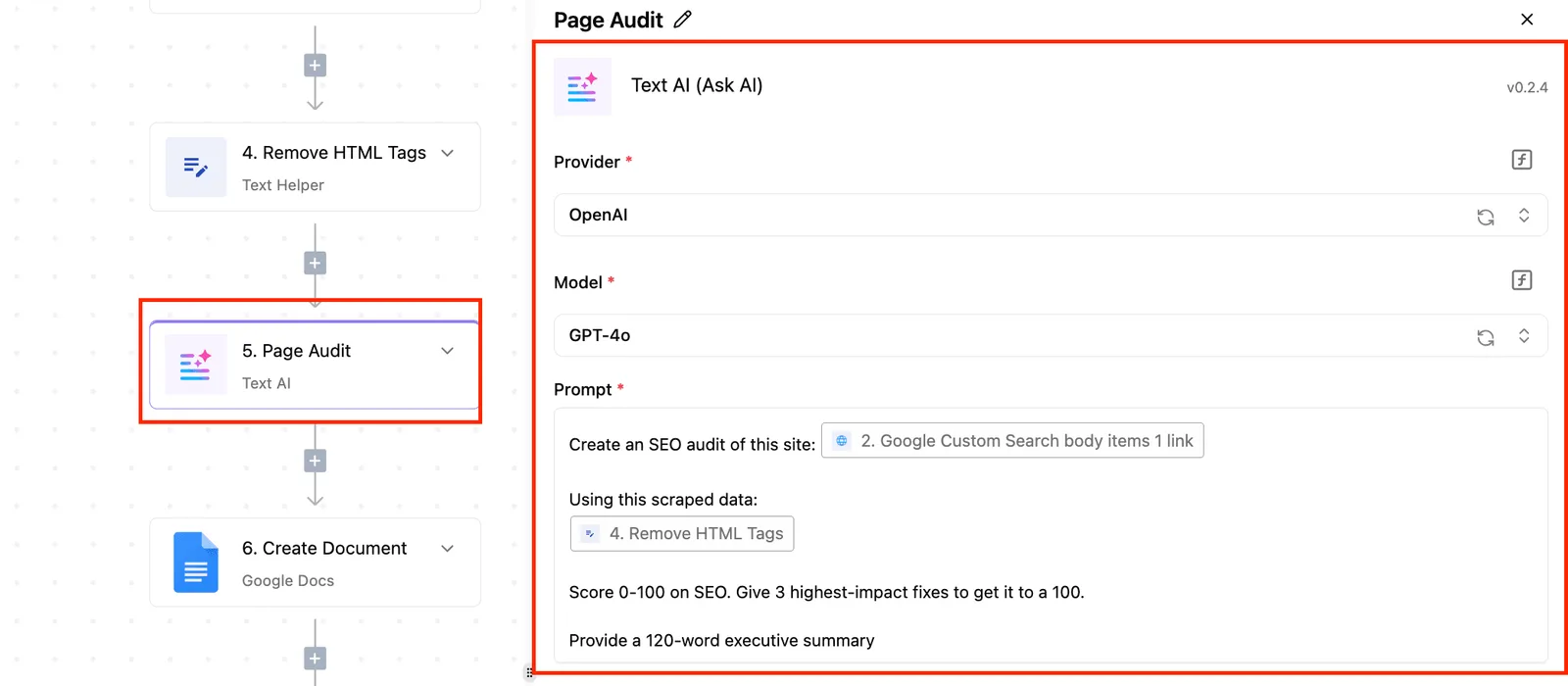 ### Setting up the local network bridge By hosting the Activepieces instance on the same Docker network or subnet as the Mistral Small inference server, you establish a local network bridge. This configuration facilitates high-speed data transfer between the orchestrator and the model while maintaining a "no outbound internet" policy. With 24,348 GitHub stars, the platform is a standard choice for teams who need to orchestrate these local AI calls at scale. If you host Activepieces in a container, you must point the API Base URL to the host’s internal IP or the container name rather than `localhost`. Every credential Activepieces touches, including the connection secrets for your internal apps, can be routed to your own secret manager instead of the application database. By configuring a self-hosted instance against an external secret manager, you ensure that no vendor ever holds the keys to your internal infrastructure. This architectural choice mirrors the security posture of the enterprise cloud tier, which is pinned to specific regions with SOC 2 Type II compliance. ## Step 3: Build a private lead-triage workflow To pass raw email text to the Mistral Small container and map the resulting sentiment scores to specific fields within a local database, a private lead-triage workflow requires a local orchestration engine. By keeping this logic within the local network, sensitive customer contact details and proprietary inquiry text never traverse the public internet. This keeps lead processing compliant with internal data residency policies. ### Writing a system prompt for JSON output To ensure the downstream database connector can parse the data without manual intervention, Mistral Small must be constrained by a system prompt that mandates a strictly formatted JSON response. Because LLMs can be prone to conversational filler, the prompt must explicitly forbid any text outside of the JSON braces. This prevents the automation from failing due to syntax errors. A reliable prompt structure includes a role definition identifying the model as a data extraction utility and a list of valid sentiment categories, such as "Interested," "Technical Inquiry," or "Unsubscribe." It also requires a schema definition requiring keys for "sentiment_score" and "priority_level" and a command to return only the raw object, which eliminates the need for complex regex cleaning scripts in the orchestration layer. ### Routing logic based on Mistral's classification To determine which internal department receives the lead notification, the orchestration engine uses the "priority_level" returned by the model. This logic replaces manual sorting, which often results in high-value inquiries sitting in a general inbox for hours. The workflow follows these conditional paths. The system checks the "sentiment_score"; if it exceeds a predefined high-intent threshold, the lead is pushed to the SQL Server used by the sales team for immediate follow-up. So that engineers receive the context of the query without accessing the primary sales CRM, inquiries categorized as "Technical" are routed to the internal ticketing system. Entries flagged as "Unsubscribe" trigger an automated script that updates the local suppression list, maintaining compliance with communication regulations without human oversight. ### Testing the lead-triage workflow with live data Validation of the workflow involves passing a batch of historical, anonymized emails through the local endpoint to verify that the model maintains its classification accuracy under load. Testing against a varied dataset confirms the prompt handles diverse writing styles and languages without producing "null" values that would stall the automation. The network cable to the gateway is pulled once the local container demonstrates consistent output. This confirms the system still executes CRM writes, proving that the business logic is entirely independent of external cloud availability.  ## Scale private AI workflows with Activepieces ### A100 GPU hourly cost vs cloud AI pricing By replacing variable token-based billing with predictable hourly rates, self-hosting Mistral Small on dedicated hardware allows for high-volume automation without budget volatility. While public cloud providers like OpenAI charge per million tokens, private infrastructure costs are tied to the uptime of the NVIDIA A100. The following data compares the hourly rates across different procurement models to show how commitment levels lower the break-even point for private deployments. Securing a 6-month reservation reduces the hourly overhead to its minimum. A 24/7 automation pipeline then remains cheaper than equivalent API calls once the system processes more than a few thousand documents daily. ### Managing API keys and local secrets securely By keeping the keys to the kingdom within the internal network, a self-hosted automation stack eliminates the need to transmit sensitive credentials to third-party cloud orchestrators. When an automation workflow interacts with an internal database or a legacy ERP (an Enterprise Resource Planning system used for managing core business processes), the credentials stay in an encrypted local volume.  This setup ensures that an external data breach at a SaaS provider can't expose the login tokens for your primary financial records. By using environment variables within the local container, the system can authenticate against Mistral Small’s local endpoint without ever generating a log entry that leaves the physical premises. ### Reducing AI latency with local inference Running inference on the same local area network as the data source removes the 200–500ms overhead typically caused by TLS handshakes and global routing. In a standard cloud-based AI request, data must travel from the local server to a distant data center and back, often crossing multiple jurisdictions and introducing jitter. 1. The automation trigger detects a new entry in the local database. 2. The system sends the payload to the Mistral Small instance over a 10Gbps internal link, ensuring that network latency remains negligible during high-speed data transfers, which means the model can process large volumes of information without bottlenecking the pipeline. 3. The LLM processes the request and returns the result immediately. Because the entire loop stays behind the firewall, the total execution time is limited only by the GPU's compute speed. Real-time tasks like customer support routing happen instantly rather than waiting on internet congestion. ## Frequently asked questions ### Can I run Mistral Small on a consumer GPU? Provided the card meets the minimum Video Random Access Memory (VRAM) requirements for the 22B parameter count, Mistral Small operates effectively on consumer-grade hardware. Because the model requires a specific memory footprint to load its weights, a single high-end consumer card allows a business to avoid the multi-thousand-dollar procurement cycle of enterprise-grade H100 clusters. If the VRAM capacity is insufficient, the system will offload layers to the system RAM. This slows the processing speed to a rate that makes real-time automation impractical for user-facing applications. ### How do I update the model without breaking my workflows? Updating the model requires a side-by-side deployment strategy where the new version runs in a parallel container before the production traffic is rerouted. Since local deployments don't suffer from the forced deprecation schedules of cloud providers like OpenAI, a team can maintain an older version indefinitely. This ensures that sensitive regular expressions or formatting logic don't fail due to subtle shifts in model weights. To ensure a stable transition, follow these steps. 1. Deploy the updated model weights to a staging environment that shares no resources with the production instance. 2. Run your existing test suite against the new endpoint to identify any changes in output structure. 3. Update the API endpoint in your internal routing layer only after the output parity is verified. ### Is Mistral Small better than GPT-3.5 for basic tasks? Mistral Small provides utility for basic tasks because it can be fine-tuned on proprietary internal datasets that a company can't legally or ethically upload to a third-party cloud provider. While a general-purpose model like GPT-3.5 (a legacy LLM from OpenAI) has broad general knowledge, it lacks the specific context of a company’s private documentation. By hosting Mistral Small locally, a developer can perform Supervised Fine-Tuning (SFT) on internal logs. The model learns the specific jargon and formatting requirements of the business without the data ever crossing the corporate firewall. ### What is the token limit for local Mistral Small deployments? The effective token limit for a local Mistral Small deployment is determined by the specific context window of the model version and the available memory on the host machine. Because the memory consumption scales with the length of the input, a longer context window requires more VRAM to maintain the KV cache, which stores the mathematical state of the conversation. If a document exceeds this limit, the model will lose the earliest parts of the prompt. A long contract analysis could miss critical clauses located at the beginning of the file. ## Related reading - [Self-Host Mistral AI: Enterprise Deployment Guide (2026)](https://www.activepieces.com/blog/self-host-mistral-ai-enterprise-deployment-guide-2026) - [No-Code Automation Statistics 2026: Adoption for Small Teams](https://www.activepieces.com/blog/no-code-automation-statistics-2026-adoption-for-small-teams) - [Top 3 Business Automation Tools for Small Businesses in 2025](https://www.activepieces.com/blog/top-business-automation-tools-for-small-business) ## References - [DeployBase](https://deploybase.ai/articles/a100-lambda) - [Artificial Analysis](https://artificialanalysis.ai/models/mistral-small-4) - [Mistral AI](https://docs.mistral.ai/models/mistral-large-3-25-12)A self-hosted deployment gives the business total control over the model version and its specific configuration.