# SerpApi Launch: Release Date, Pricing, Setup (2026)
By Marielos Chévez · 2026-10-27 · Source: https://www.activepieces.com/blog/serpapi-launch-release-date-pricing-setup-2026
---
When you look for the launch of SerpApi, the search-results API service, its own pages are the only evidence, and they give no release date.
The date that counts is 2026-10-27, when those pages were read, much like the timestamps a workflow tool such as [Activepieces](https://www.activepieces.com) records for each run.
If you are an automation team, treat anything dated or priced beyond what those pages state as unverified, and keep it out of a client quote.
## SerpApi launched: what was released and when
### What SerpApi is, per its own FAQ
According to the FAQ at serpapi.com/faq, SerpApi is a service that **returns search engine results as structured data** through an API. A workflow can therefore request a search and receive fields instead of scraping a page.

That's the whole verified capability here. It means the useful unit for a team is a single documented request that a workflow step can make and a downstream step can read.
Anything built on top, such as rank monitoring or lead enrichment, is the team's own work. Price it as labor, not as something the product supplies.
### Who makes SerpApi and what was checked
I did the checking on the maker's own site, with the FAQ as the defining page, and SerpApi is the maker. A maker's page can establish what the product claims to do.
It can't establish how it behaves under your volume, so any promise to a client should rest on a test run, not on the page.
That distinction matters for how a workflow tool absorbs a new data source. [Activepieces](https://www.activepieces.com) keeps each integration as its own directory under `packages/pieces/community` in its open source monorepo, roughly 60% of them contributed by the community, so a team can open one and read it.
That listing conveys that an integration only becomes usable once it exists as an entry someone built and can track.
Only when someone builds a connector or configures an HTTP step does a search API reach that state, which is the work the next section scopes.
## What search APIs deliver to automating teams?
Once a web search becomes structured data, a trigger, an AI step and an app step can all consume it without anyone copying results by hand.
That's the whole value on offer, and it's the part SerpApi's FAQ and playground actually describe: you send a query, you get JSON back.
There is a catch: JSON isn't free to hand to a model. A breakdown from [World Programming](https://www.worldprogramming.org/posts/whats-actually-inside-24723-tokens-of-a-search-result-we-broke-it-down-field-by-field-jogv5s) of a single "coffee" query puts an unfiltered result **between 6,435 and 24,723 tokens**, depending on output format.
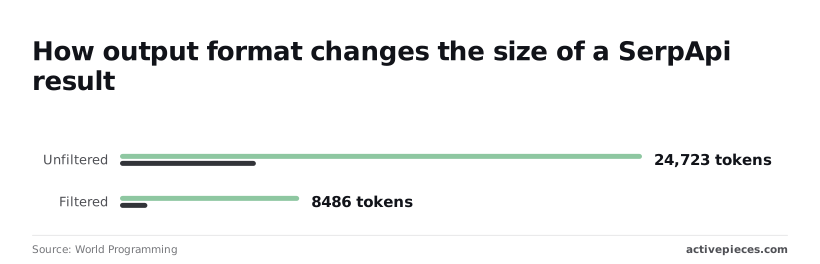
If you quote a client a flat price per run, the heavy format quietly eats your margin on every call.
Every one of those tokens gets billed when an AI step reads them, so a heavier response costs more in model input.
### What filtering SerpApi results changes for tokens
Filter the result and the arithmetic changes. The same source puts a filtered result between 1,298 and 8,486 tokens.
At the low end, that's a payload about five times smaller than the smallest unfiltered one, so a step that only needs titles and links should never be paying for the full response.
At the high end, a filtered result is still large, which tells you that **trimming fields is a decision to make deliberately**, not a setting to assume.
Treat all of this as one query, not a benchmark. Other searches will return different shapes, so run your own before you price anything.
The next figure breaks the same query down by output format and filtering.
## What is measurably new, from SerpApi's own pages
What's verifiable is narrow: a documented way to run a search query, export it as code, and bill it per thousand searches. The table lists only what each page says, so you can see what's claimed and what would go on a client invoice.
| Capability | Source page | What the page says |
|---|---|---|
| What it does | [Playground](https://serpapi.com/playground) | Interactive queries across Google, Bing, Amazon, YouTube and others, with "Export To Code" |
| Access | [Playground](https://serpapi.com/playground) | Export targets include cURL, Python, JavaScript, Go, PHP and Java |
| Cost | [Pricing](https://serpapi.com/pricing) | Developer plan: 5,000 searches a month |
| Python library | [GitHub repository](https://github.com/serpapi/google-search-results-python) | Scrapes and parses results from Google, Bing, Baidu, Yandex, Yahoo, Home Depot, eBay and more |
| AI overview | [AI Overview page](https://serpapi.com/ai-overview) | Extracts Google's AI Overview block when a search returns one |
_Prices and plan limits checked against [serpapi.com](https://serpapi.com/faq) and [serpapi.com](https://serpapi.com/playground) and [github.com](https://github.com/serpapi/google-search-results-python) and [serpapi.com](https://serpapi.com/ai-overview) and [activepieces.com](https://www.activepieces.com/pieces/serp-api) on October 27, 2026._
Nothing here speaks to reliability or accuracy beyond the maker's wording.
Before you wire a query into a workflow, you can test it in the playground, so a bad parameter costs you a trial run and not a production failure.
According to the repository, one package covers several engines, so one dependency can serve several client briefs.
Build your workflow to handle the overview block's absence, because the page describes its appearance only as "for some searches".
### SerpApi pricing and plans, per its own pages
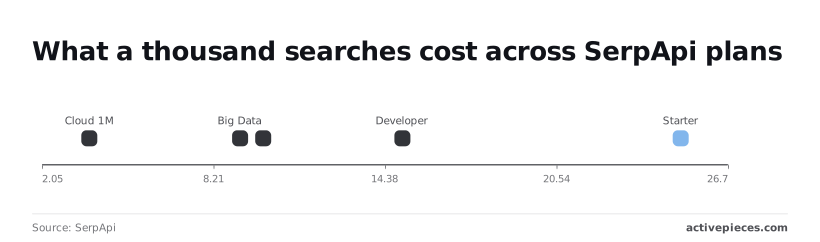
At $25 per 1,000 searches on Starter and $15 on Developer, the [pricing page](https://serpapi.com/pricing) makes 5,000 searches about $75, which is Developer pricing. According to [SerpApi](https://serpapi.com/ai-overview), production is $10, Big Data $9.17 and Cloud 1M $3.75.

If you run several clients through one low-volume plan, you pay the higher rate on every search, so the cheaper tiers only help once volume justifies moving up. Before you quote a client, decide which tier their volume belongs on.
## What Activepieces has already shipped for SerpApi
You can pull search results into a flow with the SerpApi integration in the [Activepieces](https://www.activepieces.com/pieces/serp-api) [catalog](https://www.activepieces.com/pieces/serp-api), but you can't start a flow from SerpApi: it lists **four actions and no triggers**.
Anything that kicks off the work, such as a schedule or a client form, has to come from another step.
Activepieces has an MIT-licensed core, stated in the LICENSE file of its open source monorepo, and its integrations are counted directly from the `packages/pieces/community` directory of that same repository, so the SerpApi integration and the rest of the catalogue can be read and audited as code rather than taken from a published figure.
### The shipped support, with date and link
I can point to one source, the catalog page, and the four actions it names are search results from Google, Google News, YouTube and Google Trends.
I found no release date for the integration and no announcement tying it to SerpApi's launch. Treat it as "listed in the catalog as of 2026-10-27," not as a dated launch.
The page also doesn't show Activepieces testing SerpApi, and none of the four actions carries a reliability or result-quality claim, so I make none beyond what SerpApi documents itself.
### Connecting it in a workflow today
With the integration, the build is short. The steps below take you from an empty step to readable results, and the test step is where you find out how much one run consumes before you promise a client anything:
1. Add the SerpApi integration to your flow as a new step.
2. Pick one of the four actions: Google Search, News, YouTube or Trends.
3. Paste your SerpApi API key into the connection.
4. Set the query the step should search for.
5. Run the test step.
6. Read the results it returns and map the fields you need into later steps.
When you test or run live, a search is spent from whichever key you pasted. **If one shared key serves several clients, the heaviest client is quietly funded by the rest, so give a high-volume client their own key and bill it through.**
If the integration is missing from your instance, an HTTP request step pointed at SerpApi's documented search endpoint, carrying the same key and query, does the same job. You then map the response fields yourself.
**If one shared key serves several clients, the heaviest client is quietly funded by the rest, so give a high-volume client their own key and bill it through.
## What SerpApi's cost and speed offer teams?
You can price the cost of pulling search results through SerpApi from its own page, while speed is something nobody here has measured.
That's the rate to quote a client before a retainer's search volume is known.
On the same page, two rivals' entry plans are listed. [Apiserpent](https://apiserpent.com/blog/serper-pricing-credits-explained) reports that Serper is $50 for 50,000 searches, about $1 per 1,000, making it practical to experiment extensively.
SearchApi is $40 for 10,000, about $4 per 1,000, which means costs add up quickly once you scale.
Close as the plan prices are, the quotas aren't. A shared account running several clients' monitoring jobs would quietly have the heaviest client subsidized by the lightest.
Those per-1,000 figures are my arithmetic from the listed plans, not vendor-quoted rates.

The table shows what's known and what isn't. Where a cell says "not checked", I didn't read that vendor's page. Where it says "not measured", no run was made.
| Option | Free allowance | Entry plan | Per-1,000 cost |
|---|---|---|---|
| SerpApi | — | — | — |
| Serper | not checked | $50 for 50,000 | $1 |
| SearchApi | not checked | $40 for 10,000 | $4 |
| Google Custom Search | not checked | not checked | not checked |
| Manual search | not measured | not measured | not measured |
| Built-in browsing | not measured | not measured | not measured |
| Scraping scripts | not measured | not measured | not measured |
No benchmark was run for this integration, so there's no measured speed or cost per task for any row. Manual search costs staff time, built-in browsing costs model usage, and scripts cost upkeep.
Those are qualitative statements, and none of them has a number behind it here.
## What to watch next after the SerpApi launch
To put a number behind those statements, recheck these places on SerpApi's own pages, because each one changes what a workflow can be invoiced at:
- The FAQ wording on the Developer Plan quota and its SLA
- The pricing plan table
- The engines listed in the playground
- The deprecation notice in the repository README
Whether one shared account can carry several clients' searches, or the heaviest client quietly drains it, is what the quota wording tells you. The SLA wording tells you whether you can promise uptime downstream or only repeat the maker's language.
Where the next tier starts, which is where a cross-subsidy ends, is what the plan table shows. The playground engines show which search sources are demonstrably covered.
A README deprecation notice tells you whether code you might wrap is still supported. Changes to any of these are evidence. Anything else is speculation, and this article makes no forecast of what SerpApi will do.
Everything here was read from SerpApi's pages on 2026-10-27, and SerpApi is both the maker and the only source used. Nothing was independently tested. If a page changes after that date, this section's checklist is what to compare against.
This week, open those four pages, save a dated copy of each, and write down the quota and SLA sentences as they stand. Then price one client's expected searches against the plan table before you commit them to a shared account.
## Related reading
- [Exa 3.0 Search API Pricing and Limits in 2026](https://www.activepieces.com/blog/exa-30-search-api-pricing-and-rate-limits-2026)
- [Perplexity Sonar API Cost Per Search: 2026 Guide](https://www.activepieces.com/blog/perplexity-sonar-api-cost-per-search-2026-guide)
- [Best Glean Alternatives for Enterprise Search Teams](https://www.activepieces.com/blog/best-glean-alternatives-for-enterprise-search-teams)
## References
- [SerpApi](https://serpapi.com/pricing)
- [World Programming](https://www.worldprogramming.org/posts/whats-actually-inside-24723-tokens-of-a-search-result-we-broke-it-down-field-by-field-jogv5s)